CPT code 95808: Attended polysomnography billing guide
CPT code 95808 covers attended PSG with 1 to 3 extra channels CPT code 95808 is ...

Last Updated: Nov 11, 2026
M3710 is the CCSD code for cystourethroplasty (including cystoscopy). Surgeons bill it for a reconstructive operation on the bladder and urethra, and the cystoscopy done during it is already part of the code. UK private medical insurers recognize it, subject to each policy and its pre-authorization rules.
The CCSD schedule lists four codes that must not be billed with M3710: GA522, M3820, M4510 and M4514. So a suprapubic cystostomy or a separate cystoscopy in the same session stays off the claim.
Let Pabau's smart automation suggest the right codes, reduce claim denials, and keep your practice compliant—effortlessly.
Automate repetitive tasks and focus on what matters most—your patients.
Reduce coding errors and ensure compliance with the latest regulations.
Clean claims, fewer denials, and faster reimbursements.
Powerful insights and reporting to help your practice thrive.
HIPAA compliant SOC 2 certified GDPR-compliant Trusted by 4,000+ clinics worldwide

CCSD code M3710 covers cystourethroplasty, a reconstructive operation on the bladder and urethra, and the cystoscopy done during it is part of the code.
Four codes never share a claim with M3710: GA522, M3820, M4510 and M4514.
A suprapubic catheter or a cystoscopy in the same session belongs in the operative note, not on a separate claim line.
Neighboring codes such as M3700 and M3640 name different operations, so match the note to the descriptor rather than the number.
Recognition, pre-authorization, the code combination and the operative note decide whether an M3710 claim gets paid.
CCSD code M3710 is the UK private billing code for cystourethroplasty (including cystoscopy), a reconstructive operation on the bladder and urethra. The cystoscopy the surgeon performs during the repair is part of the code, so it never earns a second line on the claim.
The code sits in the schedule maintained by the Clinical Coding and Schedule Development group, which added it on 11 March 2011. UK private medical insurers work from that schedule, so surgeons, billing teams and insurers describe the operation in the same words.
The schedule files M3710 under chapter 14, sub-chapter 14.4.0, rather than beside most bladder codes in chapter 12. Search the CCSD code library by code number, and you won’t miss it while browsing the wrong chapter.
Two parts of the schedule entry drive the billing. The descriptor tells you which operation the code pays for, and the exclusion list tells you what has to stay off the claim.
The CCSD schedule lists four unacceptable combinations for M3710. Each one describes work that is already inside the operation, or surgery that is coded another way.
The rule works in the other direction too. A look inside the bladder with no repair takes a cystoscopy code such as M4510, and M3710 doesn’t apply. Cutting the urethral sphincter through the scope, with no reconstruction, is a urethral sphincterotomy, billed as CCSD code M4400. A hydrodistension that stretches the bladder under the scope, with no repair, is billed as M4320 instead.
Insurers decide for themselves how they apply each CCSD principle. When a combination isn’t clear, call the insurer’s provider helpline and note the adviser’s name and the date in the patient file.
CCSD numbers that sit next to each other don’t step up in complexity. Each code names its own operation, so match the operative note to the descriptor, not to the number.
If the note fits one of these better, code that one instead. Our guides to CCSD code M3700 and CCSD code M3640 walk through those codes the same way.
Take an illustrative claim. A consultant urologist performs a cystourethroplasty, starting with a rigid cystoscopy and placing a suprapubic catheter before closing.
The draft claim from the operating room lists M3710, M4514 and M3820. Two of those lines have to go. The rigid cystoscopy is already inside M3710, and M3820 is on the code’s exclusion list.
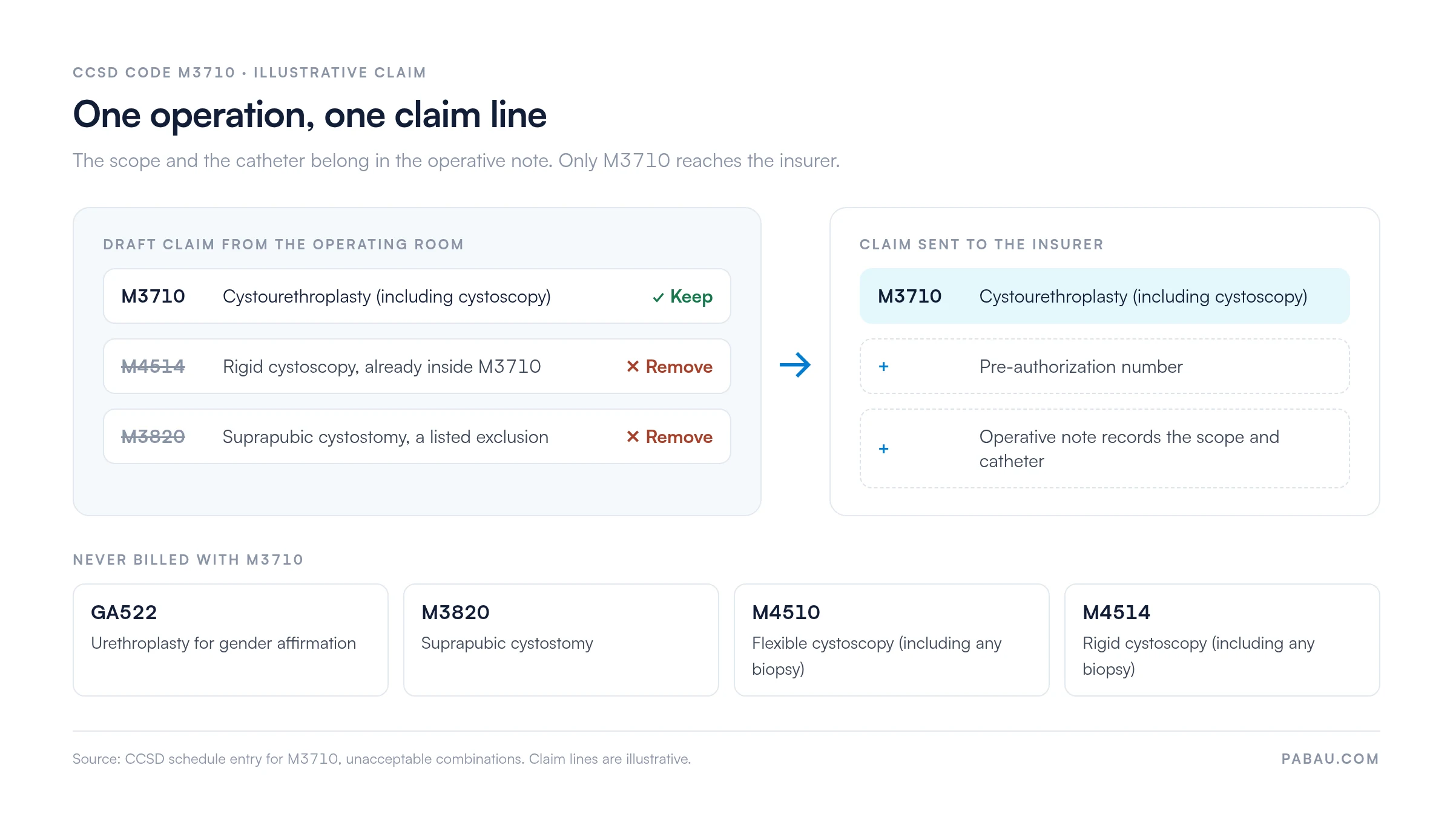
The claim goes out with M3710 alone, plus the authorization number. The operative note still records the cystoscopy and the catheter, because both happened. Only the claim lines change.
An insurer pays an M3710 claim when the paperwork proves three points. The operation was clinically needed, it matches the descriptor, and a recognized consultant performed it.
Make sure the file holds each of these before the claim goes out.
Pre-authorization rules for M3710 vary by insurer and by the patient’s policy, and they can change. The table shows where to check for each of the main UK insurers.
Without the authorization number, an insurer can decline the claim even when the operation was clinically right and the notes are complete. Some insurers accept retrospective authorization after an emergency, but that depends on the policy.
Ask for the authorization in writing, and copy the number into the patient record the day it arrives. That one habit saves a lot of chasing later.
Many UK insurers take CCSD claims electronically through Healthcode, the billing service that links practices and insurers. Some also accept claims through their own portals. Either way, the claim passes six checkpoints.
Bupa patients come with their own schedule and portal. Our guide to Bupa CCSD codes covers that insurer’s side of the process.
Each mistake below can be caught before the claim goes out. Run through the table at the review stage, while every fix is still a quick edit to the draft.
If a claim still comes back rejected, read the stated reason first. Each insurer runs its own appeal process, and the deadline is printed on the rejection notice.
Most of the work on an M3710 claim happens before submission. The authorization number, the code and the operative note have to agree. On paper or across spreadsheets, those pieces live in different places.
Pabau, the practice management platform we build, supports UK insurance billing through Healthcode and Bupa. Its claims software for practices tracks the authorization code on the case and warns when it is missing. Your team sees the warning while there is still time to chase the insurer, before the claim goes out.
The operative note, the referral and the authorization number sit on the same record as the claim. So when an insurer queries M3710, your team answers from one screen instead of searching inboxes.
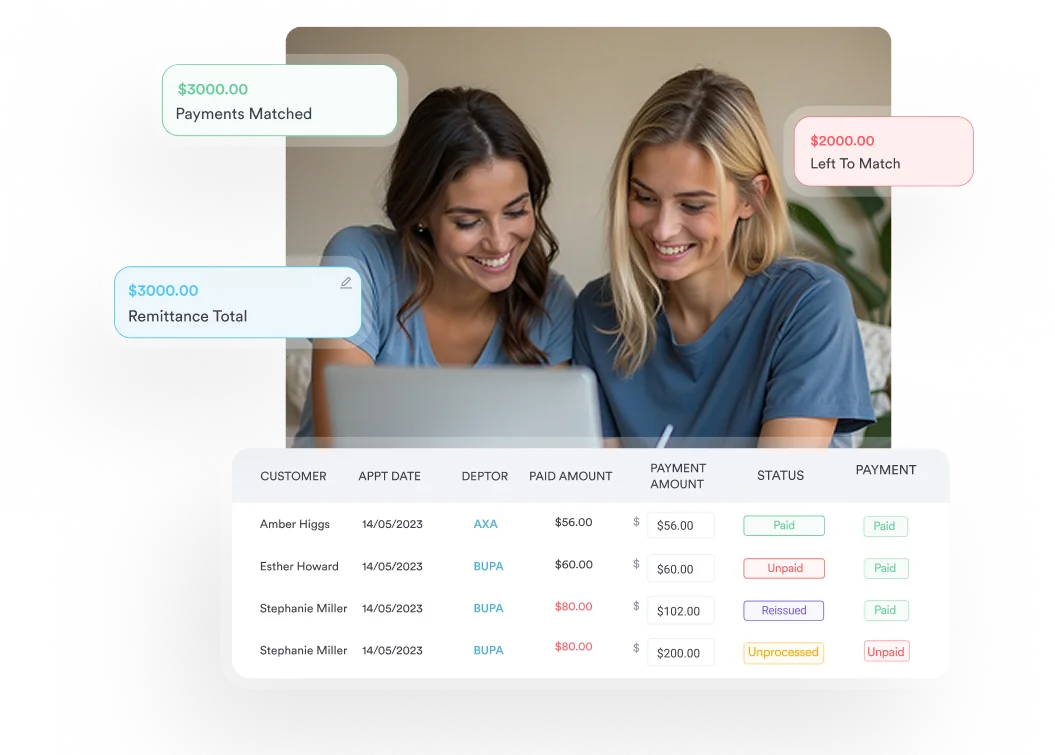

Pabau supports CCSD billing through Healthcode and Bupa, tracks the authorization code on each case and warns when it is missing. Your team spends less time answering insurer queries.

M3710 rewards a careful read of its schedule entry. The cystoscopy travels inside the code, and four other codes never join it, so a clean claim usually carries one surgical line.
Where M3710 claims go wrong is upstream. A catheter or scope code slips onto the draft, or an authorization number never reaches the file. Fix those habits once, and they hold for every CCSD code your surgeons bill.
Is chasing queried claims eating your team’s week? Book a demo to see how Pabau keeps the note, the authorization and the claim on one patient record.

Billing a cystoscopy with no reconstruction? CCSD code M4510 covers diagnostic flexible cystoscopy, one of the codes that never sits beside M3710.
Did the surgeon repair the bladder alone? CCSD code M3700 explains the code for repair of bladder, including cystoscopy.
Correcting a congenital bladder defect? CCSD code M3640 covers repair of bladder exstrophy.
Closing a urethral fistula instead? CCSD code M7330 covers closure of fistula of urethra, including cystoscopy.
Billing Bupa patients? Bupa CCSD codes explains how Bupa processes CCSD-coded procedure claims.
It’s a reconstructive operation on the bladder and the urethra, often where the two meet at the bladder neck. In the CCSD schedule, it’s billed under M3710.
CCSD stands for Clinical Coding and Schedule Development. The group maintains the procedure code schedule that UK private medical insurers use, so M3710 means the same operation to each of them.
No. CCSD codes are for privately funded treatment claimed from UK private medical insurers. NHS activity is coded with OPCS-4 instead.
No. Flexible cystoscopy, M4510, and rigid cystoscopy, M4514, are both listed as unacceptable combinations, because the cystoscopy is already part of M3710.
The full CCSD schedule is on ccsd.org.uk, behind a login. Insurers also publish their own code search tools, such as Bupa’s, which show how each one handles the code.