CPT code 48152: Whipple procedure without pancreatojejunostomy
CPT code 48152: Official description and procedure overview CPT code 48152 descr...

Last Updated: Nov 13, 2026
M8130 is the CCSD code for external meatotomy of urethral orifice. It covers an incision that widens a narrowed external urethral opening, usually for meatal stenosis, as a day-case procedure.
The matching NHS OPCS-4 code is M81.3. Dilation without an incision, or treatment of a stricture further up the urethra, needs a different code. Insurers expect a diagnosis that names the cause, such as N99.1 after circumcision.
Let Pabau's smart automation suggest the right codes, reduce claim denials, and keep your practice compliant—effortlessly.
Automate repetitive tasks and focus on what matters most—your patients.
Reduce coding errors and ensure compliance with the latest regulations.
Clean claims, fewer denials, and faster reimbursements.
Powerful insights and reporting to help your practice thrive.
HIPAA compliant SOC 2 certified GDPR-compliant Trusted by 4,000+ clinics worldwide

CCSD Code M8130 covers external meatotomy of the urethral orifice, an incision that widens a narrowed meatus rather than stretching it.
Pair it with the ICD-10 code for the documented cause: N99.1 after circumcision, N35.1 after infection, N35.0 after injury, or Q64.3 if congenital.
Most major UK private insurers require pre-authorisation for M8130, so obtain the reference number before the procedure date.
An operative note that describes dilation only, or a stricture further up the urethra, does not support M8130.
Pabau, the practice software we build, tracks authorisation codes on the patient’s case and submits UK private claims through Healthcode.
CCSD Code M8130 is the CCSD billing code for external meatotomy of urethral orifice. It sits in the urinary chapter of the CCSD Schedule of Procedures and covers one surgical act. The surgeon incises the external urethral opening (the meatus) to widen it and relieve obstruction.
That separates it from urethral dilation, which stretches the meatus without cutting it. It also separates it from internal urethrotomy, coded M7940, which treats strictures further up the urethra.
The table below summarises the core code facts a biller or coding manager needs at a glance.
M8130 is used only in UK private healthcare billing, and it is one of the urethral entries in our CCSD code library. Our guide to Bupa CCSD codes explains how the schedule works on Bupa claims.
On the NHS side, the matching OPCS-4 code is M81.3, External meatotomy of urethral orifice, under M81 Operations on urethral orifice. Check the current edition of each schedule before you cross-reference the two. Don’t confuse the urethral orifice with the ureteric orifice, where the ureter enters the bladder. Operations on that opening take CCSD code M3202.
An external meatotomy is a targeted surgical release of the urethral meatus. The consultant urologist incises the meatus, usually on its ventral side, to widen the opening and restore urinary flow. The mucosal edges are sutured for haemostasis, and the patient typically goes home the same day.
Coders reviewing an operative note should recognise five steps:
When reviewing documentation for a CCSD Code M8130 claim, the operative note must confirm the meatal incision was performed. A note describing dilation only does not support M8130.
Ask the consultant to confirm in the operative note whether the approach was dorsal or ventral. Not every insurer asks for this detail yet. It still protects against audit queries and supports the clinical record if the patient returns with re-stenosis.
Pairing the correct ICD-10 diagnosis code with CCSD Code M8130 is a prerequisite for a clean claim. Insurers check that the diagnosis supports the procedure, and a mismatch is a common reason M8130 claims are queried or denied.
Always use the most specific ICD-10 code available. UK private insurers work from WHO ICD-10, not the US ICD-10-CM, so check each code in the current NHS Classifications Browser before submitting. The treating consultant’s documented diagnosis governs the final code selection.
Put together, the coding check comes down to two questions: what the surgeon did at the meatus, and what caused the narrowing.
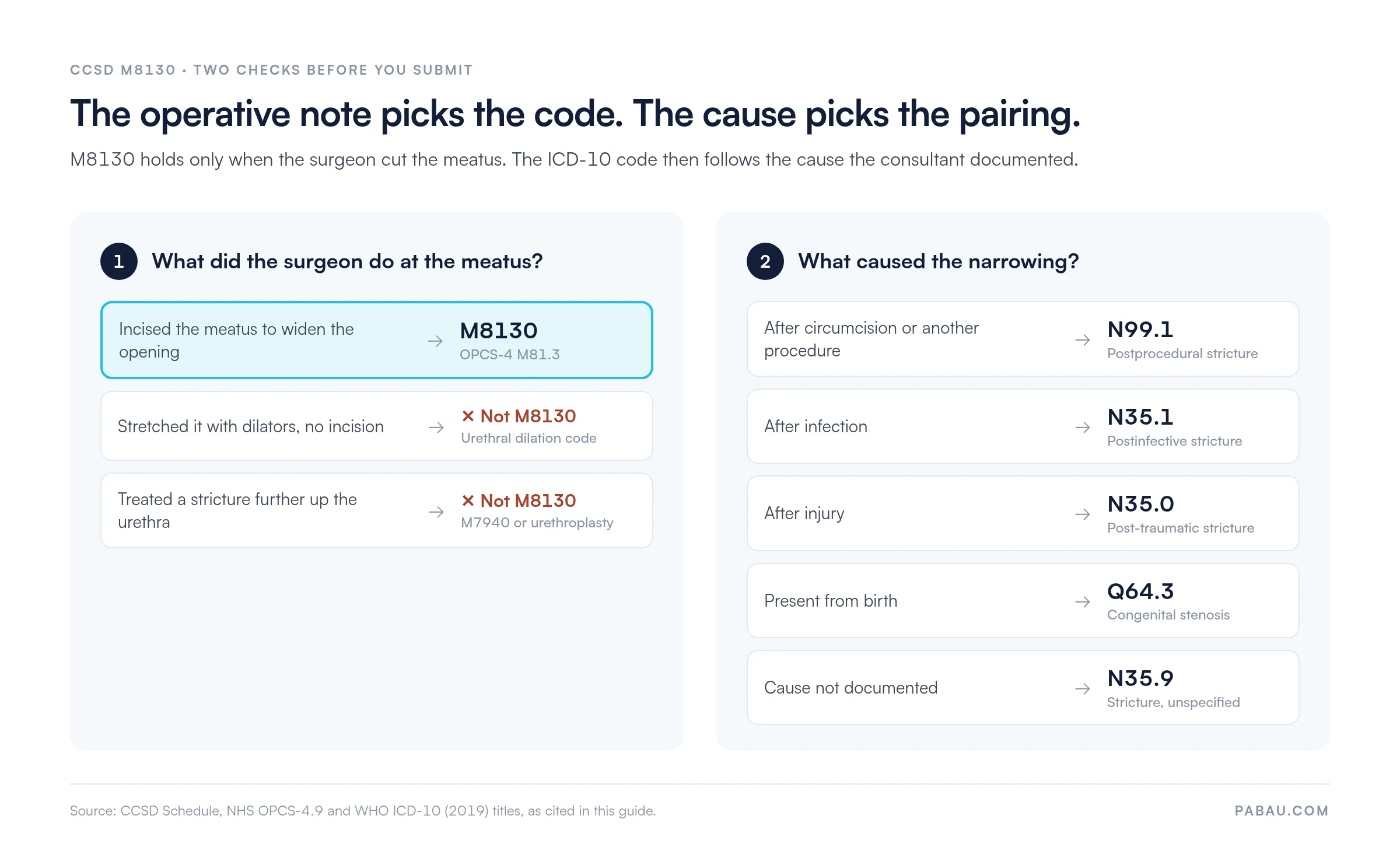
Knowing what CCSD Code M8130 bundles in, and what it leaves out, prevents both under-coding and unbundling errors.
Included within M8130: The meatal incision itself, intraoperative haemostasis, suturing of mucosal edges to skin, and routine wound dressing. These are components of the procedure and must not be claimed separately.
Not included, and requiring a separate CCSD code where clinically appropriate:
When meatotomy and circumcision happen at the same sitting, both codes may be claimed with appropriate documentation. If the foreskin is widened rather than removed, that operation is preputioplasty, coded N3010. Check the concurrent procedure rules in the current CCSD Technical Guide before submitting a combined claim, as bundling policies change.
M8130 sits within a cluster of urethral codes that are easy to confuse. Coding a meatotomy as a more complex urethral procedure is an auditable error. At the far end of that cluster, excision of the whole urethra is coded M7200. Cutting the urethral sphincter through a cystoscope is a different operation again, billed as CCSD code M4400.
Coders who also bill the NHS can map M8130 to OPCS-4 M81.3. Private insurers still expect the CCSD code on the claim, never the OPCS-4 one.
Insurers audit surgical claims, and an M8130 claim without an operative note confirming the meatotomy is open to query or denial.
Minimum documentation for a supportable M8130 claim:
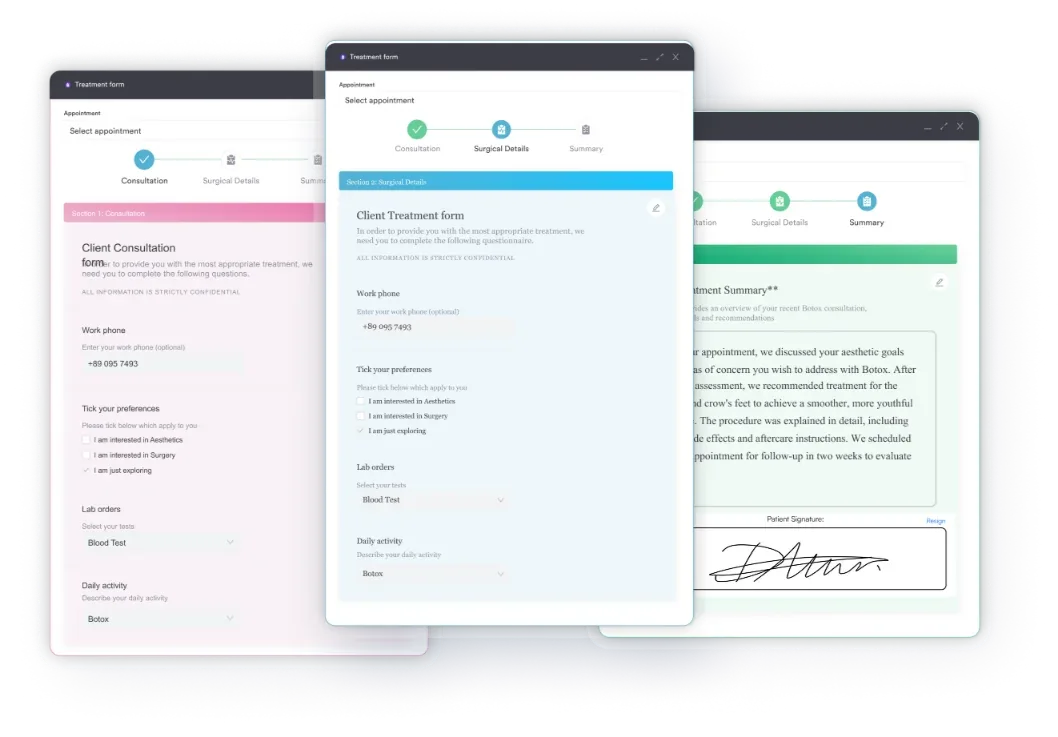
Digital consent and clinical forms keep the signed consent attached to the patient’s encounter record. That makes the supporting documentation quick to retrieve when a claim is queried.
CCSD Code M8130 is a surgical procedure code, and most UK private health insurers require pre-authorisation before the procedure date. The requirement is consistent across the major payers, though the submission channel and lead times differ.
Payer policies on pre-authorisation change. The table reflects general practice for surgical CCSD codes, so confirm the current requirement with each insurer before submitting. A claim without a valid pre-auth reference is almost always rejected at the first processing stage, however complete the documentation.
When M8130 is performed alongside circumcision at the same sitting, obtain a single pre-authorisation reference that explicitly covers both procedures. Some insurers require the secondary procedure to be listed on the authorisation letter. A reference that covers only circumcision will not support a combined M8130 and circumcision claim.
M8130 claims fail for a predictable set of reasons. Most are preventable with the right pre-submission checks.
CCSD Code M8130 is used regularly in paediatric urology. Post-circumcision meatal stenosis is a well-documented indication in boys, and congenital meatal narrowing presents in infants and young children. Several coding and documentation points are specific to these cases.
Paediatric private urology billing carries the same insurer expectations as adult billing. The CCSD code is the same; what changes is the diagnosis code, the anaesthetic route, and the consent pathway. The same expectations apply when a young boy needs a laparoscopy to locate an impalpable testis, billed under code N1352. Confirm current payer-specific paediatric policies with each insurer, as some apply age-specific authorisation criteria.
Accurate billing for M8130 follows the same six steps whatever system the practice uses.
For the fee each insurer pays, the Bupa fee schedule lists CCSD codes with their associated fee guidance.
Many M8130 denials start before the procedure, with an authorisation reference kept in an email and a diagnosis code added at the last minute. The billing team then rebuilds the claim from several places.
Pabau keeps the booking, the consultation notes and the claim on one patient record. M8130 is entered against the appointment, and the diagnosis code is attached at consultation.
With Pabau’s denial-reducing claims management, the authorisation code, dates and sessions sit on the patient’s case, with a warning when one is missing.
Claims go to UK private insurers through Healthcode and Bupa, and each one is tracked through to payment. Your team sees an insurer query the day it arrives and can answer it inside the deadline.
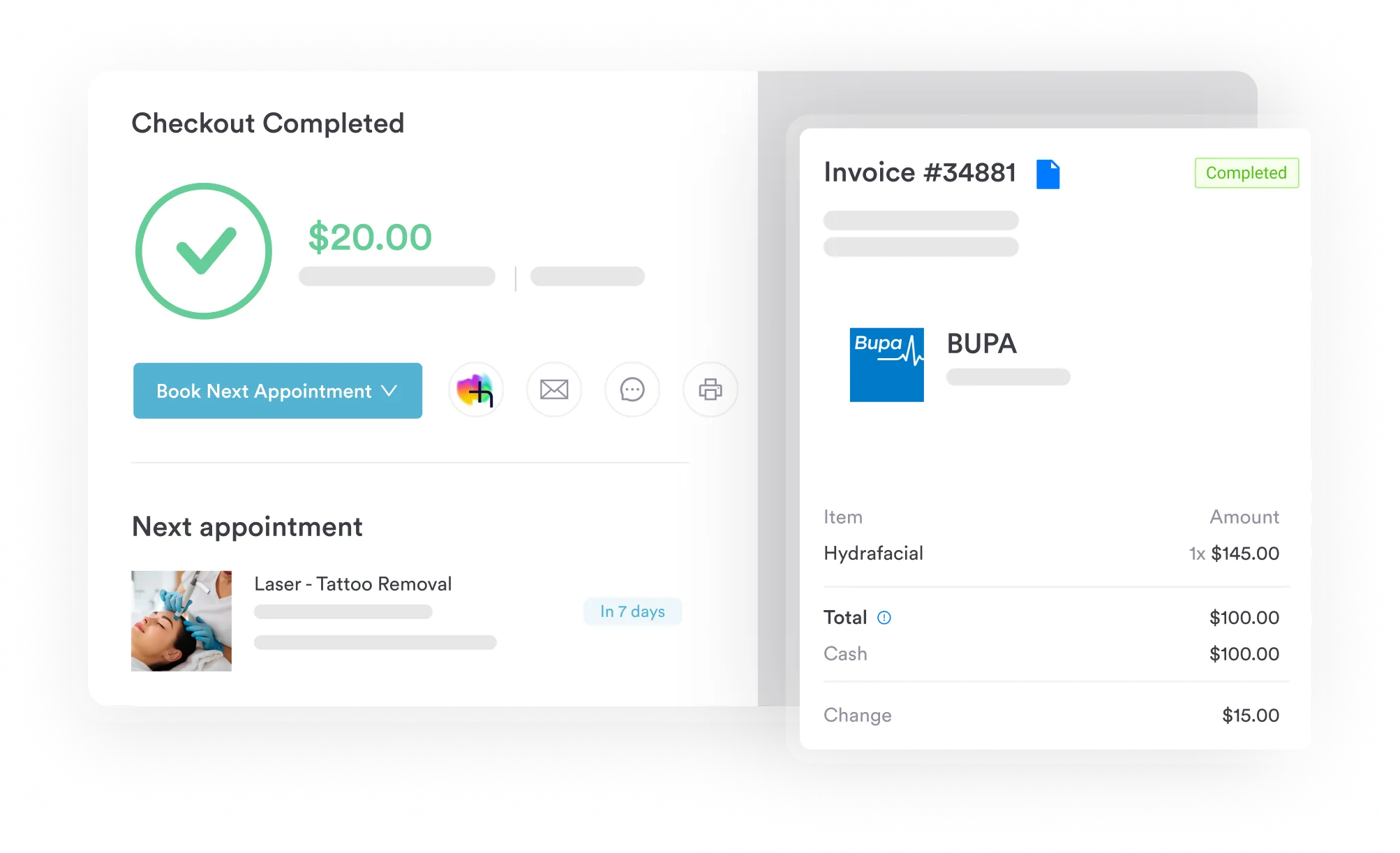

Pabau links CCSD codes to diagnosis codes, tracks pre-authorisation references on the patient’s case and submits claims through Healthcode. Fewer claims come back for missing details.

M8130 is a simple procedure to perform and an easy code to lose. The claim stands or falls on three records. You need the authorisation reference, an operative note that says the meatus was incised, and a diagnosis code that names the cause.
Settle all three before the patient is discharged, and the claim rarely comes back. Leave any of them to the billing stage, and you spend weeks chasing a query that a five-minute check would have prevented. Book a demo to see how Pabau keeps the authorisation, the notes and the Healthcode submission on one patient record.

Repairing a urethral fistula instead? CCSD code M7330 covers closure of a urethral fistula, a neighbouring code in the same chapter.
CCSD Code M8130 covers an external meatotomy of the urethral orifice, a surgical incision that enlarges the external urethral opening. It includes the incision, intraoperative haemostasis and suturing of the mucosal edges. Urethral dilation, cystoscopy, circumcision and the anaesthetist’s fee each need separate codes.
The most common pairings are N35.9 (urethral stricture, unspecified) and N99.1 (postprocedural urethral stricture) for post-circumcision cases. N35.1 covers post-infective cases, and Q64.3 covers congenital meatal narrowing in children. Use the most specific WHO ICD-10 code that matches the consultant’s documented diagnosis. A mismatch between procedure and diagnosis codes is a frequent denial trigger.
Yes. Bupa requires pre-authorisation for surgical CCSD codes, including M8130. Submit the request via the Bupa provider portal before the procedure date, and record the authorisation reference number in the patient’s billing record. Claims without a valid reference number are routinely rejected, whatever the documentation quality. Confirm the current process at bupa.co.uk/clinicians, as policies are updated periodically.
Yes. M8130 applies to both adult and paediatric meatotomy. In children, the most common indication is post-circumcision meatal stenosis, coded N99.1, while congenital presentations use Q64.3. Paediatric cases almost always need a general anaesthetic. The anaesthetist claims it separately, and the anaesthetic record must be filed before the surgical claim goes in.
M8130 covers an external meatotomy, an incision at the urethral meatus (the external opening). An internal urethrotomy, CCSD code M7940, treats a stricture within the urethral lumen, proximal to the meatus. Billing M7940 when only an external meatotomy was performed is an upcoding error and an audit risk.
The most frequent denial reasons are a missing pre-authorisation reference and an operative note that does not confirm an incision. A diagnosis code that does not match meatal-level pathology, or upcoding to a more complex urethral procedure, also triggers denials. A pre-submission check for each one prevents most avoidable denials.