CPT code 48152: Whipple procedure without pancreatojejunostomy
CPT code 48152: Official description and procedure overview CPT code 48152 descr...

Last Updated: Nov 13, 2026
N1352 is the CCSD (Clinical Coding and Schedule Development) code for laparoscopy for impalpable testis. The surgeon uses a camera to look inside the abdomen for a testis that cannot be felt. UK private medical insurers such as Bupa and AXA Health list it as Intermediate.
The code covers the laparoscopy itself, whatever it finds. Orchiopexy has its own codes, N0920 and N0820, and combined billing follows the CCSD Technical Guide business rules and the insurer.
Let Pabau's smart automation suggest the right codes, reduce claim denials, and keep your practice compliant—effortlessly.
Automate repetitive tasks and focus on what matters most—your patients.
Reduce coding errors and ensure compliance with the latest regulations.
Clean claims, fewer denials, and faster reimbursements.
Powerful insights and reporting to help your practice thrive.
HIPAA compliant SOC 2 certified GDPR-compliant Trusted by 4,000+ clinics worldwide

CCSD Code N1352 is laparoscopy for impalpable testis, a keyhole look inside the abdomen to find a testis that cannot be felt on examination.
N1352 sits in the genitalia section of CCSD chapter 12. Bupa lists it as Intermediate, band INTER 2, with a schedule fee of £286 in February 2026.
Orchiopexy has its own codes, N0920 for one side and N0820 for both, so the code follows what the operative note records.
Pair N1352 with ICD-10 Q53.1, Q53.2 or Q53.9 for an undescended testis, and Q55.0 when laparoscopy confirms the testis is absent.
For combined, repeat or bilateral procedures, follow the CCSD Technical Guide business rules and the insurer. CCSD has no CPT-style modifiers.
CCSD Code N1352 is the code for laparoscopy for impalpable testis. The surgeon uses a camera passed through the abdominal wall to look for a testis that cannot be felt in the groin or scrotum.
CCSD stands for Clinical Coding and Schedule Development, the shared schedule of private insurer procedure codes in the UK. Bupa, AXA Health, Aviva and Vitality all work from it, and claims usually travel electronically through Healthcode.
Fees and bands change, so check the insurer’s current schedule before you quote a patient. Our Bupa CCSD codes reference lists the full schedule by chapter.
The operation is usually a day case under general anaesthetic. The surgeon first examines the patient again under anaesthesia. A testis that could not be felt in clinic is sometimes palpable once the patient is relaxed.
If the testis is still impalpable, a camera port goes in at the umbilicus. The surgeon then inspects the internal inguinal ring, the testicular vessels and the vas deferens. The finding usually falls into one of three groups.
Each finding leads somewhere different, so the operative note decides which further codes, if any, belong on the claim. The diagram maps each finding to its next code and its ICD-10 diagnosis.
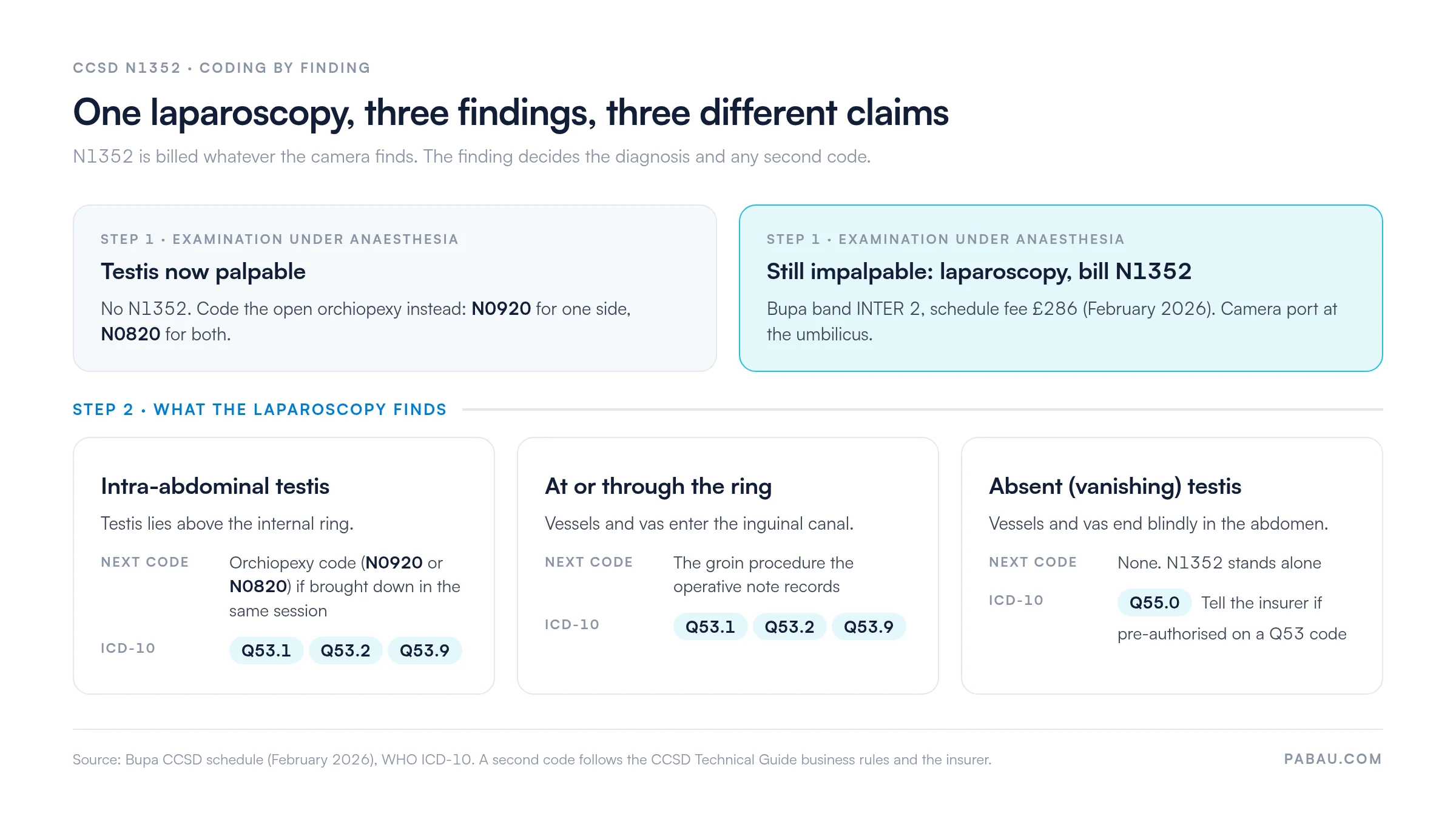
N1352 is correct when the surgeon performs a laparoscopy to locate a testis that cannot be felt. It is not the right code in three common situations.
An undescended testis is most often treated in childhood. European Association of Urology guidance recommends surgery before 12 months of age, and by 18 months at the latest. Chapter 12 is not a paediatric chapter, though, and N1352 applies to adults with an impalpable testis too.
Guidance also advises against routine ultrasound before surgery for a non-palpable testis, because imaging rarely changes the plan. Laparoscopy remains the standard way to find it.
UK insurers expect a diagnosis code from the WHO ICD-10 classification on each claim. For N1352, the code usually comes from category Q53, undescended and ectopic testicle.
Keep the diagnosis on the claim consistent with the one on the pre-authorisation. If laparoscopy shows the testis is absent, tell the insurer before you invoice on Q55.0.
Several genitalia codes sit close to N1352 in the schedule. The table shows Bupa’s February 2026 band and fee for each, so coders can see how the operative note changes the claim.
The schedule has no separate bilateral code for N1352, unlike orchiopexy and fixation. How a bilateral laparoscopy, or a laparoscopy followed by orchiopexy, is billed depends on the CCSD Technical Guide business rules and the insurer. Bilateral orchiopexy is billed once under CCSD N0820, the code for both sides. Epididymectomy is another operation with a dedicated bilateral code, CCSD N1510.
Do not assume a percentage reduction or a modifier. CCSD has no CPT-style modifiers, so check with the insurer before you invoice more than one code.
An N1352 claim depends on the operative note. Insurers that audit a payment look for the following details.
When no testis is found, the note still supports N1352. The code describes the laparoscopy that was performed, whatever it showed.
Most UK private medical insurers expect pre-authorisation before elective surgery, including N1352. Requirements differ between insurers and policies, so confirm them for each patient.
Many patients are children covered on a parent’s policy. Check that the child is a named member and that the policy covers congenital conditions before you book theatre.
Ask the insurer at pre-authorisation how it handles a laparoscopy that turns into an orchiopexy. Recording the answer before surgery saves a rejected invoice afterwards.
Most N1352 denials trace back to the paperwork. The usual causes, and their fixes, are below.
The same steps apply to wider denial management in healthcare: find the cause, correct it, then resubmit.
Private urology and paediatric surgery practices billing N1352 need each claim to reach the insurer complete. Pabau, the practice management platform we build, submits CCSD-coded claims through Healthcode.
With Pabau’s claims management software, your team tracks each claim and reconciles the insurer’s payment. The operative note sits in the same patient record, so it is ready if an insurer audits the claim.
Practices comparing platforms can weigh these features in our guide to UK medical billing software.

Pabau submits CCSD-coded claims through Healthcode, then tracks and reconciles them. Surgeons and their billing teams keep claims and operative notes on one patient record.

N1352 pays for the laparoscopy whatever the camera shows. A laparoscopy that finds no testis is billed exactly like one that finds an intra-abdominal testis. Fixing an abdominal testis afterwards is coded separately, and never with CCSD code N0930, which has been inactive since January 2009.
What changes the claim is the next step. Before the invoice goes out, check that the note records the side, the finding and any further procedure. Then confirm the insurer’s rules for each extra code.
Book a demo to see how Pabau sends CCSD claims through Healthcode and keeps the operative note beside each one.

Need the full CCSD schedule? Bupa CCSD codes covers the procedure code schedule chapter by chapter.
Is the testis being removed laparoscopically? CCSD code N0630 covers billing for laparoscopic orchidectomy.
Chasing a run of rejected insurer claims? Denial management in healthcare sets out how to trace, correct and prevent repeat denials.
Choosing billing software for a UK private practice? The best medical billing software in the UK compares the platforms private practices use to bill insurers.
CCSD Code N1352 covers laparoscopy for impalpable testis. The surgeon uses a camera to look inside the abdomen for a testis that cannot be felt. The code covers the laparoscopy, whatever it finds.
Bupa lists N1352 as Intermediate, band INTER 2, with a schedule fee of £286 in February 2026. AXA Health also lists it as Intermediate. Check each insurer’s current schedule before quoting.
N1352 is a laparoscopy to find an impalpable testis. N1350 is an open exploration of testis, including biopsy. Choose the code that matches the approach in the operative note.
Orchiopexy has its own codes, N0920 for one side and N0820 for both. Whether N1352 is also billed follows the CCSD Technical Guide business rules and the insurer, so confirm before you invoice.
Use Q55.0, absence and aplasia of testis, when laparoscopy confirms there is no testis. Tell the insurer if the pre-authorisation was granted on a Q53 code.
No. CCSD has no CPT-style modifiers. Bilateral and multiple procedures follow the CCSD Technical Guide business rules and the insurer’s own policy.