CPT code 85651: Erythrocyte sedimentation rate, non-automated
CPT code 85651: Definition, descriptor, and code summary CPT code 85651 is the p...

Last Updated: Nov 24, 2026
M7361 is the CCSD code for complex urethroplasty, eg revision surgery of the anterior urethra, posterior urethra, +/- grafting (including cystoscopy). It covers open reconstruction of the urethra where a simple repair would not describe the work, such as a redo repair or a graft.
The code sits in category 12.4.0 Urethra, in chapter 12 of the CCSD schedule used by UK private medical insurers. A simple primary repair of the anterior urethra is billed as M7360.
Let Pabau's smart automation suggest the right codes, reduce claim denials, and keep your practice compliant—effortlessly.
Automate repetitive tasks and focus on what matters most—your patients.
Reduce coding errors and ensure compliance with the latest regulations.
Clean claims, fewer denials, and faster reimbursements.
Powerful insights and reporting to help your practice thrive.
HIPAA compliant SOC 2 certified GDPR-compliant Trusted by 4,000+ clinics worldwide

CCSD code M7361 covers complex urethroplasty, such as revision surgery of the anterior or posterior urethra, with or without grafting.
CCSD sets the procedure codes used across UK private healthcare, and insurers such as Bupa, AXA Health and Aviva process claims against them.
Cystoscopy in the same operative session is included in M7361, so it is not claimed as a separate line.
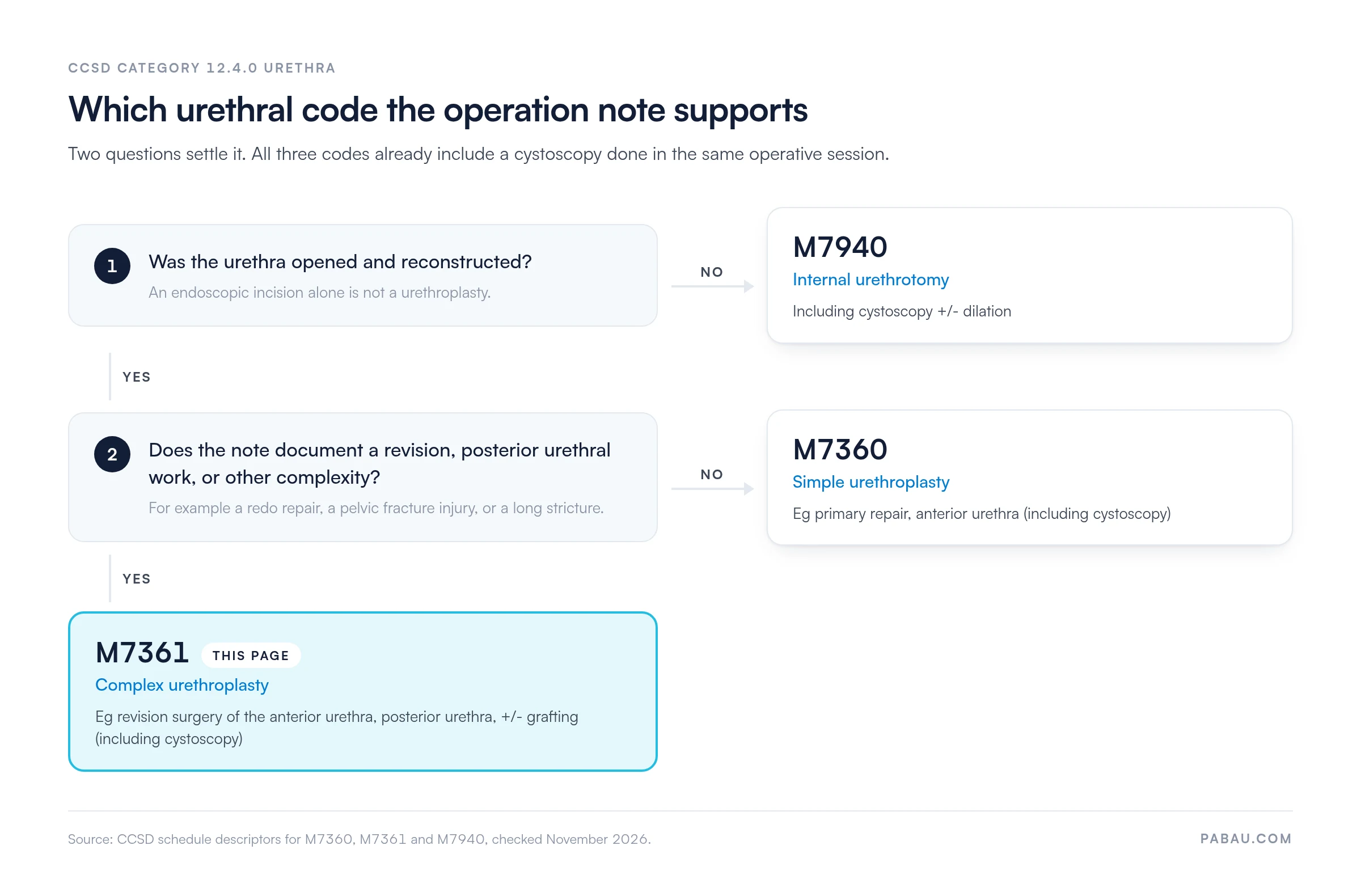
A simple primary repair of the anterior urethra is M7360, so the operation note has to show why the case is complex.
Pabau, a claims and practice management platform, keeps the authorization number, operation note and claim on one record, then sends the claim through Healthcode.
CCSD code M7361 is the UK private healthcare code for complex urethroplasty. Its official descriptor reads: “Complex urethroplasty, eg revision surgery of the anterior urethra, posterior urethra, +/- grafting (including cystoscopy).” The Clinical Coding & Schedule Development group (CCSD) publishes the schedule, and UK private medical insurers use it to identify procedures on claims. CCSD’s own account of its work describes a standard set of procedure codes for independent healthcare, maintained by representatives of four major private insurers.
M7361 sits at the complex end of the urethra category. It is reserved for cases where a simple primary repair does not describe what the surgeon did.
Three parts of the descriptor carry direct billing implications:
The wording has changed over time. CCSD’s record shows the earlier narrative named posterior urethral repairs and second or further anterior repairs. The current “eg revision surgery” wording gives examples of complexity rather than a closed list, so older billing templates may still carry the narrower text.
M7361 covers a range of reconstructive approaches to the urethra. The descriptor names both the anterior urethra (bulbar and penile segments) and the posterior urethra (prostatic and membranous segments). The following techniques can fall within its scope when the case is complex:
A cystoscopy done to assess the urethra during the operation, or to check the repair at the end, is included in M7361. A diagnostic cystoscopy at an earlier, separate attendance is a different episode. The key test is whether the cystoscopy and the urethroplasty happened in the same operative session.
M7361 applies when the reconstruction moves beyond a straightforward primary repair. The most common clinical scenarios for this code include:
The correct code depends on complexity and technique. Use the table below to separate M7361 from the other urethral procedures it is most often confused with. Confirm the current descriptors against the CCSD schedule before you bill.
An endoscopic incision with no open reconstruction is internal urethrotomy, which CCSD codes as M7940. CCSD’s coding principles for M7361 list M7940 among the codes not claimed alongside it, together with urethral dilatation and same-session cystoscopy. Two questions about the operation note settle which of the three codes applies.
UK private medical insurers reviewing an M7361 claim look for clear clinical justification in the operation note. A note that only says “urethroplasty performed” is not enough. The operation note should cover each of these elements:
Structured surgical documentation makes it harder to miss one of these elements at billing time. When each field is prompted at the point of care, the claim reaches the insurer fully evidenced.

UK private medical insurers such as Bupa, AXA Health and Aviva usually want planned surgery authorized before admission. Requirements vary by insurer and by the patient’s policy, so confirm them with the insurer each time. As a general guide, insurers ask for:
Send the request as early as you can before the planned admission. An authorization confirms the insurer expects to cover the treatment, but it does not guarantee payment at the full fee. The insurer can still check the operation note afterward against the code you submitted.
Send the authorization request with the operative plan and a short summary of why the case is complex. A clear summary answers the insurer’s likely questions early and makes a post-operative documentation query less likely.
M7361 denials follow predictable patterns, and each one below has a fix that sits in the operation note or the claim before it goes out.
CCSD sets the code and its narrative, but it does not set the fee. Each UK insurer publishes its own fee schedule against CCSD codes, and the amounts differ between insurers.
An insurer’s list may still print the older M7361 narrative, which named posterior repairs and second anterior repairs. If its wording differs from the current CCSD descriptor, ask the insurer how it wants the case coded and keep the answer on file. For Bupa, the guide to Bupa’s fee schedule explains how its recognized codes map to fee tiers.
Check the fee before the admission date. If your charge is above the insurer’s schedule, the patient pays the shortfall, so tell them in writing before the operation.
When you enter M7361 in a practice management system, work through these steps in order:
In many urology practices, the authorization sits in an email and the operation note lives in another system. The claim is then keyed in by hand. Each handoff is a chance to lose the reference number or drop the complexity statement that supports M7361.
Pabau keeps those steps on the patient record. Its claims management software supports CCSD code entry and diagnosis linking. It sends claims electronically through Healthcode and to Bupa, with the authorization details kept on the patient’s case.
The result is fewer claims bounced for a missing reference, and a clear view of what each insurer still owes. Your team spends less time on rework and more time on patients.

Pabau lets urologists and practice managers enter CCSD procedure codes, link diagnosis codes, attach clinical notes and submit insurer claims through Healthcode. Book a demo to see how it handles complex surgical codes like M7361.

An insurer pays M7361 on the evidence in the operation note. A simple anterior repair and a complex reconstruction sit one code apart, and the insurer decides which one it pays from the note. A revision case with a dated history, a named graft and a clear complexity statement holds its code. A note without them invites a downgrade to M7360.
So write the complexity statement before the claim is built, and keep the authorization with it. Pabau holds the note, the authorization and the claim together for urology practices billing UK insurers. Book a demo to see how a complex M7361 claim moves through Healthcode in your practice.

Need a full reference for Bupa CCSD procedures? Bupa CCSD codes covers Bupa’s procedure list and how its claims work in the UK.
Checking Bupa fees before you invoice? Bupa procedure codes and fee schedule walks through Bupa’s recognized codes and fee tiers.
Coding other urology procedures? CCSD code M6533 explains the laser enucleation of the prostate code and its neighbors.
Repairing a urethral fistula instead? CCSD code M7330 covers closure of a urethral fistula, a code CCSD keeps apart from M7361.
Working at the urethral meatus? CCSD code M8120 explains how meatoplasty is coded and documented for UK insurers.
CCSD code M7361 covers complex urethroplasty, such as revision surgery of the anterior or posterior urethra, with or without grafting. Cystoscopy in the same operative session is included. CCSD publishes the procedure codes that UK private medical insurers, such as Bupa, use on claims.
No. The descriptor says “(including cystoscopy)”, so a cystoscopy in the same operative session is part of M7361. A separate cystoscopy is only claimable when it happened at an earlier, separate attendance.
M7360 is simple urethroplasty, eg primary repair of the anterior urethra, including cystoscopy. M7361 is complex urethroplasty, such as revision surgery, posterior urethral repair or a repair with grafting. Use M7361 when the operation note documents why the case is complex.
Yes. The descriptor includes “+/- grafting”, so buccal mucosa graft augmentation falls within M7361. Some insurers have their own rules on graft-harvest codes, so check with the patient’s insurer before you bill any extra code.
Yes. The descriptor uses “eg revision surgery” as an example of complexity, not the only one. A primary repair with grafting, a posterior repair or a long-segment reconstruction can qualify. The operation note has to explain why the procedure is complex.
The M7361 descriptor does not say how each stage of a staged repair is reported, so confirm it with the insurer before you code. Insurers can treat staged repairs differently, so keep their answer on file.
The most common reasons are missing complexity or revision detail in the operation note, or a separate cystoscopy code for a same-session cystoscopy. Others are a graft-harvest code the insurer treats as included, or missing pre-authorization. Clear documentation and a bundling check before submission prevent most of them.