CPT code 48152: Whipple procedure without pancreatojejunostomy
CPT code 48152: Official description and procedure overview CPT code 48152 descr...

Last Updated: Nov 13, 2026
M7200 is the CCSD code for urethrectomy, the surgical removal of the urethra. UK private medical insurers use it under CCSD Chapter 12, in the Urethra section, when a consultant urologist excises the urethra.
Most cases involve cancer of the urethra, or bladder cancer that reaches or recurs in it. Endoscopic work on the urethra has its own codes, such as M7280 for valve resection, M7700 for inspection and M7920 for dilatation.
Let Pabau's smart automation suggest the right codes, reduce claim denials, and keep your practice compliant—effortlessly.
Automate repetitive tasks and focus on what matters most—your patients.
Reduce coding errors and ensure compliance with the latest regulations.
Clean claims, fewer denials, and faster reimbursements.
Powerful insights and reporting to help your practice thrive.
HIPAA compliant SOC 2 certified GDPR-compliant Trusted by 4,000+ clinics worldwide

CCSD code M7200 is urethrectomy, the surgical removal of the urethra, listed in Chapter 12 of the CCSD schedule under Urethra.
UK private medical insurers such as Bupa, AXA Health, Aviva and Vitality use the CCSD schedule to recognize and pay surgeon claims.
The operative note has to show the urethra was excised, with the approach and extent, or the claim is open to query.
When the urethra comes out with the bladder, check whether the cystectomy code you chose already describes it before adding M7200.
The CCSD schedule sets no fee, so each insurer and your recognition agreement decide what M7200 pays.
CCSD code M7200 is the Clinical Coding and Schedule Development Group’s procedure code for urethrectomy, the surgical removal of the urethra. It sits in Chapter 12 of the CCSD schedule, Urinary system and male reproductive organs, in the Urethra section.
UK private medical insurers use the CCSD schedule to identify what a consultant did in theater. A practice bills M7200 when the surgeon excises the urethra itself. Scoping, dilating or cutting inside the urethra each have their own codes, which we cover further down.
Urethrectomy is cancer surgery in most cases. The usual reasons are a primary cancer of the urethra, or urothelial cancer from the bladder that involves the urethra or comes back there.
Timing varies, and that matters for billing. The urethra can come out with the bladder at cystectomy, or months later as a separate operation. In men, a later urethrectomy is usually done through a perineal incision. In women, the urethra is often removed with the bladder as one specimen.
Seen from the coder’s desk, a standalone urethrectomy runs like this:
The Urethra section holds several codes that share an operating list with M7200. The question that separates them is simple. Was the urethra removed, or was work done inside it? Reconstruction of the bladder and urethra, with nothing removed, is a cystourethroplasty billed under CCSD code M3710.
Repair of a urethrovaginal fistula sits outside this section altogether. It falls in the female reproductive organs chapter and is billed under CCSD code P2520.
Every code below has its own entry among the CCSD codes.
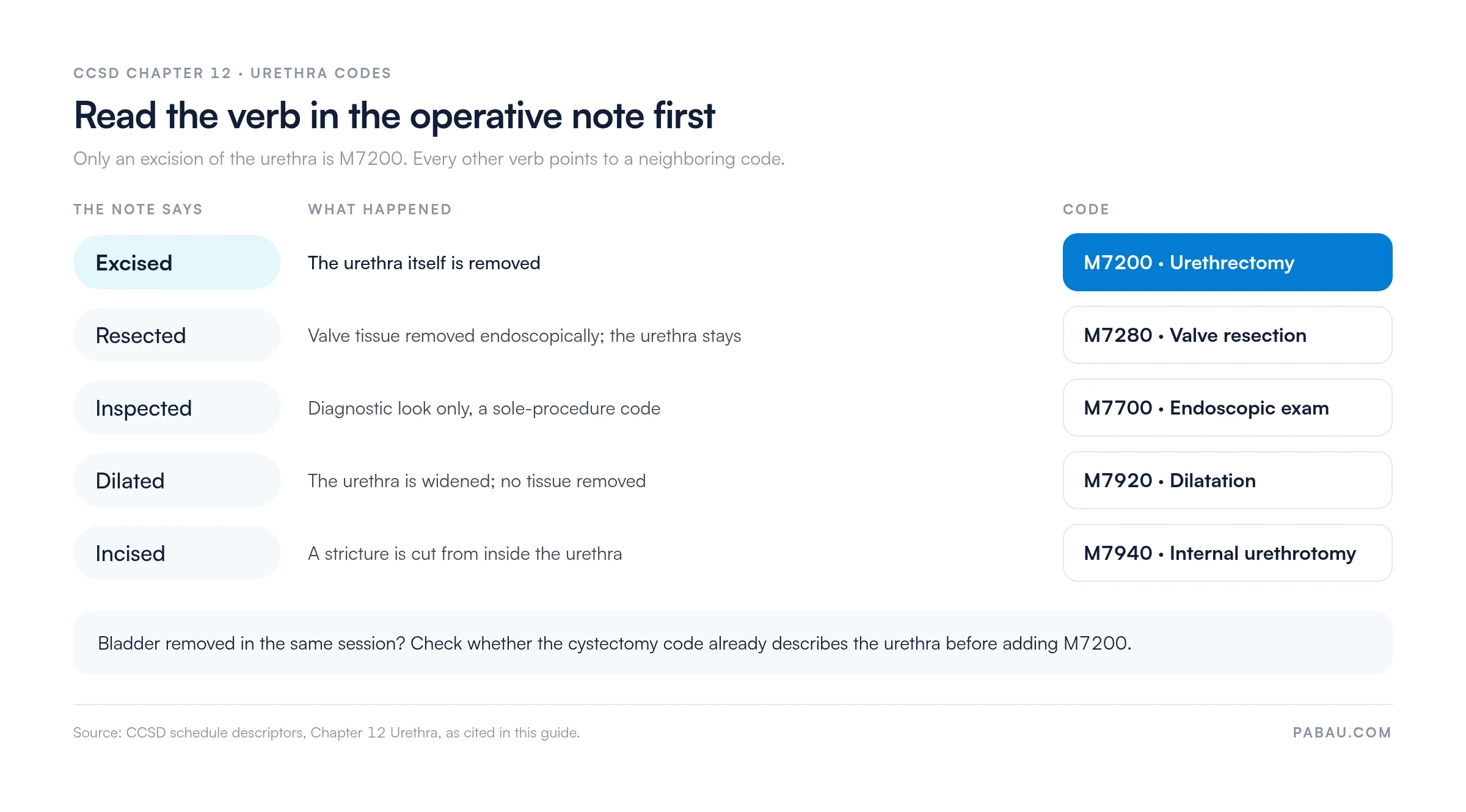
The usual mix-up starts with the search box. Notes for valve resection and internal urethrotomy get coded as M7200 because “urethra” comes up first, when they belong under M7280 and M7940. A meatotomy that only widens the external urethral opening belongs under CCSD code M8130.
The verb in the operative note settles it, and the chart below maps each verb to its code.
UK private claims pair the CCSD procedure code with an ICD-10 diagnosis. For urethrectomy, the diagnosis almost always comes from the pathology report. These are the codes that usually fit, but code from the report, not from this list.
Here’s an illustrative case. A man had a radical cystectomy for bladder cancer last year. Follow-up urethral washings now show cancer cells in the remaining urethra.
His urologist plans a urethrectomy through a perineal incision. The secretary requests pre-authorization quoting M7200 and C68.0, and the insurer issues a reference. After surgery, the note reads “urethra excised in full via perineal approach, specimen to histology.”
That claim is clean. The code, diagnosis, authorization and note all describe the same operation. Compare a claim where the note only says “urethra assessed.” That reads as an inspection, and the insurer will ask why it was billed as an excision.
Most delays happen in the hand-offs between people, not in the coding itself. This is the path a typical M7200 claim takes in a UK private practice:
The CCSD schedule defines the procedure, but it doesn’t set a fee. Each insurer sets its own benefit for M7200, and the surgeon’s recognition agreement decides the rate paid. The anesthetist bills separately, and so does the hospital for the bed, theater and nursing.
For self-pay patients, the surgeon sets the fee. Confirm current rates on each insurer’s provider portal. Our guide to Bupa CCSD procedure codes explains how one insurer’s schedule works in practice.
Most urology practices still juggle the referral letter, the authorization email, the dictated note and the invoice in separate places. When an insurer queries an M7200 claim, someone has to find all four.
Pabau, the practice management platform we build, keeps all four on one patient record. A structured operative-note form makes the surgeon record the approach and extent every time. The CCSD code, ICD-10 code and authorization number then carry through to the invoice.

Once the episode is complete, the claim goes to the insurer through Pabau’s Healthcode integration. Our claims management software tracks each claim’s status, so a query lands with the person who can answer it.
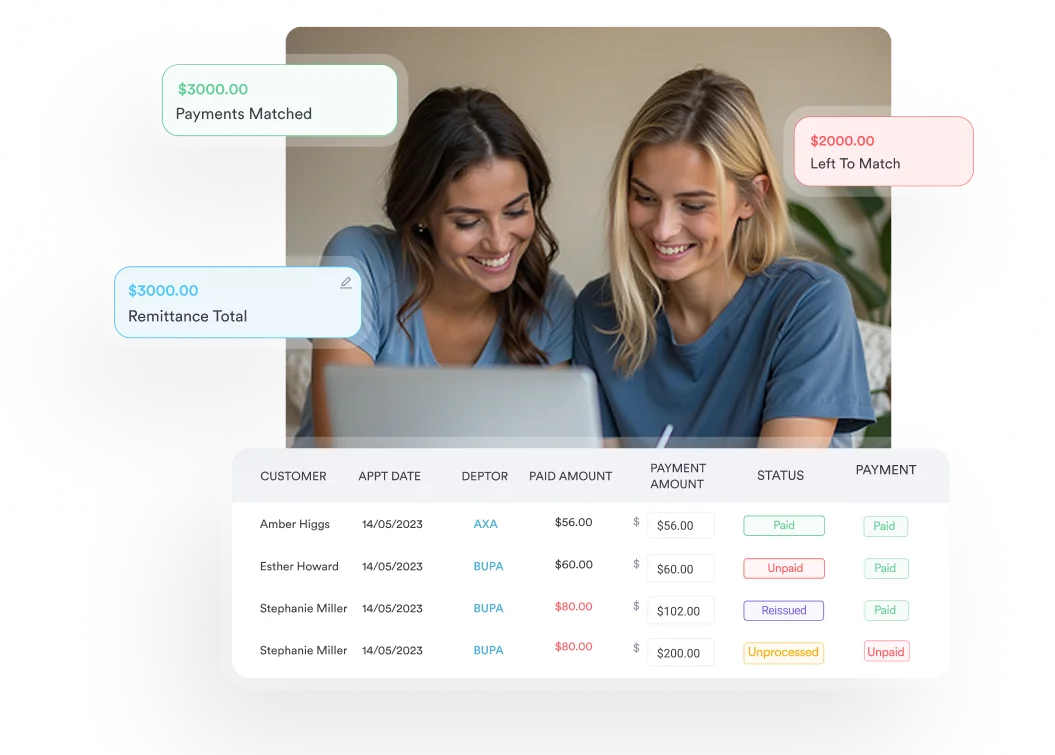

Pabau keeps the CCSD code, operative note and authorization number on one patient record. Claims reach the insurer complete, so fewer come back with queries.

M7200 is one of the simpler urethra codes to choose and one of the easier ones to get queried. The code means the urethra came out. If the note says so clearly, and the diagnosis comes from histology, the claim stands.
The one judgment call is the cystectomy overlap. Settle it before the invoice goes out, not after the insurer asks.
Book a demo to see how Pabau keeps CCSD codes, operative notes and authorizations together for every urology claim.

Coding endoscopic valve surgery? CCSD Code M7280 covers urethral valve resection and what the note must show.
Billing a stricture procedure? CCSD Code M7940 explains internal urethrotomy and how it differs from dilatation.
Working with Bupa claims? Bupa CCSD codes explains how Bupa’s recognized code schedule works.
Looking up another code? CCSD codes lists the procedure codes UK private insurers recognize, chapter by chapter.
Want fewer queried claims? Claims management software shows how Pabau handles coding, authorizations and Healthcode submission.
It can be. The urethra may be removed with the bladder as one operation, or later as a separate procedure. A separate, later urethrectomy is the clearest case for billing M7200 on its own.
UK private medical insurers generally expect pre-authorization before planned surgery. Get the reference before the operation and quote it on the invoice. Check each insurer’s own rules, because they differ.
The anesthetist sends the insurer a separate invoice for the anesthetic. M7200 on the surgeon’s claim covers the surgeon’s work only, and the hospital bills its own facility charges.
The CCSD publishes its schedule and coding guidance at ccsd.org.uk. Insurer provider portals also show the codes each insurer recognizes, so check both before you quote it.
Yes, but CPT is the US system. CPT 53210 and 53215 describe total urethrectomy in female and male patients. UK private insurers expect the CCSD code, M7200, on the claim.