

HCPCS Code E0272: Foam rubber mattress billing guide
HCPCS Code E0272: official descriptor and code overview HCPCS Code E0272 is the ...

Last Updated: Nov 6, 2026
M6530 is the CCSD code for endoscopic resection of prostate (TUR) (including cystoscopy). One code covers a transurethral resection of the prostate (TURP), from the first cystoscopic look to the catheter placed at the end. Cystoscopy is therefore never billed as a second line.
The code sits in chapter 12.5, Prostate, of the CCSD Schedule used by UK private medical insurers. Laser enucleation is billed as M6533, and an open prostatectomy as M6100.
Let Pabau's smart automation suggest the right codes, reduce claim denials, and keep your practice compliant—effortlessly.
Automate repetitive tasks and focus on what matters most—your patients.
Reduce coding errors and ensure compliance with the latest regulations.
Clean claims, fewer denials, and faster reimbursements.
Powerful insights and reporting to help your practice thrive.
HIPAA compliant SOC 2 certified GDPR-compliant Trusted by 4,000+ clinics worldwide

CCSD Code M6530 covers endoscopic (transurethral) resection of the prostate with cystoscopy included, so cystoscopy is never billed as a separate line.
M6530 comes from the CCSD Schedule used by UK private medical insurers such as Bupa, AXA Health, Aviva, Vitality and WPA.
Pair it with a WHO ICD-10 code. N40 (hyperplasia of prostate) is the usual primary diagnosis, and it has no subcodes.
Pabau, the practice management platform we build, creates CCSD invoices, attaches the insurer’s authorisation number and submits them through Healthcode.
CCSD Code M6530 is the UK private-sector procedure code for endoscopic transurethral resection of the prostate (TURP). Cystoscopic inspection of the urethra and bladder is included in the same billable episode. The descriptor reads: “Endoscopic resection of prostate (TUR) (including cystoscopy).”
M6530 sits in chapter 12.5, Prostate, of the CCSD Schedule. The schedule is maintained by UK private medical insurers and private hospital groups, and this code is based on OPCS-4 M65.3. Insurers including Bupa, AXA Health, Aviva, Vitality and WPA use it, and practices bill it to them through Healthcode.
Under the CCSD single-code principle, one code describes the procedure from start to finish. For M6530 that covers the preliminary cystoscopy, resection of obstructing prostatic tissue with a resectoscope, haemostasis, irrigation and catheter insertion. Adding a separate cystoscopy line for the same episode is an unbundling error, and the insurer will reject it. Bladder codes follow the same principle, so CCSD M4230 also carries its cystoscopy inside a single line.
TURP is performed under spinal or general anaesthesia, with the patient in lithotomy position. The urologist passes a resectoscope transurethrally under continuous irrigation, using the integrated cystoscopic optic to inspect the bladder neck and urethra before resection begins.
Resection proceeds lobe by lobe using an electrosurgical loop. Two technical variants exist:
At the end of the procedure, resected chips are retrieved for histopathology (billed separately), haemostasis is confirmed, and a urethral catheter is placed. The catheter and routine irrigation during the procedure are bundled into M6530 and are not additional billable items.
UK insurers pay M6530 when the operative note and the diagnosis code together show why surgery was needed. Accepted clinical indications include:
Private medical insurance covers acute conditions within the terms of each policy. Check at pre-authorisation that the patient’s prostate symptoms are not excluded as a pre-existing condition.
UK private claims use the WHO edition of ICD-10, not the US ICD-10-CM. That matters for BPH: US codes such as N40.1 do not exist in the WHO edition, where N40 has no subcodes. The table lists the codes coders most often need with M6530.
Choose the code that matches the authorised indication and the operative findings. You can confirm any code in the WHO ICD-10 browser. If histology later changes the diagnosis, tell the insurer before invoicing.
Knowing the bundling rules prevents two common errors. Billing cystoscopy as a separate item causes a rejection, while missing a genuinely separate service causes under-recovery.
Several CCSD codes sit close to M6530 in the urology chapters, and using the wrong one is a common audit finding. Our CCSD code library covers the wider schedule. The Bupa CCSD codes guide explains how its chapters are organised.
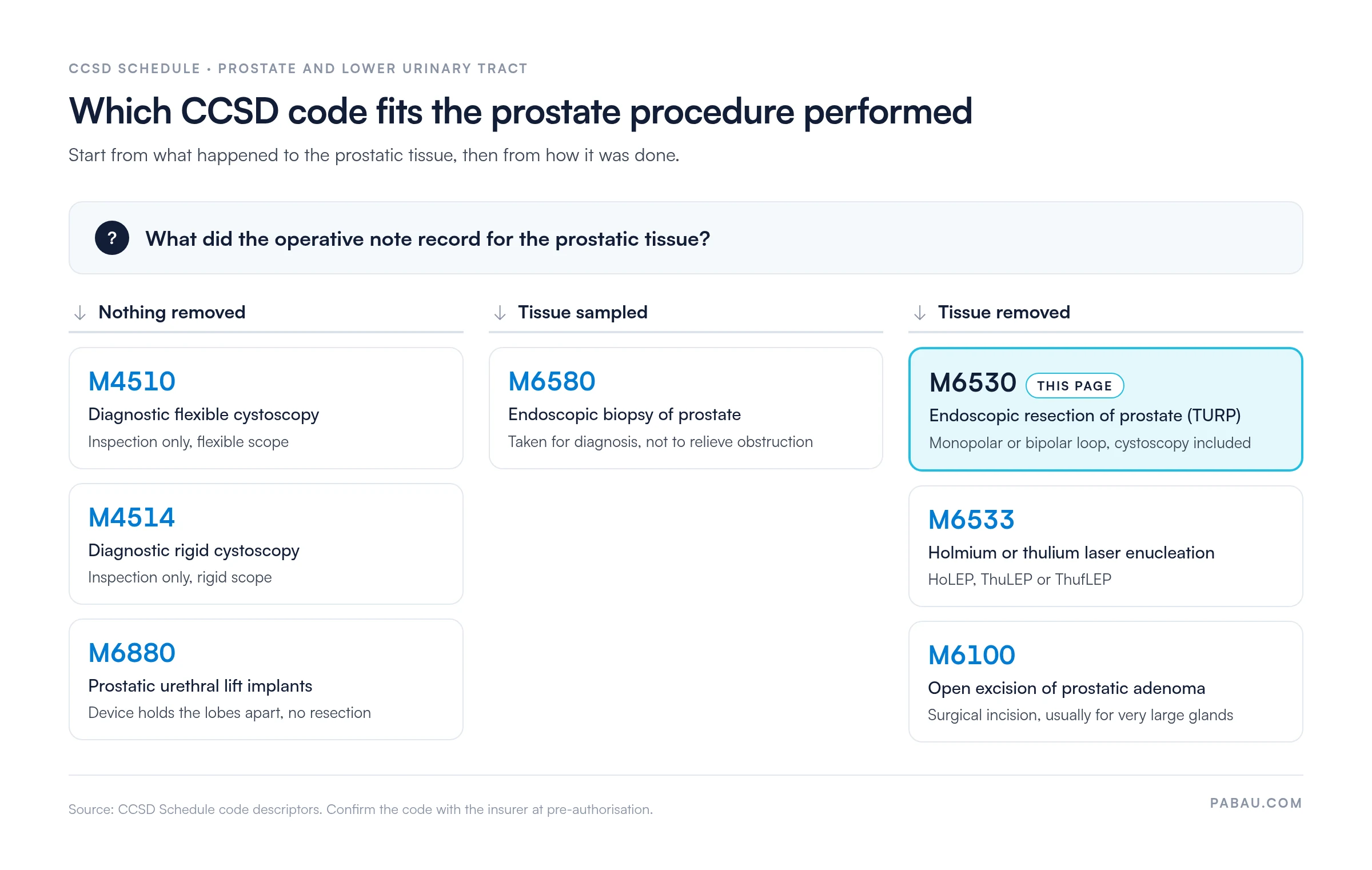
Use M6530 when prostatic tissue is resected endoscopically with a monopolar or bipolar resectoscope, and M6533 when it is enucleated with a laser. A scope that only inspected the bladder belongs under M4510. A prostate that was only sampled belongs under M6580. Endoscopic resection of obstructing urethral valves, usually in young boys, belongs under M7280.
The CCSD technical guide (PDF) sets out the rules for code selection, including unacceptable code combinations. The chart below sorts the neighbouring codes by what happened to the prostatic tissue.
Most UK private medical insurers require pre-authorisation before planned surgery such as TURP. Usually the patient contacts the insurer first, and the insurer issues an authorisation number. Going ahead without that number is a common cause of non-payment, however well the procedure is documented.
A typical pre-authorisation request for M6530 includes:
Requirements differ between insurers and policies, so confirm them before booking theatre. Check any excess, policy limit or fee cap at the same time. If the consultant’s fee exceeds the insurer’s schedule, the patient may owe a shortfall, and they should know before surgery.
CCSD codes carry no modifiers, so the code choice and the invoice details have to describe the episode. Each insurer applies its own contractual rules where more than one code is used. These are the situations that most often raise a question on an M6530 claim.
Insurers review coding patterns as part of their claims controls. An M6530 invoice with an extra cystoscopy line or an unexpected second code is likely to be queried.
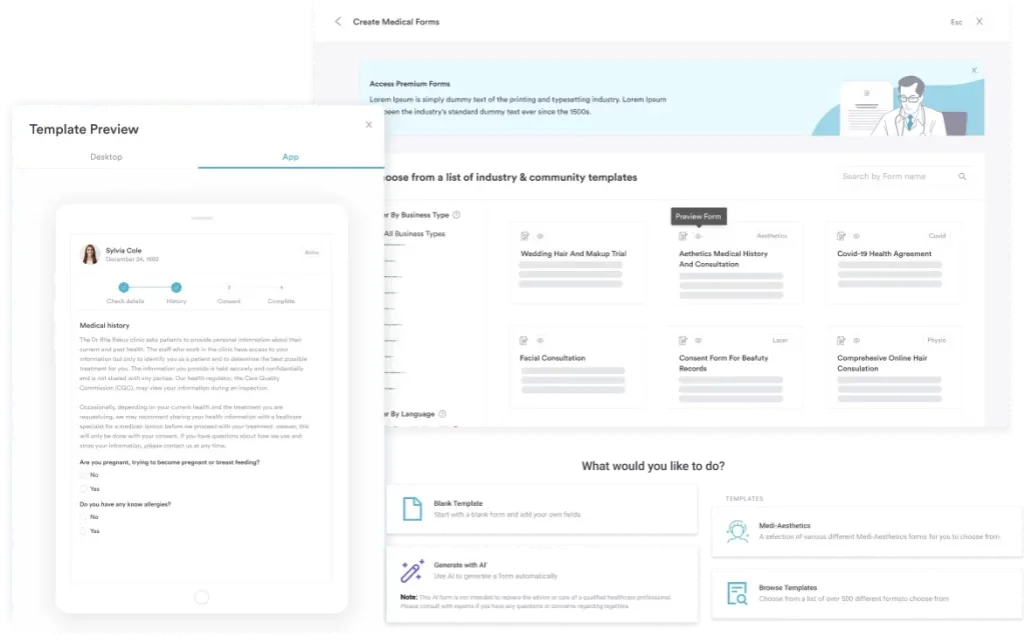
The General Medical Council expects doctors to keep clear, accurate and legible records, made at the time or as soon as possible afterwards. An incomplete or retrospectively amended operative note weakens any claim the insurer queries. Digital clinical forms in a practice management system timestamp the operative note, and every later change leaves an audit trail.
The operative report for M6530 should include:
TURP syndrome is dilutional hyponatraemia caused by absorption of hypotonic irrigation fluid. If it occurred, document it together with the management steps taken. An insurer reviewer may later find an unrecorded complication in the anaesthetic record. That mismatch casts doubt on the whole clinical record.
Run a short documentation check before the operative report is finalised. Confirm that the resected tissue weight, the irrigation fluid balance and the catheter details are recorded. Any complication needs its management described as well. A missing field delays the claim and can prompt an insurer query.
These rejection patterns recur on M6530 claims across UK private insurers. Most can be fixed by correcting the invoice or supplying the right document.
If a dispute with the insurer cannot be settled, the policyholder can use the insurer’s complaints process. Unresolved complaints can then go to the Financial Ombudsman Service.
CCSD Code M6530 bills most reliably when the procedure code, the diagnosis and the authorisation number sit in one invoice before submission. Urology practices that run claims software for private practices link each CCSD code to its diagnosis, which stops the cystoscopy double-billing error.
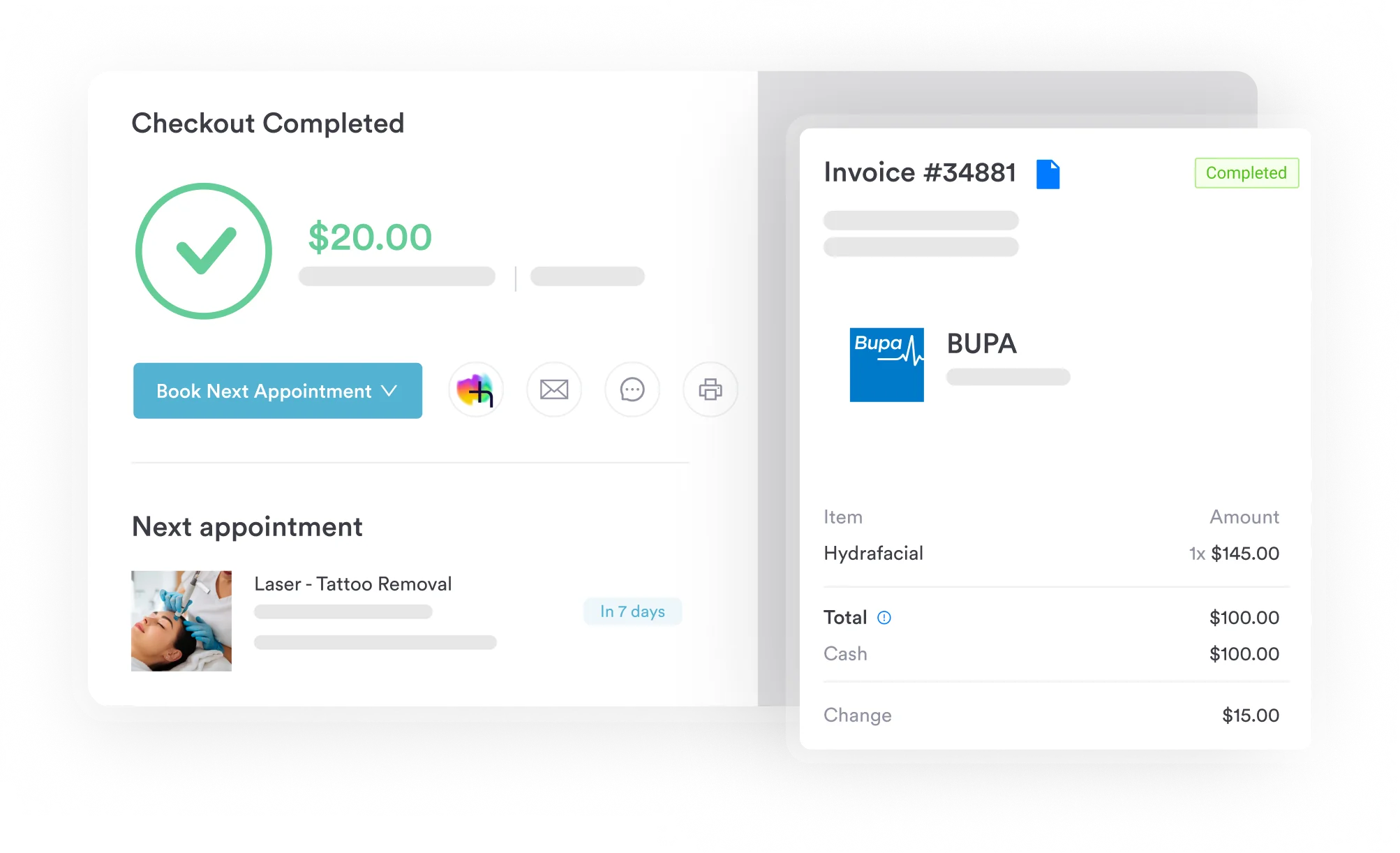
Pabau keeps the clinical record and the invoice together for UK private practices. Staff create the M6530 line, link the WHO ICD-10 diagnosis and record the insurer’s authorisation number. Pabau then submits the invoice through Healthcode and brings the claim status back into the same record.

Pabau lets urology practices create M6530 invoices, attach ICD-10 codes and authorisation numbers, and submit them through Healthcode. It avoids the double-billing errors that cause rejections.

M6530 claims go wrong in predictable places, and none of them is clinical. The cystoscopy is already inside the code, the diagnosis comes from the WHO edition of ICD-10, and the authorisation number exists before theatre is booked. Get those three right and the operative note does the rest.
If your urology practice spends time correcting invoices that should have been right first time, book a demo with Pabau. See how CCSD code entry, diagnosis linking and Healthcode submission work in a single platform.

Coding a prostate cancer case instead of BPH? CCSD Code M6182 covers laparoscopic radical prostatectomy and the documentation insurers expect for it.
Treating a prostatic abscess rather than an enlarged gland? CCSD Code M6730 explains how drainage of a prostatic abscess is coded and claimed.
Recording the medication history before surgery? Our prostate medication list sets out the BPH drugs patients often take before they are referred for TURP.
Choosing a system to submit CCSD claims? The best medical billing software in the UK compares tools that handle private insurer billing for UK practices.
CCSD Code M6530 covers endoscopic transurethral resection of the prostate (TURP), including cystoscopic inspection of the bladder and urethra in the same episode. It comes from the CCSD Schedule used by UK private insurers such as Bupa, AXA Health and Aviva. No separate cystoscopy code is added for the same episode.
No. The official descriptor for M6530 states “(including cystoscopy)”. Adding a cystoscopy code as a separate line for the same episode is an unbundling error, and the insurer will reject it. Remove the cystoscopy line and resubmit M6530 on its own.
UK private claims use WHO ICD-10, where N40 (hyperplasia of prostate) is the usual primary diagnosis for TURP. N40 has no subcodes in the WHO edition, so US codes such as N40.1 are invalid. Add R33 for urinary retention or R31 for haematuria as secondary codes where documented.
No. Laser enucleation has its own CCSD code, M6533, which covers holmium and thulium laser enucleation of prostatic adenoma (HoLEP, ThuLEP and ThufLEP). Keep M6530 for loop resection with a monopolar or bipolar resectoscope.
Most UK private medical insurers require pre-authorisation before TURP. The request usually includes the referral, the planned CCSD code (M6530), the WHO ICD-10 code, the consultant and the hospital. Requirements vary by insurer and policy, so confirm them before booking theatre.
No. CCSD codes carry no modifiers, and the prostate is a single midline organ. M6530 has no left, right or bilateral form, so it is always billed as a single line.




