

CPT Code 30801: Superficial turbinate ablation billing guide
CPT Code 30801: Official descriptor and procedure overview The American Medical ...

Last Updated: Nov 27, 2026
M6100 is the CCSD code for open excision of prostatic adenoma. UK private medical insurers use it to authorize and pay for open removal of benign prostate tissue, with the prostate capsule left in place.
Let Pabau's smart automation suggest the right codes, reduce claim denials, and keep your practice compliant—effortlessly.
Automate repetitive tasks and focus on what matters most—your patients.
Reduce coding errors and ensure compliance with the latest regulations.
Clean claims, fewer denials, and faster reimbursements.
Powerful insights and reporting to help your practice thrive.
HIPAA compliant SOC 2 certified GDPR-compliant Trusted by 4,000+ clinics worldwide

CCSD Code M6100 covers open excision of prostatic adenoma. It removes benign prostate tissue through an abdominal incision and leaves the prostate capsule in place.
UK private medical insurers such as Bupa, AXA Health, Aviva and Vitality use the CCSD schedule, but each insurer sets its own fee for M6100.
Radical prostatectomy for cancer is a different code, M6180. The CCSD schedule also lists M6100 with M6530 (TUR) as an unacceptable combination.
Get the insurer’s authorization number before surgery, and make sure the diagnosis, the procedure code and the operative note agree on the claim.
Pabau’s claims management sends UK claims through Healthcode and Bupa, so authorization numbers, clinical notes and claim status sit with the patient record.
CCSD Code M6100 is the Clinical Coding and Schedule Development code for “open excision of prostatic adenoma.”
It covers removal of the enlarged, benign inner part of the prostate through an open abdominal incision. The CCSD Group publishes the CCSD schedule of standard codes for procedures and diagnostic tests in UK private healthcare.
M6100 sits in chapter 12 of the CCSD procedure code schedule, urinary system and male reproductive organs, under category 12.5.0 Prostate. UK private medical insurers, including Bupa, AXA Health, Aviva and Vitality, use CCSD codes to authorize and pay for private treatment.
The schedule defines the procedure but sets no fee, so each insurer applies its own fee schedule to M6100. The operating urologist’s invoice covers the surgeon’s work only. The anesthetist and the hospital bill separately.
The table below sums up the core code attributes coders and practice managers need at a glance.
Open excision of prostatic adenoma is a major operation. The urologist removes the enlarged adenoma through a lower abdominal incision and leaves the prostate capsule intact. Two named open approaches are used in clinical practice, and CCSD Code M6100 covers both.
The retropubic approach reaches the prostate through an incision in the front of the prostatic capsule, without entering the bladder. The surgeon shells out the adenoma under direct vision, controls bleeding, and closes the capsule over a urinary catheter. This approach gives a clear view of the bladder neck and suits patients without bladder problems that need treating at the same time.
The transvesical (suprapubic) approach opens the bladder and removes the adenoma from above, through the bladder neck. Surgeons choose it when the patient also has bladder stones, diverticula or other problems that need direct bladder access. Because the bladder is opened, the operative note should record the bladder findings that justify this approach.
Both approaches remove the adenoma only, and the capsule stays in place. That is the clinical difference from radical prostatectomy for cancer, which removes the whole gland. It is also the billing line between M6100 and M6180, and coding one as the other misstates the operation.
M6100 fits when the open approach is clinically justified and documented. The usual underlying condition is benign prostatic hyperplasia (BPH). UK private insurers use the WHO edition of ICD-10, where BPH is a single code, N40 Hyperplasia of prostate.
You may see N40.0 to N40.3 in US references. Those subdivisions belong to ICD-10-CM, the US clinical modification, and they are not part of the WHO ICD-10 that UK insurers use.
Keep the diagnosis on the claim identical to the one given when the patient got authorization. A mismatch between the two is a common reason an insurer queries a claim.
Open prostatectomy is usually chosen when the prostate is very large. European Association of Urology guidelines place open surgery among the options for glands over about 80 mL. Failed endoscopic treatment, or bladder stones and diverticula that need open access, are other indications. Medical necessity rests on the urologist’s clinical judgment and notes, and the code only records the operation that followed.
Three selection errors cause most M6100 queries. The first is coding radical prostatectomy (M6180) for a benign adenomectomy. The second is coding M6100 when the operation was endoscopic (M6530). The third is billing M6100 and M6530 together, which the CCSD schedule lists as an unacceptable combination.
Each of these codes has its own entry in our CCSD code library. Two questions about the operative note settle which one belongs on the claim, as the diagram below shows.
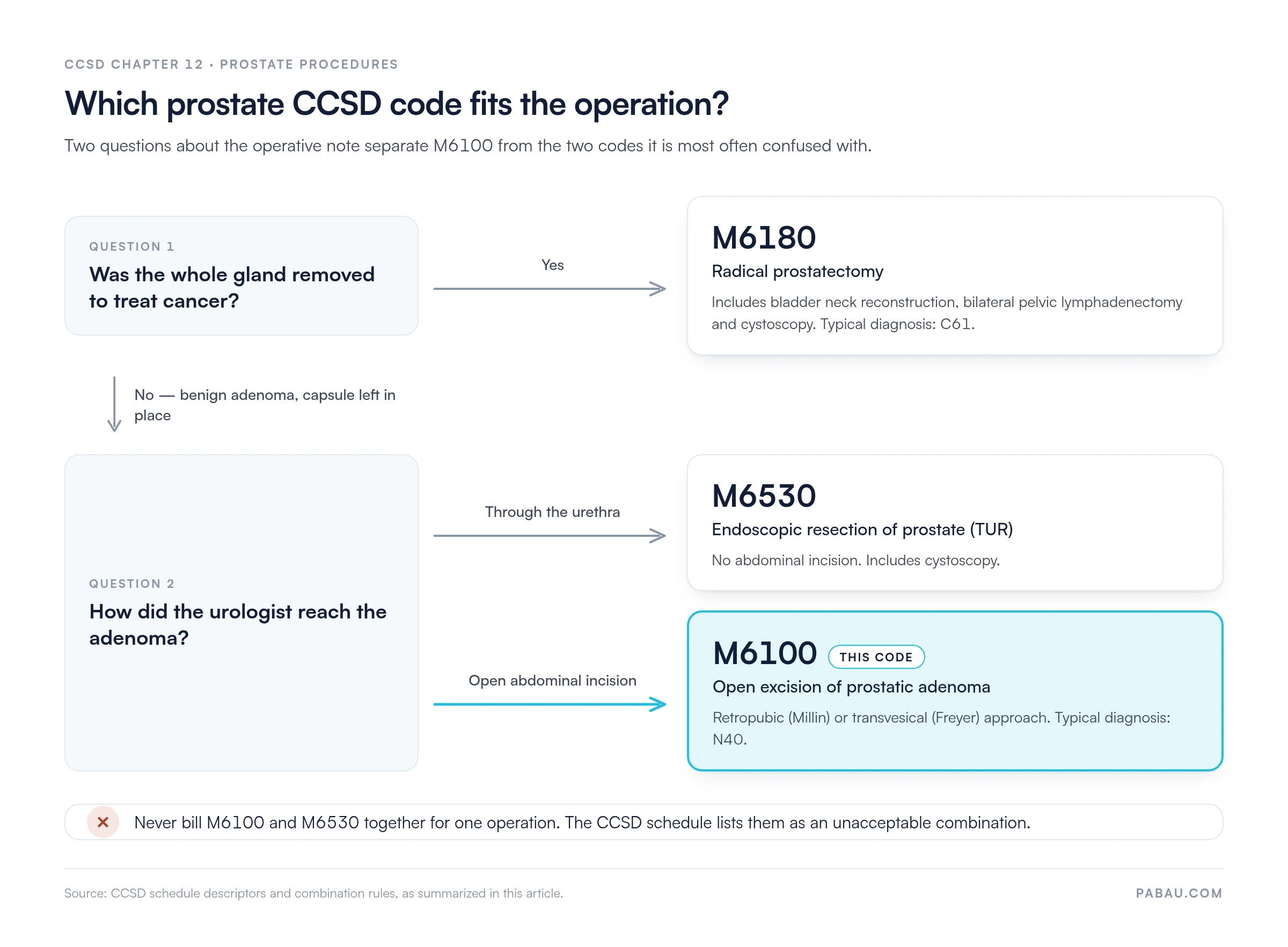
The CCSD descriptor for M6180 reads “radical prostatectomy, reconstruction of bladder neck (including bilateral pelvic lymphadenectomy) (including cystoscopy).” It describes cancer surgery that removes the whole gland, so it is never an alternative code for benign disease.
M6530 covers endoscopic resection of prostate (TUR), including cystoscopy. It reaches the prostate through the urethra, with no abdominal incision. The CCSD schedule lists M6100 and M6530 as an unacceptable combination, so the two never go on one claim for the same operation. The main selection criteria are below.
Open prostatectomy is a major planned operation. UK private insurers expect the patient to contact them and get an authorization number before treatment. Without that number, the insurer can decline the claim, and the patient may face the full bill.
Your practice software should store the authorization number against the surgical booking, so no claim goes out without it. Check each insurer’s current process before every case, because requirements change. A typical authorization request covers the details below.
Bupa, AXA Health, Aviva and Vitality each run their own authorization process and clinical criteria. The CCSD schedule standardizes the codes, but it does not set authorization rules or fees. Check each insurer’s provider guidance for M6100 before the patient is booked.
Ask the patient to get the authorization number as soon as the surgery date is agreed. Some insurers send major procedures for clinical review, and a late request can push the surgery date back. Make the authorization check a fixed step in your surgical booking workflow, so it is done well before the operation.
A complete M6100 claim needs more than the code and the diagnosis. Open prostatectomy is a high-value procedure, so insurers look closely at the operative record. Pabau, a practice management platform, has claims management software that sends UK claims electronically through Healthcode and Bupa and tracks each claim’s status.
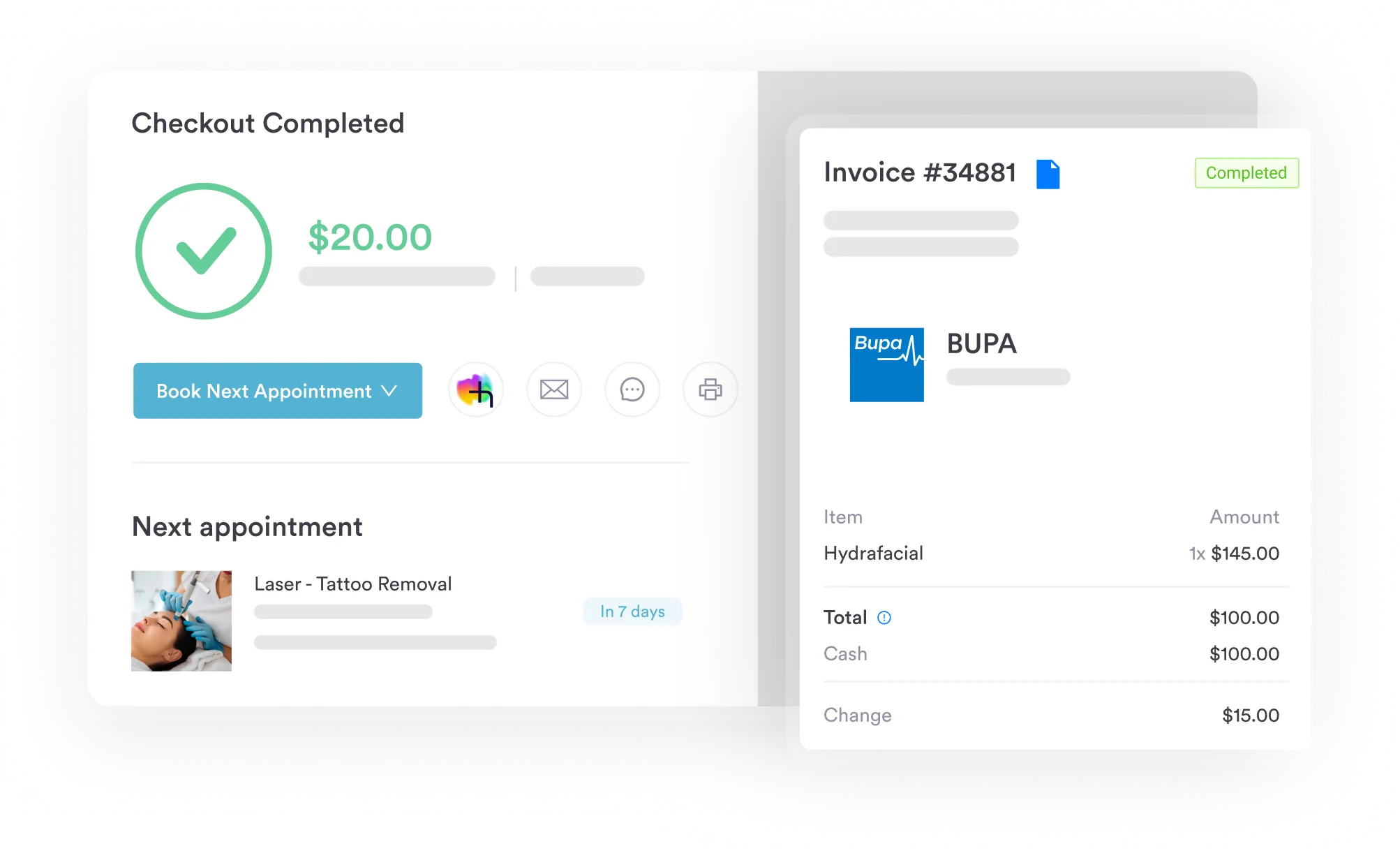
Store the operative note, the histology report and the authorization with the claim itself. When an insurer asks for clinical records during a query or an audit, your team can send them at once and payment keeps moving.
The M6100 fee pays for the operating urologist’s work only. The anesthetist bills separately, and so does the hospital. UK insurers’ fee schedules usually list a separate anesthetist fee against each CCSD procedure code.
If you do bill an assistant surgeon fee, the operative note must explain why a second surgeon was clinically needed. Insurers often query assistant fees that have no stated reason.
Denials for CCSD Code M6100 cluster around five issues. Understanding each one makes corrective action faster and prevents the same error on future claims. Effective denial management strategies start with tracking the reason on every rejection rather than resubmitting blind.
Run a monthly audit of all M6100 claims submitted in the previous 60 days. Flag any that were denied or queried, note the reason, and group them by type. If the same reason appears three or more times, treat it as a workflow problem. Fix the root cause in your submission process so the next claim goes out clean.
The CCSD schedule does not set a fee for M6100. Each UK private insurer publishes its own fee schedule, which sets the most it will pay the surgeon and the anesthetist for the code. Those maximums differ between insurers. Understanding medical billing fundamentals helps your team explain likely costs to patients before surgery.
Key reimbursement considerations for M6100 are below.
The CCSD official schedule sets out the M6100 descriptor and its unacceptable combinations. The CCSD technical guide explains the coding conventions behind them. Fee figures come from each insurer, not from CCSD.
Many urology practices still track insurer authorizations in spreadsheets or email. Operative notes then sit in one system and claims in another. That split is where diagnosis mismatches and missing authorization numbers creep in.
Pabau keeps the booking, the authorization number, the clinical notes and the claim in one patient record. UK claims go electronically through Healthcode and Bupa, and your team can see each claim’s status without chasing the insurer. The result is fewer avoidable queries on high-value claims like M6100.

Pabau helps UK private practices record insurer authorizations, keep operative notes with the patient record, and send CCSD claims through Healthcode. See how it handles M6100 and other urology billing.

Getting CCSD Code M6100 right starts before surgery. The insurer’s authorization must be in place, and the notes must show a benign adenomectomy with the capsule preserved. The diagnosis must also match across the authorization, the operative note and the claim.
Most M6100 problems trace back to one of those three points, or to confusing M6100 with M6180 or M6530. Build those checks into your booking and billing workflow, and the code becomes routine. Book a demo to see how Pabau handles urology billing for UK private practices.

Need a full CCSD code reference for your practice? Bupa CCSD codes guide covers the structure of the CCSD schedule, insurer-specific code lookup, and how to navigate CCSD billing for private healthcare.
Billing a prostate cancer operation? CCSD Code M6180 covers radical prostatectomy, including bladder neck reconstruction, pelvic lymphadenectomy and cystoscopy.
Was the operation endoscopic? CCSD Code M6530 covers endoscopic resection of prostate (TUR), the code M6100 can never be billed with.
Struggling with claim rejections across multiple specialties? Denial management in healthcare explains how to categorize, track, and resolve claim denials before they affect your practice’s cash flow.
Want to understand the billing fundamentals behind insurer fees? What is medical billing breaks down how fee schedules, insurer rules and professional fee claims work in private healthcare.
CCSD Code M6100 covers open excision of prostatic adenoma, the removal of a benign enlarged prostate through an open abdominal incision. It includes both the retropubic (Millin) and transvesical (Freyer) approaches. It pays for the operating urologist’s work only. The anesthetist’s fee, any assistant surgeon fee and the hospital’s charges are billed separately.
M6100 is an open operation through an abdominal incision. M6530 is endoscopic resection of prostate (TUR) through the urethra, including cystoscopy. The CCSD schedule lists the two as an unacceptable combination, so they never go on one claim for the same operation. Gland size, bladder findings and the surgeon’s clinical judgment decide which code applies.
M6100 removes only the adenoma, leaves the prostatic capsule intact, and is used for benign disease. M6180 is radical prostatectomy for prostate cancer (ICD-10 C61), including bladder neck reconstruction, bilateral pelvic lymphadenectomy and cystoscopy. Billing M6180 for a benign adenomectomy overstates the operation. The operative note should confirm the capsule was preserved.
UK private insurers use WHO ICD-10, where benign prostatic hyperplasia is N40 Hyperplasia of prostate. Secondary codes such as R33 (retention of urine), N21.0 (calculus in bladder) or N32.3 (diverticulum of bladder) can support the case for open surgery. N40.0 to N40.3 are US ICD-10-CM codes. The diagnosis on the claim must match the one given at authorization.
Yes, in practice. Open prostatectomy is a major planned operation. Insurers such as Bupa, AXA Health, Aviva and Vitality expect the patient to get an authorization number before treatment. Without it, the insurer can decline the claim. Check each insurer’s current process before the patient is booked.
The CCSD schedule sets no fee. Each insurer publishes its own fee schedule with a maximum for the surgeon and the anesthetist, so the amount differs between insurers. If the consultant charges more than that maximum, the patient usually pays the shortfall. Check the current figure in each insurer’s provider portal.




