CCSD code Q1802: Hysteroscopic fibroid resection billing guide
What CCSD code Q1802 covers CCSD code Q1802 is the UK private-practice code for ...

Last Updated: Nov 13, 2026
M6533 is the CCSD code for holmium or thulium laser enucleation of the prostatic adenoma (HoLEP / ThuLEP / ThufLEP), a surgical operative procedure. It covers the transurethral operation for benign prostatic hyperplasia (BPH) that separates the enlarged central tissue from the prostate capsule, then morcellates and removes it.
The code sits in the prostate section of chapter 12 of the CCSD schedule used by UK private medical insurers. A standard transurethral resection is billed as M6530, and holmium laser resection as M6532.
Let Pabau's smart automation suggest the right codes, reduce claim denials, and keep your practice compliant—effortlessly.
Automate repetitive tasks and focus on what matters most—your patients.
Reduce coding errors and ensure compliance with the latest regulations.
Clean claims, fewer denials, and faster reimbursements.
Powerful insights and reporting to help your practice thrive.
HIPAA compliant SOC 2 certified GDPR-compliant Trusted by 4,000+ clinics worldwide

CCSD code M6533 covers holmium or thulium laser enucleation of the prostatic adenoma (HoLEP, ThuLEP or ThuFLEP) for benign prostatic hyperplasia.
Resection has its own codes, M6530 for a standard TURP and M6532 for holmium laser resection. The technique in the operation note decides the code.
Insurer schedules built on CCSD band M6533 as a Major procedure, but each insurer sets its own fee.
Most insurers expect pre-authorization for planned prostate surgery, so get the reference number before the operation date.
Claims go electronically through Healthcode or direct to the insurer, and the insurer’s current provider manual sets the appeal rules.
CCSD code M6533 is the code UK private insurers use for holmium or thulium laser enucleation of the prostatic adenoma (HoLEP, ThuLEP or ThuFLEP). Insurer schedules such as National Friendly’s CCSD-based fee schedule list it under its HoLEP narrative as a Major procedure.
It is a transurethral operation for benign prostatic hyperplasia (BPH). The surgeon passes the laser through the urethra and separates the enlarged central tissue from the prostate capsule. That tissue is pushed into the bladder, morcellated and removed, so it can still go to pathology.
Watch the wording on older lists. Some insurer schedules still print the HoLEP-only narrative, Holmium Laser Enucleation of Prostatic Adenoma. If the surgeon used a thulium laser, check that the payer’s current list carries the broader wording before you submit.
The CCSD Group updates its schedule over time, so check the edition your insurer works from. Pabau’s index of CCSD codes lists the other procedure codes we cover.
Prostate operations sit side by side in the same CCSD chapter, and the laser alone doesn’t settle the code. M6532 also uses a holmium laser, but it resects the gland in pieces rather than lifting the adenoma out whole.
The panel below matches what the note describes to the code it supports.
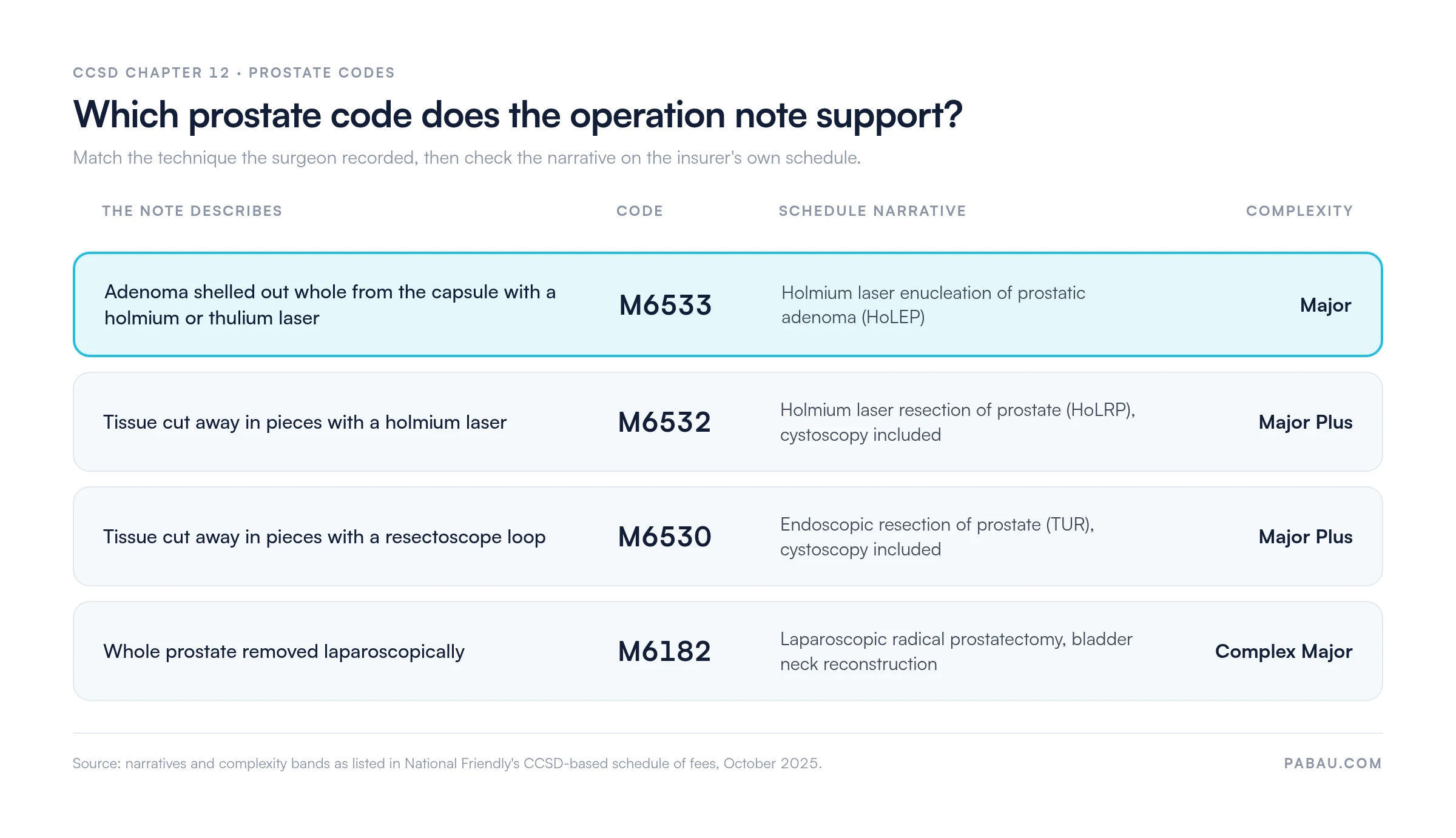
The two codes coders mix up most are M6530 and M6533, because both treat BPH through the urethra. A laparoscopic cancer operation goes to M6182 instead. An open radical prostatectomy is billed under code M6180. M6532 and M6533 describe alternative ways of treating the same gland, so check the schedule’s combination rules before both appear on one claim.
Transurethral needle ablation (TUNA) also treats BPH through the urethra, but it ablates tissue in place and is billed as CCSD code M6750.
A claim for M6533 is only as strong as the operation note behind it. If the note just says “laser prostatectomy”, the coder has to guess between enucleation and resection, and the insurer may query it.
Agree a standard procedure title with your surgeons, such as “HoLEP, laser enucleation of prostate”. When the title carries the technique, the person coding the claim reads it in seconds instead of searching the body of the note.
The work starts before the operation. Most insurers want planned prostate surgery approved in advance, and the patient’s policy decides what is covered.
The table below is a starting point, so confirm each detail with the payer before the procedure date.
Once the operation is done, the claim follows the same five steps whichever insurer pays it.
The anesthetist bills separately for the same operation. Insurer schedules such as Aetna International’s list an anesthetist fee next to the surgeon’s fee for M6533.
Most rejected HoLEP claims trace back to a handful of avoidable slips. Here is what to watch for, and how to fix each one.
If a claim is still refused, check the insurer’s current provider manual for its appeal process. Only commit to a deadline you have confirmed there.
Bupa is one of the UK’s largest private health insurers, and many urologists hold Bupa recognition. Its rules are worth knowing before the first HoLEP claim goes out.
Our guide to Bupa CCSD codes explains how Bupa’s procedure list and claim process work.
In many urology practices, the authorization lives in an email, the operation note sits in another system, and the claim is keyed in by hand. Every handoff is a chance to lose the reference number or send the wrong fee.
Pabau, the practice management platform we build, keeps those steps on the patient record. Its claims management software sends claims electronically through Healthcode and to Bupa. The authorization code, dates and sessions sit on the patient’s case, with a warning when one is missing.
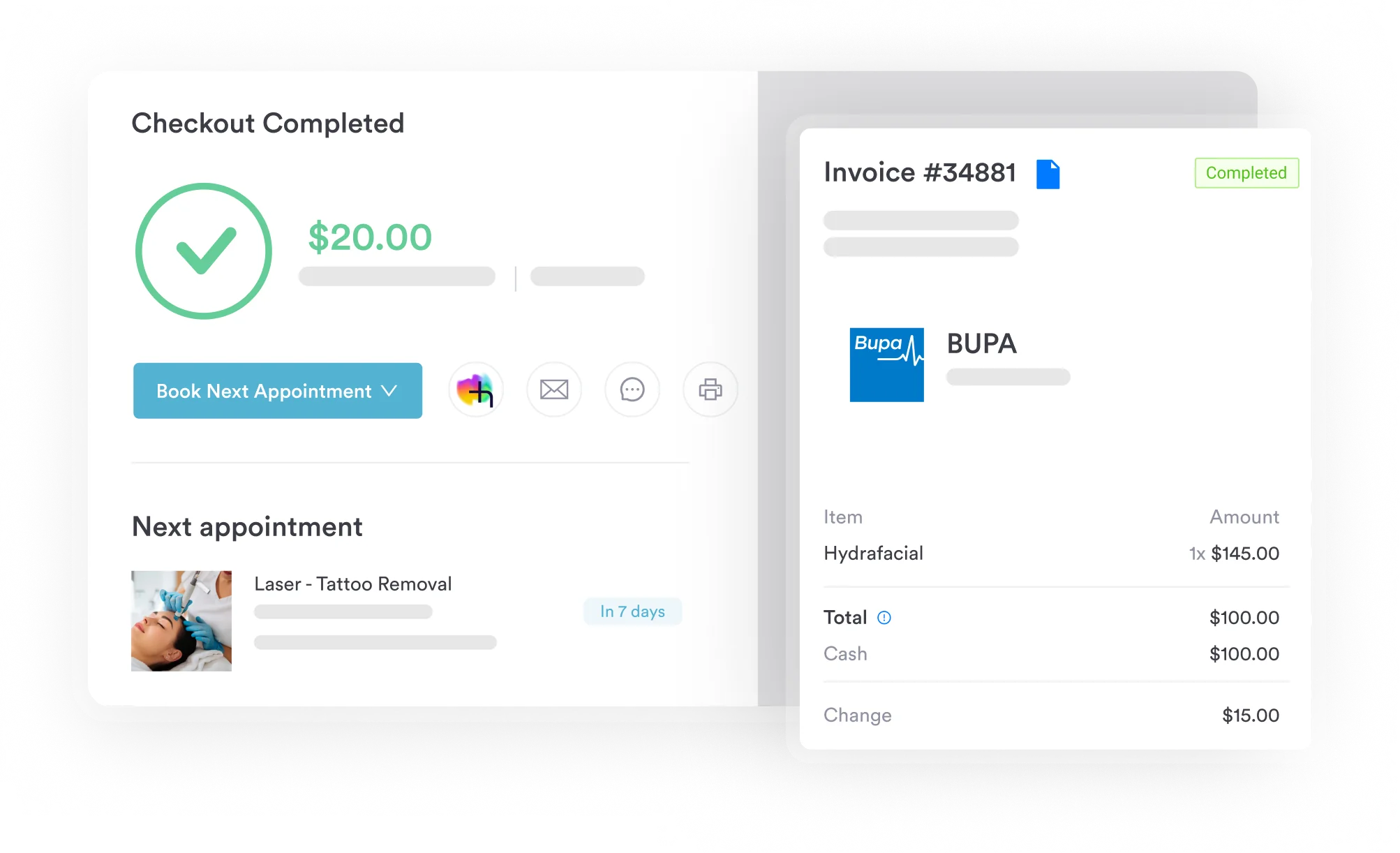
The result is fewer claims bounced for a missing reference, and a clear view of what each insurer still owes. Your team spends less time on rework and more on patients.

Pabau tracks authorization codes on the patient’s case and sends claims electronically through Healthcode and to Bupa. You see each claim’s status without phoning the insurer.

M6533 is a straightforward code once the note says “enucleation”. Most trouble comes from a vague note, an old schedule or a missing authorization, and you can catch all three before the claim leaves.
Standardize the procedure title with your surgeons, and check each insurer’s current narrative and fee. Those two habits remove most of the queries that slow HoLEP payments. Book a demo to see how Pabau tracks authorizations and sends your Healthcode claims from one patient record.

Billing a standard TURP instead? CCSD code M6530 covers endoscopic resection of the prostate, with cystoscopy included.
Coding a radical prostatectomy? CCSD code M6182 explains the laparoscopic radical prostatectomy code and its robotic and open neighbours.
Need a full Bupa CCSD billing reference? Bupa CCSD codes covers Bupa’s procedure list and how its claims work.
Checking Bupa fees before you invoice? Bupa procedure codes and fee schedule walks through Bupa’s recognized codes and fee tiers.
Yes. The current M6533 narrative names holmium and thulium laser enucleation, including ThuLEP and ThuFLEP. Some insurer schedules still print the older HoLEP-only wording, so check the payer’s list before you submit a thulium claim.
The narratives for M6530 and M6532 both say “including cystoscopy”. The HoLEP narrative printed in insurer schedules doesn’t. Check the insurer’s guidance before you add a separate cystoscopy line.
When an insurer asks for a diagnosis, UK claims use WHO ICD-10 codes. For benign prostatic hyperplasia that is N40, Hyperplasia of prostate. Use the diagnosis the surgeon documented rather than a default.
Yes, the anesthetist bills their own fee for the same procedure code. Schedules such as Aetna International’s list a separate anesthetist fee beside the surgeon’s fee for M6533.
Insurers that commonly use CCSD-based schedules include Bupa, AXA Health, Aviva, Vitality, WPA, Healix, Allianz Care and Cigna. Cover still depends on the patient’s policy, so confirm it with the payer first.