

HCPCS Code L0472: Hyperextension TLSO billing guide
HCPCS code L0472: Official descriptor and device definition HCPCS code L0472 des...

Last Updated: Nov 5, 2026
M4230 is the CCSD code for endoscopic destruction of lesion of bladder (including cystoscopy). It covers destroying a bladder lesion in situ through a cystoscope, using diathermy or laser. The cystoscopic examination is billed inside the same code.
M4230 sits in sub-chapter 12.3.0 (Bladder) of the CCSD schedule. When the lesion is removed with a resection loop instead, the correct code is M4210. A cystoscopy with no lesion treated is coded M4510 or M4514.
Let Pabau's smart automation suggest the right codes, reduce claim denials, and keep your practice compliant—effortlessly.
Automate repetitive tasks and focus on what matters most—your patients.
Reduce coding errors and ensure compliance with the latest regulations.
Clean claims, fewer denials, and faster reimbursements.
Powerful insights and reporting to help your practice thrive.
HIPAA compliant SOC 2 certified GDPR-compliant Trusted by 4,000+ clinics worldwide

CCSD code M4230 covers endoscopic destruction of a bladder lesion, with the cystoscopy bundled into the same code.
A separate cystoscopy code on the same claim counts as unbundling, and insurers running bundling edits will reject or recoup it.
The operative note decides the code: destruction in situ supports M4230, while loop resection with a specimen supports M4210.
M4210 and M4230 are listed as an unacceptable combination on the same occasion, though each insurer decides whether to apply CCSD principles.
Many UK private insurers typically require pre-authorisation for endoscopic bladder procedures, so confirm each patient’s policy before the list.
CCSD code M4230 is the code for endoscopic destruction of a lesion of the bladder, including cystoscopy. The official descriptor bundles the cystoscopic examination into the code, so one line covers both the inspection and the destruction. It applies when a urologist destroys a bladder lesion in situ through a cystoscope, using diathermy or laser.
M4230 sits in sub-chapter 12.3.0 (Bladder) of the CCSD schedule, which UK private insurers use to recognise procedures for invoicing. The M prefix covers urinary system and male reproductive procedures, and the full list of CCSD codes shows the neighbouring bladder codes. Consultants, billing teams and medical secretaries in UK private practice use M4230 to raise invoices that insurers will accept.
A consultant urologist performs the procedure under general or local anaesthetic. It follows a standard sequence:
The code follows what the operative note records, not the tumour stage. Destruction is typically used for small, superficial lesions, such as small papillary recurrences found at surveillance cystoscopy or benign bladder polyps. Muscle-invasive bladder cancer is managed with resection or cystectomy rather than endoscopic destruction.
Knowing the boundaries of the code prevents both under-claiming and unbundling. The table below sets out what M4230 does and does not cover.
The most common unbundling error is billing a cystoscopy code alongside M4230. The descriptor already says “including cystoscopy”, so insurers running automated bundling edits reject or recoup a separate cystoscopy line. Check current bundling rules against the CCSD technical guide.
The choice that matters most is between M4230 and M4210. Picking the wrong one is a common trigger for audit queries and claim adjustments.
The clinical distinction rests on technique. Destruction ablates the lesion in situ with energy, while resection removes it with a loop electrode and yields a specimen for histology. A note describing diathermy or laser destruction without a resection loop supports M4230. A note describing resected chips sent for histological staging supports M4210, as the decision chart below shows.
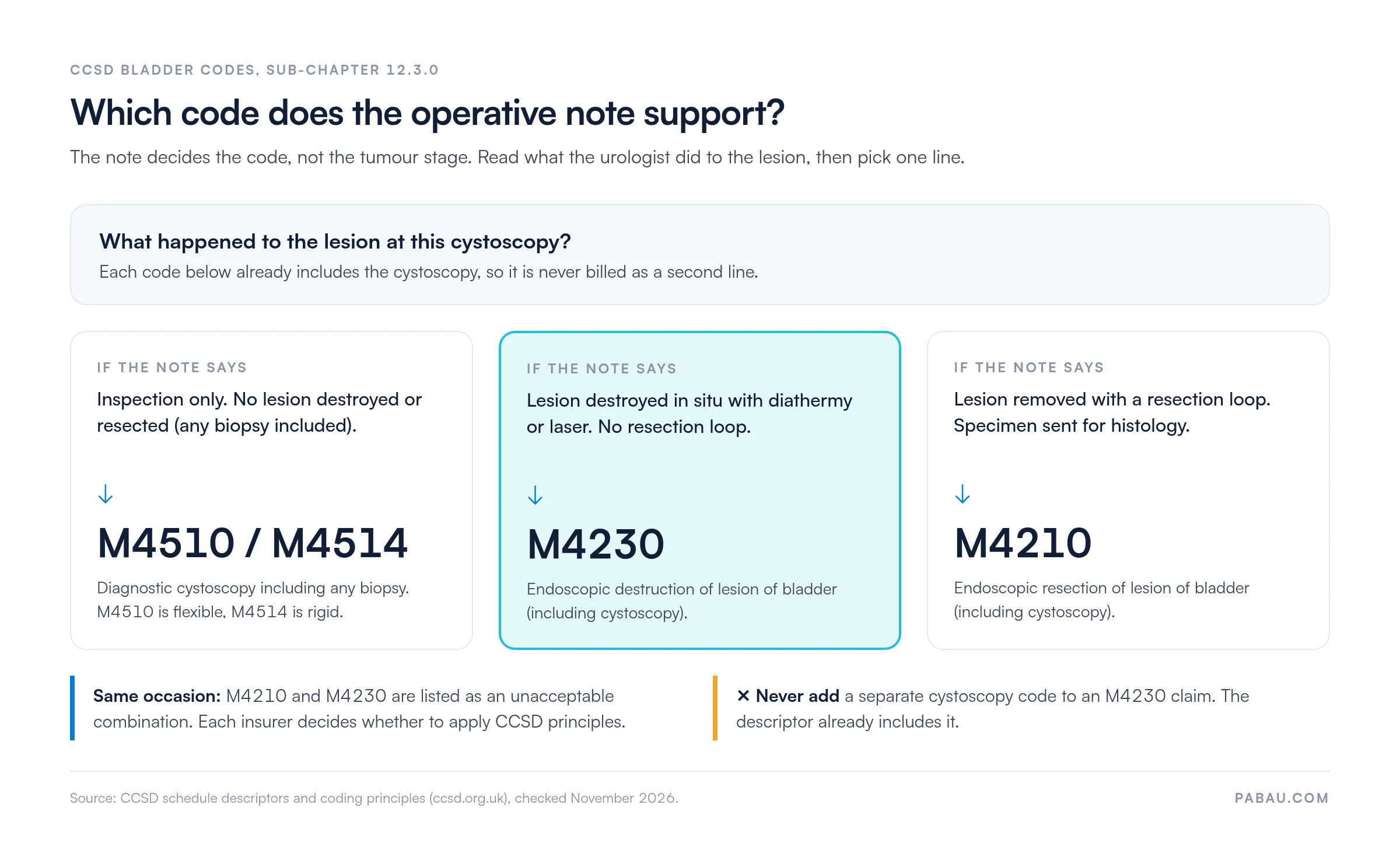
M4210 and M4230 are listed as an unacceptable combination on the same occasion. CCSD principles are guidance, and each insurer decides whether to apply them. Confirm the exact M4210 descriptor against your current edition of the CCSD schedule.
The operative note has to support the code. Coding M4230 for a case that was resected attracts an audit query. Coding M4210 for a destruction-only case claims a procedure the note does not describe, and the insurer may challenge it.
M4230 is appropriate when the operative note confirms all of the following:
M4230 does not fit muscle-invasive bladder cancer, which needs resection or cystectomy. It also does not fit a surveillance cystoscopy where no lesion was found or treated. That inspection is coded M4510 or M4514.
A complete operative note is the most important document behind an M4230 claim. Insurers can query the claim or withhold payment when the note does not clearly confirm endoscopic destruction. A structured operative note template keeps that record consistent from one case to the next.

The operative note should include all of the following to support the claim:
Building these six fields into one template means every consultant on the list records them the same way, whoever writes the note.
Review your operative note template before the next list. A note that reads only ‘cystoscopy and diathermy performed’, without the modality, lesion site or tissue disposition, may not meet insurer documentation requirements. That shortfall usually comes to light only once the claim is under query.
Many UK private insurers typically require pre-authorisation before an endoscopic bladder procedure such as M4230. The rules vary by insurer and by policy, so treat the table below as a starting point. Confirm the current position with each insurer before booking, because policies change without notice.
Bupa claims also carry their own invoice rules beyond the authorisation number. Our guide to Bupa CCSD codes covers those requirements and the authorisation process.
The five causes below are the usual reasons an M4230 claim is denied, and each one can be prevented before submission.
Claims management software that tracks pre-authorisation status alongside each appointment reduces the risk of submitting without a valid authorisation reference.
Some codes can sit on the same claim as M4230, provided the services were distinct and separately documented. The Healix fee schedule guidelines show how one insurer sets out its own billing rules.
Three combinations are not allowed alongside M4230:
Each insurer sets its own recognised fee for M4230 and publishes it in its own fee schedule. Balance billing rules vary too. Some insurers let consultants charge above the recognised rate with patient consent, while others do not.
Before quoting a patient’s out-of-pocket costs or raising an invoice, check the current recognised fee with the insurer. Each payer reviews its rates at a different point in the year, so a fee list kept for several insurers goes stale quickly.
Check the fee before pre-auth, not after. When you request pre-authorisation for M4230, ask the insurer to confirm the recognised fee at the same time. Some insurers apply a lower rate on certain plan types, and the patient needs to know any shortfall before consenting to the procedure.
Non-muscle-invasive bladder cancer (NMIBC) recurs often. Under the EAU guidelines, recurrence rates range from about 30% to over 70% at five years, depending on the EAU risk group. Patients on surveillance can therefore undergo M4230 several times, and each episode is billed as a distinct, separately documented procedure.
To stand up on audit, each repeat claim needs a fresh operative note confirming a new lesion was found and destroyed at that cystoscopy. Insurers may query M4230 claims submitted at high frequency without a clinical narrative for each new lesion.
A complete patient record that logs the surveillance schedule, each cystoscopy finding and each decision to destroy a lesion gives you the audit trail. That trail supports repeat billing over a long follow-up period.
Surveillance cystoscopy where no lesion is found or treated is a different procedure, coded M4510 (flexible) or M4514 (rigid). Billing M4230 for it is an incorrect code selection and will attract insurer queries.
Many urology billing teams keep pre-authorisation numbers in a spreadsheet and match them to the theatre list by hand. When the list changes, a reference can drop off, and the claim reaches the insurer without it.
In Pabau, each insurer authorisation is stored as a case. You attach the case when you book the procedure, and the authorisation code follows the appointment through to the invoice. Claims then go to insurers such as Bupa, AXA Health, Vitality and Aviva through Healthcode.
Before a claim leaves Pabau, claim validation checks it for missing or invalid details. If the insurer rejects it, Pabau flags the claim as needing action and shows the reason, so your team can correct it and resubmit.

Pabau links each pre-authorisation to its appointment and checks every claim before it goes through Healthcode. M4230 claims reach the insurer complete, with the authorisation reference attached.

Code M4230 from the operative note, never from habit. Once the note names the energy source, the lesion site and the tissue disposition, the choice between M4230 and M4210 is settled. An audit query then has a clear answer on file.
The pre-authorisation reference is the other check worth running before every list. A recorded reference turns a likely denial into a routine payment. Book a demo to see how Pabau links each pre-authorisation to its appointment and claim.

Need a reference for Bupa CCSD code requirements? Bupa CCSD codes and fee schedule covers invoice requirements, authorisation processes and common billing rules for UK private practice.
Coding other endoscopic urology procedures? CCSD code M0910 covers endoscopic fragmentation of kidney stones, another code that bundles the cystoscopy.
Looking up a neighbouring bladder code? The CCSD codes library lists the schedule by chapter, so you can check related codes before you invoice.
Want to reduce claim rejections across your private practice? Pabau’s claims management software tracks authorisation status and checks each claim before submission.
CCSD code M4230 is the code for endoscopic destruction of a lesion of the bladder, including cystoscopy. It covers the cystoscopic examination and the destruction of the lesion with diathermy or laser, billed as a single code. Anaesthesia, histology and post-operative consultations are not included and are coded separately.
Cystoscopy is included within M4230 and must never be billed separately on the same claim. The official descriptor includes cystoscopy, so a separate cystoscopy code on the same invoice counts as unbundling. Insurers will reject or recoup that line.
M4230 covers endoscopic destruction of a bladder lesion, where the lesion is ablated in situ with diathermy or laser. M4210 covers endoscopic resection of a lesion of the bladder, including cystoscopy, where a loop electrode removes the lesion and a specimen goes for histology. Use the code the operative note supports, because the two are listed as an unacceptable combination on the same occasion.
The operative note should confirm the endoscopic approach, the destruction modality and the lesion’s location and approximate size. It should also record the cystoscopy findings, whether tissue went for histology, and the operating consultant’s GMC number. Missing details are a common reason insurers request further clinical records before paying.



