CPT code 95808: Attended polysomnography billing guide
CPT code 95808 covers attended PSG with 1 to 3 extra channels CPT code 95808 is ...

Last Updated: Nov 11, 2026
M6180 is the CCSD code for an open radical prostatectomy with reconstruction of the bladder neck. The code already includes bilateral pelvic lymphadenectomy and cystoscopy, so neither is billed on its own.
M6180 sits in chapter 12 of the CCSD schedule, under Prostate. The laparoscopic version is M6182 and the robotic-assisted version is M6192. It has no connection to A6180, which covers excision of a nerve lesion.
Let Pabau's smart automation suggest the right codes, reduce claim denials, and keep your practice compliant—effortlessly.
Automate repetitive tasks and focus on what matters most—your patients.
Reduce coding errors and ensure compliance with the latest regulations.
Clean claims, fewer denials, and faster reimbursements.
Powerful insights and reporting to help your practice thrive.
HIPAA compliant SOC 2 certified GDPR-compliant Trusted by 4,000+ clinics worldwide

CCSD code M6180 covers an open radical prostatectomy with bladder neck reconstruction, including bilateral pelvic lymphadenectomy and cystoscopy.
The surgical approach decides the code: M6182 for laparoscopic, M6192 for robotic-assisted and M6140 for the perineal route.
CCSD lists open total cystectomy (M3400) as an unacceptable combination with M6180, and the robotic code M6192 can’t sit beside it either.
Pre-authorization is commonly required for a major procedure like this, so confirm it with each insurer before the operation date.
Pabau, our practice management platform, checks that the authorization and membership numbers are on the claim before it goes to Healthcode.
CCSD code M6180 is the code for an open radical prostatectomy with reconstruction of the bladder neck. Its full descriptor also names bilateral pelvic lymphadenectomy and cystoscopy, so both are part of the code. It sits in chapter 12 of the CCSD schedule, under Prostate.
The Clinical Coding and Schedule Development (CCSD) Group maintains the procedure schedule used for UK private healthcare billing. M6180 is one entry in our CCSD code library. Most UK private medical insurers accept CCSD codes, including Bupa, AXA Health, Aviva and Vitality. The NHS codes the same operation in OPCS-4 instead.
One mix-up turns up often in searches. A6180 shares the digits but sits in chapter 3 and covers excision of a lesion of a major nerve. It has nothing to do with the prostate.
M6180 is a bundled code. Two parts of the operation are written into the descriptor, so they are paid through M6180 and never as extra lines. Billing them separately is unbundling, and insurers recover the payment when they spot it.
The CCSD technical guide (updated October 2025) sets out these bundling principles. CCSD notes that its combination lists are guidelines, and each insurer decides how it applies them. Check the insurer’s own coding policy when a claim sits near the line.
The prostate sub-chapter holds a family of radical prostatectomy codes with almost identical wording. What separates them is the surgical approach, and the operation note has to state it.
The panel below shows which code fits which approach.
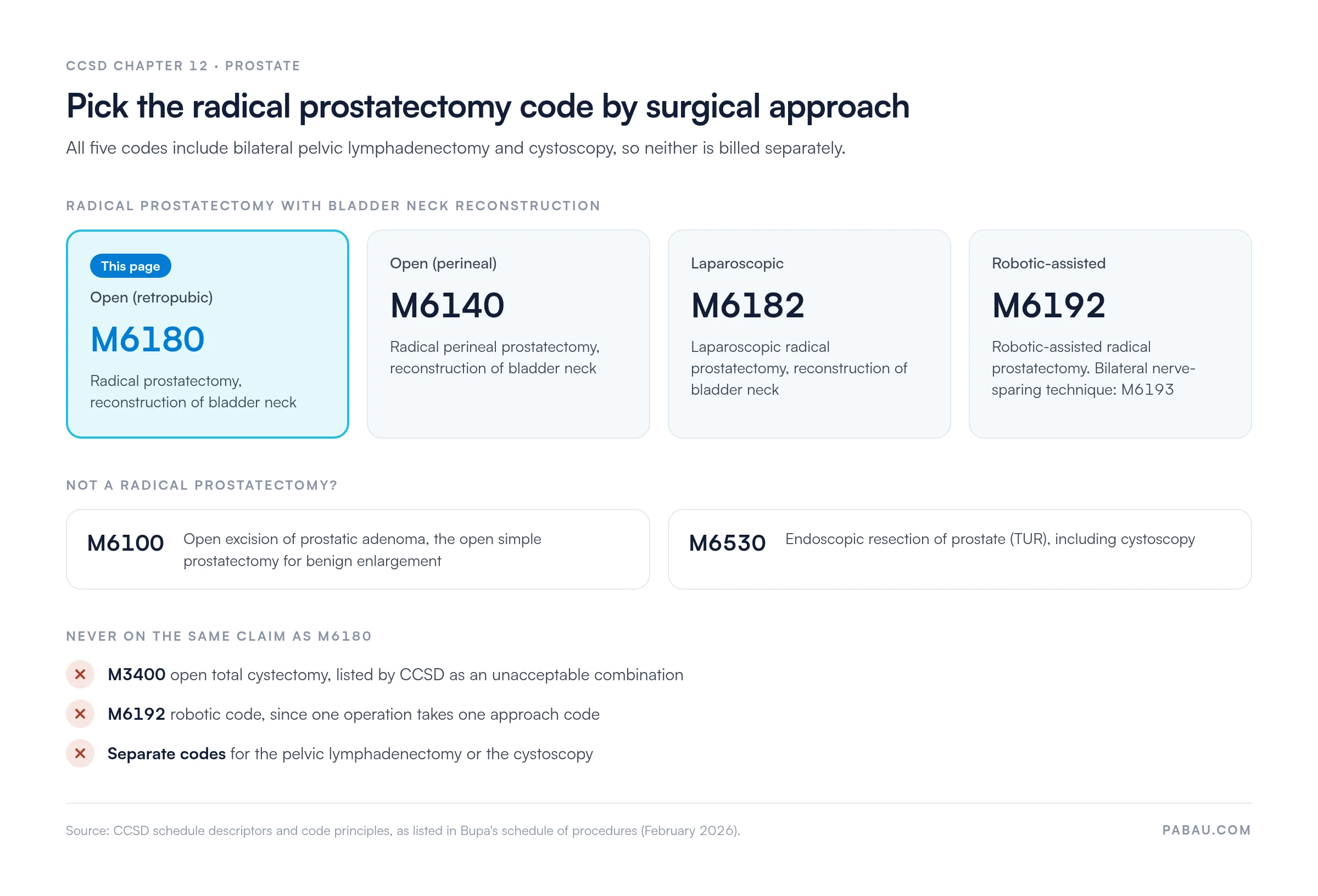
Code the approach the operation note records. For the laparoscopic version of this operation, see M6182. A transurethral resection for benign enlargement is a different operation altogether, coded M6530.
Ask the surgeon’s secretary to copy the approach wording from the operation note onto the billing sheet. Open, perineal, laparoscopic and robotic each carry their own code, and that one word decides which one the insurer pays.
A radical prostatectomy is almost always a cancer operation, so the reviewer expects to see the diagnosis behind it. The operation note then has to match the code line by line. Claims management software helps here by carrying the record straight onto the claim.
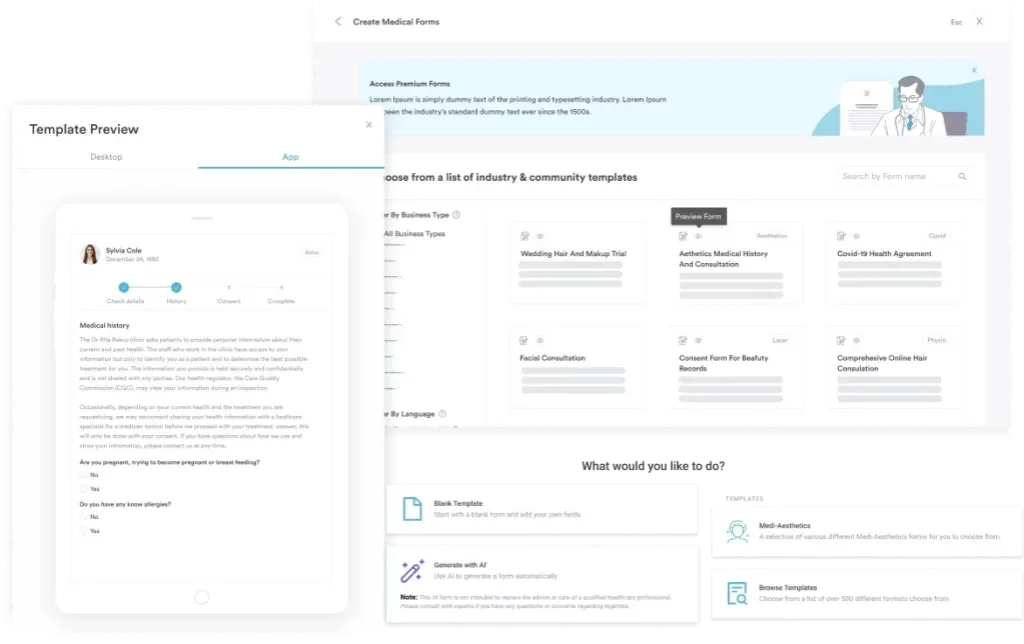
Pre-authorization is commonly required for a major procedure such as radical prostatectomy, but each insurer sets its own rule.
Confirm it per insurer before the operation date. An authorization confirms cover at that moment. It doesn’t guarantee payment if the claim later differs from what was authorized.
Bupa pays M6180 only to a consultant with Bupa recognition, so check that status before booking theater time. Its February 2026 schedule grades M6180 at CMO 4, the same grade as M6182 and M6192. Our Bupa fee schedule guide explains how those grades work.
Bupa reviewers commonly query three things on this code. These are a missing referral letter, a claim without the authorization number, and an operation note that doesn’t match the approach billed.
AXA Health uses the CCSD schedule for procedure billing by recognized specialists. Claims stall when the surgeon isn’t on AXA’s recognized list, or when the referral pathway isn’t documented. They also stall when the code doesn’t match the indication in the referral. The provider helpline can confirm the authorization rule for a patient’s policy before surgery.
Healthcode is the main electronic clearinghouse for UK private claims. A clean M6180 claim follows the same path every time.
Most M6180 denials trace back to a short list of causes. Fix the cause before resubmitting, because insurers track identical claims that bounce back more than once.
In many urology practices, the authorization number lives in an email and the code lives on a paper billing sheet. The two meet only when someone keys the claim into Healthcode by hand. That is where the missing-field rejections come from.
Pabau, the practice management platform we build, supports UK claims through Healthcode. The CCSD code and the pre-authorization number are recorded against the episode.
The claim then pulls them straight from the patient record. Pabau checks that required fields, such as membership and authorization numbers, are complete before the claim can be sent.
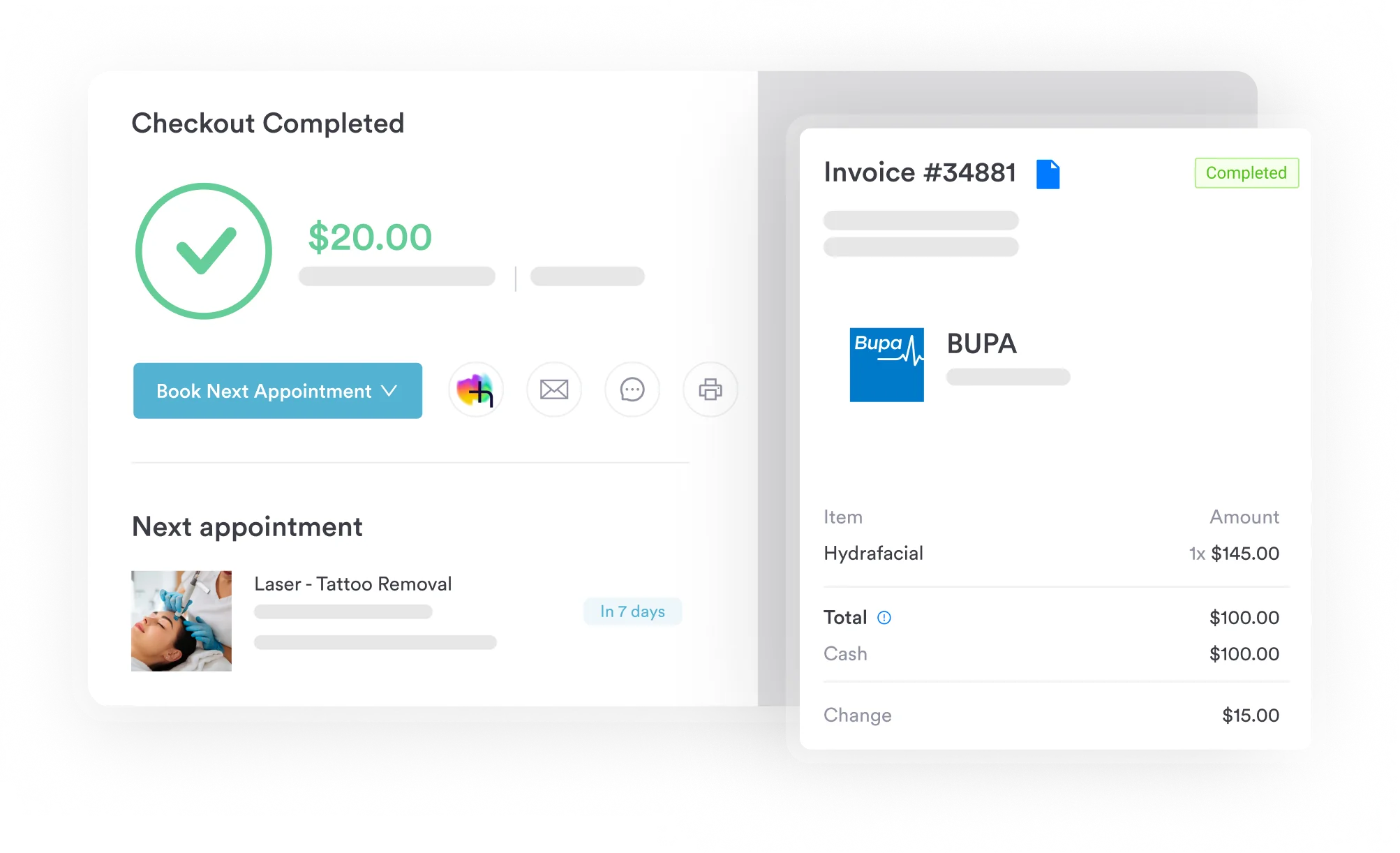
Once the claim is submitted, its status shows in the same system. Your billing team can answer insurer queries without logging in to each portal. The result is fewer resubmissions and a shorter wait for payment on a high-value operation.

Pabau records the CCSD code and pre-authorization number against each episode and sends claims through Healthcode. Your team sees each claim’s status without chasing insurer portals.

M6180 is one of the easier codes to get right, as long as you read the operation note before choosing it. The approach decides between M6180, M6140, M6182 and M6192. The descriptor already pays for the lymph nodes and the cystoscopy.
Settle the authorization and the surgeon’s recognition before the operation date, not after the denial. A claim that carries the right approach code and the authorization number usually pays on the first submission.
Book a demo to see how Pabau sends complete CCSD claims through Healthcode for your urology patients.

Need the wider Bupa CCSD picture? Bupa CCSD codes covers how Bupa applies the CCSD schedule for recognized providers.
Checking what Bupa pays for each grade? Bupa procedure codes and fee schedule explains Bupa’s grades and fees for recognized specialists.
Billing the keyhole version of this operation? CCSD code M6182 covers laparoscopic radical prostatectomy with bladder neck reconstruction.
Coding a resection for benign enlargement instead? CCSD code M6530 covers endoscopic resection of the prostate (TUR).
M6180 covers an open radical prostatectomy with reconstruction of the bladder neck. Bilateral pelvic lymphadenectomy and cystoscopy are included, so neither is billed separately.
No. A6180 is a chapter 3 code for excision of a lesion of a major nerve. M6180 is a chapter 12 prostate code, and the two only share digits.
Use M6192 for a robotic-assisted radical prostatectomy with bladder neck reconstruction. A bilateral nerve-sparing robotic operation has its own code, M6193.
Bupa’s February 2026 schedule grades M6180 at CMO 4. Grades and fees change, so check the current figure in Bupa’s code search before quoting a patient.
OPCS-4 has no single radical prostatectomy code. NHS coders combine a prostate excision code such as M61.1 with separate codes for lymph node removal and, where used, a minimal-access approach.