

HCPCS Code E0272: Foam rubber mattress billing guide
HCPCS Code E0272: official descriptor and code overview HCPCS Code E0272 is the ...

Last Updated: Nov 6, 2026
M6182 is the CCSD code for laparoscopic radical prostatectomy with reconstruction of the bladder neck. It includes bilateral pelvic lymphadenectomy and cystoscopy, so neither is coded separately when performed to the standard template.
M6182 sits in the prostate section of chapter 12 of the CCSD schedule, graded CMO 4 by Bupa. Open radical prostatectomy is coded M6180, and the robotic-assisted equivalent is M6192.
Let Pabau's smart automation suggest the right codes, reduce claim denials, and keep your practice compliant—effortlessly.
Automate repetitive tasks and focus on what matters most—your patients.
Reduce coding errors and ensure compliance with the latest regulations.
Clean claims, fewer denials, and faster reimbursements.
Powerful insights and reporting to help your practice thrive.
HIPAA compliant SOC 2 certified GDPR-compliant Trusted by 4,000+ clinics worldwide

CCSD Code M6182 covers laparoscopic radical prostatectomy only. Open surgery is coded M6180, and robotic-assisted surgery is coded M6192.
Bilateral pelvic lymphadenectomy and cystoscopy are already included in M6182 by its own descriptor. Only an extended dissection beyond the standard template may be coded separately.
All major UK private insurers require prior authorisation before M6182 is performed, and proceeding without it typically results in non-payment.
Pabau’s claims management software stores each insurer authorisation as a case and sends M6182 claims through Healthcode to Bupa, AXA Health, Aviva and Vitality.
CCSD Code M6182 is the code for laparoscopic radical prostatectomy with reconstruction of the bladder neck. Its descriptor includes bilateral pelvic lymphadenectomy and cystoscopy, so neither is coded separately when performed to the standard template. Open surgery takes M6180 instead, and robotic-assisted surgery takes M6192.
CCSD stands for Clinical Coding & Schedule Development, the group that maintains the schedule UK private medical insurers use for invoicing. Bupa lists M6182 in the prostate section of chapter 12, at grade CMO 4. Our CCSD billing guides cover the rest of the schedule code by code.
Laparoscopic radical prostatectomy is performed under general anaesthesia through four to six small ports placed in the abdominal wall. Understanding the surgical steps helps coders confirm that the operative note supports M6182 and not an adjacent code.
Every one of these steps must be described in the operative note to substantiate a valid M6182 claim. Missing documentation of the approach (laparoscopic rather than open) or the anastomosis is a frequent trigger for payer queries.
M6182 is appropriate when a consultant urologist performs a complete laparoscopic radical prostatectomy for localised or locally advanced prostate cancer in a private UK hospital. The table below summarises the clinical circumstances that support correct code selection.
Coders should confirm the approach in the operative note before assigning M6182. The principal diagnosis on every M6182 claim is malignant neoplasm of prostate, covered in the ICD-10 section below.
Four codes are routinely confused around radical prostatectomy billing. The distinctions are surgical, so the operative note is the primary arbiter. Bupa grades the open, laparoscopic and robotic codes identically at CMO 4, so the grade never tells you which one the note supports.
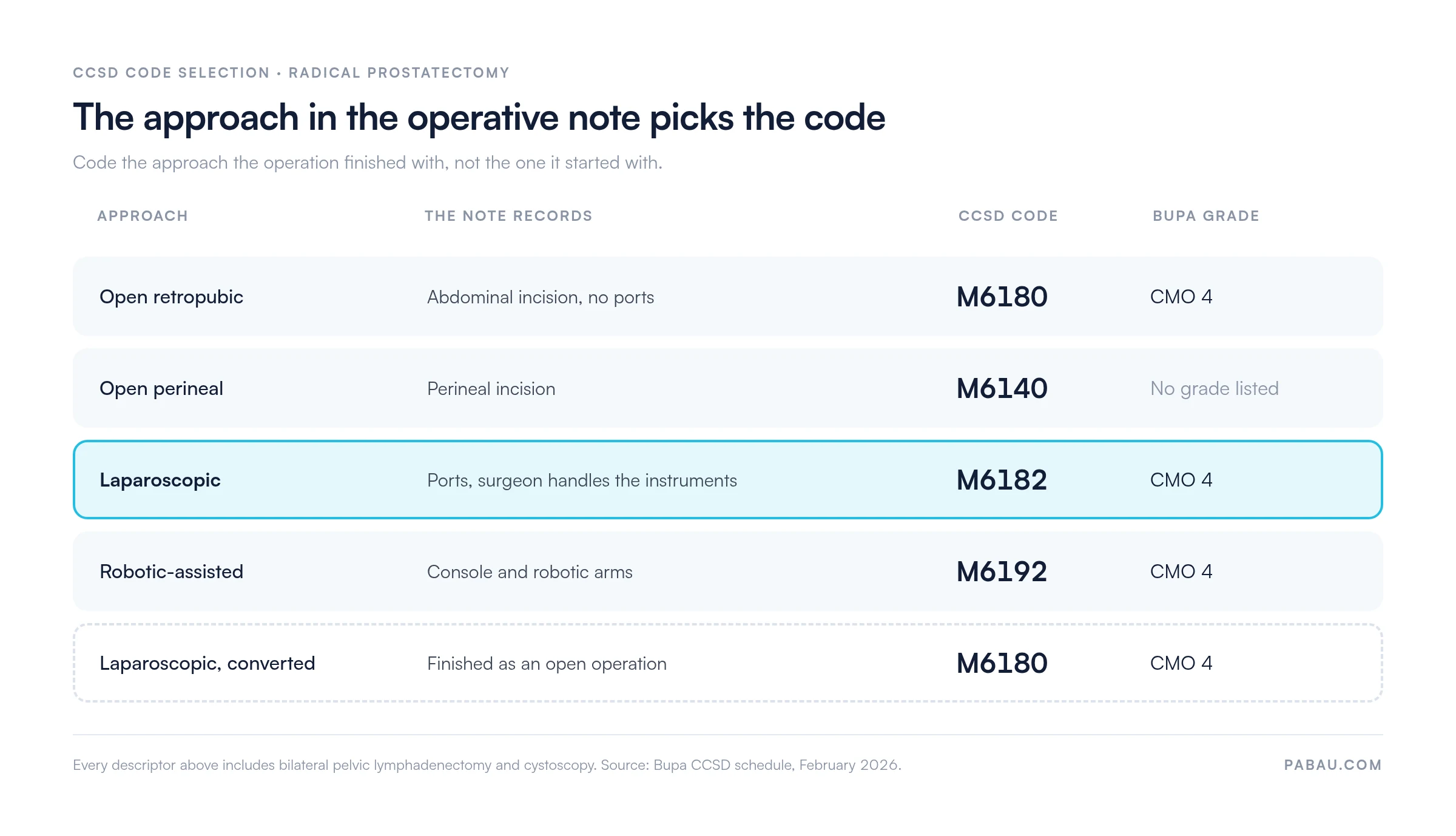
The table sets out what each code describes and the detail that separates it from M6182.
Robotic-assisted laparoscopic prostatectomy (RALP) is billed under M6192, not CCSD Code M6182. The differentiator is instrument control. In standard laparoscopic surgery, the surgeon handles the instruments through the ports directly.
In RALP, the surgeon operates a console, and robotic arms hold and move the instruments inside the patient. If the operative note records “robotic-assisted” or names the Da Vinci system, M6182 is the wrong code, even though both approaches use ports.
Bupa’s schedule also lists M6193 for robotic surgery using a bilateral nerve-sparing technique, so check the note for that detail too. Bupa, AXA Health and Vitality each publish their own fee schedules and may apply different authorisation criteria to robotic procedures.
US billing draws the line differently. There, CPT 55866 covers laparoscopic radical prostatectomy with or without robotic assistance, so a single code serves both approaches.
Yes. The official CCSD descriptor for M6182 includes bilateral pelvic lymphadenectomy and cystoscopy. A standard dissection performed with the prostatectomy is therefore never billed as a second code. This does not depend on individual insurer bundling policy, because the code wording itself settles it.
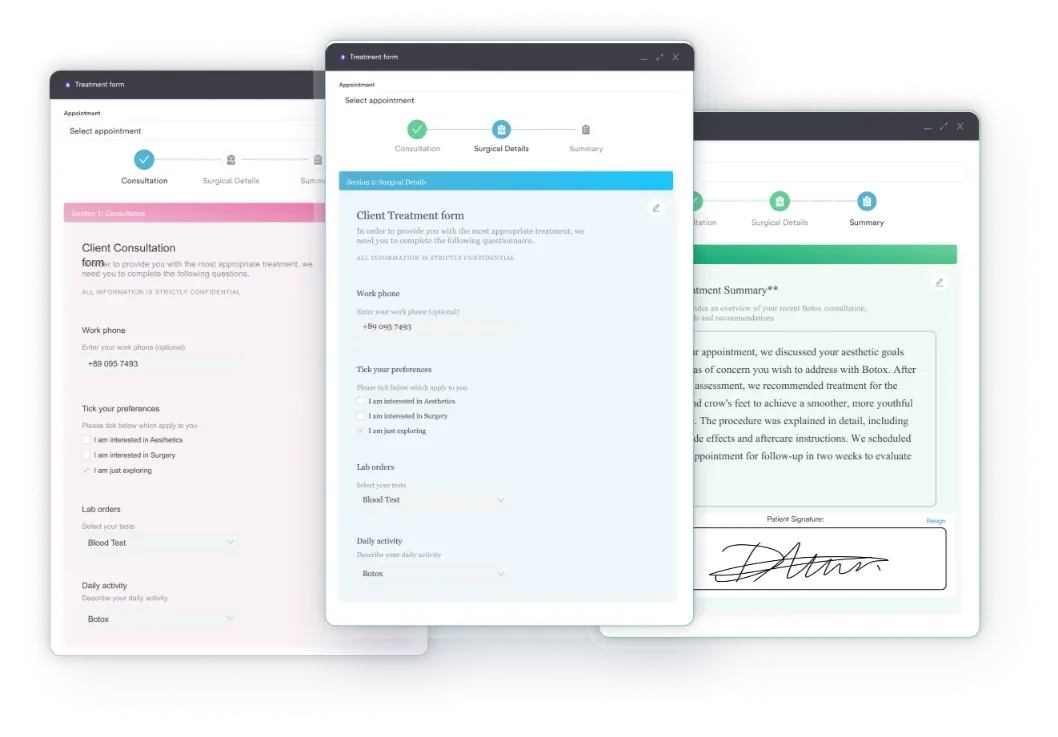
A valid M6182 claim depends on an operative note that explicitly confirms the laparoscopic approach and the structures excised. Digital consent and operative forms capture structured documentation at each stage of the patient pathway, so the record is complete by invoicing.
Every major UK private medical insurer requires prior authorisation before laparoscopic radical prostatectomy is performed. Without it, most PMIs decline the claim in full. Our Bupa CCSD codes guide covers the wider invoicing framework. The table below summarises authorisation requirements for M6182 across the major payers.
Most insurers ask for the biopsy report, so keep it with the episode. If your practice performed that biopsy, it was billed as its own episode, for example under M6580. Track authorisation status against each patient episode, and flag any procedure still waiting for approval before the admission date.
Request prior authorisation as soon as the MDT or tumour board recommendation is documented, not after the surgical date is confirmed. For M6182, most PMIs need 5-10 working days to assess the clinical evidence. Building the authorisation step into the booking workflow prevents the most common reason for non-payment on prostatectomy claims.
M6182 claims are denied for predictable reasons. Spotting the pattern early reduces rework and speeds up payment.
Intraoperative conversion from laparoscopic to open radical prostatectomy is uncommon but clinically significant. When it occurs, the CCSD code changes from M6182 to M6180, the open radical prostatectomy code. The completed procedure is an open operation, whatever the initial approach.
Coding M6182 on a claim where the operative note records “converted to open” will generate a clinical-code mismatch query at audit.
The consultant urologist claims M6182 for the surgical episode. The anaesthetist, any assistant surgeon, and certain consumables may be separately billable under their own CCSD codes.
Fees are set by individual insurers and are not publicly stated in the CCSD schedule itself. Confirm current fee values via each insurer’s portal or recognised fee schedule before invoicing.
Always confirm assistant surgeon reimbursement policy with the specific insurer before the procedure date. Bupa and AXA Health take different positions on assistant fees for laparoscopic urological surgery. An unexpected refusal leaves the practice owing the assisting clinician a fee it cannot recover from the payer.
UK private insurer claim forms require an ICD-10 diagnosis code alongside the CCSD procedure code. The principal diagnosis for a radical prostatectomy performed for prostate cancer is C61.
Secondary codes capture staging, complications, and relevant comorbidities. Verify ICD-10 code accuracy against the NHS Classifications Browser for UK-applicable fifth-edition codes before submission.
Most billing errors on M6182 come from manual steps between the operating list and the invoice. The sequence below takes one episode from booking to submission.
Many private urology practices run an M6182 episode across three places: the insurer portal for pre-authorisation, a spreadsheet for codes, and Healthcode for the invoice. Every hand-off is a chance for the authorisation number or the approach to drop off the claim.
Pabau, the practice management platform we build, keeps the episode in one patient record. Each insurer authorisation is stored as a case and attached at booking, so its code follows the appointment through to the claim. Our claims management software then sends the invoice through Healthcode to Bupa, AXA Health, WPA, Vitality and Aviva.
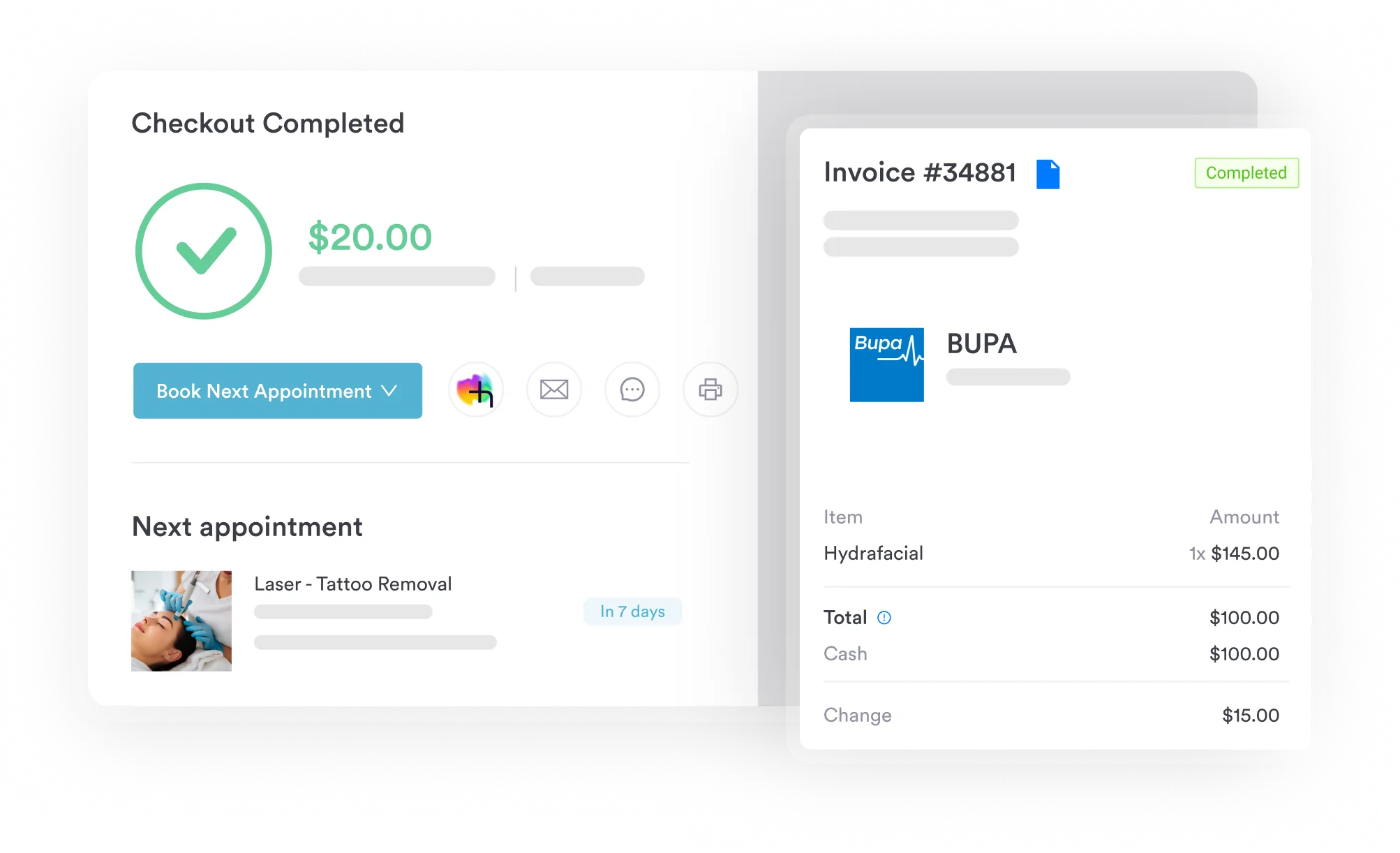
Claim validation checks every claim for missing or invalid details before it leaves Pabau. A claim still missing its authorisation code is flagged for a case to be assigned. The fix then happens before submission rather than after a rejection.

Pabau stores each insurer authorisation as a case and carries its code onto the claim. M6182 invoices then go through Healthcode to Bupa, AXA Health, Vitality and Aviva.

The code on a radical prostatectomy claim is decided by one line in the operative note: how the prostate came out. Check that line before anything else. The open, laparoscopic and robotic codes share a Bupa grade, so the invoice itself will not reveal a mismatch.
Then stop adding lines the descriptor already covers. A standard bilateral PLND and the cystoscopy are part of M6182, and billing them again invites an unbundling query that delays payment.
The trade-off worth remembering is timing. Pre-authorisation requested once the MDT has recommended surgery costs the practice a few days, while one requested after the operation rarely succeeds. Book a demo to see how Pabau carries each authorisation from booking to the Healthcode claim.

Coding the diagnosis on the same claim? ICD-10 code C61 explains the principal diagnosis that supports every radical prostatectomy claim.
CCSD Code M6182 covers laparoscopic radical prostatectomy with reconstruction of the bladder neck, including bilateral pelvic lymphadenectomy and cystoscopy. It does not cover open radical prostatectomy (M6180), robotic-assisted prostatectomy (M6192), or simple prostatectomy for benign disease.
M6180 is the standard open (retropubic) radical prostatectomy code, while M6182 covers the laparoscopic approach through trocar ports. Open perineal radical prostatectomy has its own code, M6140. If a laparoscopic procedure converts to open, M6180 applies to the completed operation.
No. Robotic-assisted laparoscopic prostatectomy (RALP) is billed under M6192 in the CCSD schedule. Bupa also lists M6193 for robotic surgery using a bilateral nerve-sparing technique. Submitting a RALP claim under M6182 is a coding error and a common denial trigger.
Yes. The official M6182 descriptor includes bilateral pelvic lymphadenectomy, so a standard dissection is never billed as a separate code. Only an extended or atypical dissection beyond the standard template may be billed separately, with the template and node yield documented.
The operative note must confirm the laparoscopic approach, the structures excised, the anastomosis and the nerve-sparing status. The claim also needs a histopathology request, a pre-operative MDT record and signed consent. Add the insurer’s prior authorisation number and link the ICD-10 code C61 to the invoice.
When a laparoscopic radical prostatectomy converts to open intraoperatively, M6180 (open radical prostatectomy) replaces M6182 on the claim. The operative note must document the conversion point and reason. Some insurers require notification when a procedure changes to a more complex approach; check individual payer policy.




