Testicular torsion pain scale: A guide and a free template to download
Download your free testicular torsion pain scale A one-page reference carrying t...

27
Last Updated: Sep 7, 2026
A prostate medication list keeps every BPH and prostate cancer drug in one place, sorted by class, dose, mechanism, and side effects. The fact that drives most prescribing decisions is timing. Alpha blockers ease symptoms within days, while 5-alpha reductase inhibitors need six to twelve months to shrink the prostate.
Miss that difference and a patient quits finasteride in week three, convinced it failed. The template below sorts the BPH agents, the combination options, and the cancer categories. Each entry carries the dosing and monitoring detail you record at the visit.
It covers the BPH agents first, alpha blockers through anticholinergics, then the prostate cancer categories. Each drug carries its generic and brand name, typical dose, mechanism, and key side effects.
Download template
A prostate medication list sorts BPH and cancer drugs by class, dose, mechanism, and side effects.
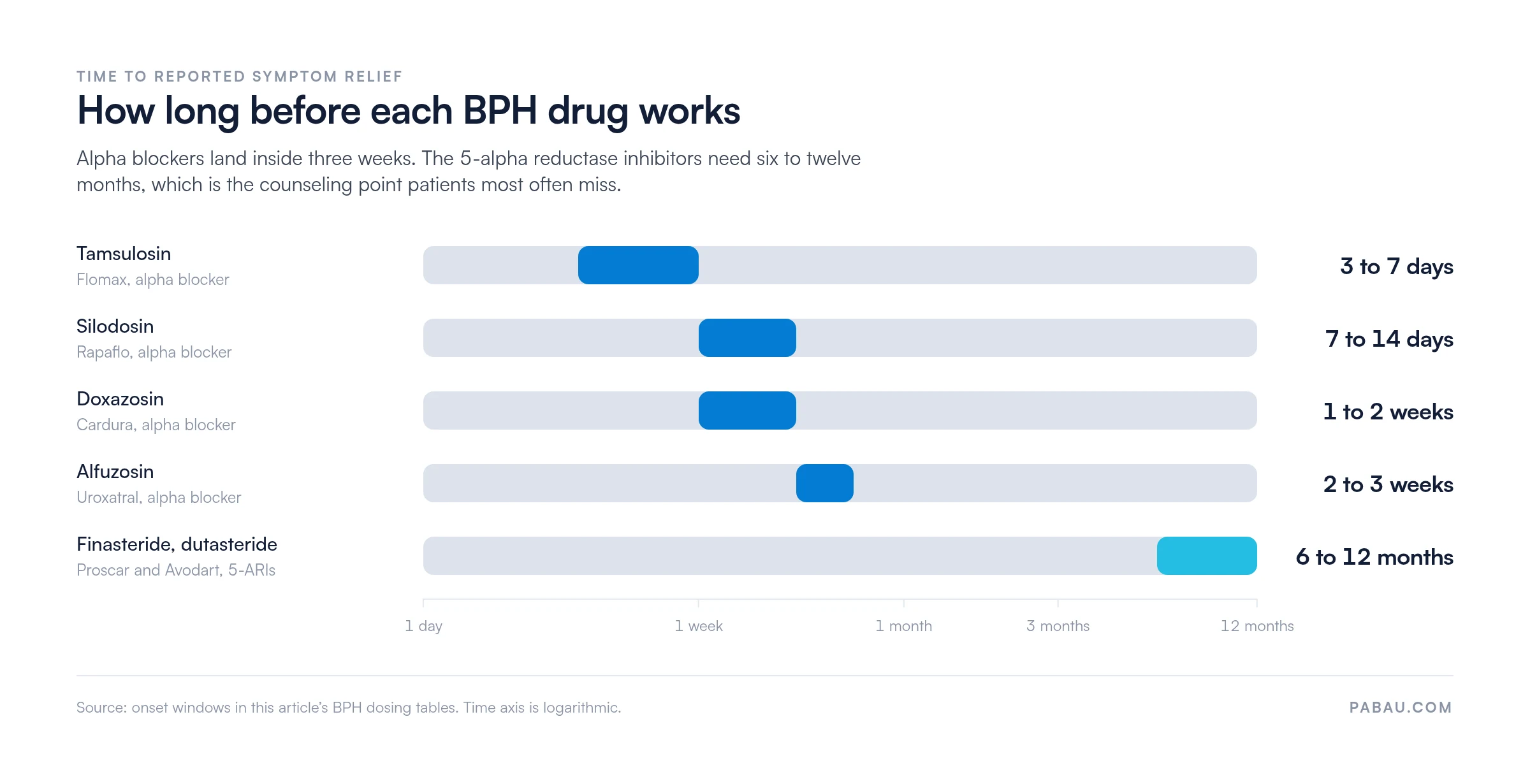
Alpha blockers such as tamsulosin relieve symptoms within days, while finasteride and dutasteride need six to twelve months.
Combination therapy suits men whose symptoms persist on one drug, and Jalyn packages dutasteride with tamsulosin in one capsule.
Prostate cancer treatment starts with androgen deprivation, then adds chemotherapy, immunotherapy, or targeted agents as disease advances.
Record the dose, the baseline labs, the counseling, and the response at every visit, or the next clinician starts blind.
Five fields carry every entry: generic name, brand name, typical dose, mechanism of action, and the side effects patients notice first. Group the entries by drug class, because class is what a prescriber settles on before choosing a molecule.
Benign prostatic hyperplasia, the noncancerous enlargement of the prostate, affects roughly 8.4 million men in the United States. It causes hesitancy, urgency, nocturia, and a weak stream. Prostate cancer is a separate problem with a separate drug set, and it remains the second leading cause of cancer death in men.
One reference covering both saves the prescriber a search. Dose, contraindication, and expected onset sit together, so the patient gets accurate counseling the first time rather than at the follow-up.
Use it at five points in the appointment, from the moment the patient’s symptoms come up to the review that follows.
Practices using digital intake forms can put the medication questions in front of the patient before the appointment. The answers arrive in the record, and the clinician starts from a populated list.

Medical management of BPH starts with one of two classes, and the two work very differently. Alpha blockers relax smooth muscle in the prostate and bladder neck. 5-alpha reductase inhibitors (5-ARIs) block the hormone that drives prostate growth.
Relief usually arrives within one to three weeks, which is why these agents go first. Tamsulosin (Flomax) 0.4 mg once daily is the most commonly prescribed. Silodosin, alfuzosin, and doxazosin offer similar efficacy.
Speed is the whole argument for this class. Alpha blockers do not shrink the prostate, so symptoms can return over the years as the gland keeps growing.
Finasteride (Proscar 5 mg) and dutasteride (Avodart 0.5 mg) reduce prostate volume by 15% to 30% over six to twelve months. Both block the conversion of testosterone to dihydrotestosterone (DHT), the hormone behind prostate growth. PSA falls as a result, and symptom progression slows.
Dutasteride inhibits both type I and type II 5-alpha reductase, so DHT suppression runs slightly deeper than with finasteride. Either agent suits men with large prostates, above roughly 40 g, or men at risk of progression.
Put the two classes on one timeline and the counseling problem becomes obvious.
Combination therapy is the next move when symptoms persist on monotherapy. Jalyn packages dutasteride 0.5 mg with tamsulosin 0.4 mg in a single capsule. One prescription then covers both smooth muscle tone and the hormonal driver of obstruction.
Two adjunct options sit alongside it. Tadalafil (Cialis) 5 mg once daily is FDA-approved for BPH symptoms, with or without erectile dysfunction. Anticholinergics such as oxybutynin (Ditropan) or tolterodine (Detrol) help when urgency dominates, though anticholinergic burden counts against them in older men.
Repeat prescriptions are where a combination regimen drifts. Prescription management tools keep the current regimen, the issue date, and the review date in one record, so nobody reissues last year’s dose.

Selection depends on stage, grade, and metastatic status. Androgen deprivation therapy (ADT) is the first-line systemic treatment. Advanced disease adds chemotherapy, immunotherapy, or targeted agents on top of it.
Hormone therapy either shuts down testosterone production or blocks the receptor. LHRH agonists such as leuprolide and goserelin suppress testosterone. Antiandrogens such as bicalutamide and enzalutamide block androgen receptor binding. Abiraterone inhibits CYP17A1, cutting androgen synthesis in adrenal and tumor tissue.
Docetaxel and cabazitaxel are taxane chemotherapy agents used in metastatic castration-resistant prostate cancer (mCRPC). Sipuleucel-T (Provenge) is an autologous cellular immunotherapy for the same setting. Targeted agents follow specific genomic alterations rather than stage alone.
Regimens change often in this space. For current treatment detail, check the National Cancer Institute’s list of FDA-approved prostate cancer drugs.
Honest counseling is what keeps a patient on therapy long enough to judge it. Sexual side effects worry men most, and they differ sharply by class, so the conversation should too.
Record tolerability at every follow-up in structured clinical records. A man reporting sexual dysfunction needs a switch or a dose change discussed at that visit, not a repeat prescription.
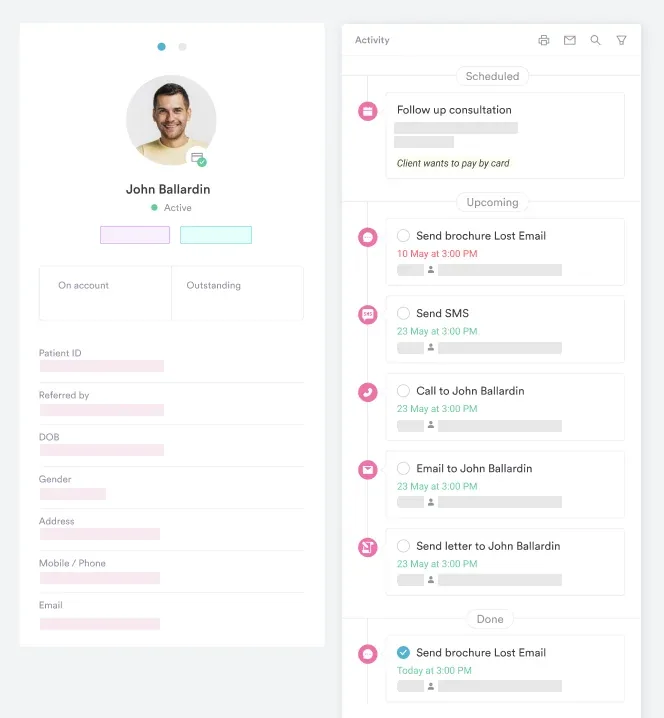
Eight fields make the next visit fast and give a referral letter what it needs. Run them as a check before the patient leaves.
Practice management software like Pabau builds those fields into the patient record itself. Pabau Scribe, our AI medical scribe, drafts the consultation note as you speak. Dose changes and counseling reach the chart the same day, not at the end of the week.
Record baseline sexual function before starting a 5-ARI or combination therapy. Men often blame the medication for a decline that age was already causing, and a documented starting point settles the question at the next visit.
Most practices hold prostate medication details in more than one place. Some of it sits in the consultation note, some in a urology letter, and some on a printout the patient carries.
Pabau keeps the medication list inside the patient record. The intake form a patient completes before the visit writes into that same record. The clinician then opens the appointment with current therapy already on screen.
Monitoring is where that pays off. PSA checks, renal function tests, and side effect reviews all run off the record, and an overdue test surfaces before the next prescription is issued. Practices seeing prostate patients every week need software for men’s health that holds the list, the labs, and the review dates together.
The result is one current list that every clinician treating the patient can see. No second spreadsheet, and no chasing a printout on the morning of the appointment.

Pabau stores the medication list inside the patient record and updates it from the patient’s own intake form. Your team gets a reminder when PSA and monitoring reviews fall due.

A prostate medication list earns its place when it tells you when each drug should start working. Set the review date to match that window, and far fewer men abandon a 5-ARI before it has had a chance.
Keep the same fields on every entry, write down what you counseled, and the next clinician picks up exactly where you stopped. Book a demo to see how Pabau keeps prostate medication records current across your whole team.

Need the exam that comes before the prescription? Genitourinary physical exam sets out the assessment sequence and what to document at each step.
Tracking hormone labs alongside medication? The male estrogen levels template gives you a reference sheet to record results against.
Running hormone therapy in the same practice? The bio-identical HRT template covers the documentation side of hormone prescribing.
There is no safety reason to stop it, but ask about it and write it down. Large placebo-controlled trials found no symptom benefit over placebo, even at higher doses. Recording it keeps a partial response from being credited to the wrong product.
Finasteride and dutasteride cut serum PSA by roughly half after six months of treatment. Double the reported value before comparing it against the reference range. A PSA that rises while a man takes a 5-ARI needs investigation, not reassurance.
Alpha blockers, tamsulosin above all, are linked to intraoperative floppy iris syndrome during cataract surgery. Stopping the drug shortly beforehand does not reliably prevent it. Flag current or past use in the record and tell the ophthalmologist before surgery is booked.
Women who are pregnant, or who may become pregnant, should not handle crushed or broken finasteride tablets or leaking dutasteride capsules. The drug absorbs through skin and can harm a male fetus. Men taking dutasteride should also avoid donating blood for six months after their last dose.