

HCPCS Code E0272: Foam rubber mattress billing guide
HCPCS Code E0272: official descriptor and code overview HCPCS Code E0272 is the ...

Last Updated: Nov 6, 2026
M6730 is the CCSD code for drainage of prostatic abscess. Bupa, AXA Health, Aviva and other UK private insurers use it to pay the urologist who drains a confirmed abscess of the prostate.
The code covers TRUS-guided transrectal aspiration, transperineal drainage and open perineal drainage alike. It sits in Chapter 12 of the CCSD schedule, under Prostate, and pairs with ICD-10 code N41.2, abscess of prostate, as the primary diagnosis.
Let Pabau's smart automation suggest the right codes, reduce claim denials, and keep your practice compliant—effortlessly.
Automate repetitive tasks and focus on what matters most—your patients.
Reduce coding errors and ensure compliance with the latest regulations.
Clean claims, fewer denials, and faster reimbursements.
Powerful insights and reporting to help your practice thrive.
HIPAA compliant SOC 2 certified GDPR-compliant Trusted by 4,000+ clinics worldwide

CCSD Code M6730 covers drainage of a prostatic abscess. Prostatectomy, biopsy and transurethral resection each have their own codes.
ICD-10 code N41.2 (abscess of prostate) is the primary diagnosis paired with M6730 on every claim.
UK private insurers, including Bupa, AXA Health, Aviva, Cigna and WPA, expect pre-authorisation before a planned drainage.
An operative note that omits the drainage approach or the imaging evidence is a common reason an M6730 claim is held or rejected.
CCSD Code M6730 is defined as “drainage of prostatic abscess” in the schedule maintained by the Clinical Coding & Schedule Development Group. UK private medical insurers, including Bupa, AXA Health, Aviva, Cigna and WPA, use this schedule to identify and pay consultant procedures.
The code applies whenever a urologist formally drains an abscess confined to, or arising from, the prostate gland. It does not cover incidental aspiration during another urological procedure. Nor does it cover drainage of peri-prostatic or pelvic collections that extend beyond the gland itself.
The descriptor is intentionally broad because drainage of a prostatic abscess can be achieved through more than one surgical approach. What unifies every M6730 claim is the confirmed diagnosis of a prostatic abscess and the deliberate intent to drain it. The operative report must reflect that intent clearly.
Within the broader Bupa CCSD code schedule, M6730 sits in Chapter 12, Urinary system and male reproductive organs, under the Prostate section. It shares that section with prostatectomy, transurethral resection and biopsy codes.
Billers unfamiliar with the chapter sometimes confuse M6730 with these neighbours, a common root cause of claim rejection. The comparison table further down sets out the distinctions.
A prostatic abscess is a focal collection of pus within the prostate parenchyma. It most commonly arises as a complication of acute bacterial prostatitis, instrumentation, or urinary retention. Left undrained, it carries a risk of pelvic sepsis.
In UK private practice, the procedure is performed or supervised by a consultant urologist on the General Medical Council (GMC) specialist register. The insurer also expects that consultant to be recognised by it before it pays the fee.
This guide covers three approaches to prostatic abscess drainage. The approach shapes the operative documentation, but each one is billed as M6730.
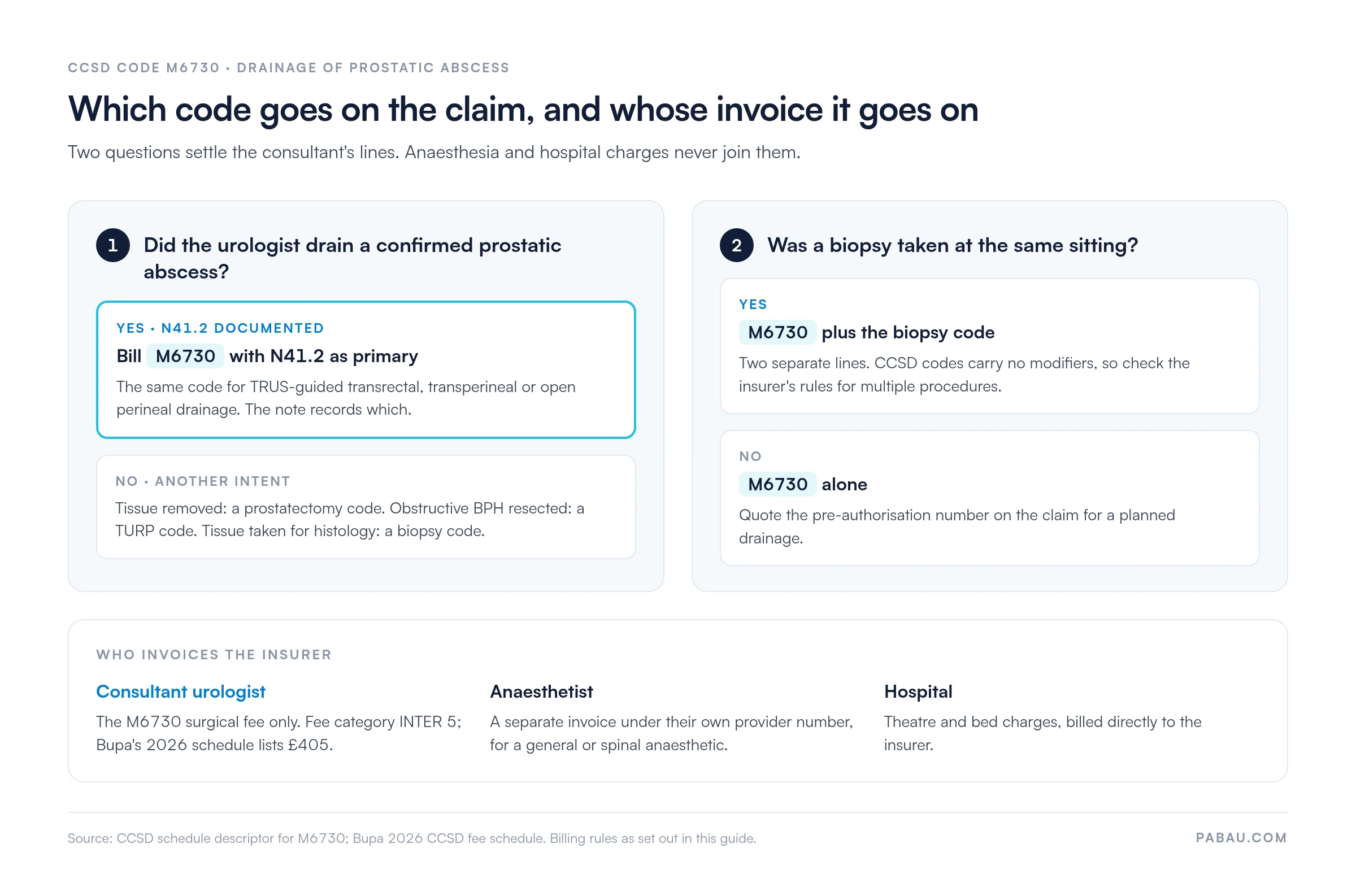
When an anaesthetist gives a general or spinal anaesthetic, they invoice the insurer separately under their own provider number. The M6730 fee on the urologist’s invoice covers the surgical work only. The hospital bills its theatre and bed charges directly, so neither belongs on the consultant’s invoice.
Every M6730 claim must carry a valid ICD-10 primary diagnosis code. The WHO ICD-10 browser lists the codes most relevant to prostatic abscess drainage.
N41.2 is the ICD-10 code for prostatic abscess and must appear as the primary diagnosis on every claim that includes M6730. UK insurers use the diagnosis to confirm the treatment falls within the patient’s cover. Without N41.2, the claim reads as a drainage performed for an unspecified reason, which triggers review or rejection.
Add secondary codes to reflect the full clinical picture documented in the patient record. Insurers such as Bupa and AXA Health check the diagnosis against the policy terms, including any exclusion for pre-existing conditions.
Private medical insurance is built around acute conditions, but a history of chronic prostatitis can prompt questions on a moratorium policy. Record the onset and any antecedent condition clearly, so the claim is not held for clarification.
Coders working in urology billing frequently meet adjacent CCSD codes that share the word “prostate” in their descriptors. A wrong code sends the claim back, so check the descriptor in the CCSD code library before you submit.
If the urologist takes a biopsy at the same sitting as the drainage, bill M6730 and the biopsy code as separate lines. An endoscopic biopsy of the prostate, for example, is M6580.
CCSD codes carry no modifiers, so check the insurer’s rules for more than one procedure at a sitting. Do not collapse both into M6730 alone, and do not bill a biopsy code alone when drainage was the primary intent.
Put together, two questions decide the consultant’s lines, and the anaesthetist and the hospital invoice separately. The chart below sets out the path.
UK private insurers assess M6730 claims against the operative report and any supporting clinical notes. A claim that lacks specific detail is treated as incomplete and either held or rejected. Digital operative notes that prompt the clinician for each required field make a missing detail less likely at submission.
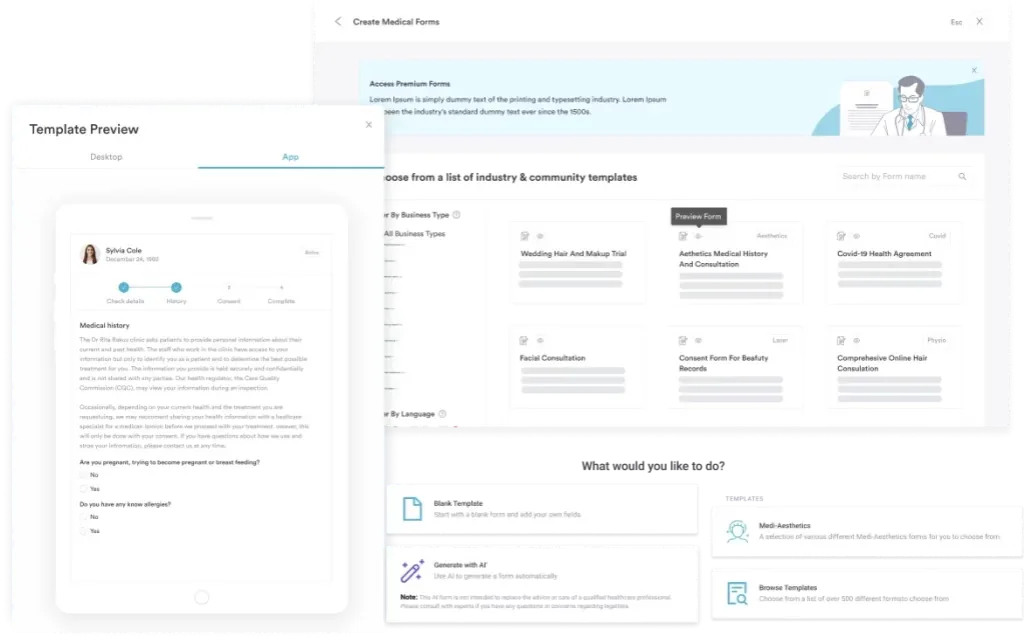
The operative note must contain all of the following to support a valid M6730 claim:
Bupa, AXA Health, Aviva, Cigna and WPA all expect pre-authorisation before a planned procedure under anaesthesia, M6730 included.
The patient usually obtains the authorisation number from their insurer, and the practice quotes it on the claim. Requirements vary by insurer and policy, so confirm cover against the patient’s current policy before the procedure date.
When the insurer asks for clinical details, have the following ready:
A prostatic abscess often presents as an emergency, with sepsis or urinary retention. Most private medical insurance policies exclude emergency admissions, so these patients are usually treated through the NHS.
If a planned drainage moves to the private sector once the patient is stable, obtain authorisation before it goes ahead.
M6730 claim rejections in UK private urology practices tend to cluster around a small set of avoidable errors. The table below maps the most frequent denial reasons to their corrective actions.
Before submitting an M6730 claim, check the operative note against six points. Confirm the N41.2 diagnosis, the drainage approach, the imaging report and the volume drained. Then check the anaesthesia type and the GMC and provider numbers. A claim that fails any one of these checks is likely to come back for clarification.
CCSD codes carry no single national fee. Each insurer publishes its own fee schedule against the code, in pounds sterling. M6730 sits in fee category INTER 5, and Bupa’s 2026 CCSD schedule lists £405 for the procedure. Fees change, so check the current figure in the Bupa code search or the relevant insurer’s schedule before you quote or invoice.
Key insurer-specific factors that affect M6730 reimbursement:
Many UK urology practices still build CCSD invoices by hand, then rekey each claim into an insurer portal. That double entry is where a missing N41.2 or a wrong authorisation number creeps in.
Pabau opens each claim pre-filled from the invoice. Its claims management software sends private medical insurance claims through Healthcode to Bupa, AXA Health and other UK insurers. Pre-authorisations are stored against the patient, and the reference carries through to the claim.
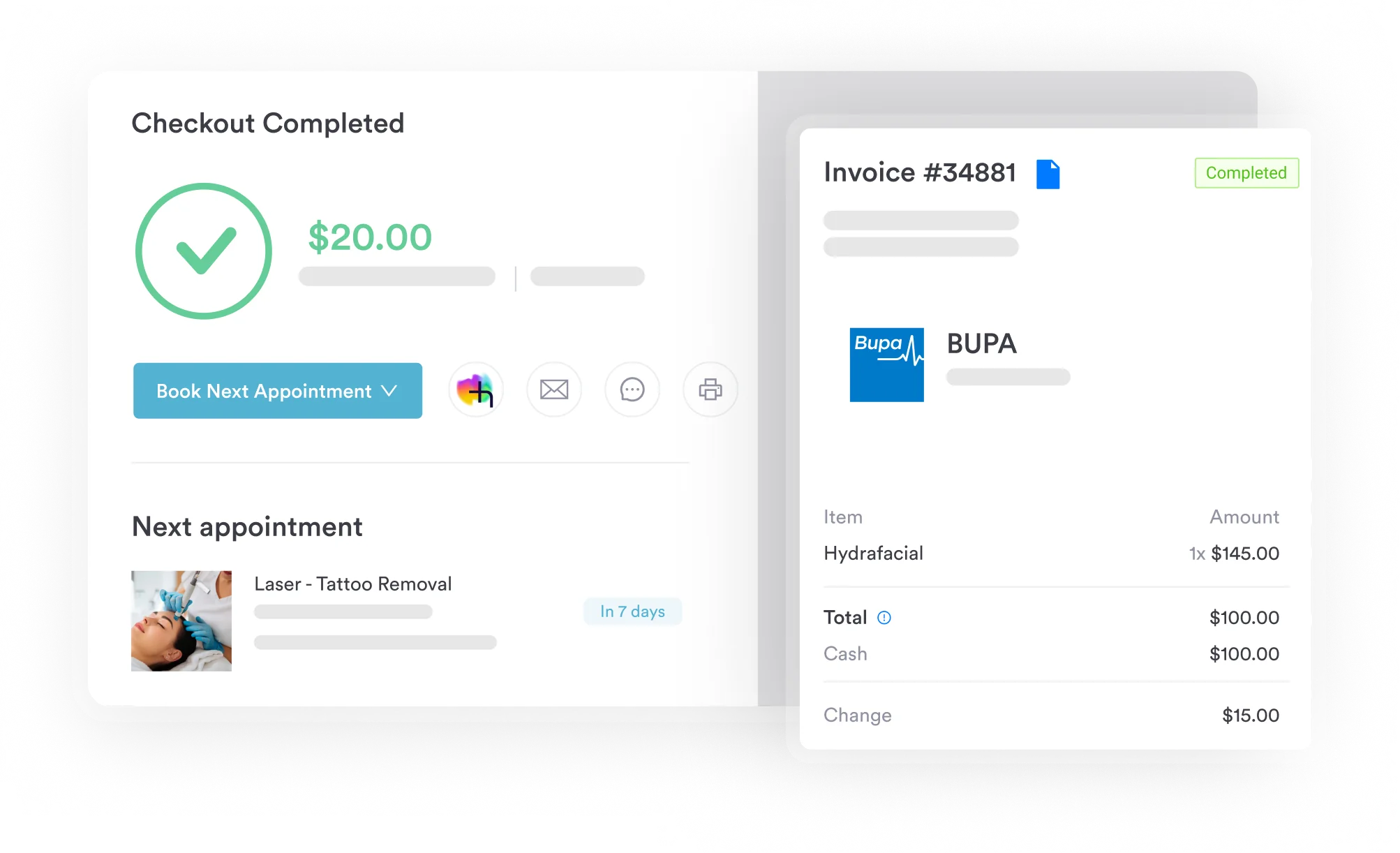
The claims dashboard then tracks each claim from pending to paid. When the insurer pays, the payment is matched to the invoice, so the surgical fee never sits unreconciled.

Pabau pre-fills each claim from the invoice, carries the pre-authorisation reference through, and sends it to Bupa, AXA Health and other UK insurers via Healthcode. Your team tracks every M6730 claim from pending to paid in one dashboard.

M6730 turns on one fact: the urologist drained a confirmed prostatic abscess. N41.2 on the claim proves the diagnosis, and the operative note proves the drainage. When either is missing, the insurer has grounds to hold the fee.
Secure the authorisation before a planned drainage, and keep hospital and anaesthetist charges off the consultant’s invoice. Most rejections on this code come from skipping one of those steps. Book a demo to see how Pabau carries the authorisation reference from booking to a paid insurer claim.

Choosing billing software for a UK practice? Best medical billing software in the UK compares the platforms that handle insurer claims and CCSD invoicing.
CCSD Code M6730 covers surgical drainage of a prostatic abscess, performed via transrectal ultrasound-guided aspiration, transperineal needle drainage, or open perineal incision. It applies when the urologist’s primary intent is to drain a confirmed abscess within the prostate, not to remove tissue or take a biopsy.
ICD-10 code N41.2 (abscess of prostate) is the required primary diagnosis on every M6730 claim. Secondary codes such as A41.9 (sepsis) or N40 (benign prostatic hyperplasia) may be added when clinically documented. An M6730 claim without N41.2 as the primary code is likely to be rejected.
Yes. Bupa, AXA Health, Aviva, Cigna and WPA expect pre-authorisation before a planned drainage under anaesthesia. The patient usually obtains the authorisation number from the insurer, and the practice quotes it on the claim. Most policies exclude emergency admissions, so an emergency drainage is usually carried out through the NHS.
The most common reasons are missing pre-authorisation, N41.2 missing as the primary diagnosis, and the wrong CCSD code, such as a prostatectomy or biopsy code. Hospital or anaesthetist charges on the consultant’s invoice also cause rejections. So do operative notes that omit the drainage approach, imaging reference or drain details.
Anaesthesia is not billed on the urologist’s M6730 invoice. The anaesthetist invoices the insurer separately under their own provider number. M6730 covers the urologist’s surgical fee only, and adding anaesthetic charges to it is a common cause of rejection.
M6730 is specific to abscess drainage and requires a confirmed prostatic abscess (N41.2). Adjacent codes cover different clinical intentions. Prostatectomy codes involve tissue removal, TURP codes address obstructive benign prostatic hyperplasia, and biopsy codes collect tissue for histology. Using any of these in place of M6730 will produce a diagnosis-to-code mismatch and a likely rejection.
No. TRUS-guided, transperineal and open perineal drainage are all billed as M6730, but the operative report must record the approach. CCSD codes carry no modifiers. If a biopsy is taken at the same sitting, bill its code as a separate line and check the insurer’s rules for multiple procedures.




