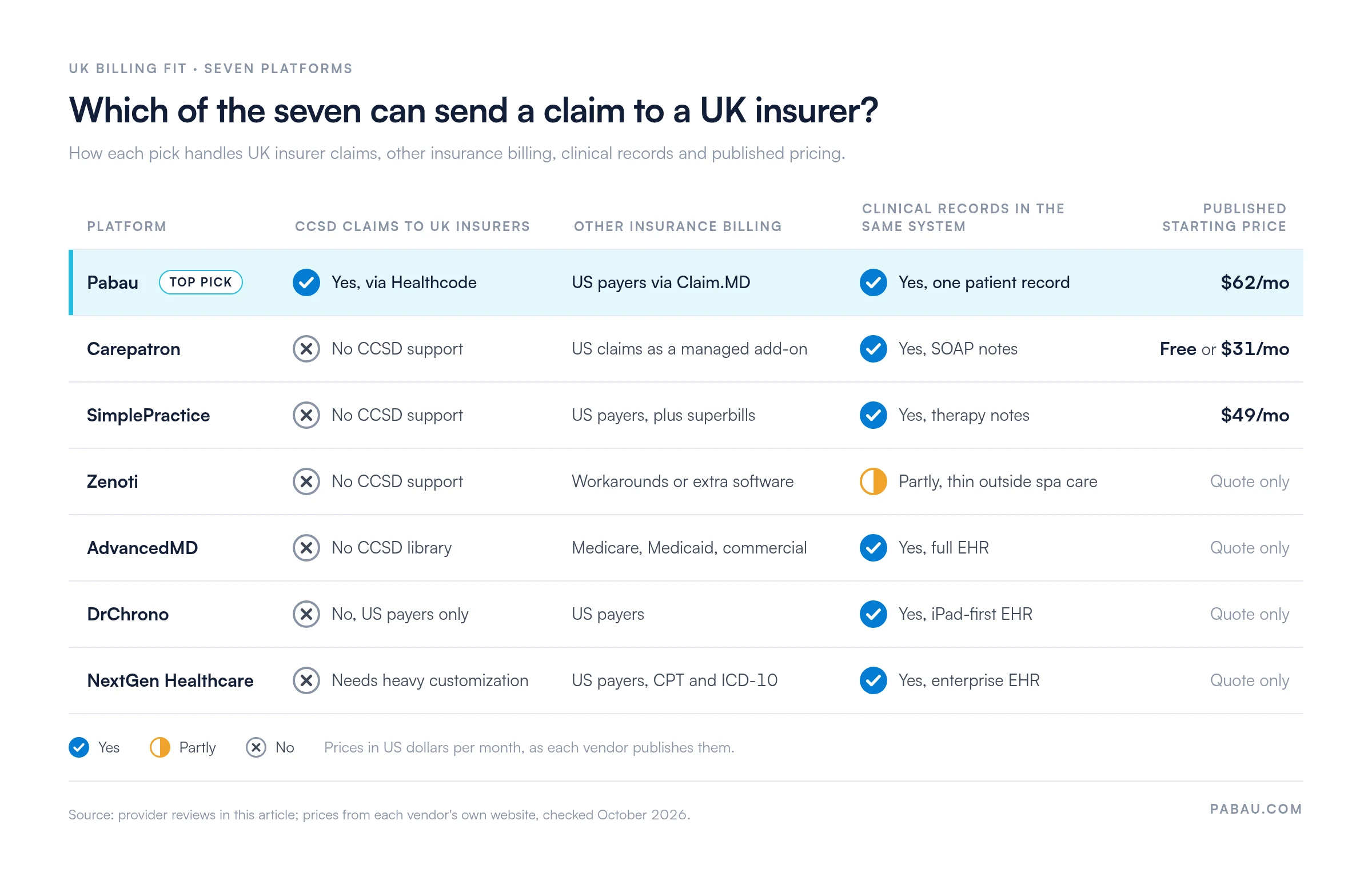
The best medical billing software in the UK for most private practices is Pabau, our practice software with insurance billing built in. It sends CCSD-coded claims to Bupa, AXA PPP and other insurers through Healthcode, and handles self-pay invoices in the same patient record.
The other six picks suit narrower needs. Carepatron is the cheapest start for solo allied health practitioners, and SimplePractice fits therapists who bill US insurers. Zenoti suits medspas with retail sales. AdvancedMD, DrChrono and NextGen Healthcare fit US practices that need deep CPT-based billing.
UK private practices face billing demands that US-designed platforms rarely cover out of the box. Private insurers expect CCSD codes, claims run across several payers, and CQC inspections expect complete documentation. A dermatology practice processing Bupa and AXA PPP claims needs different infrastructure than a therapy practice billing through SimplePractice’s US-centric insurance module.
Billing software decides whether claims clear on first submission or loop through denials. For UK practices juggling NHS interoperability, private insurance claims and self-pay patients, the right platform handles all three without separate tools. The medical billing software market growth shows how much providers now invest in revenue cycle management.
Key takeaways
1. Pabau — best for UK private practices that bill Bupa and other insurers through Healthcode alongside self-pay patients.
2. Carepatron — the lowest-cost start for solo allied health practitioners, with a free plan and built-in telehealth.
3. SimplePractice — strongest fit for therapists and counselors who bill US insurers.
4. Zenoti — built for medspas and spa chains that sell retail products alongside treatments.
5. AdvancedMD — deep revenue cycle tools for US multi-specialty practices with high claim volumes.
6. DrChrono — iPad-first EHR and billing for US primary care and ambulatory practices.
7. NextGen Healthcare — enterprise EHR for large US groups that need interoperability and population health tools.
Found our content helpful?
Quick comparison of the seven platforms
Pabau leads for multi-specialty practices that need UK insurance workflows. SimplePractice serves mental health practitioners, and Zenoti is built around spa and medspa operations. US-centric platforms (AdvancedMD, DrChrono, NextGen Healthcare) offer more clinical depth but need GDPR and CCSD code configuration.
Name
Best for
Standout feature
Starting price
Pabau
UK multi-specialty practices needing CCSD and Healthcode integration
Native CCSD code support with Healthcode insurance claims automation
From $62/month (1 user)
Carepatron
Allied health solo practitioners prioritizing cost-effectiveness
Free tier with Stripe payments and AI scribe functionality
Free, or $31 per month for Plus
SimplePractice
Mental health and therapy practices with US insurance billing
Integrated telehealth and therapy-specific documentation templates
$49 per month
Zenoti
Spa, salon, and medspa operations with retail inventory focus
POS-centric design with extensive product sales workflows
Custom pricing – contact for rates
AdvancedMD
US multi-specialty practices needing deep RCM and CPT coding
Comprehensive EHR with built-in revenue cycle management
Custom pricing – contact for rates
DrChrono
US primary care and ambulatory practices with iPad workflows
iPad-first EHR with mobile practice management
Custom pricing – contact for rates
NextGen Healthcare
Enterprise-scale US practices requiring interoperability and population health
Scalable EHR with advanced population health management tools
Custom pricing – contact for rates
Pabau alone sends CCSD-coded claims to UK insurers through Healthcode, based on the reviews below and each vendor’s pricing page, checked October 2026.
Pabau: Best for UK multi-specialty practices
Rating4.7/5★★★★★Top pick
The bottom line
Pabau sends CCSD-coded claims through Healthcode from the same record that holds the booking, notes and invoice.
Who it’s for
UK private practices billing Bupa, AXA PPP and other insurers
Multi-specialty and aesthetic practices mixing insured and self-pay patients
Multi-location groups that want one patient record across sites
Healthcode claims for UK insurers, Claim.MD for US payers
Insurer and patient shares billed from one appointment
Every subscription includes every feature
What doesn’t
Broad platform, so new staff face a learning curve
Team and enterprise prices are quoted on a demo
Pabau is an all-in-one practice management system for UK private practices in aesthetics, wellness, private GP care, longevity medicine, physiotherapy and mental health. Its billing workflows are built around CCSD codes and Bupa and AXA PPP claims sent through Healthcode integration. Multi-location groups share records under UK rules, including CQC expectations and GDPR.
The platform brings scheduling, clinical documentation, inventory, payments and insurance claims into one system. That cuts the sprawl of separate booking, billing and EMR systems many UK private practices patch together.
Take a dermatology practice running 120 appointments a week across three practitioners.
Intake forms, prescriptions, before-and-after photos, CCSD-coded claims and recall workflows all run in Pabau, with no export to other tools.
Pabau’s pitch to medical spas is one system for bookings, records and billing, so every claim starts from data your team already holds.
Pabau’s UK-first design shows most in billing. The claims management feature uses Healthcode to submit CCSD-coded claims to Bupa, AXA PPP, Aviva and other private medical insurers. Each claim fills in patient demographics and CCSD procedure codes, for example CCSD code S1110 for skin lesion curettage or cryotherapy.
Provider numbers and supporting documents come straight from the patient record too. Structured data checks catch common rejection triggers, such as mismatched policy numbers or missing authorization codes, before the claim goes out.
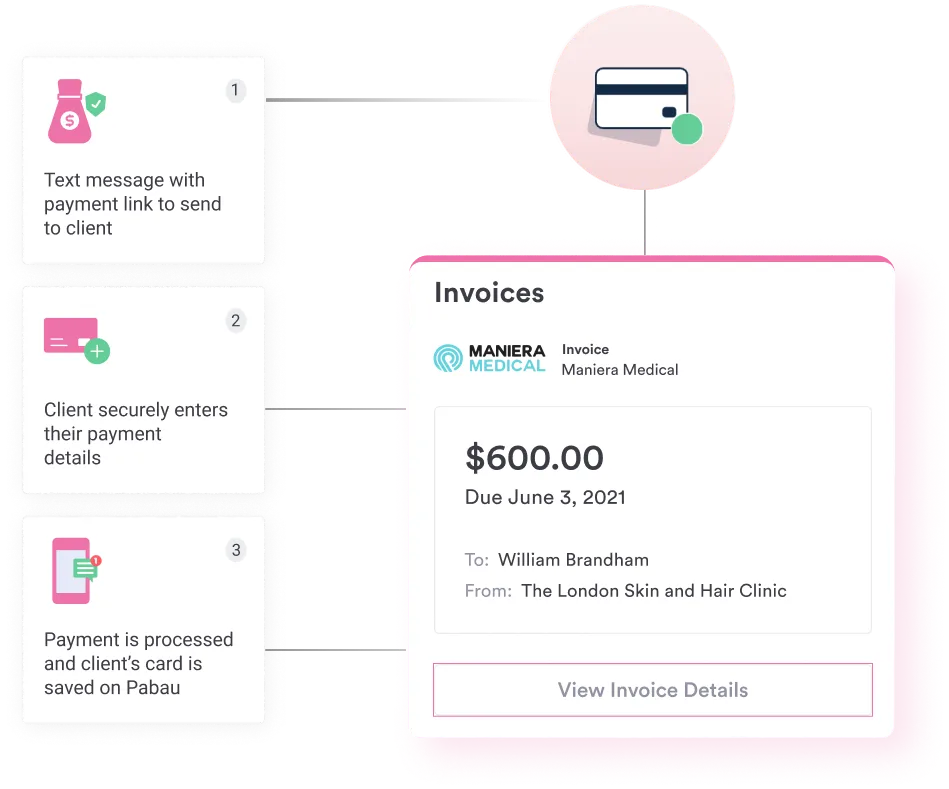
Pabau texts patients a payment link for their share of an invoice, so the self-pay excess gets collected without a phone call.
The platform supports the hybrid payment models common in UK private care. That covers self-pay invoicing, split billing (the patient pays the excess, the insurer covers the procedure) and installment plans through Klarna.
A functional medicine practice might bill a £1,200 consultation, claiming £800 from Vitality Health and invoicing £400 to the patient as an excess. Pabau’s financial module tracks both transactions under the same appointment record, reconciling payments against outstanding balances and generating separate invoices for patient and insurer portions.
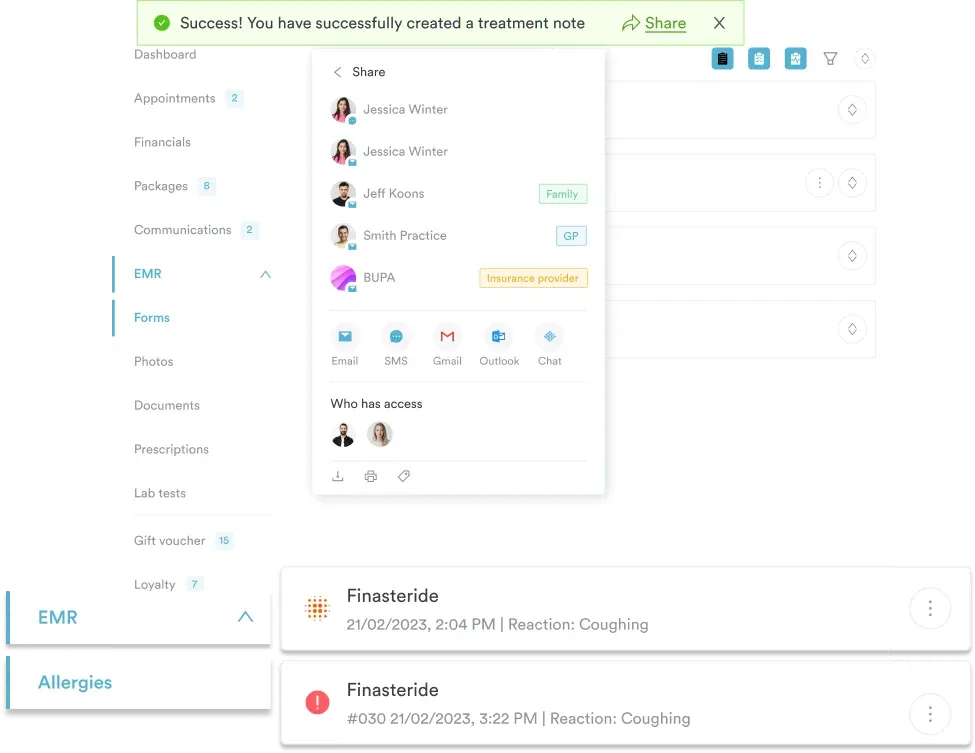
From the patient record, Pabau shares a treatment note with the patient’s insurer, such as Bupa, so claim evidence travels with the claim.
Key features
Healthcode Claims Integration: Submit CCSD-coded claims to UK private insurers through Healthcode and track each one from submission to payment
Multi-Specialty Clinical Templates: Pre-built forms for aesthetics (Botox plotting, filler consent), physiotherapy (SOAP notes, outcome measures), mental health (psychiatric evaluations, session notes) and GP consultations
Unified Patient Records: Centralized EMR combining consultation notes, prescriptions, lab results, before-and-after photos, treatment plans, and financial transactions under single patient profiles
Automated Recall & Retention: Workflow automation for Botox recall emails, annual screening reminders, membership renewal notifications, and post-treatment follow-up sequences
Multi-Location Coordination: Shared patient records, inventory, and reporting across practice locations with role-based access controls and location-specific compliance settings
Integrated Payment Processing: Pabau Pay, our card terminals, for in-person payments, plus online deposits through Stripe and Klarna financing for treatment packages
Pabau Scribe, our AI scribe: Voice-to-text clinical notes in your own templates, plus suggested ICD-11 diagnosis codes with a rationale for each. Clinicians approve every code before it is saved
CQC-Aligned Documentation: Audit trails, consent form versioning, staff training records, and complaint logging structured to support Care Quality Commission inspection requirements
Where Pabau shines
UK-Specific Insurance Workflows: The Healthcode integration is purpose-built for CCSD codes and UK private insurer claim formats. US platforms need manual CCSD code entry and have no direct connection to Bupa or AXA PPP. Practices fall back on emailed claims or clearinghouse exports.
Multi-Specialty Flexibility: One platform supports aesthetic practices plotting Botox injections and physiotherapy practices tracking range of motion. It also covers mental health practices using psychiatric evaluation templates and private GP practices managing prescriptions. Competitors typically specialize in one vertical (SimplePractice for therapy, Zenoti for spa operations).
Unified Payment Reconciliation: The financial module handles self-pay invoicing, insurance claim tracking and split billing between patient and insurer. Packages, memberships and retail sales land in the same reports. A multi-specialty practice reconciles every revenue stream without exporting to separate accounting software.
Operational Automation Depth: Pre-built workflows run recall campaigns (a 12-week Botox follow-up) and win-back sequences (patients inactive for six months) on their own. Membership renewal reminders and aftercare instructions go out the same way. That cuts admin in practices seeing 80+ appointments a week.
Embedded Compliance Tools: Consent versioning, staff training logs, complaint registers and clinical audit trails sit inside core workflows, ready for a CQC inspection. UK regulatory requirements shaped the product from the start.
Where Pabau falls short
Learning Curve for Multi-Feature Platform: The breadth of features (EMR, billing, marketing, inventory, labs, telehealth) creates onboarding complexity for small practices migrating from single-purpose tools. Pabau’s structured onboarding typically takes 7 to 10 days once your data arrives. The customer success team then trains your staff on a plan built for your practice.
US Billing Runs Through a Clearinghouse: Pabau supports CPT and ICD-10 coding, including preventive visit codes like CPT code 99385. US claims, eligibility checks and ERA remittance posting run through its Claim.MD integration, so US practices connect a Claim.MD account.
Customer reviews
Pabau’s Trustpilot reviewers often mention a learning curve at the start and a payoff once the system is set up. Several say Pabau replaced separate tools they used for scheduling, inventory and invoicing. For a reference in your specialty, ask Pabau’s team to connect you with a practice of a similar size.
Who Pabau is best for
UK multi-specialty practices processing CCSD-coded insurance claims alongside self-pay and hybrid payment models
Aesthetic and wellness practices requiring injection plotting, before-and-after photo management, and product inventory tracking
Multi-location practice groups needing shared patient records, centralized reporting, and coordinated recall campaigns across sites
Private GP and functional medicine practices combining consultations, prescriptions, lab result management, and insurance billing in unified workflows
Pricing
Plan / Tier
Price
Details
Solo
From £118/month
1 user, full platform, unlimited clients
Team, Medium, Group
Quoted on a demo
2-15 users, priced by team size and location
Enterprise
Quoted on a demo
16+ users, multi-location supported
Every plan includes the full platform, so Healthcode claims, Pabau Scribe and multi-location tools are never locked behind a higher tier. Pricing depends on your location and user count, and annual billing saves up to 20%. You can see the full breakdown on Pabau’s pricing page.
Carepatron: Best for cost-effective allied health solo practices
Rating4.4/5★★★★★
The bottom line
The cheapest way to start, with a free plan, built-in telehealth and an AI scribe, but no UK insurer claims.
Carepatron targets allied health solo practitioners and small teams prioritizing affordability and simplicity over operational depth. The platform offers a free tier with unlimited patient records, basic scheduling, and Stripe payment processing, which removes the upfront cost barrier for new practices.
The platform’s design centers on keeping features simple. A solo physiotherapist books appointments, completes SOAP notes, sends invoices and runs video consultations in one streamlined interface. It favors speed over customization. Carepatron gives up multi-location coordination, advanced inventory management and UK insurance claim workflows to keep core practice management cheap.
Key features
Free Tier Access: Unlimited patient records, basic scheduling, note templates, and Stripe payment integration at no monthly cost
Integrated Telehealth: Built-in video consultation platform eliminating the need for separate Zoom or Doxy.me subscriptions
AI Scribe Functionality: Automated clinical note generation from consultation recordings using natural language processing
Customizable Billing Items: Flexible invoice line item creation for varied service offerings and product sales
Where Carepatron shines
Zero-Cost Entry: The free tier removes financial barriers for newly qualified practitioners establishing solo practices without upfront software investment
Telehealth Consolidation: Built-in video consultation eliminates separate subscriptions to telehealth platforms, reducing monthly software costs
AI Clinical Assistance: The scribe feature reduces documentation time for practitioners conducting high-volume consultations
Where Carepatron falls short
No UK Insurance Integration: The platform has no CCSD code support or direct connection to UK private insurers. Bupa and AXA PPP claims need manual preparation
Single-Practitioner Focus: Multi-location coordination, shared inventory management, and team-based workflows are absent or rudimentary compared to Pabau or Zenoti
Customer reviews
Carepatron holds a 4.5 out of 5 rating from more than 730 reviews on G2 as of October 2026. Users highlight cost-effectiveness for healthcare providers, seamless telehealth and calendar integrations, customizable forms, and AI scribe functionality as key advantages. The high rating reflects satisfaction among solo practitioners and small allied health teams prioritizing affordability and core practice management functions.
Who Carepatron is best for
Solo allied health practitioners (physiotherapists, occupational therapists, counselors) seeking free or low-cost practice management software
Telehealth-first practices conducting primarily remote consultations and requiring integrated video functionality
Practitioners with simple billing needs processing self-pay patients without UK private insurance claim requirements
Pricing
Plan / Tier
Price
Details
Free
$0/month
Unlimited patients, telehealth, 1GB storage, AI scribe
Plus
$31/month
Unlimited storage, group telehealth, shared inbox, custom branding
Advanced
$39/month
Roles and permissions, white labeling, 1:1 onboarding manager
Managed insurance billing (add-on)
3.9% of collections + $79/month
US claims, denials, appeals and credentialing handled for you
Custom / Enterprise
Contact sales
Larger teams and multi-site practices
Carepatron prices its plans in US dollars, and paying yearly takes 20% off. The paid tiers add storage, group sessions and team controls on top of the free plan.
SimplePractice: Best for mental health and therapy practices
Rating4.5/5★★★★★
The bottom line
The therapy-specific pick, with US insurance billing and telehealth in every plan, but no UK insurer support.
SimplePractice is a leading US mental health platform, used by over 250,000 practitioners according to company figures. It specializes in therapy workflows. That means HIPAA-compliant telehealth, billing for CPT 90832-90899 psychotherapy codes and templates built for psychiatric and counseling practices. UK practices using SimplePractice typically operate under US insurance models or serve international patient populations requiring US-standard documentation.
Its therapy focus shows in session note templates (SOAP, DAP, BIRP), treatment plan builders and billing for both insurance claims and superbills. A psychology practice running 40 sessions a week handles reminders, video consultations, notes and claims in one workflow built around therapy sessions.
Key features
Therapy-Specific Documentation: Pre-built templates for psychiatric evaluations, therapy session notes, treatment plans, and progress reports aligned with mental health practice standards
Integrated Telehealth: HIPAA-compliant video platform eliminating the need for separate Zoom subscriptions, with session recording and transcript capabilities
Insurance Billing Module: Claim submission to US insurance payers with CPT code automation, ERA processing, and superbill generation for out-of-network reimbursement
Client Portal: Secure messaging, appointment self-scheduling, intake form completion, and payment processing accessible to patients between sessions
Where SimplePractice shines
Mental Health Workflow Optimization: The platform is built for therapy patterns, such as recurring weekly sessions, pre-authorization tracking and superbills for out-of-network patients. That keeps setup short for mental health practitioners
US Insurance Integration Depth: Direct claim submission to Medicare, Medicaid, and commercial payers through integrated clearinghouse connections simplifies revenue cycle management for US-based practices
Therapy Community Trust: The 250,000+ practitioner user base creates network effects: peer recommendations, established integrations with therapy directories (Psychology Today), and specialty-specific support resources
Where SimplePractice falls short
UK Private Insurance Incompatibility: No CCSD code support or direct integration with Bupa, AXA PPP, or other UK insurers. UK practices require manual claim preparation outside the platform
Non-Therapy Practice Limitations: The platform lacks clinical workflows for aesthetic treatments, physiotherapy assessments, or multi-specialty medical consultations. A private GP practice would find documentation templates and billing logic misaligned with general medical workflows
Customer reviews
On G2, SimplePractice scores 4.1 out of 5 across 129 reviews as of October 2026. Reviewers praise how easy it is to use, while several find its reporting too limited. The company reports more than 250,000 practitioner users, which points to broad adoption in US therapy.
Who SimplePractice is best for
US-based mental health practitioners (psychologists, therapists, counselors) requiring integrated insurance billing and telehealth
Therapy group practices managing multiple clinicians under shared administrative workflows and centralized billing
UK therapists serving US patients or operating under US insurance reimbursement models requiring CPT coding and superbill generation
Pricing
Plan / Tier
Price
Details
Starter
$49/month
Promo $24.50/mo first 3 months; 30-day free trial
Essential
$79/month
Promo $39.50/mo first 3 months
Plus
$99/month
Promo $49.50/mo first 3 months
Add-on: ePrescribe
$49/month
+ $89 one-time setup fee
Every SimplePractice plan includes unlimited patients, telehealth and Insurance Essentials. Higher tiers add appointment reminders, calendar sync and group appointments, and extra clinicians on Plus start at $74 each.
Zenoti: Best for spa, salon and medspa operations
Rating4.5/5★★★★★
The bottom line
Built for medspas and spa chains that sell retail alongside treatments, with pricing quoted per business.
Point of sale, retail and commissions in one system
Membership billing and renewals
24/7 global support
What doesn’t
Thin clinical records for non-spa medicine
No CCSD codes or UK insurer integrations
Zenoti serves the spa, salon, and medspa vertical with POS-centric architecture optimized for retail product sales, commission-based staff compensation, and membership subscription management. The platform’s design prioritizes transaction speed and inventory turnover over clinical documentation depth.
A medspa offering Botox alongside facials and retail skincare can use Zenoti to process treatments and track stock. Technician commissions and membership tiers sit in the same reports.
The platform’s global footprint supports multi-currency operations and localized customer service, with 24/7 support cited as a key advantage by users. Zenoti’s integrations connect to spa-specific vendors, such as product distributors, booking platforms and marketing automation tools. That suits wellness businesses balancing services with retail sales.
Key features
POS and Retail Focus: Transaction processing optimized for high-volume product sales with barcode scanning, multi-tender payments, and gift card management
Commission Calculation: Automated staff compensation tracking based on service revenue, product sales, and performance tiers
Membership Management: Recurring subscription billing, member benefits tracking, and automated renewal workflows for spa membership programs
Custom Digital Forms: Intake questionnaires and consultation forms tailored to spa and medspa service offerings
Where Zenoti shines
Retail-Service Hybrid Operations: The platform gives spa appointments and retail sales equal depth. It tracks inventory turnover, supplier orders and sales performance across both revenue streams
Commission Automation: Automated calculation of staff compensation based on service bookings and product sales reduces manual payroll reconciliation in commission-driven businesses
Global Support Infrastructure: 24/7 customer service and multi-language support accommodate international spa operations and franchise networks across time zones
Where Zenoti falls short
Clinical Documentation Limitations: The platform lacks the EMR depth required for medical practices beyond medspa treatments. Physiotherapy practices, mental health practices, or private GP services would find documentation templates and clinical workflows insufficient
No UK Insurance Billing: No native CCSD code support or UK private insurer integrations. Medspas processing insurance claims for medical-grade treatments require workarounds or supplementary billing software
Customer reviews
Zenoti holds a 4.5 out of 5 rating on G2 from more than 310 reviews as of October 2026. Company marketing materials emphasize wide feature sets at reasonable pricing, custom digital forms, localized customer service, and 24/7 global support as key value propositions.
The platform’s focus on spa and salon operations positions it as a vertical-specific solution rather than a general healthcare practice management system.
Who Zenoti is best for
Medspas balancing clinical services and retail sales requiring unified POS and service booking management
Multi-location spa and salon chains needing centralized inventory, membership management, and commission tracking across sites
Franchise spa operations requiring standardized workflows, brand consistency, and centralized reporting across independent franchise owners
Pricing
Plan / Tier
Price
Details
Zenoti OS / AI Plus
Not publicly accessible
Tiers named but no prices; contact sales / get a quote
Zenoti does not publish standard pricing. Implementation costs scale with business size, number of locations, and required integrations. Practices should request detailed quotes accounting for setup fees, monthly subscription, and payment processing rates.
AdvancedMD: Best for US multi-specialty practices that need deep RCM
Rating4.2/5★★★★★
The bottom line
Deep US revenue cycle tools tied to the clinical record, sold on custom quotes.
EHR, practice management and billing in one platform
What doesn’t
No CCSD codes or UK insurer formats
Heavy setup for solo or small practices
AdvancedMD targets US multi-specialty medical practices requiring comprehensive revenue cycle management integrated with clinical workflows. The platform combines EHR, practice management and medical billing in one system. It is built for complex CPT coding, multi-payer contracts and high claim volumes.
Take a primary care practice with five physicians and 200+ appointments a day. AdvancedMD handles its clinical documentation, insurance eligibility verification, claim submission, denial management and payment posting in connected modules.
The platform’s RCM depth shows in automated claim scrubbing, real-time eligibility checks and denial workflow management. AdvancedMD’s billing module flags coding errors, missing modifiers and missing authorizations before submission, which cuts first-pass denials. Built-in checks for Medicare, Medicaid and commercial payer rules mean billing staff step in less often than with a standalone EMR plus separate billing software.
Key features
Integrated Revenue Cycle Management: End-to-end billing workflows from eligibility verification through claim submission, denial management, and payment reconciliation
EHR with Specialty Templates: Clinical documentation templates customized for primary care, cardiology, dermatology, pediatrics, and other medical specialties
Real-Time Claim Scrubbing: Automated checks on CPT codes, including complex surgical codes such as CPT code 22840, plus modifiers and payer rules before electronic submission
Patient Portal: Online appointment scheduling, secure messaging, medical record access, and bill payment functionality for patients
Where AdvancedMD shines
End-to-End RCM Integration: The platform connects clinical documentation directly to billing. Diagnosis codes flow from encounter notes into claim forms, with payer-specific billing rules applied automatically. A polyarthritis note carries M13.0 through without retyping
Multi-Specialty Flexibility: Clinical templates and billing logic accommodate diverse medical specialties within a single platform, supporting multi-disciplinary practices without requiring separate software per department
US Payer Expertise: Built-in knowledge of Medicare, Medicaid, and commercial insurance requirements reduces configuration complexity for US-based practices navigating complex reimbursement models
Where AdvancedMD falls short
UK Private Insurance Incompatibility: The platform lacks CCSD code libraries, UK insurer claim formats, and integration with Bupa, AXA PPP, or other UK-specific payers. UK practices would require extensive customization or parallel billing systems
Complexity for Small Practices: The breadth of RCM features creates learning curves and configuration overhead disproportionate to solo or small practice needs. Practices seeking simple scheduling and invoicing may find the platform over-engineered
Customer reviews
G2 reviewers give AdvancedMD 3.6 out of 5 from more than 60 reviews as of October 2026. The platform targets mid-to-large US medical practices that need EHR and billing in one system. It sells through direct enterprise deals rather than the self-service sign-ups public review sites tend to capture.
Who AdvancedMD is best for
US multi-specialty medical practices requiring integrated EHR and revenue cycle management across multiple provider types
High-volume billing operations processing 1,000+ monthly claims with complex CPT coding and modifier requirements
Practices transitioning from paper-based systems seeking comprehensive digital transformation including clinical, administrative, and financial workflows
Pricing
Plan / Tier
Price
Details
Custom pricing
Contact AdvancedMD for a quote
Pricing varies by practice size, specialty, and module selection (EHR, PM, RCM)
AdvancedMD pricing is customized based on practice size, number of providers, specialty requirements, and whether practices purchase EHR-only, practice management-only, or full integrated RCM services. Implementation fees, training costs, and ongoing support are negotiated per contract.
DrChrono: Best for US primary care and ambulatory practices on iPad
Rating3.9/5★★★★★
The bottom line
An iPad-first EHR with built-in billing for US primary care, quoted per practice.
Who it’s for
US primary care practices
Urgent care centers and ambulatory practices
Tech-forward practices that want an open API
PricingCustom quoteFoundation, Growth and Premium plans
DrChrono pioneered iPad-first EHR design, positioning the platform for mobile-centric clinical workflows in primary care, urgent care, and ambulatory settings. The platform’s architecture prioritizes device portability and touch-optimized interfaces over desktop-centric data entry.
A primary care physician doing rounds with an iPad documents encounters, orders prescriptions and reviews lab results on the move. The interface is built for standing or walking consultations rather than a desk.
The platform integrates EHR, practice management, and medical billing under cloud-based infrastructure accessible across devices. DrChrono’s billing module covers claim submission to US payers, eligibility verification and payment posting. Its RCM depth falls short of AdvancedMD’s dedicated revenue cycle services. The platform suits primary care practices prioritizing clinical mobility and patient engagement features over complex multi-specialty billing workflows.
Key features
iPad-Optimized Interface: Touch-friendly clinical documentation, prescription writing, and patient communication designed for mobile device workflows
Patient Engagement Tools: Online booking, appointment reminders, telehealth consultations, and medical record access through patient-facing apps
Integrated Billing: Claim submission to US payers with CPT and ICD-10 coding automation and payment tracking
API Ecosystem: Open API enabling custom integrations with labs, pharmacies, imaging centers, and third-party clinical applications
Where DrChrono shines
Mobile Clinical Workflows: The iPad-first design enables bedside charting, mobile prescription management, and point-of-care documentation without desktop computer dependency
Patient-Facing Technology: Online scheduling, telehealth integration, and mobile app access improve patient engagement and reduce administrative call volume for appointment management
API Flexibility: The open API architecture supports custom integrations with third-party clinical tools, enabling practices to connect specialized diagnostic equipment or niche medical applications
Where DrChrono falls short
UK Insurance Billing Absence: No CCSD code support or UK private insurer integrations. The platform’s billing module is designed exclusively for US payer formats and claim submission protocols
Limited Multi-Specialty Depth: The EHR covers primary care workflows well. Practices that need specialty templates (dermatology, cardiology, orthopedics) may find it thinner than AdvancedMD or specialty-focused platforms
Customer reviews
As of October 2026, DrChrono averages 3.4 out of 5 on G2 across 43 reviews. Its focus on US primary care and ambulatory practices puts it in direct competition with athenahealth and eClinicalWorks.
Who DrChrono is best for
US primary care practices prioritizing mobile clinical workflows and iPad-centric documentation
Urgent care centers and ambulatory practices requiring point-of-care charting without fixed workstation infrastructure
Tech-forward practices seeking API integration capabilities to connect custom clinical tools and third-party healthcare applications
Pricing
Plan / Tier
Price
Details
Foundation
Quote on request
EHR, patient engagement, practice management and billing
Growth
Quote on request
Adds automated revenue cycle workflows
Premium
Quote on request
Adds AI features and premium add-ons
DrChrono sells three plans (Foundation, Growth and Premium) but does not publish their prices. Practices receive customized quotes based on provider count, desired feature modules (EHR, PM, billing services), and implementation requirements.
NextGen Healthcare: Best for enterprise-scale US practices that need interoperability
Rating4.0/5★★★★★
The bottom line
Enterprise EHR with population health tools and FHIR interoperability for large US groups, on custom contracts.
NextGen Healthcare serves mid-to-large US medical practices and health systems. They need scalable EHR infrastructure, population health tools and data exchange with outside health information exchanges. The platform supports multi-location operations and specialty-specific workflows. Its FHIR and HL7 support connects practices with hospital systems, regional health networks and accountable care organizations.
The population health module tracks quality measures, overdue care and patient panel analytics across thousands of patients. It supports value-based care models and MIPS reporting. A family medicine group in the Medicare Shared Savings Program can use NextGen to monitor chronic disease metrics and coordinate care transitions. Quality data then flows to CMS straight from clinical workflows.
Key features
Scalable EHR Architecture: Cloud-based platform supporting practices from 5 to 500+ providers with centralized patient records, shared templates, and unified reporting
Population Health Management: Patient panel analytics, overdue-care alerts, chronic disease registries, and quality measure tracking for value-based care programs
Interoperability Standards: FHIR and HL7 data exchange protocols enabling integration with hospital EHRs, health information exchanges, and external care coordination networks
Specialty-Specific Templates: Clinical documentation workflows customized for cardiology, orthopedics, pediatrics, OB/GYN, and other medical specialties
Where NextGen Healthcare shines
Enterprise Scalability: The platform supports growth from small group practices to multi-site health systems without requiring migration to different software, enabling long-term operational continuity
Value-Based Care Infrastructure: Built-in population health analytics, quality reporting, and care coordination tools align with Medicare Quality Payment Programs and commercial value-based contracts
Interoperability Depth: FHIR and HL7 compliance enables data exchange with hospital EHRs, regional HIEs, and external care networks, supporting coordinated care models and referral workflows
Where NextGen Healthcare falls short
UK Market Misalignment: The platform’s architecture centers on US regulatory requirements (MACRA, MIPS, HEDIS), US payer contracts, and CPT/ICD-10 coding workflows. UK practices would require extensive customization for CCSD codes, UK insurer formats, and CQC compliance workflows
Implementation Complexity: Enterprise-scale deployments involve multi-month implementation timelines, extensive staff training, and significant upfront investment. Small practices may find the platform over-engineered for their operational needs
Customer reviews
NextGen Healthcare’s EHR averages 3.7 out of 5 on G2 from more than 170 reviews as of October 2026. The platform’s enterprise focus and direct sales model mean customers deal with account representatives. Public review sites, which favor self-service software, see fewer of them.
Who NextGen Healthcare is best for
Mid-to-large US medical practices requiring scalable EHR infrastructure supporting 20+ providers across multiple locations
Practices participating in value-based care programs needing population health analytics and quality measure reporting for MIPS, MSSP, or commercial ACO contracts
Health systems requiring interoperability with hospital EHRs, health information exchanges, and regional care coordination networks
Pricing
Plan / Tier
Price
Details
Custom pricing
Contact NextGen Healthcare for a quote
Enterprise pricing based on provider count, module selection, and implementation scope
NextGen Healthcare operates enterprise sales models with pricing customized per deployment. Implementation costs include software licensing, data migration, staff training, and ongoing support services scaled to practice size and technical requirements.
Pro Tip
Before committing to US-centric platforms like AdvancedMD or DrChrono, audit your UK private insurance claim volume. If you regularly bill Bupa, AXA PPP or other UK insurers, favor platforms with native CCSD support and direct insurer integrations. Preparing claims by hand outside your EHR adds staff time and invites transcription errors that get claims denied.
How to choose medical billing software for your UK practice
Choosing medical billing software means matching it to your insurance billing complexity, specialty, patient volume and regulatory requirements. A physiotherapy practice with 40 self-pay appointments a week needs something different from a dermatology practice submitting 200 CCSD-coded Bupa claims a month.
Assess UK private insurance claim volume and complexity. Regular UK insurer billing (Bupa, AXA PPP, Aviva) needs CCSD code libraries and direct insurer integrations. US-centric platforms (SimplePractice, AdvancedMD, DrChrono) lack these, forcing manual claim preparation outside the EHR. Pabau’s Healthcode connection automates claim submission and tracking. If you rarely bill insurers, a lightweight platform such as Carepatron covers self-pay invoicing.
Match clinical specialty to documentation depth. Mental health practitioners benefit from SimplePractice’s therapy-specific templates (SOAP notes, treatment plans, psychiatric evaluations). Aesthetic practices need injection plotting, before-and-after photo management, and product inventory tracking available in Pabau. Spa operations prioritizing retail sales and commission calculation align with Zenoti’s POS-centric design. Multi-specialty medical practices need platforms supporting diverse clinical workflows (Pabau for UK contexts, AdvancedMD or NextGen for US multi-specialty groups). Check whether pre-built templates match your documentation patterns or need extensive customization.
Calculate total operational cost beyond software subscription. Factor in setup fees (£1,000+ for enterprise platforms), processing rates (2.5-3.5% per transaction), staff training, data migration and support. Pabau’s annual discount of up to 20% brings its $62 monthly starting price closer to SimplePractice’s $49. SimplePractice adds Stripe card fees and offers limited UK support. Request an itemized breakdown before committing.
Evaluate compliance alignment with UK regulations. UK practices must satisfy CQC documentation requirements, GDPR data handling protocols, and UK-specific consent standards. Some healthcare software also falls under the Medical Devices Regulations, with medical devices ethical approval requirements depending on clinical functionality. Platforms designed for UK markets (Pabau) build these requirements into core workflows, from consent versioning and audit trails to staff training logs and complaint registers. US-centric platforms emphasize HIPAA compliance and CPT coding resources from AMA, which overlap with but do not fully address GDPR requirements and CCSD coding standards. Confirm each platform offers encryption at rest and in transit, role-based access controls and audit logs of record access. Check for UK GDPR-compliant data processing agreements (DPAs) and support for data subject access requests (DSARs). Platforms without UK GDPR alignment leave you covering compliance with manual workarounds.
Test scalability against growth projections. Solo practitioners may outgrow platforms designed for single-user operations (Carepatron’s free tier) within 12-18 months. Multi-location expansion requires centralized patient records, shared inventory and consolidated reporting, which therapy-specific platforms like SimplePractice lack. Enterprise platforms (NextGen Healthcare, AdvancedMD) support 100+ provider deployments but bring more implementation work than a 5-practitioner practice needs. Choose a platform you won’t need to migrate off. Pabau scales from solo practitioners to multi-location groups on one system, and Zenoti grows with single spas expanding into franchises.
The wrong platform shows up as admin inefficiency, rising claim denials and staff frustration. A mental health practice adopting Zenoti for clinical documentation would struggle with spa-centric templates misaligned to therapy notes. An aesthetic practice choosing SimplePractice would lack injection plotting and product inventory management.
On a US-centric platform without Healthcode integration, UK practices prepare each insurer claim by hand, outside the system that holds the notes. Prioritize operational fit over feature count. A platform that matches your specialty, insurance model and compliance context beats feature-rich software built for a different kind of practice.
How Pabau runs UK insurance billing from the patient record
Most UK private practices bill two ways at once. Insured patients need CCSD-coded claims sent to Bupa or AXA PPP, while self-pay patients need an invoice and a card payment. Running both in separate tools means retyping the same patient details and chasing two sets of balances.
Pabau keeps both in the patient record. When an invoice is ready, Pabau pulls the patient, treatment and insurer details into a Healthcode claim. Every claim then moves through clear stages, from Pending to Paid, on one dashboard. Insurers outside Healthcode get the claim by email, sent from the platform with the invoice attached.
The patient’s share is handled from the same appointment. Send a payment link by text, take a card on Pabau Pay, or let patients spread the cost with Klarna. Every subscription includes every feature, so claims, payments and reporting come with every plan. Structured onboarding then sets up your insurers and price lists before you go live.
See how Pabau streamlines UK insurance billing
Discover how Healthcode integration, CCSD coding, and automated claim workflows reduce administrative burden for UK private practices. Book a personalized demo with our team.
If most of your revenue comes from UK insurers, judge every platform on one test first. Can it send a CCSD-coded claim to Healthcode without leaving the patient record? A platform that fails that test leaves your team retyping claims, however strong its other features.
Specialists have good reasons to look elsewhere. A US therapy group will get more from SimplePractice. The trade-off to remember is that a narrower tool costs less to start but rarely follows a practice that adds services or sites.
For a UK practice mixing insured and self-pay patients, Pabau is the platform to shortlist first. Book a demo to see CCSD-coded claims, Healthcode submission and patient payments run from one record.
Continue your research
Need structured CCSD code guidance for UK private insurance claims?Bupa CCSD Codes explains code structure, common procedure mappings, and claim submission requirements for Bupa private medical insurance.
Billing patients who pay for their own treatment?Patient self-pay billing guide sets out pricing models, payment policies and a collection timeline for unpaid balances.
Evaluating billing automation impact on claim approval rates?Claims Management Software details how automated CCSD coding, pre-authorization workflows, and direct insurer API connections reduce denial rates in UK private practices.
Frequently asked questions
What is medical billing software?
Medical billing software manages financial transactions between healthcare practices and patients or insurers. It automates invoice generation, insurance claim submission, payment processing, and revenue reconciliation. UK private practices use it to send CCSD-coded claims to insurers like Bupa and AXA PPP. They also track self-pay invoices and reconcile payments against outstanding balances.
Why use medical billing software?
Medical billing software reduces manual administrative work, accelerates payment cycles, and improves claim approval rates through automated coding validation. Automated workflows eliminate data entry errors, track claim status in real-time, and generate financial reports consolidating insurance and self-pay revenue streams.
What are the must-have features of medical billing software?
Essential features include automated coding support (CCSD for UK practices, CPT and ICD-10 for the US) and direct links to insurers or clearinghouses. Add self-pay payment processing, claim status tracking, denial management and financial reporting. UK practices require platforms supporting CCSD codes and direct API connections to UK insurers. US practices prioritize CPT coding automation and Medicare/Medicaid clearinghouse integrations.
What is the difference between RCM software and medical billing software?
Revenue cycle management (RCM) software covers the whole financial workflow, while medical billing software focuses on generating and submitting claims. RCM runs from patient registration to final payment posting, including eligibility checks, pre-authorization, denial management and payment reconciliation. RCM platforms like AdvancedMD cover the full workflow. Simpler billing tools like Carepatron handle invoicing and basic claim preparation.
What should I consider when buying medical billing software?
Start with UK insurance integration: CCSD code support and direct insurer connections. Then weigh specialty templates, multi-location coordination, GDPR compliance, total cost (including setup and payment processing fees), scalability and staff training time. UK practices processing significant private insurance volume require platforms with native Healthcode or equivalent UK insurer integrations rather than US-centric systems requiring manual claim adaptation.