CPT Code 98981: RTM Treatment Management Billing Guide
CPT code 98981: Definition and official descriptor CPT code 98981 is an add-on c...

Last Updated: Nov 9, 2026
M6750 is the CCSD code for transurethral needle ablation (TUNA) of the prostate. It covers the consultant urologist's radiofrequency needle treatment of benign prostatic hyperplasia, including the cystoscopy used to place the needles in the same episode.
M6750 sits in the prostate section of chapter 12 of the CCSD schedule, graded MAJOR 1 by Bupa. Anaesthesia is billed separately by the anaesthetist, and TURP is billed under M6530.
Let Pabau's smart automation suggest the right codes, reduce claim denials, and keep your practice compliant—effortlessly.
Automate repetitive tasks and focus on what matters most—your patients.
Reduce coding errors and ensure compliance with the latest regulations.
Clean claims, fewer denials, and faster reimbursements.
Powerful insights and reporting to help your practice thrive.
HIPAA compliant SOC 2 certified GDPR-compliant Trusted by 4,000+ clinics worldwide

CCSD code M6750 covers transurethral needle ablation (TUNA) of the prostate. TURP, HoLEP, UroLift and Rezum each carry their own CCSD code.
The M6750 fee covers the surgeon’s operative time and RF needle passes. Anaesthesia and post-operative follow-up are billed separately.
UK private insurers, including Bupa, AXA Health and Aviva, typically require pre-authorisation for TUNA, and the reference number must appear on the claim.
Pabau, the practice software we build, keeps CCSD codes, operative notes and insurer submissions on one patient record for UK urology practices.
CCSD code M6750 is the code for transurethral needle ablation (TUNA) of the prostate in the CCSD official schedule. UK private insurers use that schedule to pay consultants. The official descriptor is: Transurethral needle ablation (TUNA) of the prostate.
M6750 sits in the prostate section of chapter 12 of the schedule, Urinary system and male reproductive organs, alongside the other prostate procedures. Bupa grades it MAJOR 1, with a listed fee of £475 at the time of writing.
Coders working in UK private practice use M6750 when the consultant urologist has performed needle-based radiofrequency ablation of periurethral prostatic tissue as a standalone procedure. Any other prostate intervention requires its own CCSD code, however similar the outcome.
Transurethral needle ablation (TUNA) delivers radiofrequency (RF) energy through needles passed into periurethral prostatic tissue via the urethra. The heat creates localised lesions and reduces the bulk of tissue that obstructs urinary flow.
The procedure treats benign prostatic hyperplasia (BPH) causing lower urinary tract symptoms (LUTS). It suits men whose medical therapy has failed or who are unsuitable for more invasive surgery.
The clinical steps, relevant to coders verifying the operative note, are:
The signal coders look for in the operative note is an explicit mention of radiofrequency energy delivered through transurethral needles, plus the number of passes. Operative notes that leave this out are the most common documentation reason for denial.
TUNA is indicated for men with symptomatic BPH causing moderate to severe LUTS. It suits those who have not responded to medical management, or who prefer a minimally invasive option over TURP. UK private insurers typically accept the following documented indications when processing an M6750 claim:
NICE issued Interventional Procedures Guidance IPG15 for TUNA in October 2003 with special arrangements. The procedure may be performed in NHS or private settings under two conditions. Each case is recorded in a clinical governance register, and patients are told about the evidence base.
This guidance is not full NICE approval. Coders should not cite IPG15 as evidence of routine insurer cover, because each payer’s policy governs private reimbursement independently.
Private urology practices that treat men’s health patients also benefit from purpose-built software. Pabau’s men’s health clinic software tracks treatment pathways, consultation notes and procedure coding alongside insurer submissions.
The M6750 fee covers the consultant urologist’s professional time for the entire TUNA procedure from induction through completion of needle passes. The table below summarises what is bundled within that fee and what must be billed as a separate CCSD line item.
The most common billing error is a duplicate cystoscopy charge. It happens when the cystoscopy was a navigation step during TUNA rather than a standalone diagnostic episode. Confirm this distinction in the operative note before adding a cystoscopy line to the claim.
Several CCSD codes appear on the same episode as M6750 or are confused with it during coding. The table below lists the codes most relevant to urology billers working with prostate procedures.
Confirm the current CCSD codes for UroLift and Rezum in the live schedule before you submit. Both are newer procedures, and their entries change more often than older codes. The CCSD official schedule is the authoritative reference.
These four procedures all treat symptomatic BPH, but their mechanisms are distinct and each maps to a different CCSD code. The operative note is the coder’s primary distinguishing document.
If the operative note references a TURP resectoscope loop, the correct code is M6530, not M6750, whatever the BPH indication. Cross-check the mechanism, not the outcome, when selecting the CCSD code.
UK private insurers audit M6750 claims against the clinical record. An operative note that lacks procedure-specific detail is the leading cause of denial. Use digital clinical documentation tools to capture and store structured operative records against each patient episode at the point of care.
The minimum documentation elements required to support a valid M6750 claim are:
Keep structured patient records that link operative notes, pre-authorisation letters and ICD-10 codes to each episode. When an insurer queries a claim, the answer is then already on file.
Run a three-point check before you submit an M6750 claim. First, the pre-authorisation reference number is on the claim form. Second, the operative note names radiofrequency needle ablation rather than a generic ‘prostate procedure’. Third, the ICD-10 N40.x code matches the indication in the clinical record.
TUNA is an elective surgical procedure and UK private insurers typically require pre-authorisation before it is performed. The pre-authorisation reference number issued by the insurer must be included on the M6750 claim submission; claims submitted without it are routinely returned unpaid.
The major UK insurers each have their own pre-authorisation portal and clinical information requirements. The table below summarises the key touchpoints. Policies change, so verify current requirements directly with the payer before proceeding.
Pabau’s Bupa CCSD code schedule reference provides additional context on how Bupa processes CCSD-coded claims, including fee bandings and unbundling rules relevant to urology procedures.
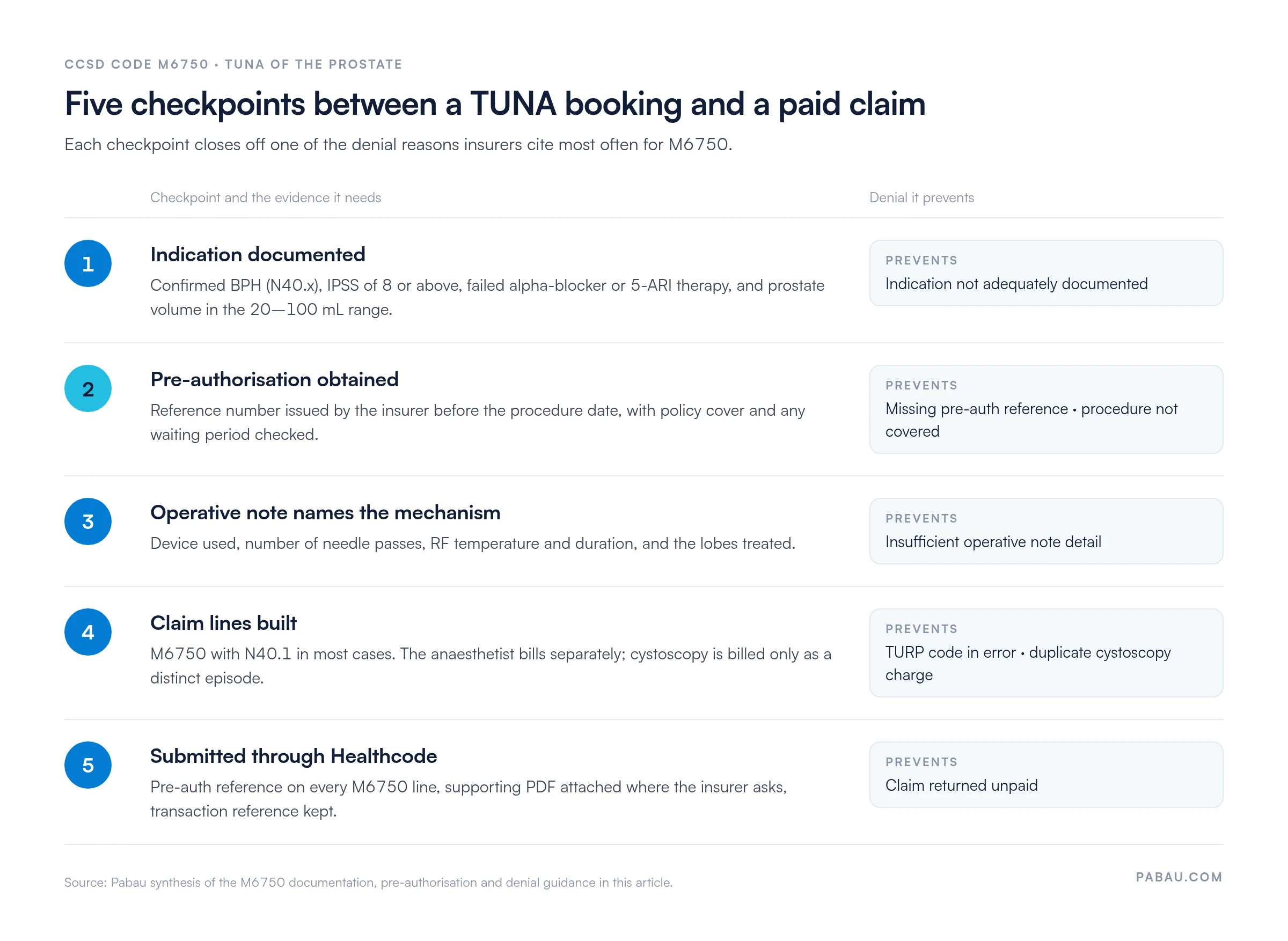
M6750 claims draw close insurer scrutiny for three reasons. TUNA has detailed documentation requirements, some payers question its evidence base, and its code sits next to more commonly billed prostate codes. The five checkpoints below close off each common denial before the claim leaves the practice.
The most frequent denial reasons and their resolutions are:
Healthcode is the primary electronic billing platform for UK private healthcare, used by the majority of UK insurers to process CCSD-coded claims. The steps below follow the standard Healthcode workflow for M6750.
Healthcode updates its interface from time to time, so contact its support team if the screens differ from this guidance.
Pabau’s private healthcare claims management tools record CCSD codes against each patient episode in the clinical record. Claims then go to Healthcode without anyone re-entering the data.
In Healthcode, never leave the pre-authorisation reference field empty on the assumption that the insurer already has the number. Each claim is processed independently. Enter the reference on every M6750 line, even for multi-episode billing under the same authorisation.
UK private insurers require an ICD-10 diagnostic code on CCSD-coded claims. For M6750, the correct codes sit within the N40 category (benign prostatic hyperplasia). The ICD-10 sub-codes distinguish between BPH with and without lower urinary tract symptoms.
N40.1 is the diagnostic code most often paired with M6750 in UK private billing. LUTS is what leads most patients to choose TUNA over continued medical management. Some insurers specify a preferred sub-code at the pre-authorisation stage; check the insurer’s clinical guidelines if N40.1 is queried.
An M6750 claim is usually pieced together from four places: the referral letter, the operative note, the insurer’s pre-authorisation email and the Healthcode portal. Every field typed twice is a chance to drop the reference number or enter the TURP code by mistake.
In Pabau, those pieces live on one patient record. Your team saves the pre-authorisation reference against the episode and writes the operative note from a structured template. M6750 and the N40.x code are recorded on the same record, and UK claims go to insurers through Healthcode and Bupa from there.
The claim then leaves with its reference number, a mechanism-level operative note and the right diagnosis code already attached. Fewer invoices come back for rework, and a query is answered from the record rather than an inbox.

Pabau keeps CCSD codes, operative notes and pre-authorisation references on one record, so UK urology practices submit cleaner claims through Healthcode.

Treat M6750 as a mechanism code first. If the operative note does not say radiofrequency energy went in through transurethral needles, the claim is not ready, however clear the BPH indication is.
The trade-off is admin up front. Pre-authorisation and a detailed operative note take time before the procedure, but far less time than chasing a returned invoice weeks later.
Book a demo to see how Pabau links the operative note, pre-authorisation reference and Healthcode claim for private urology practices.

Looking for practice management software built for UK private healthcare? Men’s health clinic software from Pabau covers the clinical, billing, and scheduling workflows specific to urology and men’s health private practices.
Want to reduce claim errors through better clinical documentation? Digital clinical documentation from Pabau lets practitioners capture structured operative notes and consent records that map directly to CCSD coding requirements.
CCSD code M6750 is the UK private healthcare code for transurethral needle ablation (TUNA) of the prostate. It covers the consultant surgeon’s operative time for the RF needle ablation. The fee includes cystoscopy performed within the same TUNA episode. It excludes anaesthesia, follow-up consultations and any diagnostic cystoscopy done as a separate episode.
Yes, TUNA typically requires pre-authorisation from UK private insurers including Bupa, AXA Health, Aviva, and Vitality before the procedure is performed. The pre-authorisation reference number must appear on the M6750 claim submission; claims submitted without it are routinely returned unpaid. Verify the specific requirements for each insurer and each patient’s policy before booking the procedure.
TUNA (M6750) and TURP (M6530) carry different CCSD codes because they are different procedures. TUNA uses radiofrequency needles to ablate prostatic tissue with heat. TURP uses a resectoscope loop to remove tissue by electrosurgical resection. In the operative note, “RF needle ablation” confirms M6750, while “resectoscope” or “chips removed” confirms TURP.
N40.1 (benign prostatic hyperplasia with lower urinary tract symptoms) is the ICD-10 code most often paired with M6750. LUTS is usually the documented indication for TUNA. N40.0, N40.2 and N40.3 may also fit, depending on the presentation. Use the sub-code that most accurately reflects the documented indication.
Three denials come up most often for M6750: a missing pre-authorisation reference, the TURP code entered in error, and a vague operative note. That note describes the outcome rather than the mechanism. Name the RF needle ablation explicitly in the note and obtain pre-auth before the procedure. Then check the CCSD code against the operative record, and most of these denials disappear.
M6750 can be billed alongside a separate anaesthetic code (billed by the anaesthetist) and, where genuinely performed as a distinct episode, a cystoscopy code. However, intra-operative cystoscopy integral to the TUNA approach is bundled within M6750 and must not be billed separately. Post-operative follow-up consultations are also billed under separate CCSD consultation codes rather than alongside M6750.