

CPT Code 98981: RTM Treatment Management Billing Guide
CPT code 98981: Definition and official descriptor CPT code 98981 is an add-on c...

Last Updated: Nov 9, 2026
M2310 is the CCSD code for open ureterolithotomy (including cystoscopy), the operation that removes a stone from the ureter through an open incision. It sits in Chapter 12 of the CCSD schedule, Urinary system and male reproductive, in the Ureter section. Cystoscopy is part of the descriptor, so it isn't billed separately.
Most ureteric stones are now treated endoscopically, and those operations carry their own ureter codes. CCSD amends and inactivates codes over time, and its schedule sits behind a login. Confirm the current status of M2310 there, or with the patient's insurer, before you book the case.
Let Pabau's smart automation suggest the right codes, reduce claim denials, and keep your practice compliant—effortlessly.
Automate repetitive tasks and focus on what matters most—your patients.
Reduce coding errors and ensure compliance with the latest regulations.
Clean claims, fewer denials, and faster reimbursements.
Powerful insights and reporting to help your practice thrive.
HIPAA compliant SOC 2 certified GDPR-compliant Trusted by 4,000+ clinics worldwide

CCSD code M2310 is open ureterolithotomy (including cystoscopy), a Chapter 12 urinary procedure in the Ureter section of the schedule.
The descriptor says open, so ureteroscopic, laser and nephroscopic stone operations take their own ureter codes.
Cystoscopy is part of the M2310 descriptor, so it doesn’t go on the claim as a separate line.
Major insurers usually require pre-authorization, so confirm it with the insurer for each patient before the surgery date.
Check the current status of M2310 in the CCSD schedule or with the insurer before you book, because codes are inactivated over time.
CCSD code M2310 is open ureterolithotomy (including cystoscopy). It’s the code for removing a stone from the ureter through an open surgical incision. The ureter is the tube that carries urine from the kidney to the bladder.
M2310 sits in Chapter 12 of the CCSD schedule, Urinary system and male reproductive, in the Ureter section. Its M prefix is the letter shared by its kidney and ureter neighbors in the schedule.
CCSD (Clinical Coding and Schedule Development) sets the codes and their descriptors. Each insurer then prices them on its own fee schedule. Our CCSD guides for coders cover the rest of the schedule, code by code.
The full schedule sits behind a login, and codes are amended and inactivated through the CCSD publication cycle. Confirm that M2310 is still active in the current schedule, or with the patient’s insurer, before you book the case.
The surgeon makes an incision over the stretch of ureter that holds the stone. The site depends on where the stone has lodged. The ureter is opened, the stone is removed and the ureter is closed.
The descriptor bundles in cystoscopy, the camera check of the bladder. So a cystoscopy done in the same session belongs to M2310 rather than to a second line on the claim. If the surgeon also places a ureteric stent, check the schedule before you add a separate stent code.
Most ureteric stones are now treated through a ureteroscope or with shockwave lithotripsy. Open surgery is the exception, so an insurer reviewing an M2310 claim may ask why it was needed. The operative note usually answers with one of these:
Write the reason in plain terms. “Stone not accessible endoscopically after failed ureteroscopy” is stronger than a bare diagnosis.
Ureter codes split mainly by route. An open incision points to M2310, while a scope through the urethra or the kidney points elsewhere. The table sets out the neighbors most often confused with it.
Descriptors are as listed on CCSD’s public code details and principles record for M3000. Check each one, and any unacceptable combinations, in the current schedule before you code. If the surgeon used a laparoscopic or robotic approach, search the schedule for the code that matches it. Don’t default to M2310, whose descriptor says open.
Shockwave lithotripsy of a ureteric stone has its own code too, M3110. The chart below adds it to the table’s codes and sorts them by route. Start from the approach in the operative note and read across to the code.
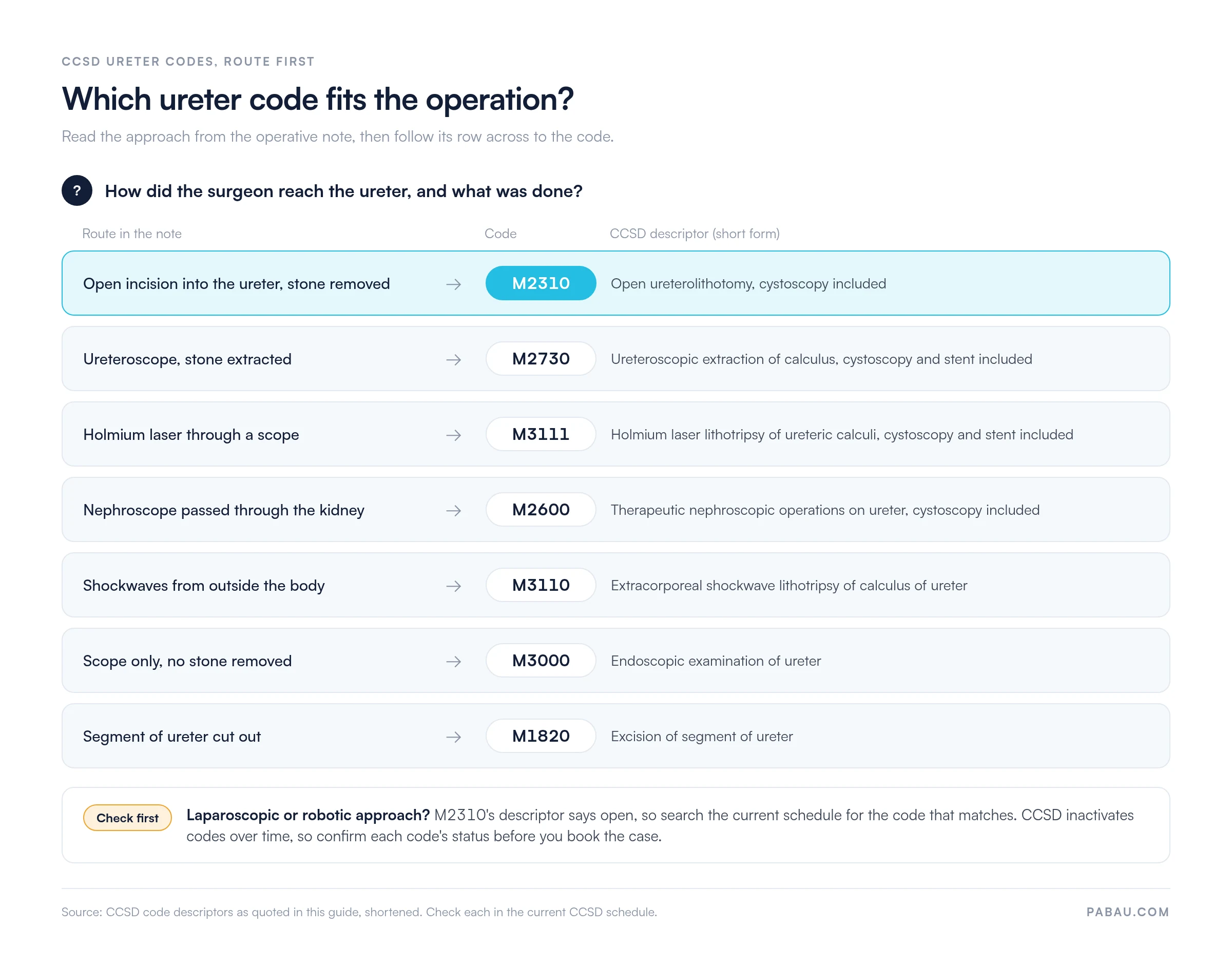
Insurers look for the diagnosis, the approach in the notes and the CCSD code to agree. For M2310, the diagnosis is usually one of these ICD-10 codes:
Code what the imaging and the operative findings show. A kidney-only stone diagnosis on an M2310 claim is a mismatch an insurer will query.
The note is the evidence behind the code. A reviewer should be able to read it and arrive at M2310 without guessing.
Major insurers usually require pre-authorization for a planned operation like M2310. Confirm the requirement with the insurer for each patient, because it turns on the policy as well as the code. Request it once the decision to operate is made, and quote M2310 with the diagnosis code.
Store the authorization number on the case as soon as it’s issued. It has to appear on the claim, and a missing number is one of the easiest refusals to avoid.
If the plan changes in the operating room, for example from ureteroscopy to an open operation, tell the insurer as soon as you can. The authorization was issued for the code you quoted, so a different code on the claim needs explaining.
Here’s the claim flow in order, from the booking to the remittance.
The anesthetist and any assistant usually invoice the insurer on their own claims. Check the insurer’s rules so their fees aren’t added to the surgeon’s M2310 line.
Fees vary by insurer and by the consultant’s agreement. Bupa’s code search tool shows its benefit for a CCSD code, and our Bupa CCSD codes guide explains how Bupa handles them.
Take an illustrative patient with an impacted stone in the left ureter, confirmed on CT. Ureteroscopy fails to clear it, and the urologist plans an open operation.
The secretary requests pre-authorization with M2310 and N20.1, then records the number on the case. In the operating room, the surgeon performs cystoscopy, opens the left ureter and removes the stone. The note records the incision, the side and the failed ureteroscopy.
The coder enters M2310 alone for the procedure, with no separate cystoscopy line. The claim goes out with the diagnosis, the authorization number and the consultant’s registration. The anesthetist bills separately.
On many teams, the authorization number sits in an email, the note in one system and the claim in another. Pabau, the practice software we build for private practices, keeps all three on the patient’s case.
Prior authorization is tracked on the case, and Pabau warns your team when it’s missing. Through claims management, claims then go electronically to UK insurers via Healthcode and Bupa. Coding decisions stay with your surgeon and coder.
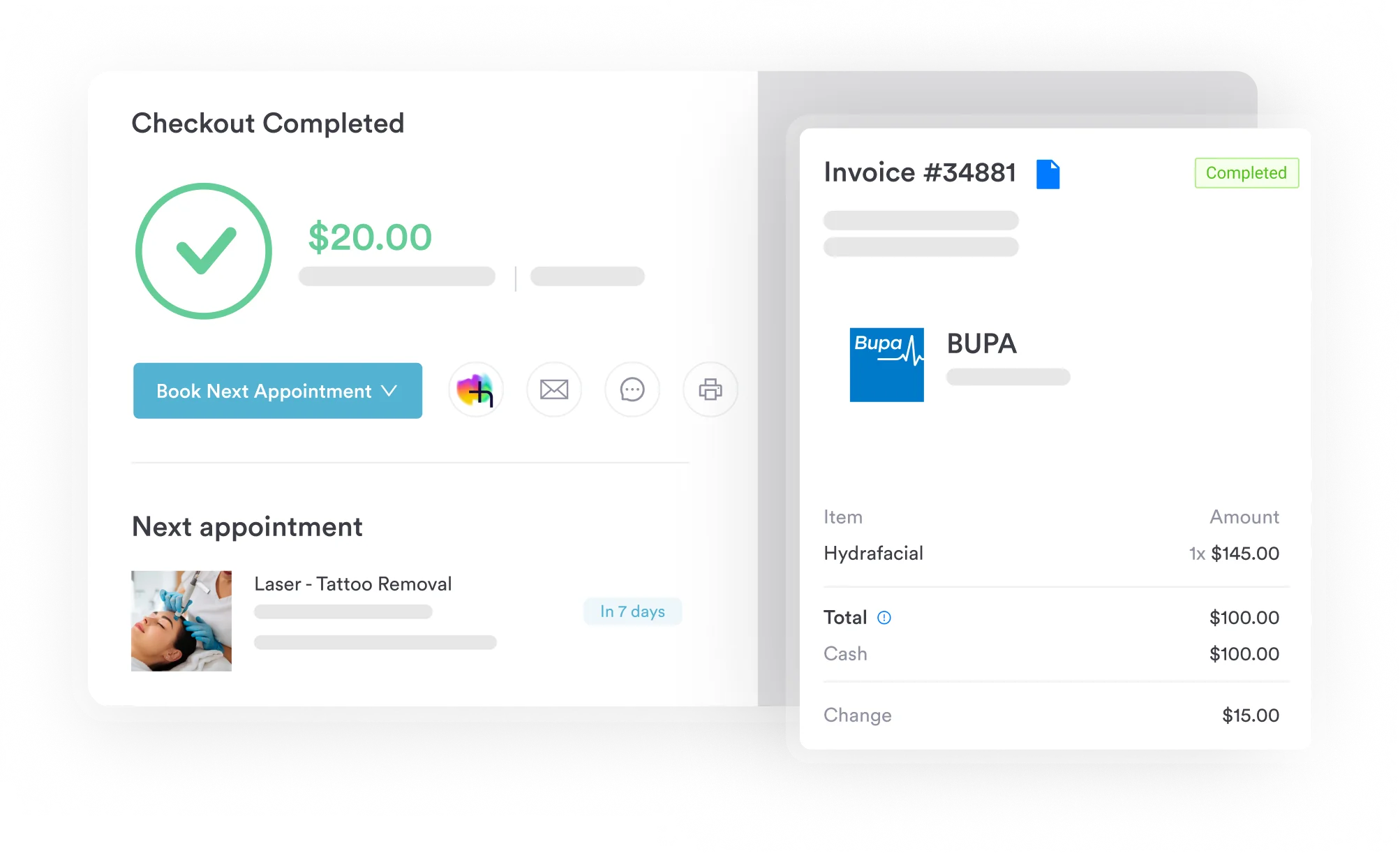

Pabau tracks prior authorization on the case and warns your team when it’s missing. Claims then go electronically to UK insurers through Healthcode and Bupa.

M2310 is one of the simpler urology codes to get right, once the route is clear. Show an open incision into the ureter and a ureteric stone diagnosis. Then explain in the note why open surgery was needed, and the claim is easy to defend.
The harder part is timing. Check the code’s status and the authorization before the surgery date, because both are hard to fix afterward. Book a demo to see how Pabau keeps authorizations and Healthcode claims on one case for UK urology practices.

Was the stone in the kidney instead? CCSD code M0610 covers open removal of calculi from the kidney.
Treating a kidney stone endoscopically? CCSD code M0910 explains endoscopic fragmentation of renal calculi.
Only examining the ureter? CCSD code M3000 covers endoscopic examination of the ureter.
Coding other open ureter surgery? CCSD code M2510 covers ureterocele excision.
Billing Bupa for urology work? Bupa CCSD codes explains how Bupa processes CCSD-coded claims.
CCSD stands for Clinical Coding and Schedule Development. The group is made up of Aviva, AXA Health, Bupa and VitalityHealth. It maintains the procedure and diagnostic schedules that UK private insurers use.
No. CCSD sets the code and its descriptor, and each insurer sets its own fee. What you’re paid depends on the insurer and the consultant’s agreement with it.
No. M2310’s descriptor says open, so a laparoscopic or robotic operation takes the code the current schedule gives that approach. If none fits, ask the insurer before you request authorization.
No. CCSD codes are for claims to UK private medical insurers. NHS hospitals record procedures in OPCS-4, the NHS procedure classification.
Use the code the current schedule names in its place, and quote that code when you request authorization. If the schedule isn’t clear, ask the insurer before you book the case.




