CPT code 36468: Injection sclerotherapy of telangiectasia billing guide
CPT code 36468 covers spider veins on a limb or the trunk CPT code 36468 reports...

Last Updated: Nov 13, 2026
M2511 is the CCSD code for excision of ureteroceles on both sides at the same operation, with or without ureteric reimplantation. It covers open or laparoscopic removal from the bladder wall, and any reimplantation at the same sitting is bundled into the code.
Excision on one side only is coded M2510, and endoscopic incision or puncture is coded M3202. M2511 sits in Chapter 12 of the CCSD schedule, Urinary system and male reproductive organs. Most UK private insurers require pre-authorisation before the operation.
Let Pabau's smart automation suggest the right codes, reduce claim denials, and keep your practice compliant—effortlessly.
Automate repetitive tasks and focus on what matters most—your patients.
Reduce coding errors and ensure compliance with the latest regulations.
Clean claims, fewer denials, and faster reimbursements.
Powerful insights and reporting to help your practice thrive.
HIPAA compliant SOC 2 certified GDPR-compliant Trusted by 4,000+ clinics worldwide

CCSD Code M2511 covers excision of a ureterocele on both sides at the same sitting, with or without ureteric reimplantation.
M2510 is the unilateral code, so a one-sided excision billed as M2511 is up-coding, and M2510 is never billed twice for a bilateral case.
Endoscopic incision or puncture of a ureterocele is coded M3202, not M2511, whichever side or sides are treated.
On a UK claim, pair M2511 with WHO ICD-10 code Q62.3, because the five-character US codes Q62.31 to Q62.39 are not valid here.
CCSD sets the code, not the fee: Bupa, AXA Health, Aviva and other insurers each set their own fee for M2511 and require pre-authorisation.
CCSD Code M2511 is the Clinical Coding and Schedule Development (CCSD) procedure code for excision of ureterocele (with or without ureteric reimplantation), bilateral. You will find it in the CCSD Schedules, which hold the standard procedure and diagnostic test codes for UK private healthcare. UK private medical insurers such as Bupa, AXA Health and Aviva use the schedule to identify procedures on claims and pre-authorisation requests.
M2511 sits in Chapter 12 of the schedule, Urinary system and male reproductive organs, under the ureter procedures. Also, you can compare it with the other Chapter 12 urology procedures in our CCSD code library.
Three parts of the descriptor decide what the code covers:
A ureterocele is a cystic dilatation of the distal ureter where it passes through the bladder wall. It is a congenital anomaly, usually found in infancy or early childhood. It also often occurs with a duplex collecting system, where two ureters drain one kidney and the upper-pole ureter forms the ureterocele.
Surgeons choose bilateral excision when ureteroceles on both sides need surgical correction in the same operative episode. Surgeons can perform the excision by two routes, and both fall within M2511:
Endoscopic decompression is often the first step in neonates and infants. It is not excision, though, so M3202 applies rather than M2511. When an open or laparoscopic excision follows later, that later operation is the one that carries M2511.
The pre-authorisation request and the operative note should name one or more of these established indications:
Vague wording such as “bilateral renal anomaly” without a functional consequence gives the insurer no reason to approve surgery. Instead, name the indication and the imaging that confirmed it.
The most important code-selection decision for this procedure is laterality. M2511 is bilateral, and M2510 covers the same excision on one side only.
CCSD builds bilaterality into the code itself. There is no bilateral modifier to add, so M2511 goes on the claim as a single line. Billing M2510 twice for a bilateral operation is incorrect, and so is listing M2510 and M2511 together for one sitting.
This differs from US CPT coding, where a unilateral code is often reported with a bilateral modifier. Under CCSD, the code alone tells the insurer that the surgeon treated both sides.
Thus, knowing the code boundaries prevents both up-coding and under-coding. The table below maps common scenarios inside and outside M2511.
Billers often confuse several codes near M2511 in Chapter 12 with it during claim preparation. Most errors come from misreading the approach, the laterality, or whether a ureterocele was excised at all. The Bupa CCSD code schedule explains how one major insurer applies the codes.
Key distinction: M3202 and M2511 are the pair most often confused. The operative note must state whether the ureteroceles were excised or only incised endoscopically.
Where reimplantation is the whole operation and no ureterocele is excised, use the replantation codes instead. That means M2030 for both ureters and M2080 for one.
Two questions settle the code for any ureterocele operation. First, what does the note say was done to the ureterocele? Second, how many sides were treated?
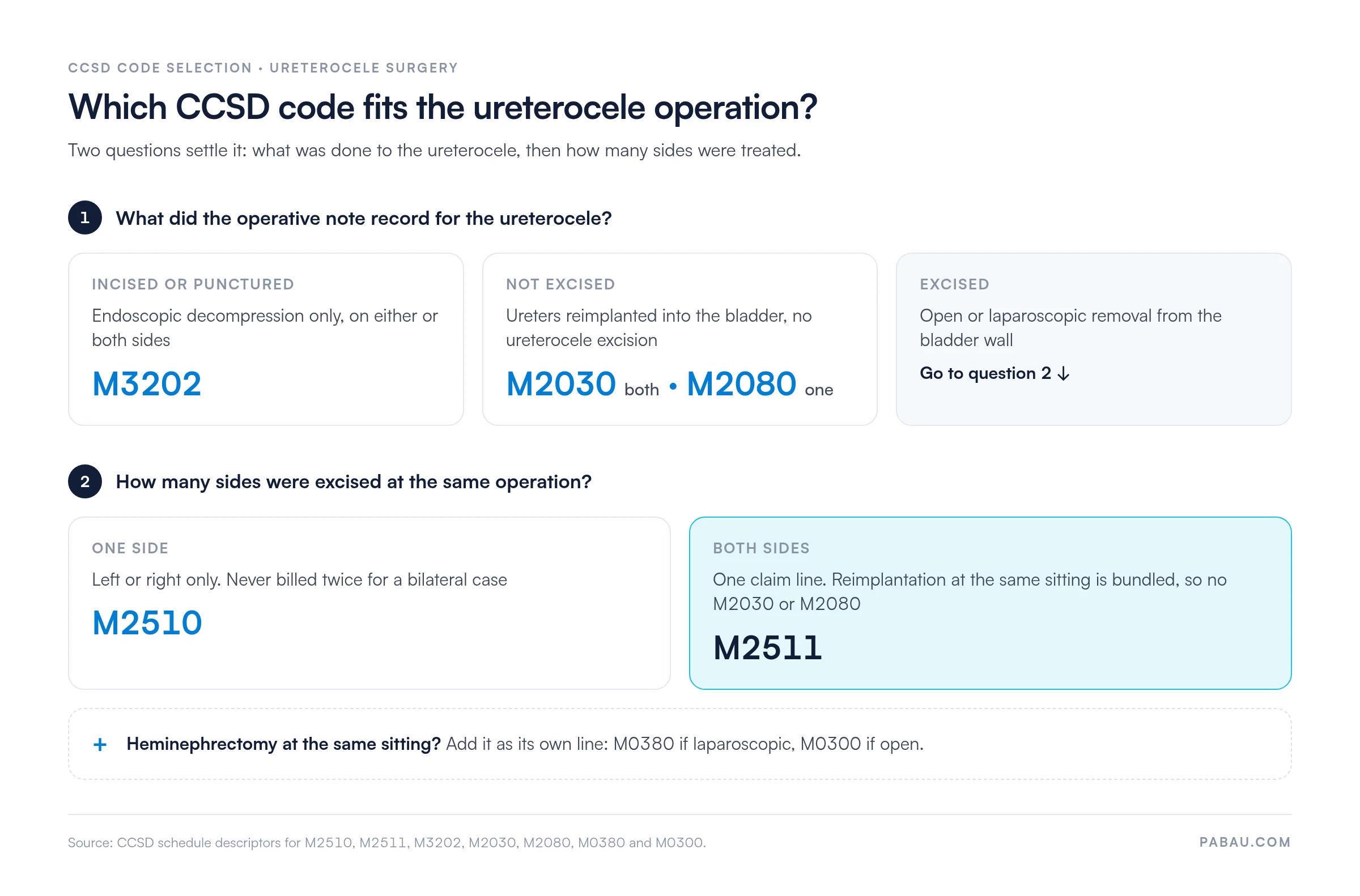
When a duplex system needs heminephrectomy and ureterocele excision at the same sitting, code each procedure separately. Use M0380 for a laparoscopic heminephrectomy or M0300 for an open partial nephrectomy, alongside M2511. Document each procedure distinctly and confirm the insurer has authorised every code before surgery.
Every M2511 claim needs at least one ICD-10 diagnosis code for the condition treated. UK claims use the WHO-based ICD-10 5th Edition, which the NHS Classifications Browser publishes. Verify each code against the edition in use on the date of surgery.
UK ICD-10 stops at four characters for these codes, so Q62.3 is the code to use. Q62.31, Q62.32 and Q62.39 belong to the US ICD-10-CM and are not valid on a UK claim. In that US system, Q62.39 means other obstructive defects, not an unspecified code.
The supplementary codes are not needed on every claim. Instead, they strengthen the clinical case at pre-authorisation, and when reflux shaped the operative plan.
Incomplete operative documentation is the most preventable reason an M2511 claim comes back. The operative note must support every element of the descriptor, and it should be complete before the patient is discharged.
However, pre-operative imaging, such as ultrasound, a MAG3 renogram or a micturating cystourethrogram (MCUG), does not travel with the claim. Keep it on the patient record, because insurers may ask for it at audit or when they dispute authorisation.
Build an operative note template for ureterocele excision with a separate field for each side. Fields for laterality, approach, reimplantation technique and imaging stop the note from leaving out the detail that separates M2511 from M2510.
M2511 is a major elective paediatric urology procedure, so UK private insurers, including Bupa, AXA Health, Aviva and Vitality, usually require pre-authorisation before elective surgery. A claim without an authorisation reference is one of the most common reasons insurers refuse an M2511 claim.
In addition, the anaesthetist usually needs the same authorisation reference for their own invoice. Share it with them once you confirm the theatre list.
Policies change, so confirm current requirements with each insurer. The Bupa code search shows how Bupa treats each CCSD code for its members.
CCSD publishes codes and descriptors, not prices. So it does not set a fee for M2511, and there is no national tariff for private procedures. Each insurer decides what it will pay for the code under its own fee schedule.
Therefore, do not quote a fee for M2511 from memory or from another insurer’s schedule. Check the current figure with the patient’s insurer before you send a treatment estimate.
Insurers refuse M2511 claims for a familiar set of reasons. Each one maps to a check you can build into the workflow before submission.
When an insurer refuses a claim, read the insurer’s reason before you resubmit. Resubmitting without fixing the stated reason usually brings a second refusal.
A structured workflow prevents the denial reasons above. These steps apply to most UK private insurer claims for M2511.
Surgeons perform M2511 under general anaesthesia, usually in children. The anaesthetist bills their own fee on a separate invoice, so the surgeon’s M2511 claim carries no anaesthesia element.
An M2511 claim depends on three records: the insurer’s authorisation reference, the signed operative note and the invoice. When those sit in a portal, a shared drive and a spreadsheet, a missing detail only shows up when the claim comes back.
Pabau, the practice management platform we build, keeps all three on the patient record. Your surgeons can build an operative note template with a field for each side. The coder then sees the laterality before choosing between M2510 and M2511.
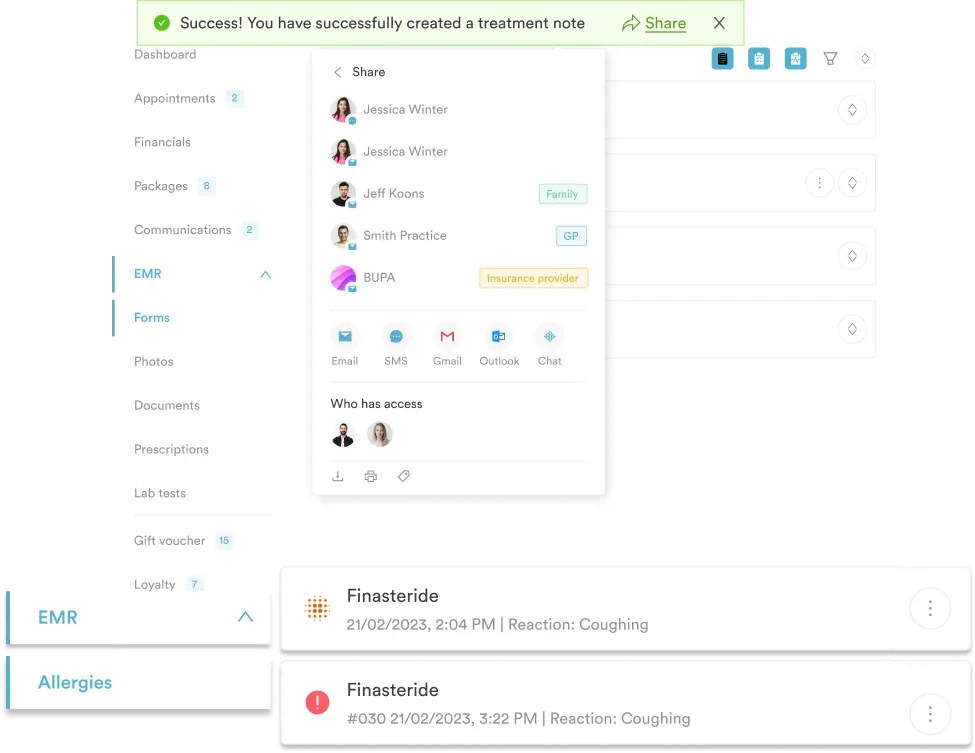
Pabau’s claims management software tracks pre-authorisation status and sends insurer claims through Healthcode. It also shows which claims are still unpaid, so your team chases them before they age.
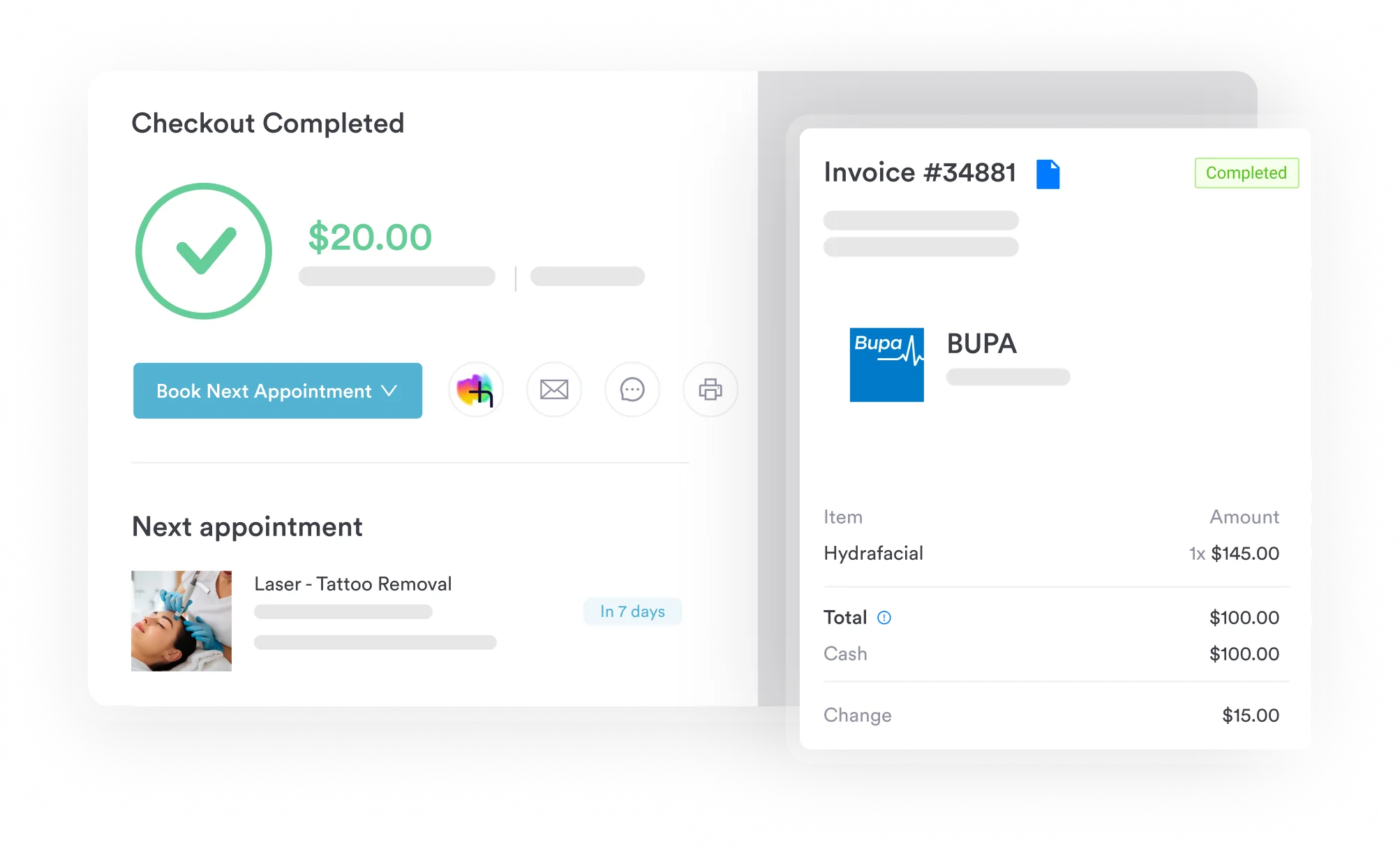

Pabau helps private surgical practices track pre-authorisation, keep operative notes on the patient record and submit CCSD-coded claims through Healthcode. Your team spends less time chasing refused claims.

M2511 is a simple code to assign once the operative note proves excision on both sides. Claims fail on the paperwork around it: a missing authorisation reference, a note that names one side, or a US diagnosis code.
So make pre-authorisation a condition of booking theatre, and give surgeons a note template with a field for each side. That small step before surgery spares your team a round of corrections after it.
Book a demo to see how Pabau keeps authorisations and operative notes attached to every CCSD claim your practice submits.

Operating on one side only? CCSD code M2510 covers unilateral ureterocele excision, with or without reimplantation.
Reimplanting both ureters without excision? CCSD code M2030 covers bilateral replantation of the ureters into the bladder.
Treating the ureterocele endoscopically? CCSD code M3202 covers operations on the ureteric orifice, including endoscopic incision.
Reimplanting one ureter without excision? CCSD code M2080 covers unilateral replantation of the ureter into the bladder, including cystoscopy.
CCSD Code M2511 covers open or laparoscopic excision of ureteroceles on both sides at the same operation, with or without ureteric reimplantation. The code already includes reimplantation at the same sitting. Excision on one side only takes code M2510.
Reimplantation is optional, because the descriptor covers excision with or without it. When the surgeon reimplants either or both ureters at the same sitting, M2511 already includes that step. Do not add M2030 or M2080, and record in the operative note whether reimplantation took place.
On a UK claim, the primary diagnosis is Q62.3, other obstructive defects of renal pelvis and ureter, which includes congenital ureterocele. Add Q62.5, Q62.6 or N13.7 where documented. The codes Q62.31, Q62.32 and Q62.39 are US ICD-10-CM codes and are not valid on a UK claim.
Yes, in most cases. Bupa, AXA Health, Aviva and Vitality usually require pre-authorisation before elective surgery. Submit M2511 with the ICD-10 diagnosis and clinical evidence before the theatre date, and put the authorisation reference on the claim.
M2510 covers excision of a ureterocele on one side, and M2511 covers excision on both sides at the same sitting. Billing M2511 for a one-sided operation is up-coding. Billing M2510 twice for a bilateral operation is also incorrect, because CCSD has no bilateral modifier.
CCSD sets the code, not the fee. Each insurer publishes its own fee schedule and complexity banding, so the amount paid for M2511 differs between Bupa, AXA Health, Aviva and others. Check the current figure with the patient’s insurer before you send a treatment estimate.