HCPCS Code L0472: Hyperextension TLSO billing guide
HCPCS code L0472: Official descriptor and device definition HCPCS code L0472 des...

Last Updated: Nov 5, 2026
M2080 is the CCSD code for unilateral replantation of ureter into bladder (including cystoscopy). It covers reconnecting one ureter to the bladder at a new site, with the cystoscopy in the same session included.
Both ureters in one session are coded M2030, and robotic-assisted cases use M2090 or M2091. M2080 sits in the Ureter section of Chapter 12 of the CCSD Schedule, and Bupa grades it MAJOR 3.
Let Pabau's smart automation suggest the right codes, reduce claim denials, and keep your practice compliant—effortlessly.
Automate repetitive tasks and focus on what matters most—your patients.
Reduce coding errors and ensure compliance with the latest regulations.
Clean claims, fewer denials, and faster reimbursements.
Powerful insights and reporting to help your practice thrive.
HIPAA compliant SOC 2 certified GDPR-compliant Trusted by 4,000+ clinics worldwide

CCSD code M2080 covers replantation of one ureter into the bladder, with cystoscopy in the same session included. A separate cystoscopy line on the claim is an unbundling error.
Both ureters in one session take M2030, and a robotic-assisted case takes M2090 or M2091. CCSD codes carry no bilateral modifier, so two M2080 lines are wrong.
Open surgery to correct vesico-ureteric reflux has its own code, M2210. Agree which code fits with the insurer before the pre-authorisation request goes in.
Pabau, the practice management software we build, creates CCSD invoices, submits them to UK insurers through Healthcode and tracks each claim against the patient record.
CCSD code M2080 is the UK private healthcare procedure code for unilateral replantation of the ureter into the bladder. It belongs to the CCSD Schedule, maintained by the Clinical Coding & Schedule Development (CCSD) Group. The official descriptor reads: Unilateral replantation of ureter into bladder (including cystoscopy).
UK private medical insurers, including Bupa, AXA Health, Aviva, Vitality and WPA, use CCSD codes to authorise and pay for procedures. M2080 sits in the Ureter section of Chapter 12, Urinary system and male reproductive organs. Bupa grades it MAJOR 3 for complexity.
The descriptor sets three limits on the code. The operation reconnects the ureter to the bladder, it treats one side only, and it includes cystoscopy. For the wider insurer code set, see Pabau’s Bupa CCSD codes guide.
The costliest mistake on this code is using it when a different one applies. The CCSD Schedule splits ureteric reimplantation across six codes by side, by robotic assistance and by indication, as the grid shows.
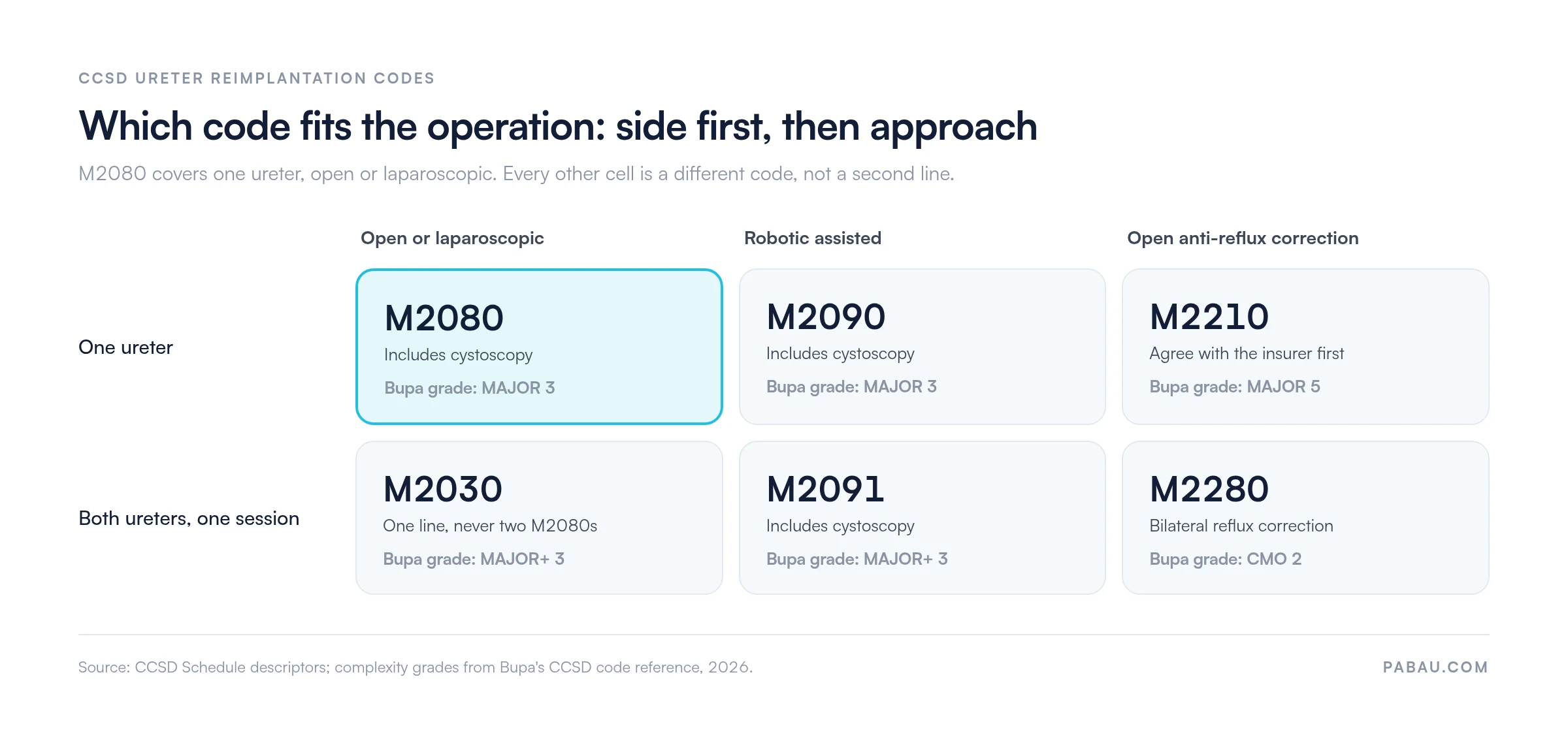
CCSD codes carry no modifiers, so a bilateral case is never two M2080 lines. It is one M2030 line, or M2091 when robotic assisted.
Reflux is the indication that needs the most care. Bupa grades M2210 two bands above M2080 within MAJOR, and its descriptor names the condition being corrected. When reimplantation is done to correct vesico-ureteric reflux, ask the insurer which of the two codes it expects before surgery.
Unilateral ureteric reimplantation detaches one ureter from the bladder and reconnects it at a new site on the bladder wall. It corrects a fault at the vesico-ureteric junction that endoscopic treatment cannot resolve.
Whatever the approach, the operation follows the same core steps:
Open and laparoscopic approaches both use M2080. A robotic-assisted reimplantation has its own code, M2090, so the operative note must state the approach clearly.
M2080 is indicated for a one-sided disorder at or near the vesico-ureteric junction that needs the ureter reconnected to the bladder. The main indications are:
UK private insurers use the WHO version of ICD-10, not the US ICD-10-CM. The pairings below are WHO codes, checked against the WHO ICD-10 browser.
The WHO codes are less detailed than the US ones. N13.70, N13.721, N28.89 and S37.12 are US-only codes and do not belong on a UK claim. The diagnosis on the invoice must match the pre-operative assessment and the operative note.
The descriptor defines the scope of M2080, so each step it names is included. The CCSD Group also lists unacceptable combinations for codes commonly billed together.
Each insurer has its own contractual rules on using two procedure codes, so contact the insurer before adding a second code. Insurers audit claims after payment and can ask for money back on codes combined incorrectly.
Several CCSD codes sit near M2080 in the schedule’s Ureter section. Choosing the wrong one, or adding a lesser code alongside M2080, is a common cause of rejection.
A ureterocele excised with reimplantation of the same ureter is coded M2510, not M2080 plus a second line. A transplant ureter takes M2160. Ureters joined to an ileal conduit rather than the bladder form a urinary diversion, coded M1910. The CCSD Group updates the schedule through regular bulletins, so check each code on the insurer’s code search before invoicing. Pabau’s CCSD codes library covers the rest of the schedule, chapter by chapter.
Insurers scrutinise M2080 claims because reimplantation is major reconstructive surgery. The operative note should cover each of these points.
Keep the operative note against the patient record so it can be found quickly if the insurer asks for clinical information. Structured patient records that link notes to the invoice shorten the response to an audit query.
State the side and the approach in the first line of the operative note. Those two facts decide between M2080, M2030 and M2090, and an insurer reviewer looks for them first.
Most major UK private medical insurers require pre-authorisation before planned major surgery such as ureteric reimplantation. Going ahead without an authorisation number is a common cause of non-payment, however well the procedure is documented. Policies change often, so confirm requirements before booking theatre.
A typical pre-authorisation request for M2080 includes:
Where a ureter is injured during another operation and repaired at once, there is no chance to authorise beforehand. Contact the insurer as soon as possible afterwards and send the operative notes from both procedures.
If the patient’s policy has an excess or a surgical sub-limit, confirm the figures during pre-authorisation. An exhausted benefit then shows up before surgery, not as a surprise at invoicing.
Healthcode is the UK clearing house through which practices send electronic invoices to most major private medical insurers. Claims management software linked to Healthcode cuts keying errors and shows claim status in one place.
These rejection patterns recur on M2080 claims across UK private insurers. Each has a specific fix.
Review every M2080 claim once a quarter. Record the reason for each rejection or query and compare it with the table above. When the same reason comes back, fix the documentation step that produced it, not only the claim.
Without an integrated system, billing staff build each CCSD invoice by hand. They then chase authorisation numbers by email and log in to separate insurer portals to check payment.
Pabau keeps the clinical record and the invoice together. Pabau creates CCSD invoices for each episode, submits them to UK insurers through Healthcode and brings claim status back into the same system.
Digital clinical forms let the surgeon record the M2080 details at the point of care: side, indication, approach and cystoscopy findings. The facts that separate M2080 from M2030 and M2090 are then in the note before anyone raises the invoice.

Pabau creates CCSD invoices, submits them to UK insurers through Healthcode and tracks each claim against the patient record. See how it handles complex urology billing.

Coding M2080 correctly comes down to two questions before invoicing: how many ureters, and was the operation robotic? One ureter by open or laparoscopic surgery is M2080, with the cystoscopy on the same line. Both ureters take M2030, and a robotic case takes M2090 or M2091.
Reflux adds a third question, because M2210 may fit better. Settle it with the insurer at pre-authorisation, and the invoice then matches what was approved.
Book a demo to see how Pabau handles CCSD invoicing and Healthcode claim tracking for UK urology practices.

Billing for other Bupa procedures? Bupa CCSD codes and fee schedule covers the full Bupa code set with billing and documentation guidance for UK private practices.
Reimplanting both ureters? CCSD Code M2030 explains the code for bilateral replantation of ureter into bladder.
Operating to correct reflux? CCSD Code M2210 covers open correction of vesico-ureteric reflux on one side.
Freeing the ureter rather than reconnecting it? CCSD Code M2530 explains unilateral ureterolysis.
Looking up another procedure? CCSD codes brings together Pabau’s CCSD code references in one place.
CCSD code M2080 covers replantation of one ureter into the bladder, with cystoscopy in the same session included. It comes from the CCSD Schedule used by UK private insurers such as Bupa, AXA Health and Aviva. Both ureters in one session are coded M2030 instead.
Yes. The official descriptor reads “Unilateral replantation of ureter into bladder (including cystoscopy)”, so cystoscopy is part of the code. Adding a separate cystoscopy line to the same claim is an unbundling error, and the insurer will reject it.
M2080 covers one ureter and M2030 covers both ureters in the same session. CCSD codes carry no bilateral modifier, so a bilateral case is one M2030 line, not two M2080 lines. Bupa grades M2080 at MAJOR 3 and M2030 at MAJOR+ 3.
A robotic-assisted reimplantation of one ureter is coded M2090, and both ureters are coded M2091. Open and laparoscopic cases stay on M2080, so the operative note must state the approach.
The operative note should state the side treated, the confirmed indication, the new ureter-to-bladder connection and the cystoscopy findings. It should also record the approach, any adjuncts and the WHO ICD-10 code matching the pre-authorisation request.