HCPCS Code V5255: Digital monaural ITC hearing aid billing guide
HCPCS Code V5255: Official descriptor and code definition HCPCS Code V5255 is a ...

Last Updated: Nov 19, 2026
Billable Code
M2600 is the CCSD code for therapeutic nephroscopic operations on ureter (including cystoscopy). UK private insurers use it when a surgeon treats the ureter through a nephroscope. A cystoscopy in the same session is part of the code.
M2600 sits in sub-chapter 12.2.0 Ureter of the CCSD schedule, reference Fl.048. A diagnostic examination of the ureter is coded M3000, and ureteroscopic stone extraction M2730, so the operation note decides which code fits.
Let Pabau's smart automation suggest the right codes, reduce claim denials, and keep your practice compliant—effortlessly.
Automate repetitive tasks and focus on what matters most—your patients.
Reduce coding errors and ensure compliance with the latest regulations.
Clean claims, fewer denials, and faster reimbursements.
Powerful insights and reporting to help your practice thrive.
HIPAA compliant SOC 2 certified GDPR-compliant Trusted by 4,000+ clinics worldwide

CCSD code M2600 covers therapeutic nephroscopic operations on the ureter, and a cystoscopy in the same session is part of the code.
The CCSD schedule lists no M2500 and no M2601. A diagnostic examination of the ureter is M3000, and M2600 has no bilateral variant.
Ureteric stones can carry their own codes, such as M2730 for ureteroscopic extraction and M3111 for holmium laser lithotripsy.
The operation note has to name the instrument, the side, the ureteric segment and the treatment carried out.
Claims go electronically through Healthcode or direct to the insurer, with the pre-authorization number on the claim.
CCSD code M2600 is the code UK private insurers use for therapeutic nephroscopic operations on the ureter. It comes from the schedule kept by the Clinical Coding & Schedule Development Group (CCSD), which insurers such as Bupa build their procedure lists on.
Therapeutic means the surgeon treated something through the nephroscope, such as a stricture, a stone or a foreign body. The narrative ends with “(including cystoscopy)”, so a cystoscopy in the same session belongs to M2600 rather than to a second line.
The CCSD Group revises its schedule from time to time, so confirm the code against the list your insurer currently uses. Pabau, the practice software we build, keeps an index of CCSD codes covering the other procedures we have written up.
M2600 is the only nephroscopic code for the ureter in the CCSD schedule. The codes around it cover other ureter operations, and the operation note decides which one fits.
The CCSD schedule has no M2500 and no M2601, although some billing guides list them. A diagnostic look at the ureter is coded M3000, which our page on CCSD code M3000 covers in full.
The schedule lists no bilateral variant for M2600, so ask the payer how it wants both sides billed. Stent insertion or removal as the main procedure is a different case, because the narrative for M2920 already includes bilateral work.
Stone work needs a second look before you code. Ureteroscopic extraction has its own code, M2730, and holmium laser lithotripsy has M3111. An open operation to remove a ureteric stone is coded M2310 instead. The diagram below sorts these codes by what the note records about the instrument and the technique. A stone removed from the bladder through an open incision falls outside that diagram and is coded CCSD M3900.
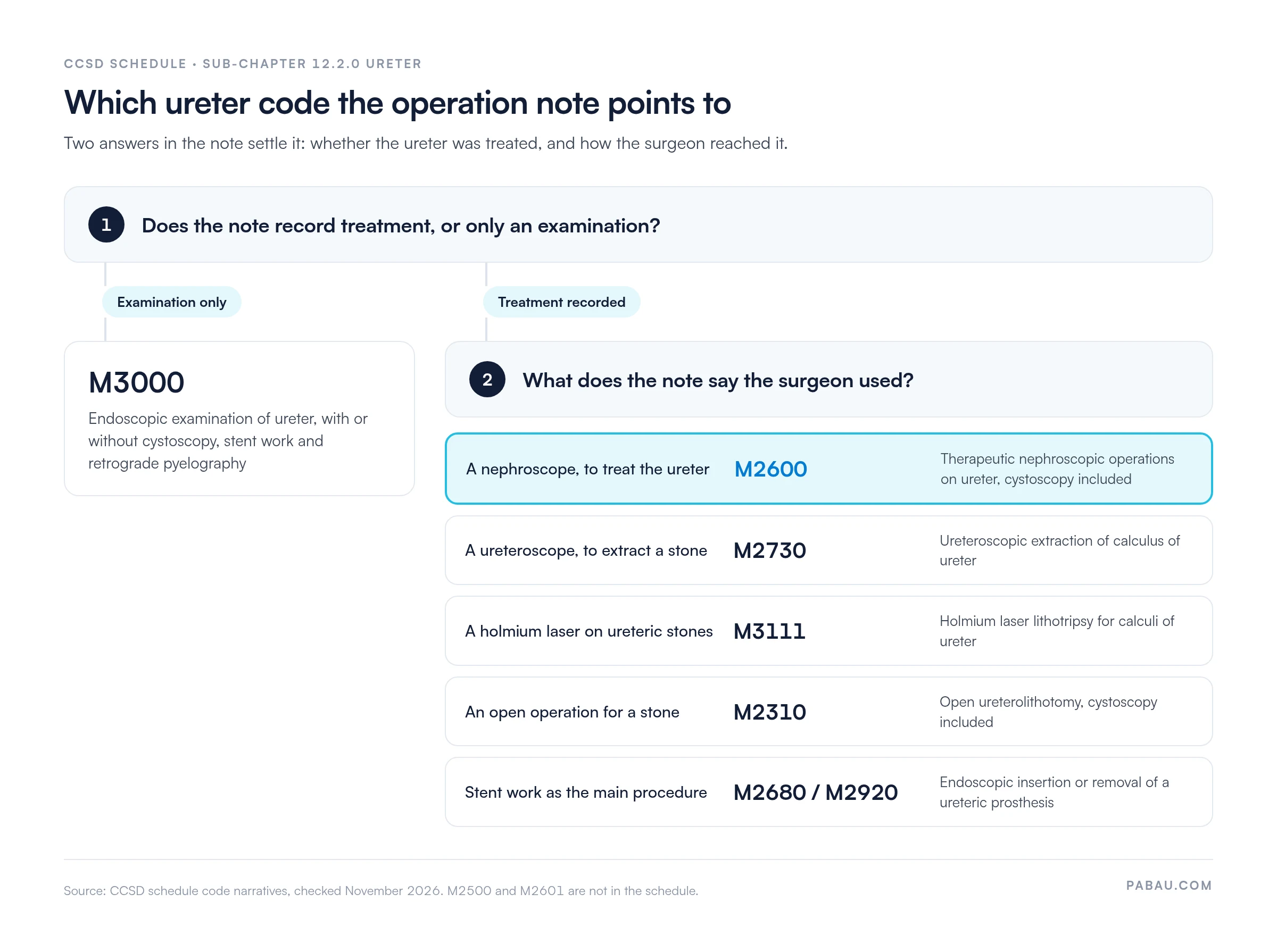
A claim for M2600 is only as strong as the note behind it. A note that records what the surgeon saw, but no treatment, reads as an examination and points to M3000.
Agree a standard procedure title with your urologists, such as “Therapeutic nephroscopy, left upper ureter, stricture dilated”. When the title names the instrument, side and treatment, the code choice is settled before anyone reads the full note.
Where an insurer wants a diagnosis on the claim, UK practices use the WHO edition of ICD-10. You can search it in the WHO ICD-10 browser. Code the condition the surgeon documented rather than a default.
The US edition, ICD-10-CM, adds characters to some of these, such as C66.1 and C66.2 for the right and left ureter. Those codes belong on US claims, not UK ones.
Check cover first. Confirm with the insurer that the patient’s plan covers the operation before the date is set.
The table shows what each insurer usually expects. The payer’s current provider guide has the final word on every detail.
Once the operation is done, the claim follows the same six steps whichever insurer pays it.
The anesthetist bills separately for the same operation, under their own fee. If an assistant surgeon takes part, ask the insurer before the operation whether it pays an assistant fee for this procedure.
M2600 claims are most often held up by a handful of avoidable slips.
If a claim is still refused, check the insurer’s current provider manual for its appeal process. Our guide to denial management in healthcare covers the follow-up work in more depth.
Bupa is one of the UK’s largest private health insurers. Its rules are worth knowing before the first M2600 claim goes out.
Our guide to Bupa CCSD codes explains how Bupa’s procedure list works. For fee tiers, see our guide to the Bupa fee schedule.
On many urology cases, the authorization sits in an email and the operation note in the hospital system. Someone then keys the claim in by hand, and each handoff is a chance to lose the reference number.
Pabau keeps the billing side of those steps on the patient record. Its claims management software handles insurance billing through Healthcode, including Bupa. It tracks the authorization code on the case and warns when one is missing.
Your team can also build operation-note forms in Pabau’s digital forms, with fields for side, segment and treatment. The coder then reads the note rather than piecing it together.
The result is fewer claims bounced for a missing reference, and a clear view of what each insurer still owes.

Pabau handles insurance billing through Healthcode, including Bupa. It tracks the authorization code on the patient’s case and warns when one is missing.

M2600 is a narrow code. It fits treatment of the ureter through a nephroscope, with the cystoscopy folded in, and the note has to show that treatment.
Claims stall on codes that are not on the schedule and on an examination coded as treatment. Stone work coded as M2600 when it belongs under M2730 or M3111 stalls them too. Check the note against the narrative before the claim leaves.
Agree a standard procedure title with your urologists, and confirm bilateral handling with each insurer. Book a demo to see how Pabau keeps authorizations and Healthcode claims on one patient record.

Coding a diagnostic look at the ureter? CCSD code M3000 covers endoscopic examination of the ureter, with or without cystoscopy and stent work.
Looking up another procedure code? CCSD codes lists the CCSD procedure codes Pabau covers.
Need a full Bupa CCSD billing reference? Bupa CCSD codes covers Bupa’s procedure list and how its claims work.
Checking Bupa fees before you invoice? Bupa procedure codes and fee schedule walks through Bupa’s recognized codes and fee tiers.
Inserting or removing a ureteric stent? CCSD code M2920 covers endoscopic insertion or removal of a prosthesis into the ureter.
CCSD code M2600 covers therapeutic nephroscopic operations on the ureter, including cystoscopy. It applies when a surgeon treats the ureter through a nephroscope, for example a stricture or a foreign body. A diagnostic examination of the ureter is coded M3000 instead.
Yes. The narrative reads “(including cystoscopy)”, so a cystoscopy in the same session is part of M2600. Billing it as a separate line duplicates part of the code.
M2600 is for treating the ureter through a nephroscope. M3000 is an endoscopic examination of the ureter, with or without cystoscopy, stent work and retrograde pyelography. If the note records findings but no treatment, M3000 is the closer match.
No bilateral variant is listed for M2600, so confirm with the payer how it wants both sides billed. There is no CCSD code M2601. Record both sides in the operation note so the insurer can see what was done.
Not always. The schedule has M2730 for ureteroscopic extraction of a ureteric stone and M3111 for holmium laser lithotripsy of ureteric stones. Check the schedule against the instrument and technique the note describes before you choose.
The operation note should name the nephroscope and route, the side, the ureteric segment, the findings and the treatment carried out. Record any stent placed or removed, and keep the pre-authorization reference with the case.
No. M2600 is a therapeutic code, so the note has to show treatment. Billing it for an examination overstates the work, which insurers treat as upcoding. A diagnostic examination of the ureter is coded M3000.
Yes, on a separate claim. The anesthetist bills for the same operation under their own fee, and the hospital bills its facility charge separately. Neither belongs on the surgeon’s M2600 claim.