CPT code 34812: Open femoral artery exposure for endovascular repair
CPT code 34812: Official descriptor and procedure overview CPT code 34812 is off...

Last Updated: Nov 19, 2026
Billable Code Specific Code
M3900 is the CCSD code for open removal of calculus from bladder (including cystoscopy). It covers an open cystolithotomy, where the surgeon opens the bladder through a lower abdominal incision and removes the stones directly.
The cystoscopy performed during the operation is part of the code, so it is never billed separately. Endoscopic stone removal is coded M4420 or M4410 instead. M3900 sits in sub-chapter 12.3.0 Bladder of the CCSD schedule, the standard procedure code set for UK private healthcare.
Let Pabau's smart automation suggest the right codes, reduce claim denials, and keep your practice compliant—effortlessly.
Automate repetitive tasks and focus on what matters most—your patients.
Reduce coding errors and ensure compliance with the latest regulations.
Clean claims, fewer denials, and faster reimbursements.
Powerful insights and reporting to help your practice thrive.
HIPAA compliant SOC 2 certified GDPR-compliant Trusted by 4,000+ clinics worldwide

CCSD code M3900 covers open bladder stone removal with the cystoscopy bundled in, so M4510 or M4514 is never added for the same session.
ICD-10 N21.0 (calculus in bladder) is the primary diagnosis for M3900, and a mismatched diagnosis is a common denial trigger.
Most private payers expect pre-authorization before open bladder surgery, so confirm each insurer’s current rules before the procedure date.
The operative note should record the open approach, the indication, stone details, cystoscopic findings and the surgeon’s GMC number.
Pabau, a practice management platform with insurance billing, tracks the authorization reference on each case and warns staff when it is missing.
CCSD code M3900 is the Clinical Coding & Schedule Development Group (CCSD) schedule code for open removal of calculus from bladder (including cystoscopy). The CCSD Schedules hold the standard codes for procedures and diagnostic tests in UK private healthcare. The group that maintains them includes representatives of four major private health insurers.
The descriptor itself bundles the cystoscopy into M3900. CCSD’s coding principles list M4510 (flexible cystoscopy) and M4514 (rigid cystoscopy) as unacceptable combinations with M3900. Billing either one for the same operative session is unbundling, and the claim will be rejected or queried.
M3900 sits in sub-chapter 12.3.0 Bladder, within chapter 12.0.0 Urinary System and male reproductive organs. It is a UK private healthcare code, not a CPT or HCPCS code. M3900 is billed by the operating surgeon, normally a consultant urologist. When a case could fit a neighboring code, browse related CCSD codes before the claim goes out.
Open cystolithotomy is a surgical approach used when bladder stones cannot be managed through the urethra. The patient lies supine under general anesthesia. The surgeon makes a lower abdominal incision, opens the bladder (cystotomy), and extracts the calculus or calculi directly. The bladder is irrigated to confirm complete stone clearance, then closed in layers.
The included cystoscopy serves a confirmatory role. The urologist performs a cystoscopic examination at the outset or before the cystotomy is closed. It confirms the stones’ characteristics and location, then verifies complete removal at closure. This is why the CCSD descriptor brackets it as an included component rather than a separate procedure.
M3900 is normally a short-stay inpatient admission. Recovery takes longer than after an endoscopic approach, and a urinary catheter usually stays in place after surgery.
M3900 applies only when the open surgical approach is clinically justified. The two most common reasons are stone size and failed prior endoscopic removal. According to published urological guidance, stones larger than approximately 3-4 cm are often unsuitable for transurethral fragmentation and are more safely managed by open cystolithotomy. Stones coinciding with an open pelvic procedure being performed for another indication may also be removed under M3900 at the same sitting.
The clinical indication must be documented in the operative note and, where required, supported by imaging. Payers audit indications for open surgical codes. If the documentation does not make the open approach clinically defensible, the claim is at risk of retrospective rejection.
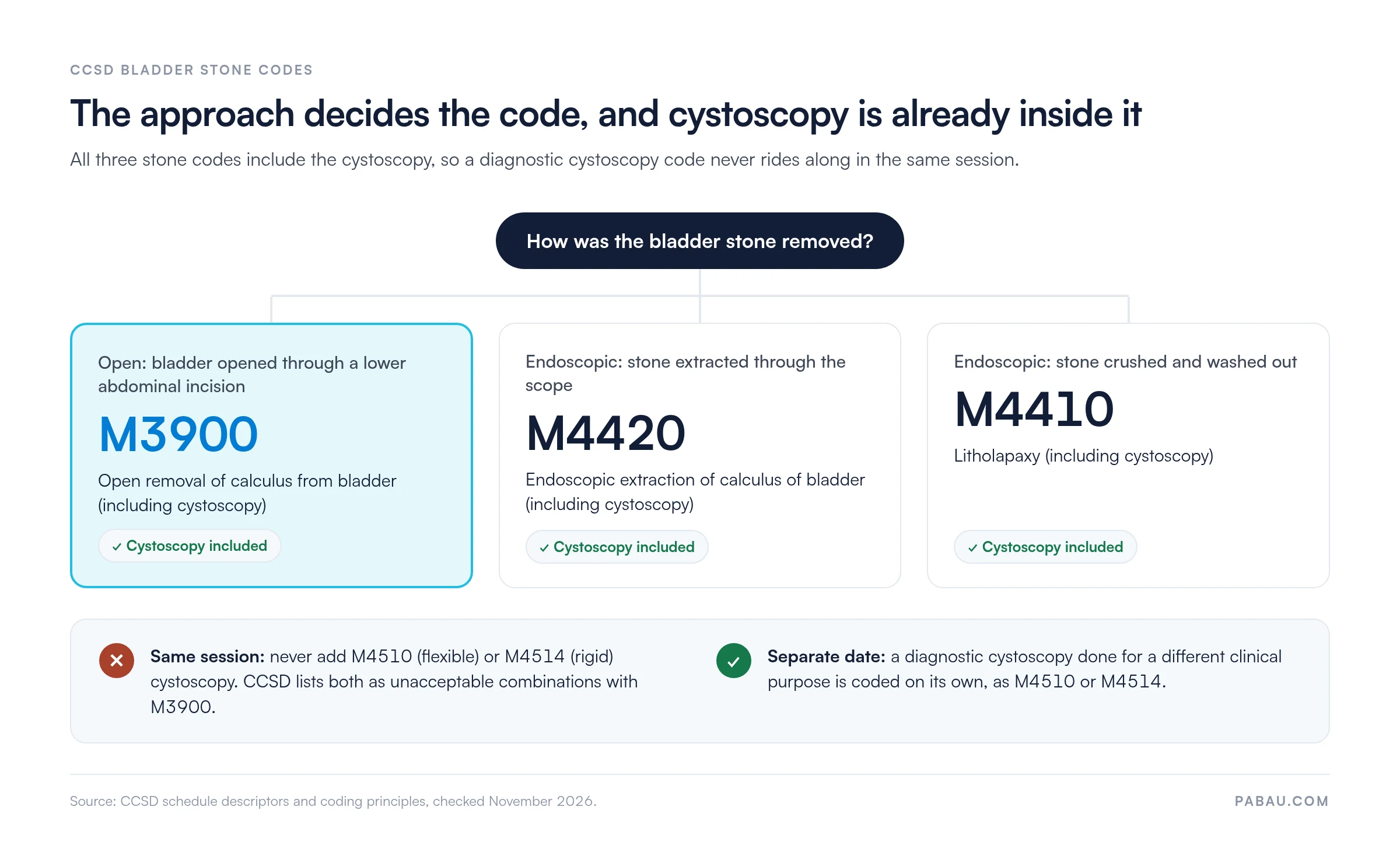
Coders most often confuse M3900 with the endoscopic stone codes and the diagnostic cystoscopy codes beside it. M4420 covers endoscopic extraction of a bladder stone, and M4410 covers litholapaxy, both including cystoscopy. M4510 and M4514 cover diagnostic flexible and rigid cystoscopy. The CCSD schedule treats each one as a distinct procedure.
Cystoscopy performed during an M3900 open stone removal is bundled into the code. A separate diagnostic cystoscopy on a different date, for a different clinical purpose, is billed on its own as M4510 or M4514. The diagram below shows which code each approach takes.
ICD-10 N21.0 (calculus in bladder) is the primary diagnosis code for M3900 claims. Payers validate diagnosis-to-procedure alignment automatically. Submitting M3900 against an unrelated or vague diagnosis code is a common mechanical denial trigger.
Always verify diagnosis codes against the current ICD-10 edition. The NHS Classifications Browser provides the authoritative UK ICD-10 5th edition tabular list and is free to access.
Most private payers expect pre-authorization before open bladder surgery, so confirm each insurer’s current rules before the procedure date. A claim sent without a valid authorization reference is likely to be refused rather than queried. For Bupa’s own rules, see our Bupa CCSD billing guidance.
Pre-authorization requirements change, so verify current policy with the individual payer before elective open surgery. Record the authorization reference in the patient file and enter it on the Healthcode claim.
Request pre-authorization as soon as the decision to proceed with open cystolithotomy is made, not on the day of surgery. Many payers need 48-72 hours to process a surgical authorization, and late or same-day requests are often declined.
An M3900 claim without a complete operative note is an M3900 claim that payers will query or reject. The operative note is the primary clinical evidence that the procedure billed was the procedure performed. It must be completed on the day of surgery or no later than the next working day.
Structured digital forms make it harder to skip a required field before the claim goes through Healthcode.
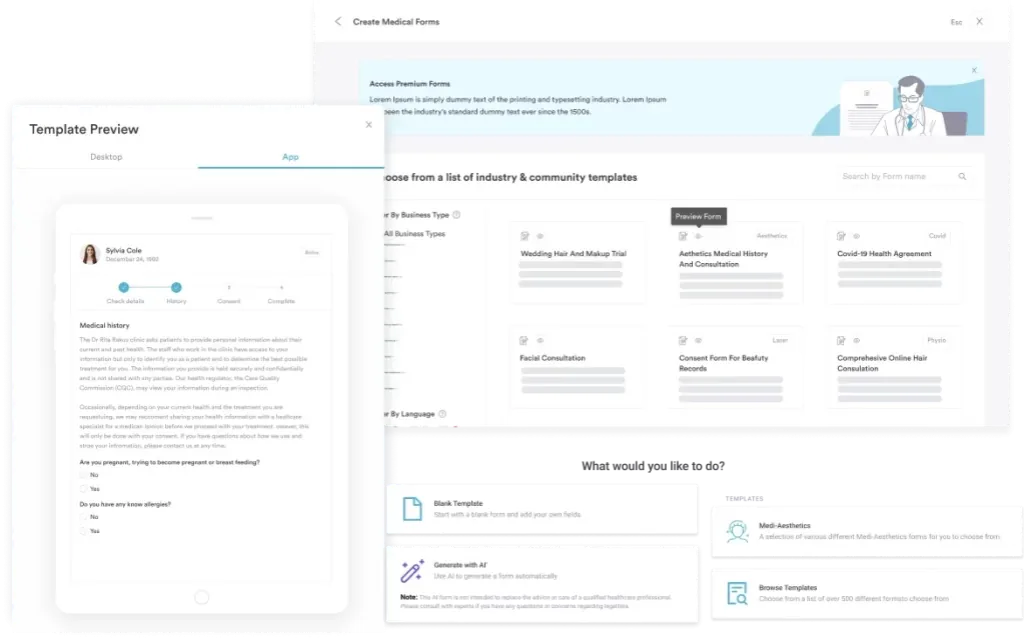
The following elements are required in the operative note for a defensible M3900 claim:
M3900 denials follow similar patterns across payers. Most rejections fall into six categories, and each one can be prevented before the claim goes out.
M3900 covers the surgeon’s fee for the open cystolithotomy. The anesthetist bills separately, using the CCSD anesthetic code for the duration and complexity of the procedure. Anesthetic codes are not bundled within M3900.
Whether the payer covers the anesthetist’s fee depends on the patient’s policy terms and the payer’s recognition agreements. Most major UK private health policies cover separately billed anesthetic fees for recognized surgical procedures, though not all do. Confirm with the payer before billing.
Healthcode is the main electronic billing gateway for UK private healthcare claims. Bupa, AXA Health, Aviva and Vitality accept or require Healthcode submission for surgical codes, including CCSD code M3900.
The CCSD official site publishes the current schedule and technical guide, which define the business rules that apply to code submissions including M3900.
M3900 claims usually go wrong at a handoff. One person secures the authorization, the surgical team writes the operative note, and the billing team builds the claim days later. When each step lives in a different system, a missing reference only surfaces once the insurer queries it.
Pabau keeps those steps on one patient record. The authorization code, dates and sessions are tracked against the case, and staff see a warning when one is missing. Claims then reach insurers through Healthcode and Bupa with Pabau’s private practice claims management tools.
The operative note, consent forms and invoice sit in the same record as the claim. Your billing team reads the surgeon’s note instead of chasing it, and the note is ready when an insurer asks for it.

Pabau tracks each authorization reference against the case and warns when one is missing. Claims go to insurers through Healthcode, with the clinical record behind them.

Choosing M3900 is rarely the hard part. The descriptor names the open approach and bundles the cystoscopy, so a clean claim carries one surgical code and N21.0. Payment is decided around the code instead. It turns on the authorization secured before the procedure date and an operative note that makes the open approach defensible.
If your M3900 claims get queried, check those two things before you revisit the coding. Confirm each insurer’s current pre-authorization rules for open bladder surgery, and make sure the note records the indication, the stones and the cystoscopic findings.
Pabau keeps the authorization reference and the clinical record on the same case, then sends the claim through Healthcode. Book a demo to see how that works for a urology private practice.

Need a full reference for Bupa CCSD procedures? Bupa CCSD codes covers how Bupa procedure codes map to the CCSD schedule and what billing rules apply.
Looking to reduce claim rejections across your private practice? Private practice claims management explains how Pabau handles CCSD billing, pre-authorization tracking, and Healthcode submission.
Coding a stone further up the urinary tract? CCSD code M2730 covers ureteroscopic extraction of a ureteric stone, with cystoscopy and stent insertion or removal included.
CCSD code M3900 covers open removal of calculus from the bladder, with cystoscopy included as a bundled component of the procedure. It applies when a consultant urologist performs an open cystolithotomy under general anesthesia to remove bladder stones that cannot be managed endoscopically.
Cystoscopy is included in M3900 and must not be billed separately. The official CCSD descriptor reads “Open removal of calculus from bladder (including cystoscopy).” CCSD lists M4510 and M4514 as unacceptable combinations with M3900, so billing either for the same session is unbundling.
ICD-10 N21.0 (calculus in bladder) is the required primary diagnosis code for M3900 claims. Secondary codes such as N39.0 (urinary tract infection) or N13.8 (obstructive uropathy) may be added where clinically documented. A diagnosis-to-procedure mismatch is one of the most common mechanical denial triggers for M3900.
Most UK private insurers expect pre-authorization before open bladder surgery such as M3900. Rules vary by insurer and policy, so confirm the current requirements with Bupa, AXA Health, Aviva or Vitality before booking. Request it before the procedure date, not on the day of surgery.
Most M3900 rejections fall into six categories. They are a missing pre-authorization reference, an unbundled cystoscopy code such as M4510, a diagnosis mismatch, and an incomplete operative note. The other two are a fee outside the payer’s current schedule and a duplicate submission for the same episode.
M3900 is the open surgical approach, used when endoscopic removal is not feasible. Endoscopic stone removal is coded M4420 for extraction or M4410 for litholapaxy, both including cystoscopy. Diagnostic cystoscopy codes M4510 and M4514 are never added to M3900 in the same session. The code must match the approach in the operative note.