CPT Code 52352: Ureteroscopic stone removal billing guide
CPT Code 52352: Official descriptor and procedure overview CPT Code 52352 descri...

Last Updated: Oct 30, 2026
M0610 is the CCSD code for open removal of calculi from kidney. CCSD stands for Clinical Coding and Schedule Development, the group that maintains the procedure schedule used by UK private medical insurers. The code covers open surgery that removes stones through the renal parenchyma, the renal pelvis, or both.
M0610 sits in Chapter 12 of the CCSD schedule, Urinary system and male reproductive organs, under Kidney/Renal Pelvic. Bupa, AXA Health, Aviva and Vitality price the code against their own fee schedules. Percutaneous, endoscopic, robotic-assisted and shockwave stone treatments have separate codes.
Let Pabau's smart automation suggest the right codes, reduce claim denials, and keep your practice compliant—effortlessly.
Automate repetitive tasks and focus on what matters most—your patients.
Reduce coding errors and ensure compliance with the latest regulations.
Clean claims, fewer denials, and faster reimbursements.
Powerful insights and reporting to help your practice thrive.
HIPAA compliant SOC 2 certified GDPR-compliant Trusted by 4,000+ clinics worldwide

CCSD Code M0610 covers open removal of calculi from kidney, billed to UK private medical insurers such as Bupa, AXA Health, Aviva and Vitality.
Percutaneous nephrolithotomy (M0940) and robotic-assisted kidney stone removal (M0942) have their own CCSD codes and are unacceptable combinations with M0610.
Open pyeloplasty (M0510) is also an unacceptable combination with M0610, so check the CCSD schedule before adding a second procedure code.
N20.0, calculus of kidney, is the usual primary diagnosis, and insurers may query a diagnosis that does not match the documented stone.
Pabau, our practice management software, submits M0610 claims to insurers through Healthcode and tracks each one to payment.
CCSD Code M0610 is the UK private medical insurance code for open removal of calculi from kidney. It sits in the schedule maintained by the Clinical Coding & Schedule Development (CCSD) Group, which UK private medical insurers use to identify procedures on claims.
M0610 applies when a surgeon removes kidney stones through an open incision. The kidney is entered directly, through the renal parenchyma, the renal pelvis, or both. Its OPCS-4 equivalent, M06.1, lists nephrolithotomy and pyelolithotomy together under the same code.
The code sits in Chapter 12 of the CCSD schedule, Urinary system and male reproductive organs, under Kidney/Renal Pelvic (12.1.0). Insurers including Bupa, AXA Health, Aviva and Vitality recognise CCSD codes. Most practices submit these claims electronically through Healthcode.
Open stone removal is a major operation with a defined sequence. The operative note should record each stage, because those details support M0610 if an insurer queries the claim.
Surgeons choose the open route when stone size, anatomy or a failed earlier procedure makes a percutaneous or endoscopic approach unsuitable.
M0610 fits only when the clinical record explains why open surgery was needed. Insurers look for agreement between the diagnosis, the approach recorded in the notes and the CCSD code on the claim.
Typical indications include:
Where none of these reasons is documented, an insurer may ask why a percutaneous or endoscopic code was not used.
A frequent coding error is choosing M0610 when the stone was removed by a less invasive route. The approach recorded in the operative note decides the code.
Ureteroscopy and shockwave lithotripsy also have their own CCSD codes and are never billed as M0610. Look up the current code numbers in the CCSD schedule, and read the CCSD Technical Guide for the coding principles.
The diagram below maps each recorded approach to the code it points to. It also shows the three codes that never share a claim with M0610.
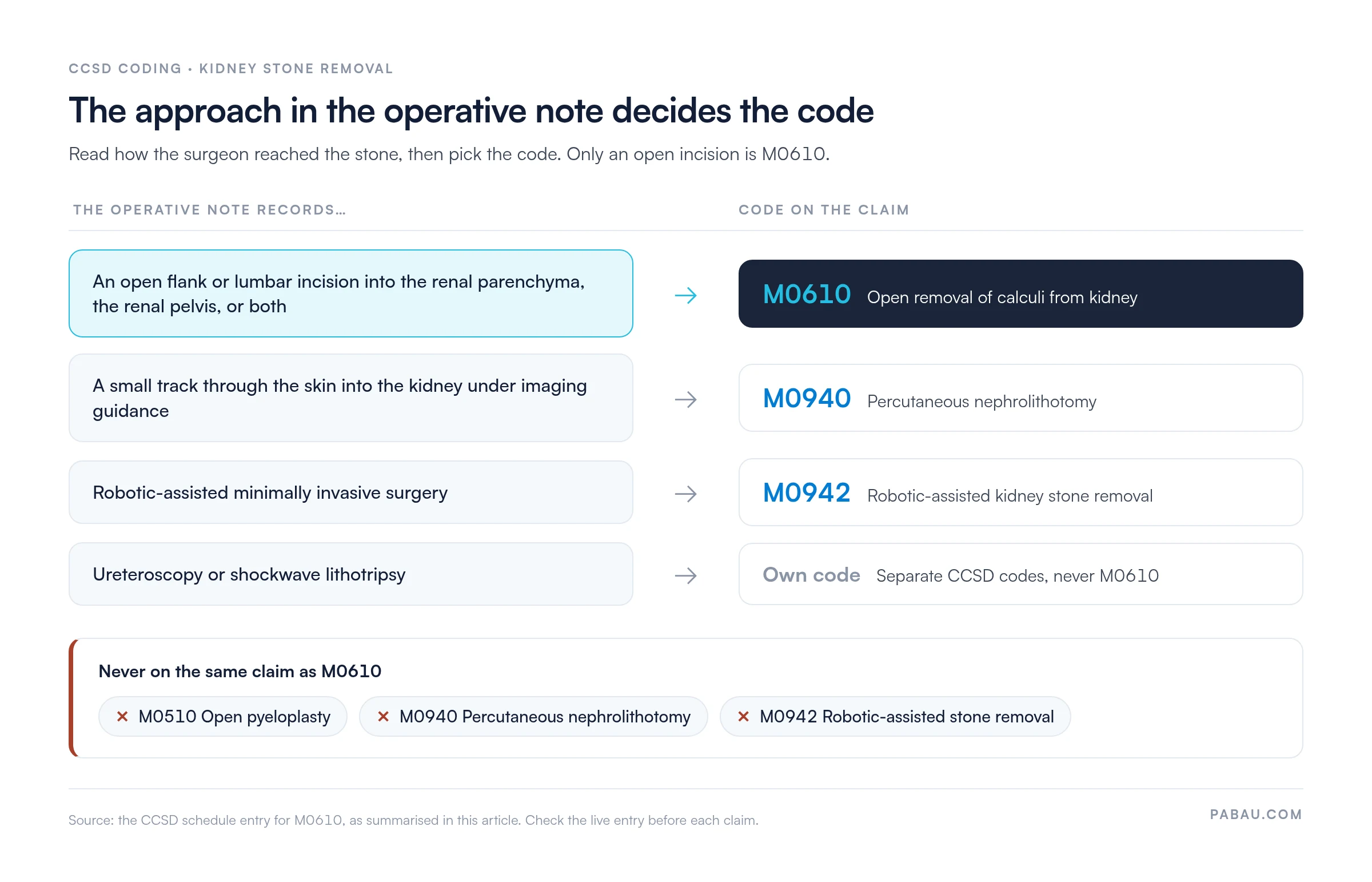
The CCSD schedule lists codes that must not appear on the same claim as M0610. These include:
The list is updated, so check the full M0610 entry on the CCSD website before each submission. The CCSD principles are guidance, and each insurer decides how it applies them.
Before submitting an M0610 claim, open its entry in the CCSD schedule. Check every other procedure code on the claim against the unacceptable combinations listed there. The list changes over time, and M0942 was added in 2024.
Most M0610 claims carry ICD-10 code N20.0, calculus of kidney, as the primary diagnosis. UK insurers expect an ICD-10 diagnosis alongside the CCSD procedure code.
Insurers may query a mismatched diagnosis, such as a ureteric-only stone code on a claim for open kidney surgery. Match the diagnosis to the stone location on imaging and in the operative note.
UK private medical insurers usually require pre-authorisation before an elective admission such as open stone surgery. The patient or the practice contacts the insurer, which issues an authorisation number for the claim.
Insurers typically ask for:
Authorisation is given for a specific procedure. If the planned approach changes, contact the insurer before the claim goes in. An automated reminder before the theatre date can prompt the patient to confirm the number is still valid.
An incomplete operative note is a frequent reason for an M0610 query. The note must show that the kidney was opened surgically, and how.
Record the following in every M0610 operative note:
Without a clear statement of the open approach, an insurer may treat the claim as a less invasive procedure.
CCSD codes carry no CPT-style modifiers. There is no bilateral, repeat-procedure or assistant-surgeon modifier to add to M0610.
An assistant surgeon or an anaesthetist claims separately, where the insurer allows it. Whether those fees apply to M0610 depends on the insurer, so check the CCSD Technical Guide and the insurer’s fee schedule.
Insurer tools such as the Bupa code search and the Healix fee schedule show how individual insurers list a CCSD code and its fees. For how Bupa structures and applies CCSD codes on its claims, see the Bupa CCSD codes guide.
Five causes come up repeatedly on rejected M0610 claims, and each has a direct fix.
Start by reading the insurer’s reason for the rejection, then correct the claim or gather evidence. Send the operative note, the imaging report and a short clinical letter explaining why open surgery was needed.
Quote the authorisation number on every response. Reply within the insurer’s stated timeframe, and resubmit through Healthcode once the insurer agrees the correction.
Billing teams handling M0610 often keep the operative note, the authorisation number and the Healthcode submission in separate places. Pabau, the practice management platform we build, holds them on one patient record.
Through Pabau’s claims management, your team submits claims to insurers via Healthcode and tracks each one. Staff can see where every M0610 claim stands without phoning the insurer.
Coding decisions stay with your surgeon and coder, who choose the CCSD code and the diagnosis. Treatment note templates can prompt the surgeon to record the incision, the structure opened and the clearance imaging. The coder then has the detail an insurer asks for.

Pabau keeps the operative note, the authorisation number and the claim on one patient record. Claims go to Bupa, AXA Health, Aviva or Vitality through Healthcode, and your team tracks each one to payment.

An M0610 claim is easiest to defend when the operative note names the incision, the structure opened and the reason open surgery was chosen. Without those details, an insurer may ask why a less invasive code was not used.
Make the CCSD schedule check a habit before every submission, because unacceptable combinations change over time. Open pyeloplasty, percutaneous nephrolithotomy and robotic-assisted stone removal are the three to watch.
Book a demo to see how Pabau keeps M0610 notes, authorisations and Healthcode claims together for UK urology practices.

Need a wider view of how CCSD codes work? Bupa CCSD codes guide explains how CCSD codes are structured and used on UK private medical insurance claims.
Billing a different open kidney operation? CCSD Code M0800 covers the open kidney operations code and how it differs from stone removal.
Was the stone treated through a scope instead? CCSD Code M1000 covers therapeutic endoscopic kidney operations and the documentation they need.
Coding a kidney removal rather than a stone? CCSD Code M0210 walks through nephrectomy with perirenal tissue excision for UK insurers.
CCSD Code M0610 covers open removal of calculi from kidney through a surgical incision. The surgeon reaches the stones through the renal parenchyma, the renal pelvis, or both. Percutaneous, endoscopic, robotic-assisted and shockwave treatments are coded separately.
M0610 is open surgery through a flank or lumbar incision. M0940 is percutaneous nephrolithotomy, performed through a small track into the kidney under imaging guidance. The CCSD schedule lists the two as an unacceptable combination, so only one goes on the claim.
N20.0, calculus of kidney, is the usual primary diagnosis for M0610. Insurers may query a mismatched diagnosis, such as a ureteric-only stone code, so match the code to the imaging and the operative note.
Yes, in most cases. UK private medical insurers usually require pre-authorisation before an elective admission such as open stone surgery. The insurer issues an authorisation number, which goes on the claim submitted through Healthcode.
No. The CCSD schedule lists open pyeloplasty, M0510, as an unacceptable combination with M0610. Check the current M0610 entry on the CCSD website before adding any second procedure code to the claim.
No. CCSD codes carry no CPT-style modifiers. Assistant surgeon and anaesthetist fees are claimed separately where the insurer allows them, so check the CCSD Technical Guide and the insurer’s fee schedule.