HCPCS Code T2045: Hospice general inpatient care, per diem
HCPCS code T2045: Official descriptor and code classification HCPCS code T2045 i...

Last Updated: Nov 2, 2026
M3000 is the CCSD code for endoscopic examination of the ureter, with or without cystoscopy, insertion or removal of a stent, and retrograde pyelography. It covers a ureteroscopy that inspects the ureter, plus any of those optional steps in the same session.
Because those steps sit inside the descriptor, they are never billed as separate lines. Ureteroscopic stone extraction (M2730) or holmium laser lithotripsy (M3111) replaces M3000 rather than adding to it. An examination that goes on into the renal pelvis falls under kidney-section codes such as M1120 and M1130.
Let Pabau's smart automation suggest the right codes, reduce claim denials, and keep your practice compliant—effortlessly.
Automate repetitive tasks and focus on what matters most—your patients.
Reduce coding errors and ensure compliance with the latest regulations.
Clean claims, fewer denials, and faster reimbursements.
Powerful insights and reporting to help your practice thrive.
HIPAA compliant SOC 2 certified GDPR-compliant Trusted by 4,000+ clinics worldwide

CCSD Code M3000 covers endoscopic examination of the ureter, including any cystoscopy, stent insertion or removal, or retrograde pyelography in the same session.
Separate cystoscopy (M4510, M4514) or retrograde pyelography (M3010) lines are unacceptable combinations with M3000, so they never go on the same claim.
Ureteroscopic stone extraction (M2730) or holmium laser lithotripsy (M3111) is billed instead of M3000, not alongside it.
Most major UK private medical insurers expect pre-authorisation before ureteroscopy, and a note without laterality is a frequent reason for a query.
Pabau, the practice management platform we build, handles CCSD invoicing plus Healthcode claim submission and status tracking for UK urology practices.
CCSD Code M3000 is the code for “Endoscopic examination of ureter (+/- cystoscopy and insertion/removal of stent) +/- retrograde pyelography.” It belongs to the CCSD (Clinical Coding and Schedule Development Group) schedule, the procedure coding system used by UK private medical insurers. M3000 sits in chapter 12, urinary system and male reproductive organs, within section 12.2.0 (Ureter).
The code applies when a consultant urologist passes a ureteroscope into the ureter to examine its lumen. The descriptor writes in three optional steps: a cystoscopy, insertion or removal of a ureteric stent, and retrograde pyelography. Any of them in the same session stays on the single M3000 line. Our CCSD codes library lists the nearby codes in the urinary chapter.
A ureteroscopy coded as M3000 follows a standard retrograde approach. In short, knowing the clinical sequence helps billing staff confirm that the operative note records each element the insurer will look for.
Rigid ureteroscopes suit the distal ureter, whereas flexible scopes reach the proximal ureter. Scope type belongs in the operative note, but it does not change the code while the examination stays within the ureter.
Once the surgeon takes the scope on to examine the renal pelvis, the procedure becomes a ureterorenoscopy, which the schedule codes in the kidney section (12.1.0). Diagnostic ureterorenoscopy is M1120 and therapeutic ureterorenoscopy is M1130. So verify both against the current schedule before invoicing.
The coding question for M3000 is what the surgeon did beyond looking. Cystoscopy, stent insertion or removal, and retrograde pyelography are part of the M3000 descriptor, so they never add a line. Treating a stone changes the code instead.
Two coding errors account for most M3000 rejections in this area. One is billing M3000 when a stone code applied. The other is adding lines for steps the descriptor already covers. The chart below sets out which code each kind of session takes.
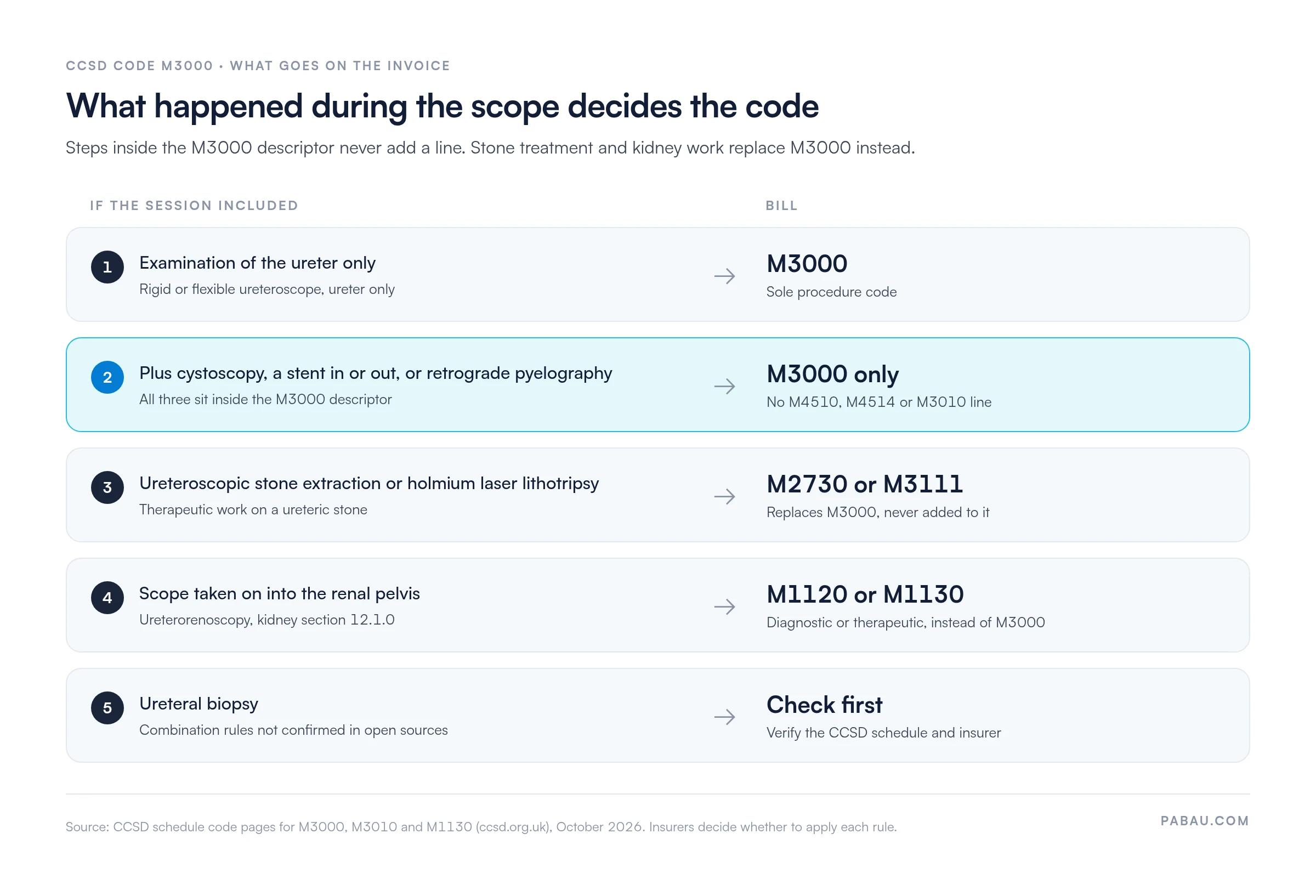
Several CCSD codes sit close to M3000, and most of them cannot appear on the same claim. In fact, CCSD lists the codes below as unacceptable combinations with M3000 or as replacements for it. However, insurers decide whether to adopt each CCSD rule, so check the insurer’s own schedule as well.
Cystoscopy is the line most often mishandled on a ureteroscopy invoice. Because the M3000 descriptor already includes it, a separate M4510 or M4514 line is an unacceptable combination under CCSD rules. Instead, remove it before submission rather than waiting for the insurer to reject it.
The kidney codes follow the same logic. Likewise, CCSD lists both M1110 and M1000 among the kidney codes that cannot be billed with M3000.
A clear, complete operative note is the biggest single factor in M3000 claim acceptance. Vague or incomplete notes are a leading reason UK private insurers query ureteroscopy claims. In addition, UK GDPR requires accurate patient records that are enough to back clinical and admin decisions.
The operation note should contain these elements for M3000 to proceed without query:
Review the operative note before coding rather than after claim submission. Laterality is the easiest documentation fault to correct before invoicing. If the note records only ‘left ureteric calculus seen’ without stating that the left ureter was examined, add a structured addendum before invoicing. Fixing the note before submission is far simpler than correcting a claim after a denial.
Most major UK private medical insurers require pre-authorisation before the surgeon performs a ureteroscopy. Going ahead without a valid authorisation number is a common cause of non-payment for CCSD Code M3000, however well the team documents the procedure. Because insurers update their authorisation policies often, confirm requirements with the insurer before booking.
When a patient’s policy includes an excess or a sub-limit for surgical procedures, confirm these figures during pre-authorisation rather than at invoicing. That way, an exhausted benefit shows up before it becomes a surprise denial.
Healthcode is the UK private healthcare electronic data interchange (EDI) clearing house through which practices submit CCSD claims to most major UK private insurers. Using private healthcare claims management software linked to Healthcode reduces submission errors. It also lets staff track claim status without logging into insurer portals one by one.
Most M3000 denials trace back to a handful of preventable errors. The table below maps each one to the check that stops it before submission.
Appeals against denials for missing pre-authorisation are hard to win. Insurers treat a missing authorisation number as an eligibility failure rather than a clinical dispute. Therefore, prevention is the dependable strategy.
The CCSD schedule publishes no bilateral rule for M3000, and CCSD codes carry no modifiers. Bilateral handling is therefore insurer-specific, so verify the approach with each insurer before submitting.
In practice, two approaches dominate:
Contact the insurer’s provider helpline to confirm their preferred approach, and send the operative note as supporting documentation either way. State bilateral intent clearly in the note: “diagnostic ureteroscopy performed bilaterally; right ureter examined first, then left ureter.” That wording stops the insurer from treating a second line as a duplicate.
Build a bilateral ureteroscopy query into your pre-authorisation checklist. When the clinical team indicates bilateral scope is planned, contact the insurer at pre-auth stage to confirm their preferred billing approach. Resolving this before the procedure means the invoice is correct from the outset rather than being revised after denial.
Without an integrated system, billing staff build each CCSD invoice by hand. Then they log in to separate insurer portals to see whether each claim has been paid.
Pabau creates CCSD invoices for each episode and submits them electronically through Healthcode. As a result, claim status comes back into the same system, so staff can see which M3000 claims are still outstanding without opening each insurer portal.
For practices whose main insurer is Bupa, the Bupa CCSD procedure codes reference covers the wider code set and Bupa-specific billing requirements.

Pabau creates CCSD invoices, submits them through Healthcode and tracks each claim’s status. Your billing team spends less time chasing insurers and more time on patients.

Coding M3000 correctly comes down to one question before invoicing: did the surgeon treat the ureter, or only examine it? An examination with cystoscopy, a stent change or a retrograde pyelogram stays on one M3000 line. Stone treatment or a scope into the kidney moves the claim to a different code.
Build that question into the operative note template and the pre-authorisation request, and fewer queries reach the insurer. The cost is a few extra fields for the surgeon, which is far less work than resubmitting a rejected claim.
Book a demo to see how Pabau handles CCSD invoicing and Healthcode claim tracking for UK urology practices.

Billing for other Bupa procedures? Bupa CCSD codes and fee schedule covers the full Bupa procedure code set with billing and documentation guidance for UK private practices.
Did the scope go on into the kidney? CCSD Code M1000 explains the therapeutic endoscopic kidney code that cannot be billed alongside M3000.
Looking up another procedure? CCSD codes brings together Pabau’s CCSD code references in one place.
CCSD Code M3000 covers endoscopic examination of the ureter. Its descriptor also includes optional cystoscopy, insertion or removal of a ureteric stent, and retrograde pyelography in the same session. Those steps stay on the single M3000 line. For stone extraction or laser lithotripsy, bill its own code, which replaces M3000.
Yes, in most cases. The major UK private medical insurers, including Bupa, AXA Health, Aviva, and Vitality, typically require pre-authorisation before the surgeon performs a ureteroscopy. Going ahead without a valid authorisation number is the most common reason M3000 claims are rejected, and appeals in these cases are rarely successful. Always confirm pre-auth requirements with the specific insurer before booking the procedure.
The most common reasons are missing or expired pre-authorisation, missing laterality in the operative note, and the wrong code for what was done. Billing cystoscopy, a stent change or retrograde pyelography as a separate line also triggers rejections, since M3000 already includes them. In addition, vague operative reports, exhausted benefits and lapsed membership account for many of the rest.
CCSD publishes no bilateral rule for M3000, so handling is insurer-specific. For example, some insurers accept two M3000 lines, one for each ureter, and set their own price for the second. Others, however, want one M3000 line, with the operative note confirming both sides were examined. Confirm the insurer’s approach at pre-authorisation.