CPT Code 25210: Excision of a single carpal bone
CPT Code 25210: Official descriptor and quick-reference data CPT Code 25210 is a...

Last Updated: Nov 26, 2026
M2890 is the CCSD code for push manipulation of stone prior to lithotripsy (as sole procedure). The urologist moves a ureteral stone back toward the kidney so a later lithotripsy session can target it accurately.
The code applies only when that push-back is the only procedure in the session. UK private medical insurers such as Bupa, AXA Health, Aviva and Vitality use the CCSD Schedule to process specialist claims.
Let Pabau's smart automation suggest the right codes, reduce claim denials, and keep your practice compliant—effortlessly.
Automate repetitive tasks and focus on what matters most—your patients.
Reduce coding errors and ensure compliance with the latest regulations.
Clean claims, fewer denials, and faster reimbursements.
Powerful insights and reporting to help your practice thrive.
HIPAA compliant SOC 2 certified GDPR-compliant Trusted by 4,000+ clinics worldwide

CCSD Code M2890 covers push manipulation of a stone before lithotripsy, and it applies only when the push-back is the sole procedure in that session.
The CCSD Schedule lists M2890 in chapter 12 and records a conflict with M3111, holmium laser lithotripsy of a ureteral stone.
UK private medical insurers such as Bupa, AXA Health, Aviva and Vitality adjudicate CCSD claims, most of them submitted electronically through Healthcode.
ICD-10 N20.1 (calculus of ureter) is the usual paired diagnosis, because the stone sits in the ureter when the manipulation takes place.
Pabau, a practice management platform, keeps the operative note, authorization number and Healthcode-ready invoice on one patient record, so M2890 claims go out complete.
CCSD Code M2890 is listed in the CCSD Schedule as “Push manipulation of stone prior to lithotripsy (as sole procedure).” The schedule holds the standard procedure codes for UK private healthcare. It is maintained by the Clinical Coding and Schedule Development (CCSD) Group, whose members represent four major private medical insurers. Insurers use it to identify the procedure on every specialist claim.
M2890 sits in chapter 12 of the schedule, which covers the urinary system. For other codes in the schedule, see the UK private billing reference for CCSD codes.
Three elements of the descriptor define when the code applies:
Read together, the three elements explain most M2890 billing mistakes, which the denial section below covers.
Push manipulation is a short endoscopic procedure. The urologist passes a ureteroscope or a ureteral catheter into the ureter. Irrigation pressure or direct instrument contact then moves the calculus back toward the renal pelvis.
The clinical rationale is simple. Extracorporeal shockwave lithotripsy (ESWL) works best when the stone sits within the kidney’s collecting system, where the focal point can be aimed accurately. A stone lodged in an awkward ureteral segment can be hard to target. That raises the risk of incomplete fragmentation and repeat treatment. Push manipulation moves the stone to a more favorable position before the lithotripsy session.
Key procedure details coders need to capture:
M2890 is indicated when two conditions are both present. First, the patient has a ureteral calculus that needs lithotripsy for definitive stone clearance. Second, the stone’s current position is unsuitable for direct ESWL targeting without prior repositioning.
Clinical scenarios that commonly meet both criteria include:
M2890 is not indicated when the urologist fragments or extracts the stone ureteroscopically in the same session. That work is coded elsewhere in chapter 12, for example ureteroscopic extraction under M2730. The CCSD Schedule lists M2890 as conflicting with M3111, holmium laser lithotripsy of a ureteral stone. The manipulation must also be a clinically necessary step toward planned lithotripsy.
Document the imaging findings that made push manipulation necessary. A radiology report or intraoperative fluoroscopy image confirming the stone’s pre-manipulation ureteral position gives the insurer a clear clinical rationale. That reduces the risk of a ‘not medically necessary’ query.
The phrase “as sole procedure” in the M2890 descriptor limits when the code can be billed. M2890 may only be claimed when push manipulation is the only procedure performed and billed in that session. The diagram below sets out the three session types coders meet.
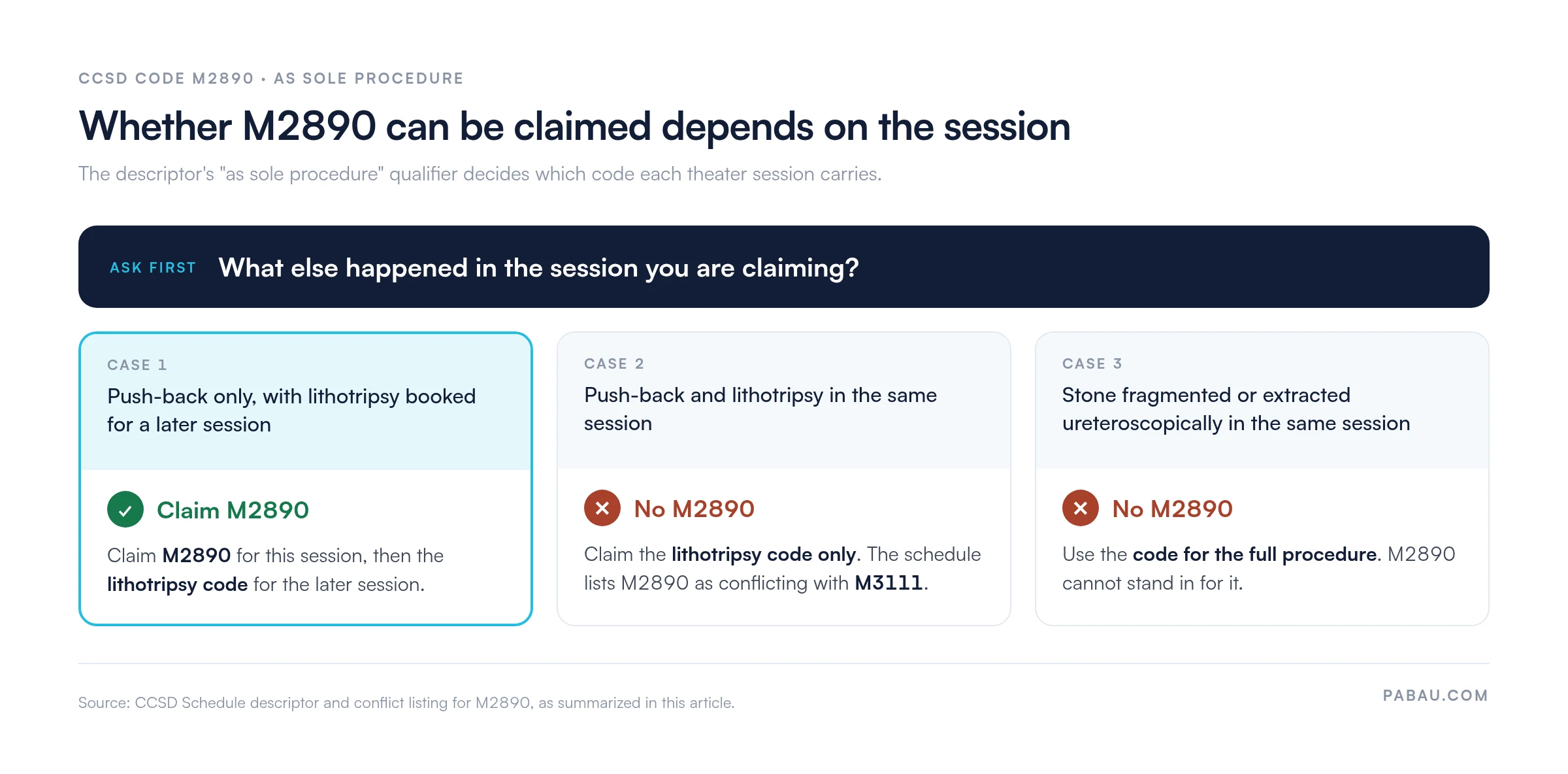
Two practical consequences follow from this rule:
The clean sequence is M2890 for the push-back session, then the lithotripsy code for the later session. Once the stone sits in the kidney, that may be extracorporeal lithotripsy under M1400. A stone still in the ureter points to ureteric ESWL under M3110. Check the exact lithotripsy code against the current schedule before you submit either claim.
M2890 sits among the chapter 12 codes for ureteral stone management. Choosing M2890 when a more comprehensive code applies is a common audit finding. The Bupa CCSD codes guide covers the broader code structure.
Check descriptors and conflicts for other chapter 12 codes against the current CCSD Schedule or an insurer’s own tool, such as the Bupa code finder.
Every M2890 claim should carry an ICD-10 diagnosis code that confirms the clinical indication. UK private claims use the WHO ICD-10 classification for diagnosis coding. The code must match the stone’s location at the time of the manipulation.
Use the ICD-10 code that reflects the stone’s pre-manipulation location, since that is the clinical problem treated in the session. Using N20.0 (calculus of kidney) when the stone was in the ureter at the time is a documentation mismatch that often triggers a query.
Insurers reviewing an M2890 claim look for evidence that push manipulation was a clinically necessary, standalone procedure. The operative note should include each of the following:
A clinical record system that timestamps each entry keeps your operative notes structured. It gives you an auditable chain linking the radiology, the procedure note, and the claim date. Using digital forms for procedure documentation means all five elements above are captured in a consistent, reviewable format every time.
Pre-authorization rules vary by insurer and by policy. UK private medical insurers generally ask the patient to obtain an authorization number before planned specialist treatment. Confirm authorization for the push-back session as well as for the lithotripsy that follows.
Record which CCSD codes each authorization covers, and add the authorization number to the claim. Rules change with each insurer’s policy updates, so check before every session rather than relying on a previous claim.
M2890 claims are rejected for a predictable set of reasons. Most are preventable with clear session records and documentation. The table below maps each denial type to its root cause and resolution.
A correctly submitted M2890 claim follows the clinical workflow. Use this checklist before you submit:
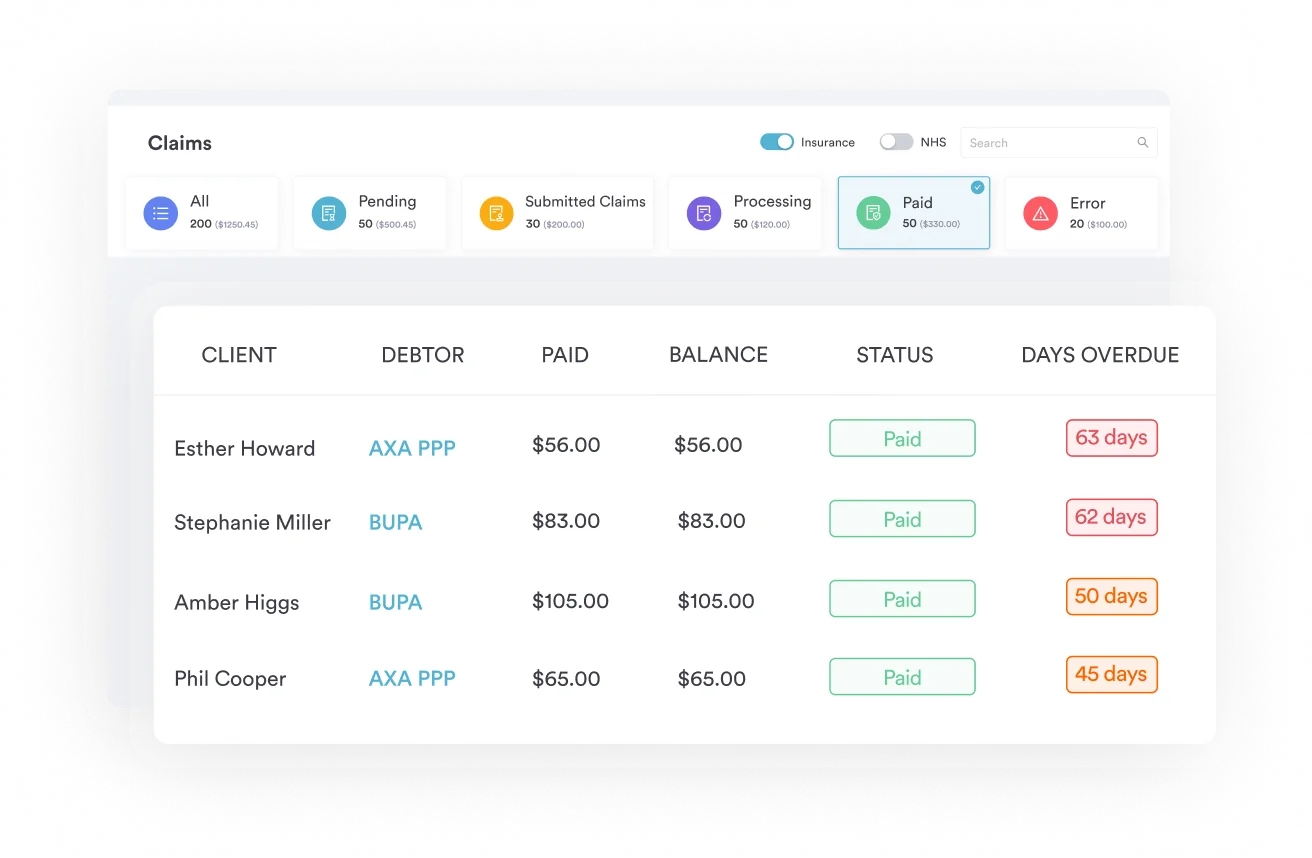
The claims management software in Pabau lets billing teams attach procedure notes to claim records. They can also flag M2890 claims for follow-up and log query outcomes in one place.
Create an M2890 checklist your practice administrator runs before every push manipulation claim. It should confirm the sole-procedure session, the authorization number, an N20.1 or N20.2 diagnosis, and all five operative note elements. A five-minute check prevents weeks of query correspondence.
Many urology practices keep the operative note in one system, the authorization number in an email and the invoice in another. That split is where M2890 claims lose the detail insurers query.
Pabau keeps all three on one patient record. The operative note, imaging reference and authorization number sit beside a Healthcode-ready invoice, so the billing team checks one screen before submitting.
The result is fewer claims returned for missing documentation, and less time spent rebuilding a session history when an insurer asks.

Pabau keeps operative notes, authorization numbers and Healthcode-ready invoices on one patient record for UK private urology practices.

CCSD Code M2890 is simple in concept but easy to mishandle. The sole-procedure qualifier decides every claim, because push manipulation must stand alone in its session. Claiming it alongside M3111 or another lithotripsy code invites a rejection that is preventable at the point of scheduling.
Getting M2890 paid depends on documentation as much as on the code. A record that shows the ureteral stone position, the separate session and the authorization number answers most insurer queries before they arise. To see how Pabau supports billing for private urology practices, book a demo.

Need a broader CCSD billing reference? Pabau’s CCSD code guide covers the CCSD schedule structure, common specialist codes, and how UK private medical insurers adjudicate CCSD claims.
Struggling with claim submission workflows? Pabau’s claims management software helps private practices submit, track, and query claims without manual spreadsheet management.
Coding other ureter procedures? Pabau’s guide to CCSD code M2200 covers billing for ureterostomy closure.
CCSD Code M2890 is the CCSD Schedule code for push manipulation of stone prior to lithotripsy, claimable only as the sole procedure in a session. It covers endoscopic repositioning of a ureteral stone back toward the kidney. Lithotripsy can then target the stone more accurately in a later session.
Not for the same session. The descriptor says “as sole procedure,” so M2890 applies only when the push-back is the only procedure performed. The CCSD Schedule also lists M2890 as conflicting with M3111, holmium laser lithotripsy of a ureteral stone. Lithotripsy belongs in a separate session with its own code.
N20.1 (calculus of ureter) is the primary ICD-10 code for most M2890 claims, because the stone is in the ureter when the manipulation takes place. Use N20.2 when imaging confirms stones in both the kidney and the ureter. Avoid N20.0 (calculus of kidney) for the manipulation session, as it describes the stone’s position after the push-back.
Insurers typically look for an operative note that records the clinical indication, the pre-manipulation imaging and the instrument and technique used. It should also confirm the post-manipulation stone position and show that the session was separate from the lithotripsy. Claims missing these details are often queried as not medically necessary.
The descriptor refers to lithotripsy in general, not only ESWL. When a holmium laser fragments the stone in the same session, M2890 does not apply, because the schedule lists it as conflicting with M3111. Use M2890 only when the push-back session is fully separate from the lithotripsy.
The most common cause is a code conflict with lithotripsy in the same session. A missing authorization number, or a diagnosis code that does not match the stone’s position, also triggers rejections. Check each one before you submit the claim through Healthcode.