HCPCS Code Q4185: Cellesta flowable amnion billing guide
HCPCS Code Q4185: definition and official descriptor HCPCS Code Q4185 is the Lev...

Last Updated: Nov 20, 2026
M2730 is the CCSD code for ureteroscopic extraction of calculus of ureter (including cystoscopy and insertion/removal of stent). UK private medical insurers use it when a urologist removes a ureteric stone through a ureteroscope. Any stent placed or taken out in the same session is included.
M2730 sits in chapter 12 of the CCSD schedule, in the ureter section. A diagnostic ureteroscopy with no stone removed is M3000, and a stone broken up with a holmium laser is M3111. The operation note decides between them, so it has to say how the stone came out.
Let Pabau's smart automation suggest the right codes, reduce claim denials, and keep your practice compliant—effortlessly.
Automate repetitive tasks and focus on what matters most—your patients.
Reduce coding errors and ensure compliance with the latest regulations.
Clean claims, fewer denials, and faster reimbursements.
Powerful insights and reporting to help your practice thrive.
HIPAA compliant SOC 2 certified GDPR-compliant Trusted by 4,000+ clinics worldwide

CCSD code M2730 covers ureteroscopic extraction of a ureteric calculus, with cystoscopy and stent insertion or removal included in the descriptor.
N20.1 (Calculus of ureter) is the primary ICD-10 diagnosis code paired with M2730 on private insurer claims.
Billing cystoscopy or a same-session stent on top of M2730 is unbundling, and insurers reject the extra line.
A stone broken up with a holmium laser is billed as M3111, and a ureteroscopy with no stone removed is M3000.
Pabau’s claims management software tracks pre-authorization codes on each case and sends UK insurer claims through Healthcode and Bupa.
CCSD code M2730 is the UK private insurance code for removing a ureteric stone through a ureteroscope. Cystoscopy and stent work are included in the one fee. It belongs to the CCSD Schedules, the standard procedure codes for the UK private healthcare sector. The official descriptor reads: Ureteroscopic extraction of calculus of ureter (including cystoscopy and insertion/removal of stent).
Three components sit inside the descriptor, so the single M2730 fee covers all of them:
Every neighboring ureter procedure has its own entry in the full CCSD code list. Check the descriptor there whenever the operation note could fit two codes.
Each step below maps to something the operation note has to record. A standard ureteroscopic calculus extraction under M2730 runs in this order:
CCSD code M2730 applies when a ureteric stone needs surgical removal. In England, NICE guideline NG118 on renal and ureteric stones, published January 8, 2019, sets the order of treatment. Adults with a ureteric stone under 10 mm are offered shockwave lithotripsy first. Ureteroscopy is considered when lithotripsy has failed, is unsuitable, or can’t clear the stone within four weeks.
For ureteric stones of 10 to 20 mm, NICE recommends ureteroscopy as the first offer. Shockwave treatment has its own code, M3110, so a patient who moves from lithotripsy to ureteroscopy generates two separate claims.
Pair M2730 with one of the following ICD-10 diagnosis codes on the insurer claim form. The NHS Classifications Browser can confirm the correct code for the UK ICD-10 edition.
Diagnosis code caution: Submitting N23 without imaging that confirms a ureteric stone may trigger an insurer review request. N20.1 is the preferred and most defensible pairing.
Unbundling is a frequent billing error on M2730 claims. It happens when a practice bills cystoscopy or stent insertion as separate line items on the same claim. Both sit inside the M2730 descriptor, so neither can be claimed again. A stent removed at a separate later visit is the exception, and is billed as M2920 or M2930.
M2730 sits among the CCSD ureter codes, and each neighbor describes a different route to the stone. Picking the wrong one is a common reason for a rejected M2730 claim. The closest neighbor is M3000, the diagnostic code, because it also starts with a ureteroscope. Once a stone has passed into the bladder, the bladder codes apply instead, with M3900 for open removal. The chart after the table maps each route in the operation note to its code.
Failed extraction: If the ureteroscope reached the stone but retrieval failed, the operation note must document the attempt. Private medical insurers (PMIs) differ on whether that case is M2730 or M3000, so confirm with the insurer before you submit.
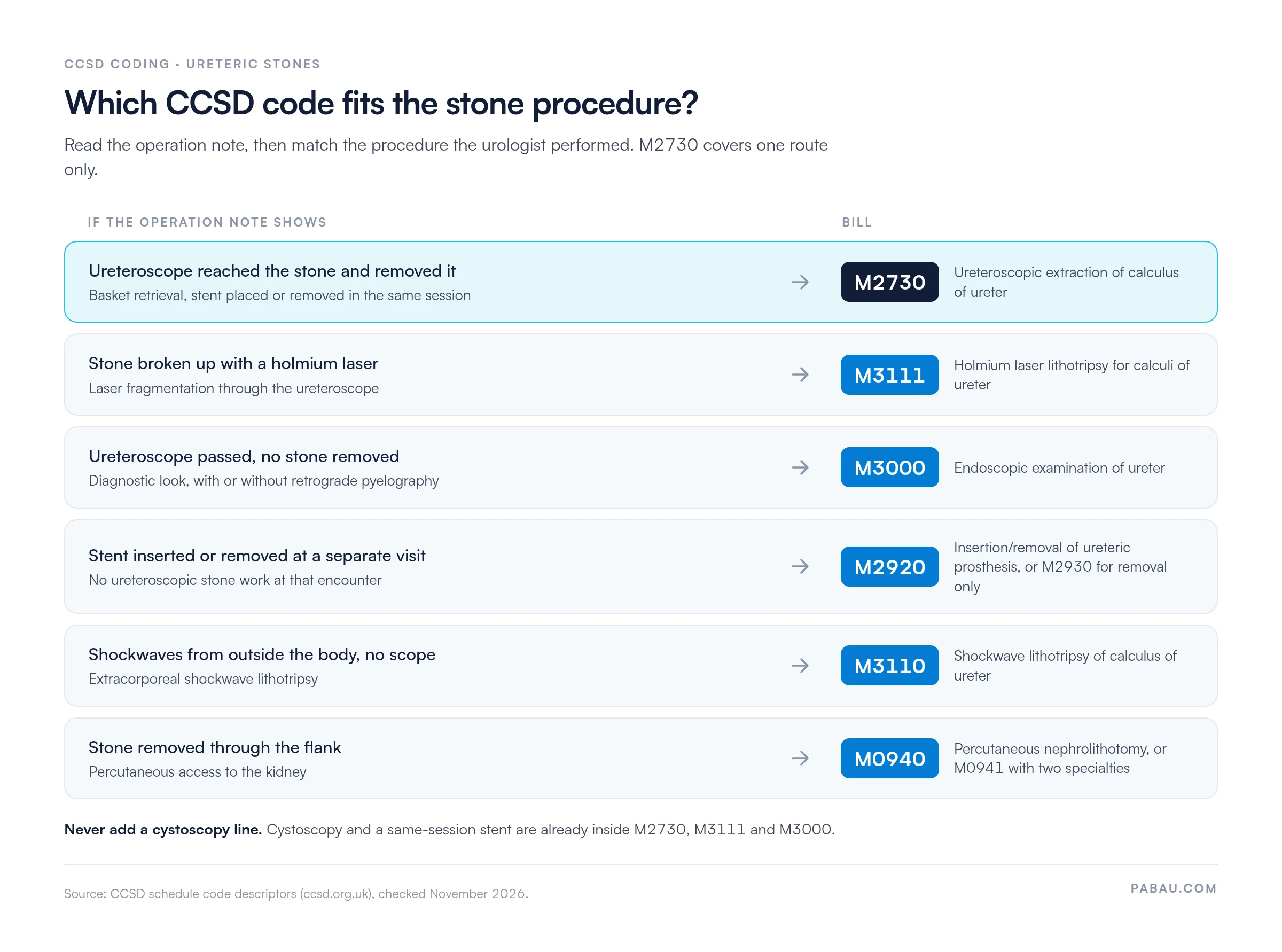
A complete operation note is the most important document behind a CCSD code M2730 claim. Templates that prompt for each mandatory field cut the risk of a documentation-based rejection. The operation note must confirm all of the following:

Run a four-point check before any M2730 claim leaves the practice. Was the ureteroscope advanced to the stone, and was the stone extracted rather than lasered? Was a stent placed or removed, and is an in-date pre-authorization reference on the invoice?
Most UK private medical insurers treat ureteroscopic stone extraction as an elective or semi-urgent procedure. The major PMIs require pre-authorization before the operation goes ahead. Claiming M2730 without a valid, in-date reference is an avoidable cause of denial.
Standard pre-authorization requirements across Bupa, AXA Health, Aviva and Vitality typically include:
Emergency ureteric stone cases (urosepsis, complete obstruction, solitary kidney) may bypass the standard elective pre-authorization pathway. Confirm the emergency admission route with the relevant insurer. For Bupa members, the Bupa code search portal lets you look up M2730 before you submit. Our guide to Bupa CCSD codes explains how Bupa applies the schedule.
Watch for these causes of CCSD M2730 claim denial:
Pabau’s private practice claims management tracks the authorization code, dates and sessions on each case, and warns the team when one is missing. An M2730 claim then doesn’t leave the practice without its reference.
Holmium laser lithotripsy breaks a ureteric stone into fragments before they are retrieved. The CCSD schedule gives that procedure its own code, M3111. Its descriptor reads: Holmium Laser Lithotripsy for calculi of ureter (including cystoscopy and insertion/removal of stent).
M3111 replaces M2730 for a laser case, so the claim carries one procedure code for the session. Choose it by how the stone came out:
Cystoscopy and stent work sit inside M3111 too, so the unbundling rules above still apply. Record laser use in the operation note, because the note is what justifies M3111 over M2730.
Ureteroscopic calculus extraction under CCSD code M2730 is performed under general or spinal anesthesia. It is typically a day-case procedure at a private hospital or independent treatment center. Complex stones, bilateral disease or significant comorbidities can mean an overnight inpatient admission.
The M2730 surgeon’s fee is the same in either setting. What changes is the facility invoice:
Confirm with the PMI whether the pre-authorization reference covers both settings. A change of planned setting may need a revised authorization before admission.
In many private urology practices, an M2730 case passes through three people. A secretary obtains the pre-authorization, and the urologist dictates the operation note into one system. A billing clerk then submits the claim from another, without sight of either document.
Pabau, a practice management platform for private practices, keeps those three steps on one patient record. The authorization code, dates and sessions sit on the case, with a warning when one is missing. The urologist completes the operation note in a digital form, and the claim goes to the insurer through Healthcode or Bupa.
The result is a claim built from the same record as the note behind it. Your billing team stops chasing references by email, and a laser case is far less likely to go out as M2730.

Pabau keeps the pre-authorization, the operation note and the insurer claim on one patient record for UK private urology practices. See how it handles CCSD claims for your team.

M2730 pays cleanly when the operation note answers one question without ambiguity: How did the stone come out? A basket extraction is M2730, a laser case is M3111, and a look with no extraction is M3000.
Agree that wording with your urologists before the next operating list, and check each pre-authorization reference against the date of surgery. The trade-off is a few extra fields per note, in exchange for claims that don’t come back.
Book a demo to see how Pabau links the operation note, the pre-authorization and the Healthcode claim for each M2730 case.

Need a full Bupa code reference for your urology practice? Bupa CCSD codes covers the complete CCSD schedule as used by Bupa, including urology procedure codes and fee chapter navigation.
Looking to reduce claim admin for your private practice? Claims management software from Pabau tracks pre-authorizations on the case and sends UK claims through Healthcode.
Treating the stone through the kidney instead? CCSD code M2600 covers therapeutic nephroscopic operations on the ureter and how to bill them.
Removing a stent at a follow-up visit? CCSD code M2930 explains billing for removal of a prosthesis from the ureter.
CCSD code M2730 covers ureteroscopic extraction of a calculus of the ureter. Cystoscopy and insertion or removal of a ureteric stent are included as integral parts of the procedure. All three are bundled within the single M2730 surgeon’s fee and can’t be billed separately on the same-session claim.
M3000 covers endoscopic examination of the ureter, a diagnostic ureteroscopy with no stone extraction. M2730 is the correct code when a stone is extracted during the ureteroscopic session. If the ureteroscope was passed but no stone was retrieved, M3000 applies, provided the operation note supports it.
A DJ stent inserted or removed during the same ureteroscopic session as the stone extraction is included within M2730. It can’t be billed separately. A stent removed at a later, distinct encounter, such as a follow-up flexible cystoscopy, may be billed as M2920 or M2930.
Yes. Major UK private medical insurers, including Bupa, AXA Health, Aviva and Vitality, require pre-authorization before an elective ureteroscopic stone extraction. The pre-authorization reference must appear on the invoice. Emergency cases may follow a different admission pathway, but most PMI policies still require authorization retroactively.
The usual causes are an expired or missing pre-authorization reference, or cystoscopy billed as a separate line item. Claims also fail when M3000 is used after a stone was extracted, or when a laser case is billed as M2730 instead of M3111. An operation note that doesn’t confirm ureteroscopic access can trigger a denial too, and so can N23 without imaging confirmation.
No. Holmium laser lithotripsy of a ureteric stone has its own CCSD code, M3111, which includes cystoscopy and stent insertion or removal. Bill M3111 instead of M2730 when the laser fragmented the stone, and record laser use in the operation note.