

CPT Code 98981: RTM Treatment Management Billing Guide
CPT code 98981: Definition and official descriptor CPT code 98981 is an add-on c...

Last Updated: Nov 9, 2026
CCSD code M1820 covers excision of segment of ureter, the operation that removes a diseased length of ureter and leaves the kidney in place. Surgeons use it for a short stricture, a small ureteric tumor or a damaged section. It sits in Chapter 12 of the CCSD schedule, Urinary system and male reproductive.
The claim usually trips on what happens next. Joining the ends or replanting the ureter into the bladder can pull in codes the schedule won't accept alongside M1820. Pair the code with the diagnosis the operative note supports, and check every extra ureter code before you submit.
Let Pabau's smart automation suggest the right codes, reduce claim denials, and keep your practice compliant—effortlessly.
Automate repetitive tasks and focus on what matters most—your patients.
Reduce coding errors and ensure compliance with the latest regulations.
Clean claims, fewer denials, and faster reimbursements.
Powerful insights and reporting to help your practice thrive.
HIPAA compliant SOC 2 certified GDPR-compliant Trusted by 4,000+ clinics worldwide

CCSD code M1820 is excision of segment of ureter, a partial ureterectomy that removes one diseased length and keeps the kidney.
It lines up with OPCS-4 M18.2 and sits with the ureter codes in Chapter 12 of the CCSD schedule.
The schedule lists unacceptable combinations with M1820, including M2090 and M3000, so check every extra code against it before the claim goes out.
Pair it with the diagnosis the operative note supports, such as an N13 stricture code or C66 for a ureteric cancer.
Pabau tracks the authorization code on each patient’s case and warns when one is missing, so an M1820 claim doesn’t go out without it.
M1820 pays for removing one segment of the ureter, the tube that carries urine from the kidney to the bladder. The surgeon cuts out the diseased length, and the kidney stays. Clinicians call this a segmental or partial ureterectomy.
CCSD codes are the procedure codes UK private medical insurers use, maintained by the Clinical Coding & Schedule Development group. M1820 lines up with OPCS-4 M18.2, the NHS classification’s code for the same operation. That shared description helps hospital coders and practice billers land on the same answer.
Knowing where the code stops matters just as much. These neighbors are billed differently:
The map below sets M1820 beside the ureter codes it’s most often confused with.
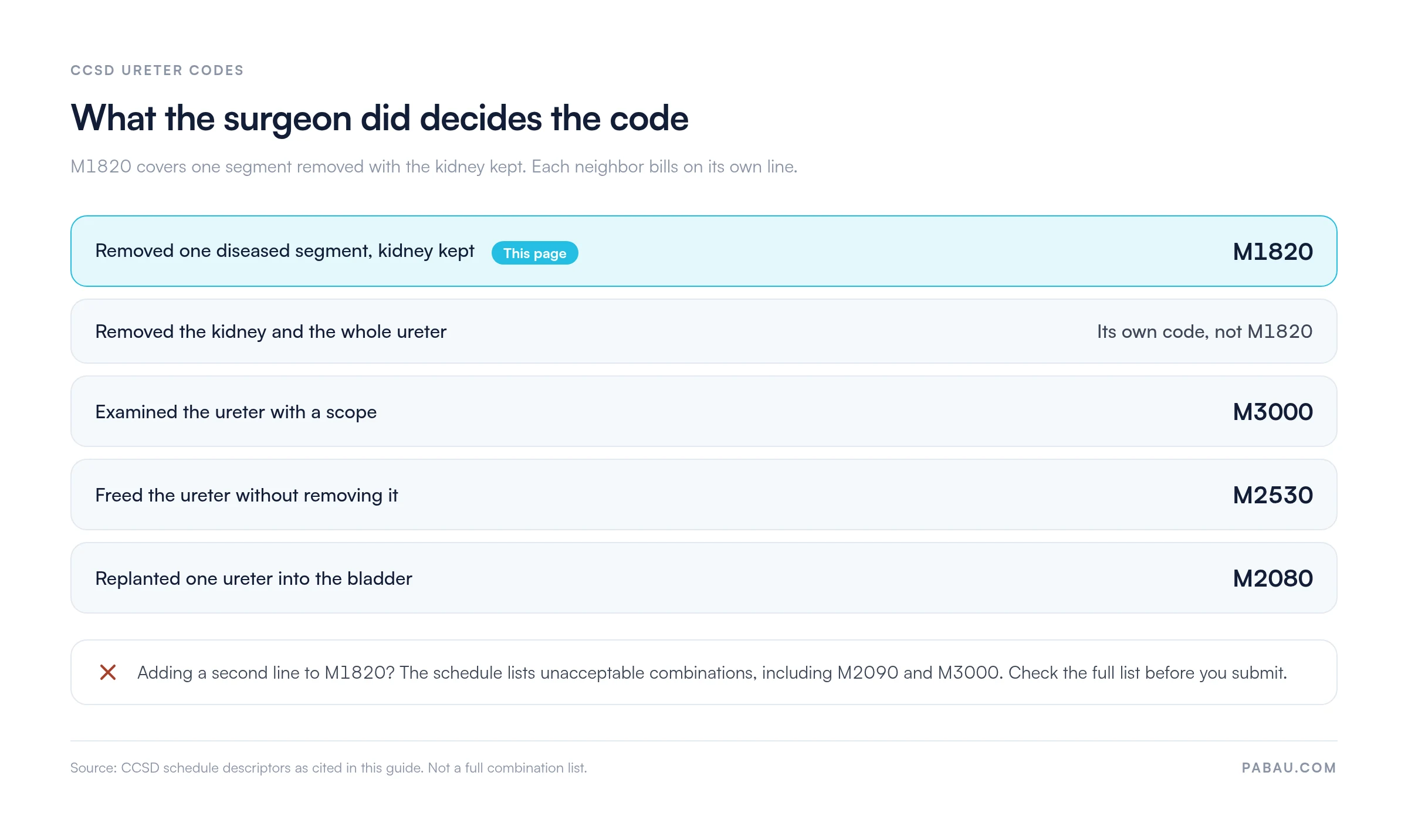
The operation suits a problem confined to one short length of ureter. Three situations come up again and again.
How the surgeon restores drainage depends on where the segment was. A mid or upper section is usually joined end to end. A section near the bladder often means replanting the ureter into the bladder instead. Replantation has codes of its own, such as M2080 for one side. That second step is where most coding trouble starts.
UK insurers expect an ICD-10 code on the claim. Take it from the indication in the operative note, not from the name of the procedure. These codes fit the usual reasons for the operation.
If the final histology changes the picture, update the diagnosis before you invoice. A claim sent with a stricture code and corrected to C66 later invites a query.
The CCSD schedule lists unacceptable combinations for M1820, including M2090 and M3000. Neither belongs on the same claim.
The full list may be longer. Other ureter codes, including M1120 for diagnostic ureterorenoscopy and M2530 for ureterolysis, may carry the same flag. Check each one in the CCSD schedule before you add it.
When a second procedure genuinely took place, describe it as its own step in the operative note. If the schedule still blocks the pair, raise it with the insurer before you invoice, not after a rejection.
A vague note is the quickest route to an insurer query on a partial ureterectomy. Before the claim goes out, check that the note states:
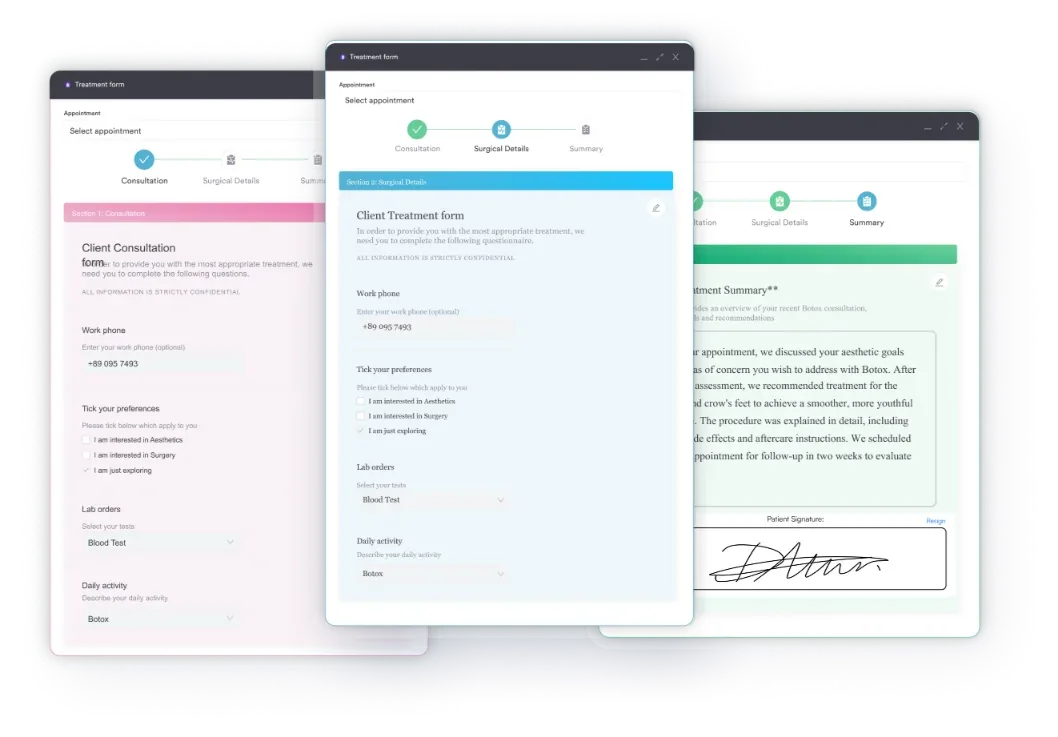
The signed consent form and pre-operative imaging belong in the same record. Digital clinical forms make that record easier to keep consistent across surgeons.
Most of the work happens before the invoice exists. Here’s the usual sequence for a planned operation.
Each clinician bills separately. The surgeon claims M1820, while the anesthetist and the hospital send their own invoices.
Here’s how a straightforward claim might come together. The case is illustrative.
A patient develops a 2 cm stricture in the middle third of the left ureter after an earlier ureteroscopy. Imaging shows the kidney above it has swollen. The surgeon removes the narrowed segment and joins the healthy ends over a stent.
The biller codes M1820 with N13.1, because the stricture has caused hydronephrosis. The note confirms the side, the segment length and the end-to-end repair. The surgeon also inspected the ureter with a scope in the same session. That look stays off the claim, because the schedule lists M3000 as an unacceptable combination with M1820.
Histology comes back benign, so N13.1 stands. The authorization reference was issued before surgery, and it goes on the invoice exactly as issued.
Partial ureterectomy billing passes through several hands. The surgeon writes the note, pathology reports days later and the biller holds the authorization reference.
Pabau, the practice management platform we build, keeps those pieces on one patient record. Through its claims management software, UK practices send claims to Healthcode and BUPA from that same record.
The authorization code, its dates and its sessions are tracked on the patient’s case. Pabau warns you when one is missing, so the reference is in place before the claim leaves.
For an M1820 claim, the histology update and the authorization reference sit beside the claim they belong to. An insurer query weeks later gets answered from one screen.

Pabau tracks the authorization on each patient’s case, warns when it’s missing and sends UK claims through Healthcode and BUPA. Billing teams answer insurer queries from one record.

M1820 looks simple on paper. One segment of ureter comes out, and one code goes on the claim. The difficulty sits in the steps around it.
Keep the diagnosis tied to the histology, keep blocked codes off the claim and make the note say exactly what was removed. Those three habits answer most insurer questions before anyone asks them.
Build them into the workflow rather than into someone’s memory. A check held in the system survives a busy list and a change of staff.
Book a demo to see how Pabau keeps CCSD codes, authorization references and operative notes on one record.

Need the wider view of the CCSD schedule? Bupa CCSD codes covers the full Bupa schedule with billing rules and payer-specific guidance.
Replanting the ureter after a low excision? CCSD code M2080 explains how unilateral replantation of the ureter into the bladder is billed.
Coding a scope of the ureter instead? CCSD code M3000 sets out the rules for endoscopic examination of the ureter.
Freeing a trapped ureter rather than removing it? CCSD code M2530 covers unilateral ureterolysis and how it is claimed.
Checking what a procedure is worth under Bupa? Bupa procedure codes and fee schedule explains how the fee schedule works and where to verify a current rate.
It’s M18.2. NHS hospitals record the operation with that OPCS-4 code, while UK private insurers expect CCSD code M1820 on the claim.
The Clinical Coding & Schedule Development group, whose members include Aviva, AXA Health, Bupa and Vitality. It maintains the codes and their descriptions, but it doesn’t set fees. Each insurer decides what it pays.
It depends on the insurer and the patient’s policy. Check the insurer’s current fee schedule or provider portal before you quote the patient, because rates change.
No. A partial ureterectomy removes a segment, and a ureteroureterostomy joins the two remaining ends. Surgeons often do both in one operation. Check the schedule before you bill the join as a separate line.




