HCPCS Code E0272: Foam rubber mattress billing guide
HCPCS Code E0272: official descriptor and code overview HCPCS Code E0272 is the ...

Last Updated: Nov 6, 2026
M3110 is the CCSD code for extracorporeal shockwave lithotripsy of calculus of ureter. It covers one session of shockwaves focused on a ureteric stone from outside the body, so the fragments can pass naturally.
The code sits in the ureter section of chapter 12 of the CCSD schedule. A kidney stone treated the same way takes M1400, while imaging guidance, stents and anaesthesia are coded separately.
Let Pabau's smart automation suggest the right codes, reduce claim denials, and keep your practice compliant—effortlessly.
Automate repetitive tasks and focus on what matters most—your patients.
Reduce coding errors and ensure compliance with the latest regulations.
Clean claims, fewer denials, and faster reimbursements.
Powerful insights and reporting to help your practice thrive.
HIPAA compliant SOC 2 certified GDPR-compliant Trusted by 4,000+ clinics worldwide

CCSD Code M3110 covers extracorporeal shockwave lithotripsy of a stone in the ureter. A kidney stone treated the same way takes M1400.
N20.1 (calculus of ureter) is the usual ICD-10 pairing for M3110, and N20.2 applies when kidney and ureter stones occur together.
Imaging guidance, stent insertion and anaesthesia are coded separately, because M3110 covers the shockwave session only.
Most UK private medical insurers require pre-authorisation before ureteric ESWL, and a missing authorisation reference is a common denial trigger.
Pabau’s claims management software stores each pre-authorisation as a case and sends claims to Bupa, AXA Health and Vitality through Healthcode.
CCSD Code M3110 is the Clinical Coding and Schedule Development code for extracorporeal shockwave lithotripsy (ESWL) of a calculus of the ureter. High-energy shockwaves are focused on a ureteral stone from outside the body. The stone breaks into fragments that pass naturally through the urinary tract.
The CCSD schedule organises urology codes by anatomical site. M3110 sits in the ureter section of chapter 12 and covers the whole ureter, from the ureteropelvic junction to the ureterovesical junction. Our CCSD codes index lists the neighbouring urology procedures in the same schedule.
The code covers one treatment session. Repeat sessions for the same stone episode are billed separately and, in most cases, need fresh pre-authorisation.
ESWL for a ureteral stone is a non-surgical outpatient procedure. Knowing the clinical steps helps billing staff match the operative note to M3110 and spot ancillary services that take their own code.
The procedure typically takes 45 to 60 minutes. A ureteral stent inserted beforehand to help fragments pass is a separate procedure with its own CCSD code. Taking that stent out later by cystoscopy is a separate claim again, billed as CCSD M2930. Anaesthesia, whether general or intravenous sedation, is coded separately too.
M3110 covers the shockwave lithotripsy session applied to the ureteral stone only. It does not bundle imaging guidance, stent procedures or anaesthesia. Coding each one correctly prevents both underclaiming and insurer rejections for over-coding.
Always confirm with the insurer whether fluoroscopy guidance is bundled into their benefit schedule payment for M3110 or billed separately. Some fee schedules absorb imaging into the procedure rate, while others expect a separate radiology claim. Misreading the schedule is a common source of duplicate-claim rejections.
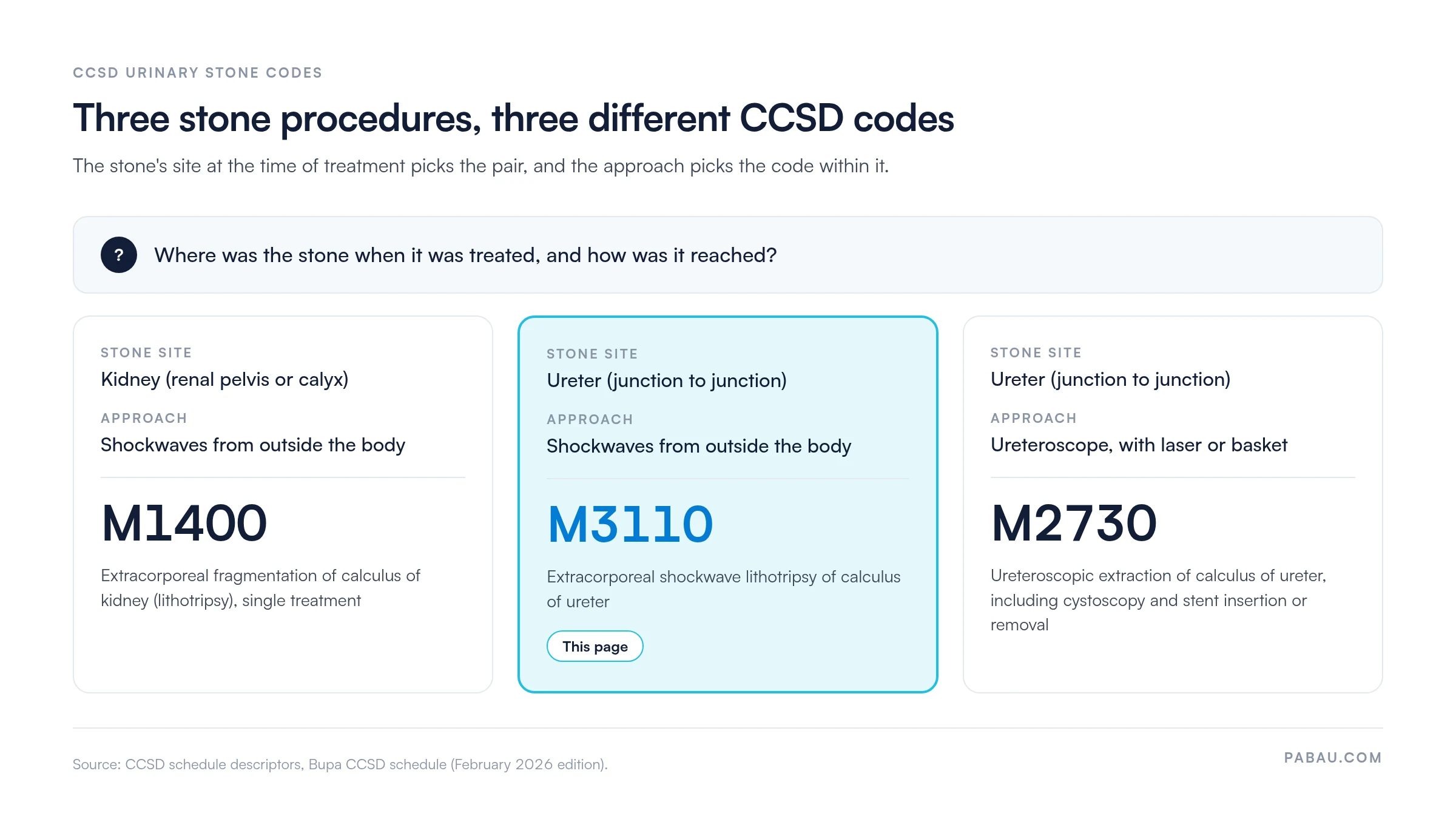
The stone’s location decides which lithotripsy code applies. M3110 versus M1400 is the most common mix-up in private urology billing, because both codes describe shockwave treatment from outside the body.
The line between M1400 and M3110 is anatomical. The operative note must state whether the stone sat in the kidney or the ureter at the time of treatment. Where ureteroscopy only examines the ureter and removes no stone, M3000 applies instead. A kidney stone broken up through a flexible ureteroscope rather than by shockwaves takes CCSD code M0910.
A stone can migrate from the kidney to the ureter between pre-operative imaging and the procedure date. The operative note should then record the intraoperative confirmation.
Coders who work from the referral letter instead of the operative note risk choosing the wrong code. The chart below sets out the three codes by stone site and approach.
Every CCSD Code M3110 claim needs a supporting ICD-10 diagnosis code on the claim form. The ICD-10 code confirms clinical necessity and must match the stone location documented in the medical record. Check the selection against the clinical notes, instead of defaulting to one code for every ureteral stone.
N20.1 is the most specific diagnosis code for the large majority of M3110 claims. Using N23 when the stone site is documented invites insurer queries and requests for further clinical justification. The Bupa code search tool lets billing teams check accepted diagnosis pairings for each procedure code before submission.
Several legitimate ancillary codes often accompany M3110 claims. Each one is a separate service and needs its own documentation. Billing them without confirming that each service was delivered and recorded is an unbundling risk.
UK private medical insurers treat ureteric ESWL as an elective urology procedure that needs pre-authorisation. A claim for M3110 without an authorisation reference is one of the quickest routes to a denial in private urology billing. Requirements vary by insurer, so check the current benefit schedule at the time of service.
Vitality and Aviva each publish provider fee schedules, so billing teams can check procedure-specific requirements and reimbursement levels.
Approval timelines differ between insurers, so submit pre-auth requests well before the procedure date. For Bupa claims, our Bupa CCSD codes guide covers how the schedule works and what submission needs.
A clean M3110 claim stands on the operative or procedure note. Every element listed below should be present before the claim is submitted. Missing documentation is both a denial risk and an audit exposure.
Pabau, the practice management platform we build, lets urology teams set up structured procedure note templates. Setting these six elements as required fields means each note reaches billing with every element filled in.
ESWL claims for ureteral stones are denied for a small set of predictable reasons. Most are avoidable with the right pre-submission checks.
Not every ureteral stone fragments fully in a single session. When a stone persists, a second or third ESWL session may be clinically justified. Each session is billed under M3110, and each one needs its own pre-authorisation and clear record of clinical necessity.
Many urology billing teams track M3110 episodes across an insurer portal, a spreadsheet of authorisation numbers and the clinical record. A reference typed into the wrong place, or missing from a repeat session, comes back weeks later as a denial.
Pabau’s claims management software stores each insurer pre-authorisation as a case. Staff attach the case when booking the ESWL session, so the authorisation reference follows the appointment onto the claim.
Claims go to Bupa, AXA Health, Vitality, WPA and Aviva through Healthcode, and Bupa cover can be checked in seconds before the session. Claim validation flags missing or invalid details before submission. The dashboard then tracks every claim from Pending to Paid, searchable by authorisation code.
Run a three-point check before submitting any M3110 claim. Confirm the operative note places the stone in the ureter, and that the authorisation reference is recorded in the billing system. Then confirm the ICD-10 code matches the most specific location documented. These three checks clear most M3110 denial triggers before submission.

Pabau stores each pre-authorisation as a case, validates claims before submission and sends them to UK insurers through Healthcode. See how it fits a private urology practice.

M3110 rarely fails on the code itself. Claims fail when the record cannot show where the stone sat, how it was treated, and that the insurer authorised that session.
Make the operative note the source of the code, and treat every repeat session as a new authorisation. A practice that does both turns ureteric ESWL into one of the more predictable claims in private urology.
Book a demo to see how Pabau links each ESWL session to its pre-authorisation and sends the claim through Healthcode.

Coding a patient whose stone site isn’t confirmed yet? ICD-10 Code N23 explains when unspecified renal colic is the right diagnosis code, and when it isn’t.
Is the stone being treated endoscopically inside the kidney instead? CCSD Code M1000 covers therapeutic endoscopic operations on the kidney.
Checking how Bupa lists urology procedures? Our Bupa procedure codes and fee schedule guide brings the insurer’s codes together in one place.
Comparing billing systems for a UK private practice? The best medical billing software in the UK compares the options for insurer claims and self-pay billing.
CCSD Code M3110 covers extracorporeal shockwave lithotripsy of a calculus of the ureter, meaning one shockwave session to fragment a ureteric stone. It excludes fluoroscopic guidance, stent insertion, anaesthesia and follow-up consultations, which are billed under their own codes.
M1400 covers extracorporeal lithotripsy of a kidney stone, while M3110 covers shockwave lithotripsy of a ureteric stone. The stone’s site at the time of treatment decides the code. Confirm it from the operative note, not from the referral letter or pre-operative imaging alone.
N20.1 (Calculus of ureter) is the primary ICD-10 code paired with M3110 when the stone is confined to the ureter. N20.2 (Calculus of kidney with calculus of ureter) applies when the patient has concurrent renal and ureteral stones. Avoid N23 (unspecified renal colic) when the stone location is clearly documented.
Yes. Most UK private medical insurers, including Bupa, AXA Health, Vitality Health and Aviva, require pre-authorisation before ureteric ESWL. Obtain the authorisation reference before the procedure date and record it on every claim line for the episode.
Yes. Stent insertion uses a separate CCSD code and can be billed alongside M3110 when a JJ stent is inserted as a distinct service. Bundling rules differ by insurer, so check whether the benefit schedule folds stent insertion into the M3110 rate first.
Each session is billed under M3110 separately. Each one needs fresh pre-authorisation and documentation showing the residual stone burden. Some insurer benefit schedules cap reimbursable sessions per stone episode, so check the current schedule before every session.