

ICD-10 Code S53.013D: Anterior subluxation of unspecified radial head
ICD-10 Code S53.013D: Quick reference summary Use the table below as your first ...

Last Updated: Nov 6, 2026
Billable Code Specific Code
T87.9 is the billable ICD-10-CM code for unspecified complications of amputation stump. It applies when the provider documents a complication of the residual limb but does not name its type.
The code closes category T87, Complications peculiar to reattachment and amputation. Coders reach for it only after ruling out the named stump codes for neuroma, infection, necrosis, dehiscence and other specified complications.
Let Pabau's smart automation suggest the right codes, reduce claim denials, and keep your practice compliant—effortlessly.
Automate repetitive tasks and focus on what matters most—your patients.
Reduce coding errors and ensure compliance with the latest regulations.
Clean claims, fewer denials, and faster reimbursements.
Powerful insights and reporting to help your practice thrive.
HIPAA compliant SOC 2 certified GDPR-compliant Trusted by 4,000+ clinics worldwide

T87.9 is a billable ICD-10-CM code for an amputation stump complication when the chart documents no more specific type.
Check T87.81, T87.89 and the T87.3x, T87.4x and T87.5x codes first, because T87.9 applies only when the record supports no more detail.
Payers, Medicare included, look harder at unspecified complication codes, so thin chart documentation puts a T87.9 claim at risk of denial.
A completed CDI query that returns no further specification is the strongest support for T87.9 on audit or appeal.
Pabau, the practice management platform we build, sends electronic claims after a real-time eligibility check and tracks each one through to the remittance.
ICD-10 code T87.9 is the billable ICD-10-CM code for unspecified complications of amputation stump. Coders assign it when the provider documents a stump complication but names no specific type, such as infection, necrosis, neuroma or dehiscence.
The table below summarizes the reference data to check before T87.9 goes on a claim.
T87.9 covers any complication arising from an amputation stump that the treating provider has documented without naming its specific nature. The ICD-10-CM tabular places it as the residual subcategory of T87. It applies only after every more specific sibling has been ruled out.
In ICD-10-CM, “unspecified” means the documentation supports no more precise descriptor. Take a note that reads “stump wound with no further characterization.” If the chart cannot show whether that wound is dehiscence, infection, necrosis or neuroma, T87.9 is the correct assignment. If the chart does support a named complication and the coder misses it, that is a coding error.
Chart scenarios that typically code to T87.9 include:
T87.9 does not cover phantom limb syndrome, which codes to G54.6 or G54.7. Complications of internal prosthetic devices go to the T84 categories, and aftercare for a healed amputation uses Z47.81 or a related Z47 code.
Stump edema is not a T87.9 scenario either. It is an inclusion term under T87.89, so documented edema codes there instead.
Category T87 covers two families: complications of reattached body parts (T87.0x to T87.2) and complications of amputation stumps (T87.3x to T87.9). Most stump subcodes split first by complication type, then by extremity.
T87.9 carries no laterality option. The side of the stump matters only once the complication type is known, because the neuroma, infection and necrosis codes split by extremity. A note that says “left lower limb stump complication, nature not determined” names a side but no type, so it still codes to T87.9.
The ICD-10-CM Official Guidelines require the most specific code available. T87.9 is appropriate only after the coder has worked through the specificity ladder below.
The chart below lays the same ladder out by documented finding, with T87.9 as the last stop.
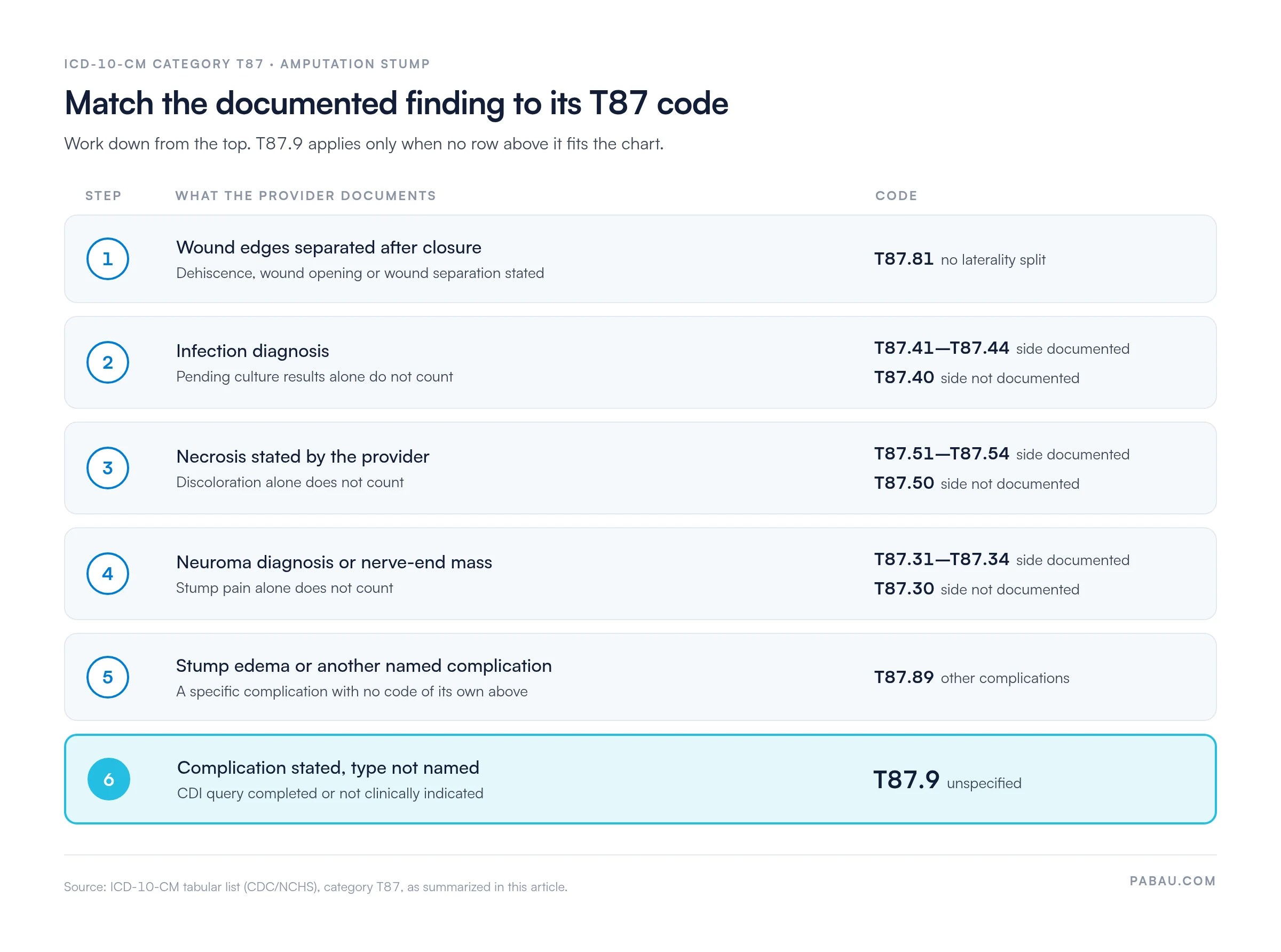
T87.81 applies when the stump wound edges have separated after surgical closure. The chart must document wound opening, wound separation, or dehiscence explicitly. A note of “wound not healing” or “wound with drainage” without separated edges does not support T87.81. T87.9 may apply there, pending a CDI query. T87.81 carries no laterality split, so site documentation does not change this code.
T87.4x codes require a documented infection diagnosis. Laterality is captured when the chart records it. T87.41 covers the right upper extremity, T87.42 the left upper, T87.43 the right lower and T87.44 the left lower. When the side is not documented, T87.40 applies.
T87.9 may serve as a temporary placeholder while culture results are pending and no infection diagnosis is documented. The coder must follow up and amend the claim once results return. Keeping T87.9 after infection is confirmed is a coding error.
Necrosis must be documented explicitly, as “stump necrosis,” “tissue death at the residual limb,” or equivalent clinical language. Discoloration alone does not confirm necrosis without a provider statement. Laterality is coded where documented: T87.51 right upper, T87.52 left upper, T87.53 right lower and T87.54 left lower. T87.50 covers necrosis with no side recorded. Without a necrosis diagnosis, T87.9 applies.
Stump neuroma is a specific complication requiring provider documentation of a nerve-end mass or a neuroma diagnosis. Once confirmed, the neuroma codes split by extremity, so a neuroma at a left lower extremity stump codes to ICD-10 code T87.34. Stump pain alone, particularly burning or phantom-type pain, does not automatically translate to T87.3x. The chart needs a clinical diagnosis of neuroma, or imaging or exam findings consistent with one that the provider has documented. Where stump pain is noted but no neuroma is confirmed, T87.9 is appropriate.
Before assigning T87.9, run a CDI query whenever the chart holds findings that could support a named sibling code. Wound drainage, a pain pattern, discoloration and wound separation all qualify. Record the query and the provider response. A completed query that returns ‘no further specification possible’ is your strongest defense if a payer audits the unspecified code.
An unspecified code holds up on audit when the chart contains the right elements. Check each of these before a T87.9 claim goes out.
Good CDI practice treats a run of unspecified complication codes as a cue for provider education. When one provider’s notes keep producing T87.9 with no query activity, the documentation habit usually needs attention first.
The General Equivalence Mappings (GEMs) published by the Centers for Medicare and Medicaid Services provide directional crosswalk data between ICD-9-CM and ICD-10-CM. GEMs are approximations. Use them for retrospective billing, legacy payer system matching and audit trail documentation, and confirm clinical specificity separately.
The backward map from ICD-10-CM to ICD-9-CM is simple for T87.9, which maps back to 997.60. For retrospective records that hold only an ICD-9-CM code, 997.60 translates forward to T87.9 as the closest equivalent. A payer system still running on ICD-9-CM legacy data treats 997.60 as the billing code. Every current claim uses T87.9.
Medicare and most commercial payers accept T87.9 as a billable code, but acceptance still leaves the claim open to scrutiny. The Centers for Medicare and Medicaid Services (CMS) applies medical necessity review criteria to unspecified complication codes. Some Medicare Administrative Contractors (MACs) have also issued Local Coverage Determinations (LCDs) for amputation aftercare that require specificity to unlock covered services.
These are the procedure codes most frequently paired with T87.9 on claims. NCCI procedure-to-procedure edits govern which pairs of CPT codes are accepted without a modifier, so confirm current edit status via the CMS NCCI edits page before submitting.
The debridement codes 97597 and 97598 are the most common pairing. Payers expect medical necessity documentation that explains why debridement is required. The chart must state the nature of the wound, its size and the clinical rationale. T87.9 without that support draws post-payment audit requests from most MACs.
T87.9 denials follow predictable patterns, and each one traces to a preventable documentation or coding failure. Read the CARC on the remittance first, because each claim denial code points to one of the patterns below.
Sometimes a T87.9 claim is denied on specificity grounds when the coder believes the assignment was correct. The appeal should then include the CDI query and response, and the chart language that was reviewed. Add a written explanation of why the documentation supported no named sibling code.
The ICD List reference database and ICD-10-CM coding guidance treat unspecified codes as valid when no more specific detail is available. The burden is on the coder to show the review was thorough.
Track your T87.9 denial rate by payer over a rolling 90-day period. A payer that denies T87.9 far more often than your other stump codes likely has an unspecified-code policy your team has not yet worked around. The CARC codes on the ERAs Pabau receives against each claim show the pattern quickly.
Billing teams working stump complication claims often juggle the chart, a clearinghouse portal and a spreadsheet of denials. That split makes it hard to see which payer is pushing back on unspecified codes, and why.
Pabau’s denial-cutting claims management keeps that work in one place. Claims go out as electronic CMS-1500 forms through the Claim.MD integration, after a real-time eligibility check confirms the patient’s coverage.
Claim status updates and electronic remittance advice (ERA) land back against the same claim. Your team sees a T87.9 denial and its CARC code as soon as the payer responds. That leaves time to pull the CDI query and chart notes for the appeal.

Pabau sends electronic CMS-1500 claims through Claim.MD after a real-time eligibility check, then tracks claim status and ERAs. See how it fits your amputation aftercare billing.

T87.9 earns its place on a claim once the chart has been checked against every named T87 sibling and any CDI query has come back. With that review on file, the code holds up on audit and on appeal.
The trade-off is time. A provider query can hold a claim for a day or two. An unsupported T87.9 risks a downcode, a denial and record requests on later stump claims.
If your practice bills amputation aftercare often, track T87.9 denials by payer and tighten the query step for the payers that push back. To see how Pabau supports denial management and claim tracking for your practice, book a demo.

Need a clean-claim checklist for amputation aftercare billing? What makes a clean claim walks through the documentation and coding requirements that prevent denials before submission.
Confused about how clearinghouses process ICD-10-CM codes? How a medical claims clearinghouse works explains the routing and validation steps between your practice and the payer.
Want to understand denial codes on your remittances? Denial codes in medical billing covers CARC and RARC code meanings and how to respond to each denial type.
ICD-10 code T87.9 is the billable ICD-10-CM code for unspecified complications of amputation stump. It is assigned when a residual limb complication is documented but its type is not named. Dehiscence, infection, necrosis, neuroma and edema each have their own T87 code.
Use T87.9 when the record documents a stump complication but contains no language that maps to a named sibling code. If the chart hints at a specific pathology, send a CDI query first. Wound separation, purulent drainage, tissue death and a nerve-end mass all count as hints.
Yes, Medicare accepts T87.9 for claim submission. Claims that pair it with high-cost procedures, such as debridement or prosthetic fitting, are more likely to draw a MAC record request. Attach supporting documentation up front, and check the LCD covered-code list for the procedure, since it varies by MAC jurisdiction.
The closest ICD-9-CM equivalent is 997.60, amputation stump complication, unspecified, per the CMS General Equivalence Mappings. The mapping is an approximation. Say so in any crosswalk statement you use for retrospective billing or audit trails.
The usual reasons are a chart that notes symptoms but states no complication, and a chart that supports a named sibling code nobody queried. CPT-ICD pairings can also fail LCD or NCD coverage lists. Some payers reject unspecified codes without an attestation or CDI query response. The CARC codes on your ERAs show which reason a payer is applying.
No, the ICD-10-CM Official Guidelines do not make an external cause code mandatory with T87.9. Some payers and LCDs do require a sequela or external cause code alongside unspecified complication codes. Check the payer policy and MAC LCD before submitting.



