ICD-10 Code Y76.0: Diagnostic obstetric and gynecological devices
ICD-10 Code Y76.0: Definition and billable status ICD-10 Code Y76.0 is a valid, ...

Last Updated: Oct 23, 2026
Billable Code Specific Code
T87.40 is the billable ICD-10-CM code for infection of amputation stump, unspecified extremity.
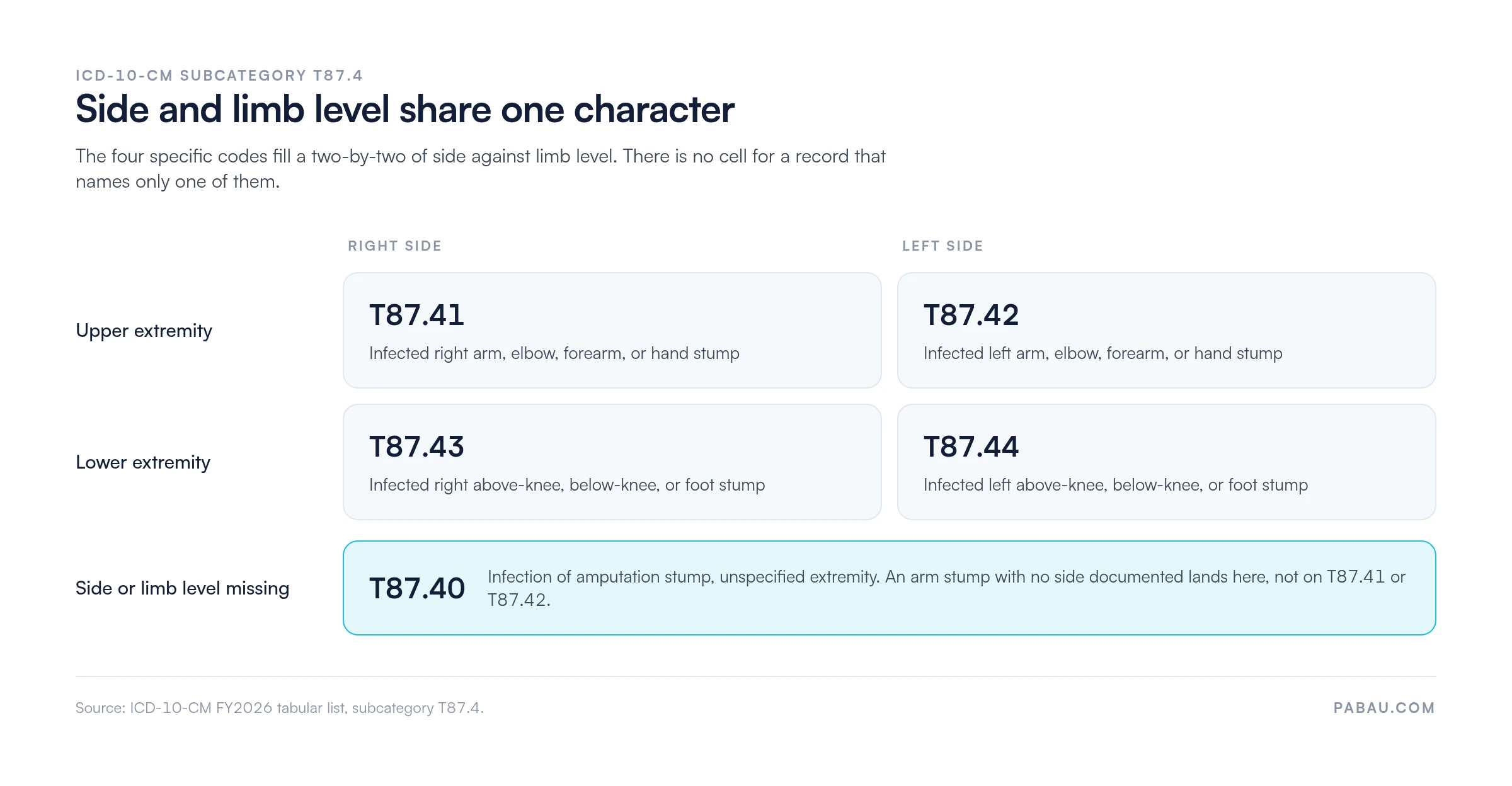
Subcategory T87.4 holds five codes in total. The other four carry laterality. T87.41 covers the right upper extremity, T87.42 the left upper, T87.43 the right lower, and T87.44 the left lower.
Payers query specificity, so an unspecified code on a record that plainly says “right below-knee” invites an audit flag. It also covers the ICD-9-CM crosswalk, MS-DRG groupings, and the documentation checklist.
Let Pabau's smart automation suggest the right codes, reduce claim denials, and keep your practice compliant—effortlessly.
Automate repetitive tasks and focus on what matters most—your patients.
Reduce coding errors and ensure compliance with the latest regulations.
Clean claims, fewer denials, and faster reimbursements.
Powerful insights and reporting to help your practice thrive.
HIPAA compliant SOC 2 certified GDPR-compliant Trusted by 4,000+ clinics worldwide

Subcategory T87.4 contains five codes: T87.40 for an unspecified extremity, plus T87.41 to T87.44 for the right and left upper and lower extremities.
T87.40 applies only when the record names neither the side nor whether the stump sits on an upper or lower limb.
Inclusion terms under T87.40 are abscess of amputation stump and cellulitis of amputation stump.
T87.40 is billable through FY2026, effective October 1, 2025, and has been active without revision since FY2016.
Practice management software like Pabau keeps ICD-10-CM documentation and claim submission in one record, so coders see the side the clinician documented.
T87.40 is a leaf-level code in ICD-10-CM, so it carries no further subdivision and can go straight onto a claim. According to the CDC/NCHS ICD-10-CM web tool, the code sits in Chapter 19 (S00-T88), block T80-T88, subcategory T87.4.
Chapter 19 covers injury, poisoning and certain other consequences of external causes. The table below summarizes the code’s attributes for a quick check before submission.
T87.40 describes a post-amputation complication in which the residual limb develops a bacterial infection at or near the surgical stump site. It applies when the treating clinician’s documentation does not identify which extremity is involved.
In practice, that happens most often with multi-limb amputees. It also happens in emergency or transfer cases with incomplete records, and in wound care notes that refer only to the stump. The CMS ICD-10 codes page lists T87.40 within the T87 category for complications of reattachment and amputation.
Replanted limbs and amputation stumps take different subcategories. A complication of a reattached right upper extremity is reported with T87.0X1, never with T87.40.
The ICD-10-CM tabular list includes two official inclusion terms under T87.40. Both describe infectious presentations at an amputation stump site:
These are inclusion terms, not exclusive alternatives. When the record documents cellulitis over an underlying abscess at an unspecified stump site, T87.40 still covers it. Do not code both inclusion terms separately, because T87.40 captures either presentation under a single billable code.
T87.40 is the unspecified-extremity member of a five-code set. The other four split by side as well as by limb, so upper and lower each have a right and a left code. Our reference on T87.42 works through the same subcategory from the left upper extremity angle.
When documentation supports a more specific assignment, select the matching sibling code. The table below maps each one to its clinical scenario.
Key decision rule: T87.40 is not a shortcut for an uncertain coder. Use it only where the record fails to identify the extremity. If the note says “left below-knee amputation stump infection,” assign T87.44. Querying the provider costs less than a rejection that comes back carrying one of the standard denial codes.
One case trips coders up. Laterality and limb level are bundled into a single character here, so there is no code for an upper extremity with the side unknown.
A note reading “infected arm stump” with no side documented still maps to T87.40, not to T87.41 or T87.42. Query the clinician for the side rather than guessing between right and left. The grid below shows where each of the five codes sits.
The hierarchy around T87.40 shows coders which level of specificity the record can support. It also surfaces related codes when secondary diagnoses are present. The full classification path is below, with all four siblings under parent code T87.4.
Other T87 codes may appear as secondary diagnoses alongside T87.40. They include T87.1x for complications of reattachment of extremity, T87.5x for necrosis of amputation stump, and T87.8x for other amputation stump complications. T87.1x resolves at the sixth character, where T87.1X2 covers a complication of a reattached left lower extremity.
Never report T87.40 alongside T87.41, T87.42, T87.43, or T87.44 for the same stump in the same episode. The five codes are mutually exclusive.
Before assigning T87.40, check the record for wound care notes, operative reports, or prior encounters that name the extremity. A query to the treating clinician costs less time than a payer denial and appeal. Once documentation is updated, replace T87.40 with T87.41, T87.42, T87.43, or T87.44 on the corrected claim.
Practices managing legacy billing records need the ICD-9-CM equivalent for T87.40. Per the ResDAC guidance on ICD codes in Medicare files, ICD-9 to ICD-10 mappings run through the General Equivalence Mappings published by CMS.
Those mappings are not always one to one. Verify against the current GEMs file before using them for retrospective billing or research.
ICD-9-CM 997.62 mapped to chronic infection of amputation stump. ICD-10-CM introduced the laterality specificity that ICD-9 never had, splitting one legacy code into five.
The GEMs forward mapping from 997.62 therefore returns T87.40 through T87.44 as candidates. Context from the original medical record decides which one is correct, so do not default to T87.40 because it is the unspecified option.
When T87.40 appears as a principal or secondary diagnosis on an inpatient claim, it can contribute to MS-DRG assignment. Practices running Pabau submit these claims electronically through the Claim.MD integration, which connects to thousands of US payers for real-time eligibility and claims routing.
MS-DRG assignment depends on the full claim context. The principal diagnosis, the secondary diagnoses, the procedures performed, and the CC/MCC hierarchies all feed the grouper. T87.40 may contribute to the groupings below, based on findacode.com data. Verify against the current CMS DRG Grouper before finalizing an inpatient claim.
After adjudication, the remittance advice reflects whichever DRG the grouper assigned, not the diagnosis code the coder entered.
T87.40 is appropriate only when the record cannot support a laterality code. The AAPC Codify ICD-10-CM lookup shows T87.4 resolving to five codes at the fifth character. Four of them name a side and a limb, which leaves T87.40 for records where neither is documented.
Before assigning ICD-10 code T87.40, confirm the following documentation is present in the medical record:
High volumes of post-amputation wound care claims are easier to control with claims management software that flags unspecified codes before submission. That flag gives the coder a chance to query the record or the clinician before the claim reaches the payer.
Add a laterality prompt to your post-amputation wound care note template. A single field offering ‘Right upper / Left upper / Right lower / Left lower / Not documented’ takes seconds to complete. It removes the most common reason T87.40 gets queried by payers, and template edits are far quicker than denial appeals.
T87.40 is payable, but unspecified codes attract attention. Medicare Administrative Contractors and RAC auditors look for site-specific documentation on post-amputation claims, because laterality is available in the code set. A pattern of T87.40 across a practice’s claims is the kind of signal that triggers a records request.
The same test follows unspecified codes into other chapters. K37 covers unspecified appendicitis, and a coder who assigns it has to show that no acute, chronic or complicated form appears in the record.
Musculoskeletal billing raises the same question. M87.9 records osteonecrosis without a site or a cause, so payers ask why no specific M87 subcode was available.
Some of these patients are being supplied mobility equipment while the stump heals, and that claim runs on a separate documentation track. A power wheelchair code such as HCPCS code K0839 needs prior authorization and a face-to-face mobility exam on file.
Most T87.40 problems trace back to four habits. Each one is avoidable at the documentation stage.
ICD-10 code T87.40 has been valid and unchanged since it first appeared in FY2016. The WHO ICD-10 browser confirms the international parent classification that ICD-10-CM derives from. The US clinical modification has carried T87.40 through every annual update to the current FY2026 edition.
In most practices, the stump infection is documented in one system and coded in another. A wound care note names the limb, but the coder never sees it. T87.40 then goes out on a claim the record could have supported at full specificity, and the correction costs a refile.
Pabau, practice management software built for medical and aesthetic practices, keeps the clinical record and the claim in one place. Wound care templates can carry a laterality field, so the side and limb level are captured at the point of care. The diagnosis code attached to the encounter then flows into the claim without rekeying.
Claims go out electronically through Claim.MD to thousands of US payers, and remittances come back against the same encounter. Coders spend less time chasing clarification, and fewer post-amputation claims go out unspecified when the record could have named the limb.

Pabau connects your clinical records to your billing workflow, so the diagnosis codes in your notes flow directly into your claims. Fewer transcription errors, fewer rejected claims, and a cleaner audit trail for post-amputation care visits.

The question worth asking before T87.40 goes on a claim is whether the chart has already answered it. Pull the operative report or the prior wound care note first. A side named anywhere in the record makes T87.41 through T87.44 the correct assignment instead.
Practices that build a laterality prompt into the post-amputation note stop the problem at source. The coder sees the side without asking, and the claim goes out specific the first time. Book a demo to see how Pabau keeps that documentation attached to the claim it supports.

Need to understand how clearinghouse submission works for ICD-10 codes? Medical claims clearinghouse covers how electronic claims routing works between practices and payers.
Coding a left upper extremity stump infection instead? ICD-10 code T87.42 walks through the same subcategory from the laterality-specific side.
Want the documentation that keeps a post-amputation claim clean? Clean claim sets out what a payer needs on first submission.
Already sitting on a batch of rejected stump infection claims? Denial management in healthcare explains how to work, appeal, and prevent them.
New to the wider billing process behind diagnosis coding? What is medical billing connects coding, submission, and payment end to end.
ICD-10 code T87.40 is a billable diagnosis code for infection of an amputation stump. It applies when the documentation does not name the side or whether the stump is on an upper or lower limb. Inclusion terms are abscess of amputation stump and cellulitis of amputation stump.
Yes. T87.40 is a billable, leaf-level ICD-10-CM code valid for all HIPAA-covered transactions. It is part of the FY2026 code set, effective October 1, 2025, and has been active without revision since FY2016.
T87.4 splits into five codes. T87.40 covers an unspecified extremity. T87.41 is the right upper extremity and T87.42 the left upper. T87.43 is the right lower and T87.44 the left lower. Use T87.40 only when the record identifies neither the side nor the limb level.
T87.42 is an upper extremity code. It means infection of amputation stump, left upper extremity. Lower extremity stump infections use T87.43 for the right side and T87.44 for the left side.
The closest ICD-9-CM equivalent is 997.62, infection of amputation stump. ICD-9-CM carried no laterality distinctions, so the GEMs forward mapping from 997.62 returns all five T87.4 codes as candidates. The original medical record decides which one is correct.
T87.40 may contribute to MS-DRG 573, 574, or 575, covering skin graft and debridement for skin ulcer or cellulitis. Which one applies depends on whether a qualifying MCC or CC appears on the inpatient claim. DRG assignment always reflects the complete clinical picture, not the diagnosis code alone.
Use T87.40 only when the clinician’s documentation identifies neither the side nor the limb level. Typical cases are multi-limb amputees with an ambiguous wound care note, or transfer cases with incomplete records. A note reading ‘infected arm stump’ with no side documented also maps to T87.40, because no side-unspecified upper extremity code exists.