

ICD-10 code S61.201A: Open wound of left index finger without nail damage
ICD-10 code S61.201A covers a left index finger wound of unstated type ICD-10 co...

Last Updated: Oct 16, 2026
Billable Code Specific Code
ICD-10 code T87.50 is the billable diagnosis code for necrosis of amputation stump, unspecified extremity. It applies when the record confirms dead tissue at a residual limb but never says which limb is affected.
That window is narrow. Once a note names the side and the limb, T87.51 through T87.54 take over, and payers expect the more specific code. Getting it right keeps debridement and wound care claims from stalling on specificity edits. The harder calls, separating necrosis from infection and pairing the right procedure codes, follow below.
Let Pabau's smart automation suggest the right codes, reduce claim denials, and keep your practice compliant—effortlessly.
Automate repetitive tasks and focus on what matters most—your patients.
Reduce coding errors and ensure compliance with the latest regulations.
Clean claims, fewer denials, and faster reimbursements.
Powerful insights and reporting to help your practice thrive.
HIPAA compliant SOC 2 certified GDPR-compliant Trusted by 4,000+ clinics worldwide

T87.50 is billable for necrosis of an amputation stump when the record doesn’t name the affected extremity.
T87.53 and T87.54 apply for right or left lower extremity; T87.51 and T87.52 are the upper extremity codes.
Necrosis (T87.50) and infection (T87.40) describe different processes and can be coded together when both are documented.
Under the CMS-HCC V28 model, T87.50 maps to HCC 409, Amputation Status, Lower Limb/Amputation Complications.
Pabau’s claims management software supports clean claim submission and denial tracking through Claim.MD.
ICD-10 code T87.50 is a valid, billable ICD-10-CM code for necrosis of amputation stump, unspecified extremity. It’s valid for FY 2026 and FY 2027 (effective Oct 1, 2026), and it has been billable continuously. Use it only when the record confirms stump necrosis but never names the limb.
Here’s the reference data to check before a claim goes out.
According to the CDC/NCHS ICD-10-CM web tool, T87.50 needs no 7th character. The T87 category builds laterality into the code itself, so coders never append A, D or S to T87.50.
Amputation stump necrosis is tissue death at the residual limb after an amputation. The cause is usually ischemic. Poor perfusion at the surgical margin, a flap with a weak blood supply, or a secondary infection can all leave devitalized tissue behind.
Patients with diabetes or peripheral vascular disease are at higher risk, since both conditions slow healing at the stump.
T87.50 applies when the record confirms necrosis at an amputation stump, but the provider hasn’t identified the extremity. “Unspecified extremity” doesn’t mean both sides. It means the side and limb are missing from the documentation the coder has at the time of coding.
These scenarios commonly support T87.50:
The code covers necrosis after any surgical amputation, from partial and transmetatarsal levels to major limb amputations. It doesn’t cover necrosis of an intact limb that is scheduled for amputation. Those cases take codes for the underlying vascular or diabetic condition.
The FY 2027 tabular lists no Excludes1 or Excludes2 notes at T87, T87.5 or T87.50. It also lists no inclusion terms and no “use additional code” instruction. So the coding call rests on the documentation rather than on tabular notes.
Two companion codes often travel with T87.50 in practice:
Because no Excludes1 note separates T87.50 from T87.40, both can appear on the same claim. Payers still look for support for each one. The note has to describe the necrosis and the infection separately.
The T87.5- necrosis codes and the T87.4- infection codes are easy to mix up. Both families split the same way. There’s one unspecified code, then right and left upper, then right and left lower.
T87.53 applies when the record names the right lower extremity as the affected limb. Typical triggers are operative reports for a right below-knee (BK), above-knee (AK) or transmetatarsal amputation. Use T87.53 over T87.50 whenever that detail is on record.
Payers running specificity edits can deny a claim when a more specific code was available. Keep the upper-limb sibling in mind too. T87.51 covers the right upper extremity, not the right leg.
T87.54 mirrors T87.53 for the left lower extremity. If any part of the record names the left leg as the necrosis site, T87.54 replaces T87.50. Its upper-limb counterpart is T87.52, which covers the left upper extremity.
When the note is silent on side, query the provider before you settle for the unspecified code.
T87.50 is only as defensible as the note behind it. Auditors look for specific language. Vague terms like “wound breakdown” or “stump problem” don’t support the code on their own.
To hold up on audit, the clinical note should show all five of these:
A clean claim means every diagnosis traces back to a specific element of the note. For T87.50, that element is the word “necrosis” in the provider’s assessment.
A stump necrosis claim passes five checkpoints before it pays. Each one stalls in its own way, as the path below shows.
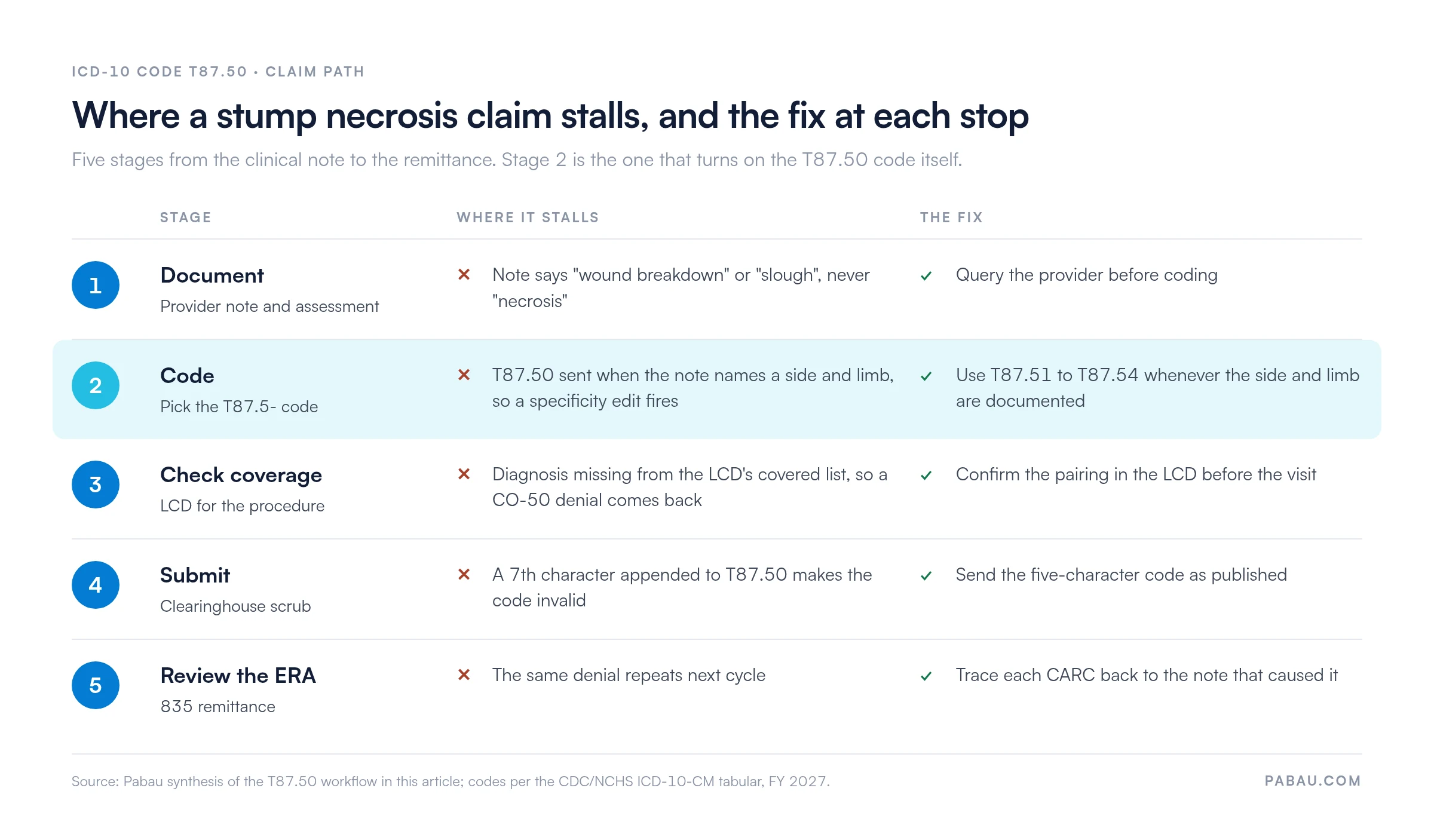
In day-to-day billing, stages one and two happen at charge entry. That’s the cheapest place to stop a laterality error. Once the claim reaches the clearinghouse, every fix means a correction and a resubmission.
T87.50 usually supports a procedure or a visit rather than standing alone. These are the codes most often paired with it in wound care and amputation follow-up.
Check each code against the Medicare Local Coverage Determination (LCD) for wound care or prosthetics before you submit. Debridement isn’t covered automatically under T87.50. The diagnosis has to appear on the LCD’s covered list for the procedure to pay.
Run an eligibility check before you bill debridement (97597/97598) with T87.50. Some payers pay for debridement only when the stump necrosis code is on the LCD covered-diagnosis list. Checking before the appointment cuts same-day denials for wound care visits.
T87.50 usually works as a supporting diagnosis. It rarely stands alone as the reason for a visit. Instead, it backs up the medical necessity of wound care, debridement and prosthetic services.
On inpatient claims, the DRG depends on the principal diagnosis, any major operating room procedure, and documented complications or comorbidities (CC/MCC). Check the current CMS MS-DRG Definitions Manual before you assume a DRG. The CMS ICD-10 page carries the current code files.
Under the CMS-HCC V28 model, T87.50 maps to HCC 409, Amputation Status, Lower Limb/Amputation Complications. The T87 complication codes generally sit in that group alongside the lower limb amputation status codes (Z89.4- through Z89.6-). Confirm the mapping against the CMS mapping table for the payment year, since it changes annually.
After adjudication, the electronic remittance advice (835 file) shows which T87.5- claims were denied and under which CARC. Reviewing it every cycle lets coders fix documentation patterns before the next batch goes out.
T87.50 denials follow predictable patterns. Knowing the pattern is half the fix. Upstream documentation is the other half.
Six quick checks catch the problems above before a payer does:
Run the same list during post-denial audits, too. Each fix then feeds back into how the next notes get written.
Most T87.50 problems start before charge entry, in a note that never named the limb. They surface weeks later as a denial on the remittance.
Pabau, the practice management platform we build, ties each claim to the visit record. Its claims software for practices pre-fills the claim form from the patient record. It also checks that required fields are complete before the claim is sent.
In the US, claims go out through Claim.MD, with real-time eligibility checks before the appointment. ERA remittances post back, and claim status stays visible. So your billing team can spot a denial pattern on stump necrosis claims and fix it at the note.

Pabau pre-fills claims from the patient record, checks eligibility before the visit, and posts ERA remittances back. Wound care teams spend less time reworking denied stump necrosis claims.

T87.50 is the right code for one narrow case: confirmed stump necrosis with no side or limb on record. Treat it as a holding position while a laterality query is open.
The trade-off is speed against payment. Sending T87.50 now is faster. But if the note names a limb, the payer expects one of T87.51-T87.54, and a quick query costs less than a denial and a resubmission.
Keep necrosis and infection separate in the note, and check the LCD before you bill debridement. Book a demo to see how Pabau helps wound care practices send cleaner stump necrosis claims.

Need a framework for reducing claim denials? Denial management in healthcare covers structured workflows for identifying, appealing, and preventing common payer rejections.
Want to understand clearinghouse claim routing? Medical claims clearinghouse explains how electronic claim submission works and why payer connectivity affects reimbursement speed.
Looking for CARC code definitions? Denial codes in medical billing lists the most common claim adjustment reason codes and corrective actions for each.
Coding a different stump complication? ICD-10 code T87.89 covers other complications of amputation stump that aren’t necrosis or infection.
Building a post-denial audit? Medical billing compliance explains the controls that keep coding and documentation audit-ready.
Yes. T87.50 is a billable ICD-10-CM code, valid for FY 2026 and FY 2027 (effective Oct 1, 2026). Report it only when the side and limb aren’t documented. Otherwise, use T87.51-T87.54.
Use T87.53 for the right lower extremity and T87.54 for the left. T87.51 and T87.52 are the right and left upper extremity codes. T87.50 fits only when the record never names the limb.
Use T87.81, dehiscence of amputation stump. Dehiscence alone doesn’t support T87.50. If the provider also describes necrotic tissue, query whether a T87.5- code applies as well.
Yes. Under CMS-HCC V28, T87.50 maps to HCC 409, Amputation Status, Lower Limb/Amputation Complications. Confirm the mapping each payment year, because CMS updates the tables annually.
Yes, when the provider documents both necrosis and infection at the stump. No Excludes1 note separates them. Describe each condition in the note so the payer sees support for both codes.



