ICD-10 code T32.0: Corrosions under 10% of body surface area
What ICD-10 code T32.0 covers: Chemical corrosions under 10% T32.0 reports chemi...

Last Updated: Nov 26, 2026
Billable Code Specific Code
S87.81XS is the billable ICD-10-CM code for crushing injury of right lower leg, sequela. It covers visits for a problem a healed crush between the right knee and ankle left behind, such as chronic pain, scarring or nerve damage.
The code never works alone. Code the residual condition first, then add S87.81XS second, because the S only points back to the original injury. Reverse the order or pick the wrong side, and the claim is likely to come back. Below, you'll find the full code set, the notes payers look for and a checklist to run before you submit.
Let Pabau's smart automation suggest the right codes, reduce claim denials, and keep your practice compliant—effortlessly.
Automate repetitive tasks and focus on what matters most—your patients.
Reduce coding errors and ensure compliance with the latest regulations.
Clean claims, fewer denials, and faster reimbursements.
Powerful insights and reporting to help your practice thrive.
HIPAA compliant SOC 2 certified GDPR-compliant Trusted by 4,000+ clinics worldwide

S87.81XS is the billable ICD-10-CM code for a crushing injury of the right lower leg, sequela, between the knee and the ankle.
Code the residual condition first, such as G89.21 for chronic pain due to trauma, and report S87.81XS second.
The seventh character S goes on the injury code only, never on the code for the residual condition.
A healed injury with no residual problem takes Z09 plus Z87.828 at a follow-up exam, not a sequela code.
On a sequela claim, the mechanism code takes the S character too. Activity and status codes stay with the first encounter, and place codes generally do as well.
ICD-10 code S87.81XS is the billable code for crushing injury of right lower leg, sequela. The FY2027 ICD-10-CM Official Guidelines for coding and reporting put the residual condition first and the injury code with S second. So the companion code says what you’re treating, and S87.81XS says where it came from.
The lower leg runs from just below the knee to just above the ankle, so it takes in the shin and the calf. A crush to the knee itself codes to S87.0-. Ankle, foot and toe crushes move to category S97.
The X in the sixth position is a placeholder. S87.81 has only five characters, so the X holds the spot and the S lands seventh.
Category S87 takes three seventh characters. Each one describes the stage of care, not how badly the leg was hurt.
D and S are the pair coders mix up. Use D while you’re still caring for the crush injury itself, including healing checks and rehab. Use S once the injury has healed and you’re treating a problem it caused.
That’s where the order flips. Under guidelines I.B.10 and I.C.19.a, the nature of the sequela goes first. S87.81XS goes second, and the S is added only to the injury code. The flow below shows which codes each kind of visit takes, and in what order.
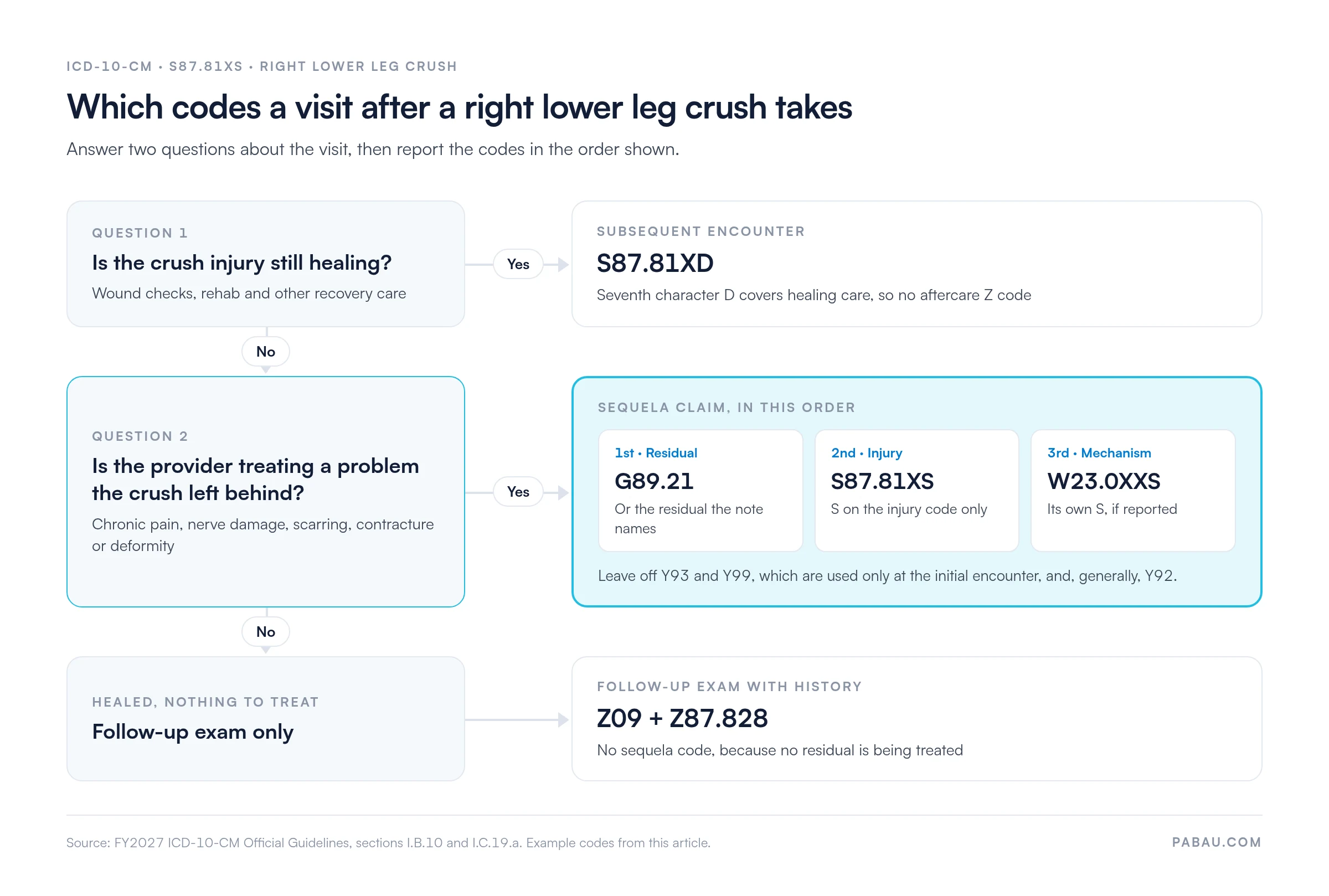
S87.81XS can’t carry a sequela claim alone, so the residual code comes from the provider’s note. These are common pairings after a lower leg crush, each listed before S87.81XS on the claim.
Before you assign a residual code, check that the provider has linked it to the crush injury in writing. A note that says ‘right leg pain’ isn’t enough. Look for wording like ‘chronic pain secondary to the 2024 crush injury of the right lower leg.’ If the link is missing, query the provider for an addendum.
The same patient can need three different code sets across a year. The table shows which one fits each kind of visit.
Two rules keep these apart. Aftercare Z codes aren’t used for injuries, because the seventh character D already covers healing care. And Z87.828 records history only, so it never stands in for active treatment of a residual.
Side, site and stage separate S87.81XS from its neighbors. The site errors usually come from notes that say “leg” or “foot” loosely. To check a neighbor’s own notes before you switch codes, look it up in our ICD-10 library for coders.
Chapter 20 reporting isn’t a national mandate. The guidelines explain how to assign these codes and encourage reporting, while a state rule or payer contract may require it.
On a sequela visit, the mechanism code gets its own S in the seventh position. Activity (Y93) and status (Y99) codes are used only once, at the initial encounter. Place of occurrence (Y92) is generally assigned only once, at that same encounter. Leave all three off this sequela claim.
Workers’ compensation carriers may also ask for the original accident report. Confirm their rules before you send the claim.
In 2024, a warehouse worker’s right lower leg was pinned between a moving loading platform and a truck bed. The wounds healed within months. Now he sees a pain specialist for chronic pain across the shin.
The note says “chronic pain due to the 2024 crush injury of the right lower leg.” The claim lists G89.21 first, S87.81XS second and W23.0XXS third. Y93 and Y99 are used only once, at the initial encounter, and Y92 generally is too, so none of them go on it.
Most of this list is about the note, because medical billing compliance starts with what the provider writes.
For an appeal, send the acute-episode record, the provider’s causal link statement and the corrected claim. A denial management routine keeps those files together, and a clean claim review catches most errors before the first submission.
Sequela claims usually go wrong on small details, like a swapped side or a reversed order. Catching them depends on the coder seeing the provider’s note while the claim is built.
Pabau, a practice management platform with built-in billing, keeps the note, the codes and the claim on one patient record. Its claims management sends 837P claims through its Claim.MD integration.
Your team can run eligibility checks before the visit and post ERA remittances when payment arrives. A denied sequela claim then sits beside the note your coder needs for the appeal.
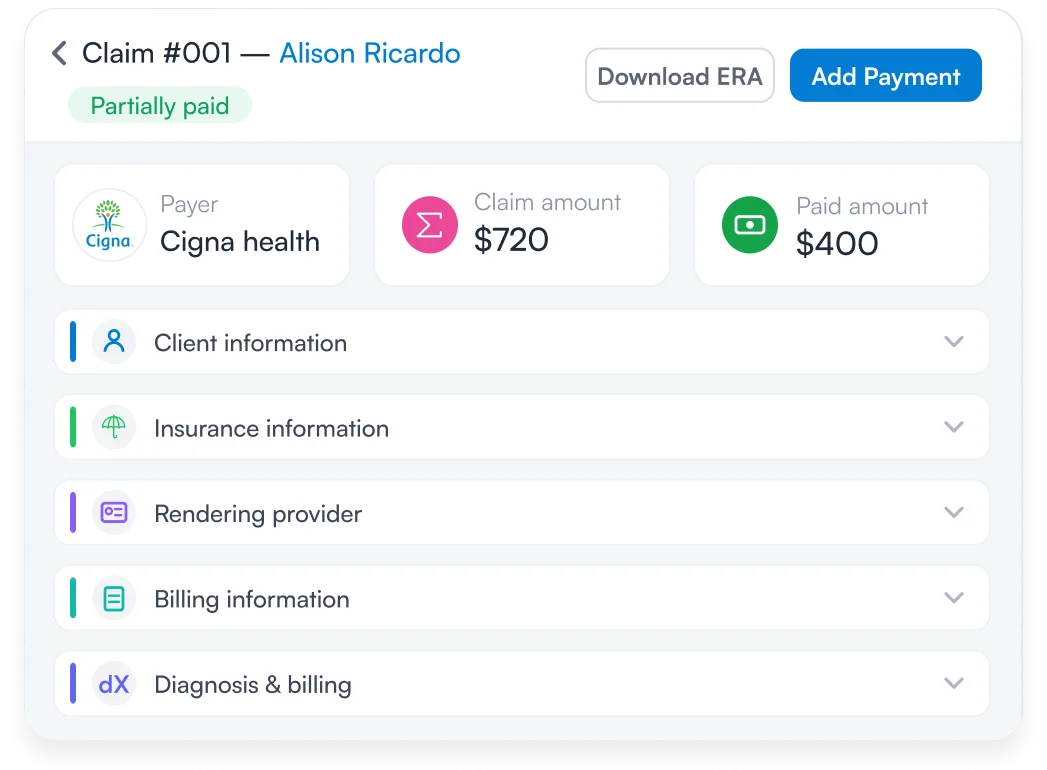

Pabau keeps notes, codes and claims on one patient record and sends 837P claims through Claim.MD. Your coders can check the side and the code order before a claim goes out.

S87.81XS explains where today’s problem came from. Code the problem you’re treating first, then let S87.81XS point back to the crush.
If you tighten one habit, make it the provider query. A note that names the residual, the right lower leg and the causal link makes the rest of the claim simple to build.
Book a demo to see how Pabau keeps notes, codes and claims on one record. Your coders can then check each sequela claim before it goes out.

Need to read the codes on a returned sequela claim? Denial codes in medical billing explains the common CARC codes and how to respond to each one.
Submitting claims electronically for the first time? 837 file guide walks through the electronic claim format that carries ICD-10-CM codes to payers.
Want to confirm coverage before a sequela visit? Insurance eligibility verification covers how to check coverage and prior authorization before the patient arrives.
No. The official guidelines set no time limit on sequela codes. A residual can appear months or years after the crush, and S87.81XS still applies once the provider links it to the injury.
ICD-9-CM used 906.4, late effect of crushing, for any body site. ICD-10-CM replaced it with injury codes that carry the seventh character S, so S87.81XS now names the site and the side.
Yes. S87.81XS is a valid, billable code in the FY2027 ICD-10-CM code set (effective October 1, 2026), and it was valid in FY2026. Check the annual update each October, since codes and guidelines can change.
Yes, when it’s the right leg and the visit treats a residual. The calf sits within the lower leg, so it codes to S87.81-. Pair it with the muscle residual, such as M62.461 for a contracture.