ICD-10 code I50.20: Unspecified systolic heart failure
ICD-10 code I50.20 covers systolic heart failure with no stated acuity ICD-10 co...

Last Updated: Nov 12, 2026
Billable Code Specific Code
T87.44 is the billable ICD-10-CM code for infection of amputation stump, left lower extremity. Use it when the provider documents an infection in the residual limb after a left leg, foot or toe amputation.
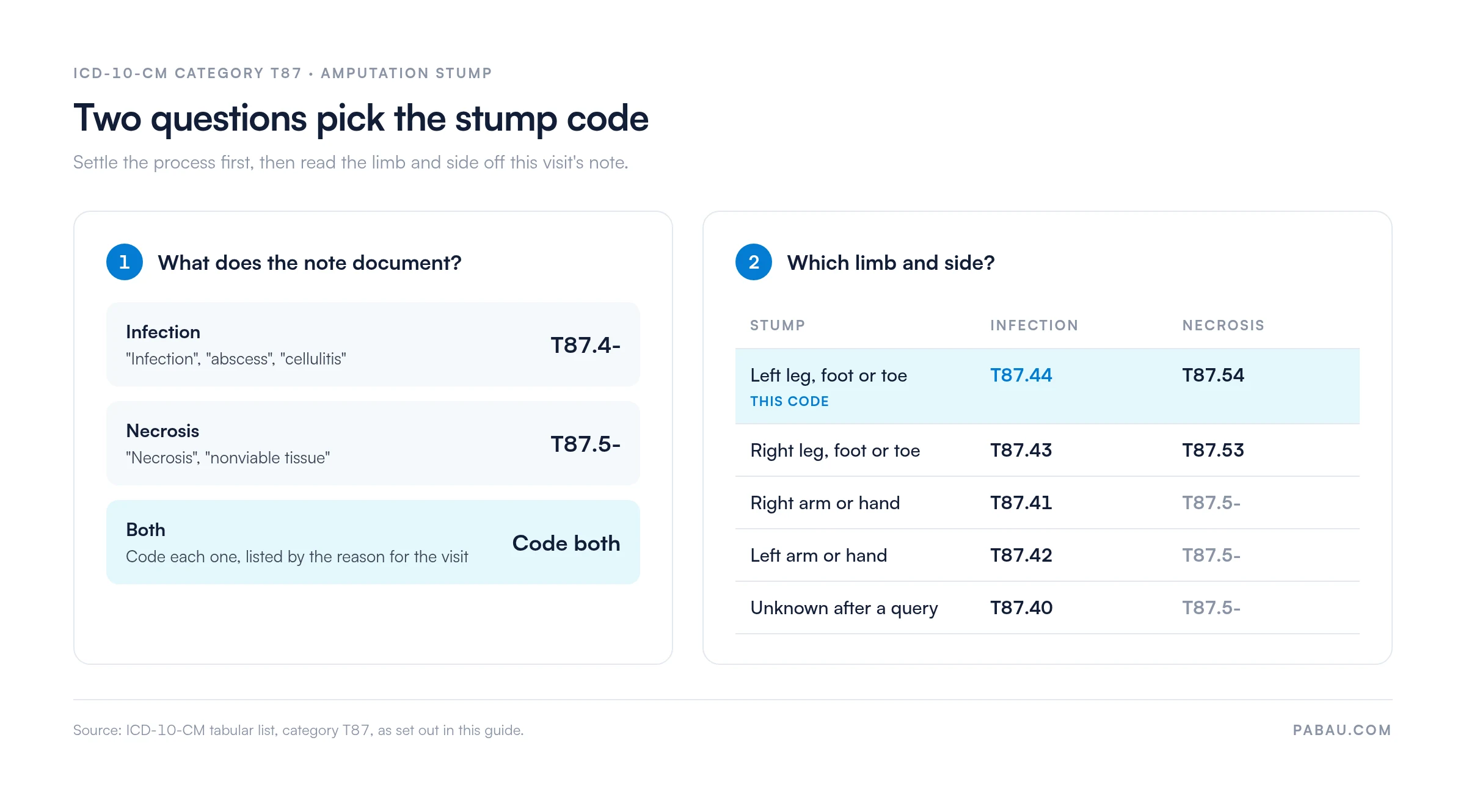
It sits under T87.4 in category T87, and assignment turns on side and process. T87.43 covers the right leg, and necrosis without infection goes to T87.54.
Let Pabau's smart automation suggest the right codes, reduce claim denials, and keep your practice compliant—effortlessly.
Automate repetitive tasks and focus on what matters most—your patients.
Reduce coding errors and ensure compliance with the latest regulations.
Clean claims, fewer denials, and faster reimbursements.
Powerful insights and reporting to help your practice thrive.
HIPAA compliant SOC 2 certified GDPR-compliant Trusted by 4,000+ clinics worldwide

ICD-10 code T87.44 is a billable, specific code for infection of an amputation stump on the left lower extremity, valid for the current fiscal year.
The right leg has its own code, T87.43, so confirm the side in the record before you choose between them.
T87.4 is a non-billable header, so the claim needs the full code, T87.44.
Infection (T87.44) and necrosis (T87.54) are separate codes, and you report both when the provider documents both.
Pabau, our practice management platform, routes T87.44 claims to US payers through Claim.MD and posts remittances back to the patient record.
ICD-10 code T87.44 is the code for infection of amputation stump, left lower extremity. You use it when a patient who has already lost part of the left leg, foot or toes develops an infection in the residual limb.
Most of the coding work comes down to two choices. The first is the side, because T87.43 is the right-leg twin. The second is the process, because necrosis without infection has a code of its own. The guide below takes both questions in order.
The code set updates every October 1. Check the current status in the CDC/NCHS ICD-10-CM web tool before you submit claims.
T87.44 is the last step in a short chain. Each level above it is a heading, and only the final code goes on a claim.
The CMS ICD-10-CM code files treat only complete codes as valid for billing. A claim that carries T87.4 comes back for more specificity, so it never reaches payment as sent.
T87.44 also takes no 7th character. Category T87 has no initial, subsequent or sequela extensions, so don’t add an A, D or S to it.
The fifth character of T87.4x records the side and the limb. Here’s the full set, with T87.44 in bold.
If the provider’s note leaves the side out, check the rest of the record first. The official coding guidelines let you take laterality from other clinicians’ notes, such as nursing or wound care entries.
Query the provider only when the record is silent or contradicts itself. Fall back to T87.40 only when that query can’t settle it.
T87.44 records infection of the left lower extremity stump, and T87.54 records necrosis at the same site. Infection means an organism is driving inflammation. Necrosis means the tissue has died, and a stump can have one, the other or both.
When a note documents infected and necrotic tissue on the same stump, report T87.44 and T87.54 together. List T87.44 first when the visit is for treating the infection. List T87.54 first when debridement of dead tissue is the main service.
T87.44 covers one problem on one limb. These neighboring codes catch the conditions it leaves out, and mixing them up is a common audit flag.
Most T87.44 problems start in the note rather than on the claim. Before you code, check that the provider has covered these four points, which also keeps each clean claim on track for first-pass acceptance.
Here’s the path a typical outpatient claim takes, and where each step can stall.
Take an illustrative patient with type 2 diabetes and peripheral artery disease. She had a left below-knee amputation eight months ago and now has redness, warmth and pus at the stump.
The provider documents “cellulitis of the left below-knee amputation stump”, and the culture grows MRSA. Here’s how the diagnosis lines read.
If the provider later debrides dead tissue at the same site and documents necrosis, T87.54 joins the claim. That’s the dual-coding case from the comparison above.
Run through these points before the claim leaves your system. Each one maps to a denial reason in the next section.
Stump-infection denials follow a pattern, so fixing the cause beats reworking each remittance. Solid denial management workflows start with these five.
Our guide to denial codes in medical billing maps each claim adjustment reason code (CARC) back to a likely cause.
T87.44 rarely sits alone on a claim. These codes often join it, from organism and limb-absence codes to the debridement lines it supports.
Some MACs list wound measurements and depth notes that must appear before 97597 or 97598 is covered on a stump wound. Confirm the LCD in your jurisdiction before you bill.
A stump-infection claim often depends on someone retyping the code, the side and the procedure lines from the note. Each retype is a chance to pick T87.43 by mistake or drop the necrosis code.
Pabau, the practice management platform we build, pre-fills the claim from the patient record. Diagnosis codes on the patient’s problem list seed the claim, and the built-in ICD-10-CM library lets you check T87.44’s siblings without leaving the screen. Required fields are checked before the claim can be sent.
In the US, Pabau sends claims to payers electronically through Claim.MD. Eligibility checks run before the visit, and remittances post back to the record. Our claims management software tracks each claim after submission, so your team sees which ones are paid, pending or denied.

Pabau pre-fills claims from the patient record, checks required fields and sends them to US payers through Claim.MD. Remittances post back automatically, so denials surface fast.

T87.44 comes down to two checks. Is it the left leg, and is it infection rather than necrosis? Get both right and the code itself seldom causes trouble.
The harder work happens upstream, in the note. A provider who writes “infection of the left below-knee stump” hands you a claim that holds up. A note that only says “drainage” sends you back for a query, and a delayed payment.
Pabau’s integration with Claim.MD’s clearinghouse carries that clean code through to payment and tracks each claim after it’s sent. Book a demo to see how Pabau handles stump-complication claims from note to remittance.

Want to see how clearinghouse edits catch errors before submission? Claim.MD clearinghouse guide explains how claims are checked against payer rules before they go out.
Looking for documentation standards that hold up on audit? Medical billing compliance guide covers the record-keeping that keeps claims audit-ready.
Curious how ICD-10 codes travel to payers? 837 file overview explains how diagnosis codes are carried in the 837P and 837I formats.
Record silent on the side even after a query? ICD-10 code T87.40 covers a stump infection on an unspecified extremity.
Wound opening along the suture line? ICD-10 code T87.81 covers dehiscence of an amputation stump.
ICD-9-CM used 997.62, infection (chronic) of amputation stump, with no side or limb. ICD-10-CM splits that one code into T87.40 through T87.44, so laterality now decides the code.
Use T87.43, infection of amputation stump, right lower extremity. T87.44 is the left-side code, so the side in the record decides between them.
Yes, when it is on the left foot, because ICD-10-CM treats a toe stump as part of the lower extremity. Pair it with Z89.412 for the left great toe or Z89.422 for other left toes.
T87.44 is a CC under MS-DRG, not an MCC. As a secondary diagnosis on an inpatient claim, it can raise the severity tier unless a CC exclusion applies.
Yes, when a culture names it. Add a code from B95-B97 after T87.44, such as B95.62 for MRSA, to identify the cause.
Phantom limb syndrome uses G54.6 with pain or G54.7 without pain. Report it separately from T87.44 when both are documented.