ICD-10 code T32.85: Corrosions of 80-89% of body surface
ICD-10 code T32.85 at a glance ICD-10 code T32.85 is the billable ICD-10-CM code...

Last Updated: Nov 26, 2026
Billable Code Specific Code
ICD-10 code T32.0 is the billable ICD-10-CM code for corrosions involving less than 10% of body surface. A corrosion is a chemical injury, such as an acid or alkali splash, so a thermal burn of the same size takes T31.0 instead.
T32.0 is an extent code. It is reported with a T51-T65 toxic-effect code that names the chemical, and normally with a T20-T25 corrosion site code, unless the site is unspecified. It is four characters long and takes no seventh character. Getting the order, the documented percentage and the chemical right keeps these claims clean.
Let Pabau's smart automation suggest the right codes, reduce claim denials, and keep your practice compliant—effortlessly.
Automate repetitive tasks and focus on what matters most—your patients.
Reduce coding errors and ensure compliance with the latest regulations.
Clean claims, fewer denials, and faster reimbursements.
Powerful insights and reporting to help your practice thrive.
HIPAA compliant SOC 2 certified GDPR-compliant Trusted by 4,000+ clinics worldwide

T32.0 is the billable ICD-10-CM code for corrosions involving less than 10% of body surface, which means chemical injuries only.
Thermal, electrical and radiation burns that cover less than 10% of body surface use T31.0, not T32.0.
T32.0 takes no seventh character, so T32.0XXA, T32.0XXD and T32.0XXS are not valid codes.
Code the toxic effect (T51-T65) first, then the corrosion site code (T20-T25), then T32.0 for extent.
In the CMS v44 grouper, T32.0 sits on the principal diagnosis list for MS-DRG 935, non-extensive burns.
T32.0 reports chemical corrosions that cover less than 10% of the body surface. The CDC ICD-10-CM browser tool lists its official descriptor as “Corrosions involving less than 10% of body surface.” It is billable and specific, and valid for the current fiscal year.
A corrosion is a chemical injury, such as an acid or alkali splash. The T32 category sorts those injuries by how much skin they cover, not by where they are. A thermal burn of the same size belongs to T31.0 instead.
T32 lives in Chapter 19, inside the block for burns and corrosions of multiple and unspecified body regions (T30-T32). Codes in T20-T25 name the injured site. T32 records how much body surface the corrosion covers.
T32.0 is the smallest band, and it is not subdivided. From T32.1 upward, a fifth character adds the share of third-degree corrosion.
Two facts decide the code. The injury must be a corrosion, and the documented extent must be under 10% of body surface. Depth does not change the extent code, so a third-degree corrosion covering 4% still takes T32.0.
The site code carries the depth. The corrosion subcategories in T20-T25 run from unspecified degree to third degree. For example, T23.601A is a second-degree corrosion of the right hand, initial encounter.
The decision path below puts both facts in order, from the type of injury to the extent band.
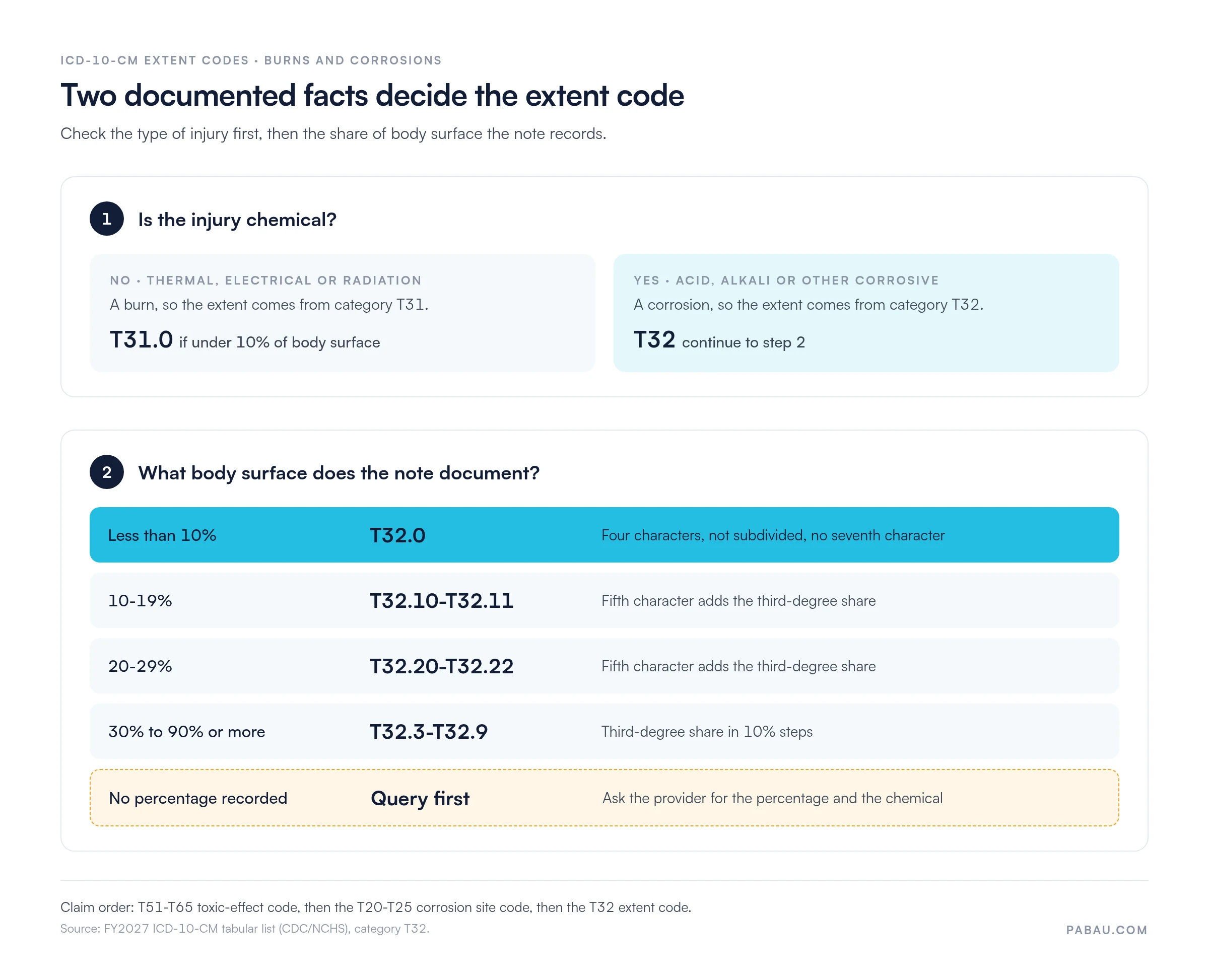
The extent comes from a clinical estimate, not from the coder. The Rule of Nines is the common adult method, and it works for corrosions just as it does for burns. The provider records the method and the percentage.
Most chemical splashes cover a small patch, so many providers gauge them with the patient’s palm, roughly 1% of body surface. For children, the Lund-Browder chart adjusts for head and limb proportions that change with age. Whichever tool is used, the note should name it.
If the note says only ‘small chemical burn’, query the provider for a percentage before you assign T32.0. Ask for the name of the chemical in the same query, because the toxic-effect code depends on it.
Corrosion coding has its own sequence. The corrosion codes in T20-T25 carry a “code first” note for T51-T65, which identifies the chemical and the intent. Here is the order to follow.
Two details trip coders up. First, skip X46-X49 for the cause, because ICD-10-CM records the chemical and the intent in the T51-T65 code. Second, the encounter character (A, D or S) goes on the toxic-effect and site codes. T32.0 takes none.
A patient splashes oven cleaner on the right hand while cleaning the kitchen at home. The provider documents a second-degree alkali corrosion of the right hand. Using the palm method, the note puts the extent at about 1% of body surface.
Here is how the coder reads that note, one fact at a time:
At a later dressing check, the site code switches to its D character. If T32.0 is reported again, it stays exactly as written, since it has no seventh character.
Most T32.0 errors come from picking a neighbor that sounds close. The table shows when each one is right.
When a note says “chemical burn,” treat it as a corrosion. ICD-10-CM classifies burns due to chemicals as corrosions, so the burn subcategories and T31.0 do not apply.
In the CMS ICD-10 MS-DRG Definitions Manual (v44, FY2027), T32.0 sits on the principal diagnosis list for MS-DRG 935. The burn DRGs in MDC 22 are listed below.
A third-degree site code, a graft, an inhalation injury or long ventilation can move a case into another burn DRG. The code-first toxic-effect code can also become the principal diagnosis. So run the full claim through your grouper rather than predicting from T32.0 alone.
Check the CMS ICD-10 code files each October for the new fiscal year. Our guide to medical billing workflows shows where DRG grouping fits in the revenue cycle.
T32.0 claims usually go wrong in the note or the code format. Catch the six errors below before a payer does, and add them to your denial management routine. If one slips through, the payer’s CARC denial codes point you to the fix.
Run through these six checks before a corrosion claim leaves the practice:
If one check fails, hold the claim and query the provider. A clean claim costs far less than a denial worked after the fact. The AAPC ICD-10-CM lookup helps when you need to double-check a descriptor or an excludes note.
Corrosion claims stall when the key facts sit in free text. The chemical, the percentage and the depth per site get buried, so coders end up querying.
In Pabau, a practice management and EHR platform, you can build those fields into structured patient records. The note then prompts the provider for each element the claim needs.
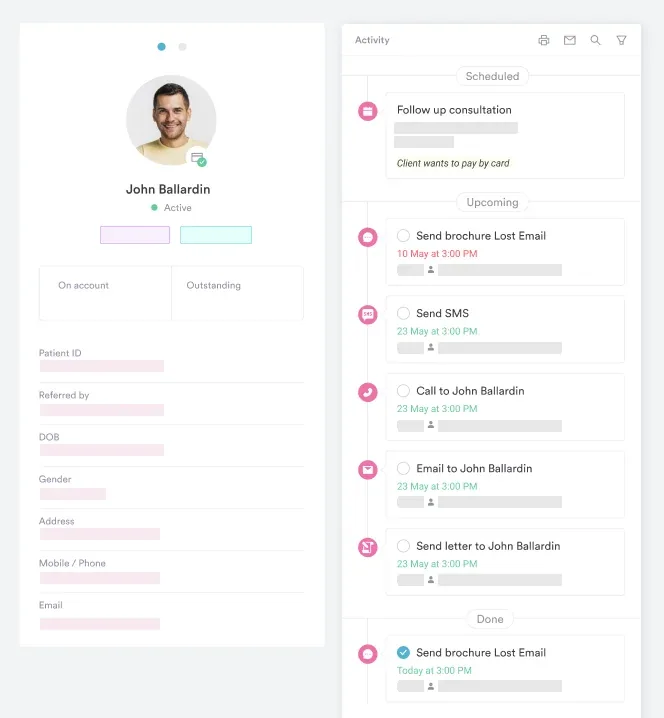
From there, Pabau’s claims management software pre-fills the claim from the invoice and the client card’s insurer details. It then scrubs the claim for missing or invalid details before sending. US practices submit through Claim.MD, with eligibility checks and remittance posting.
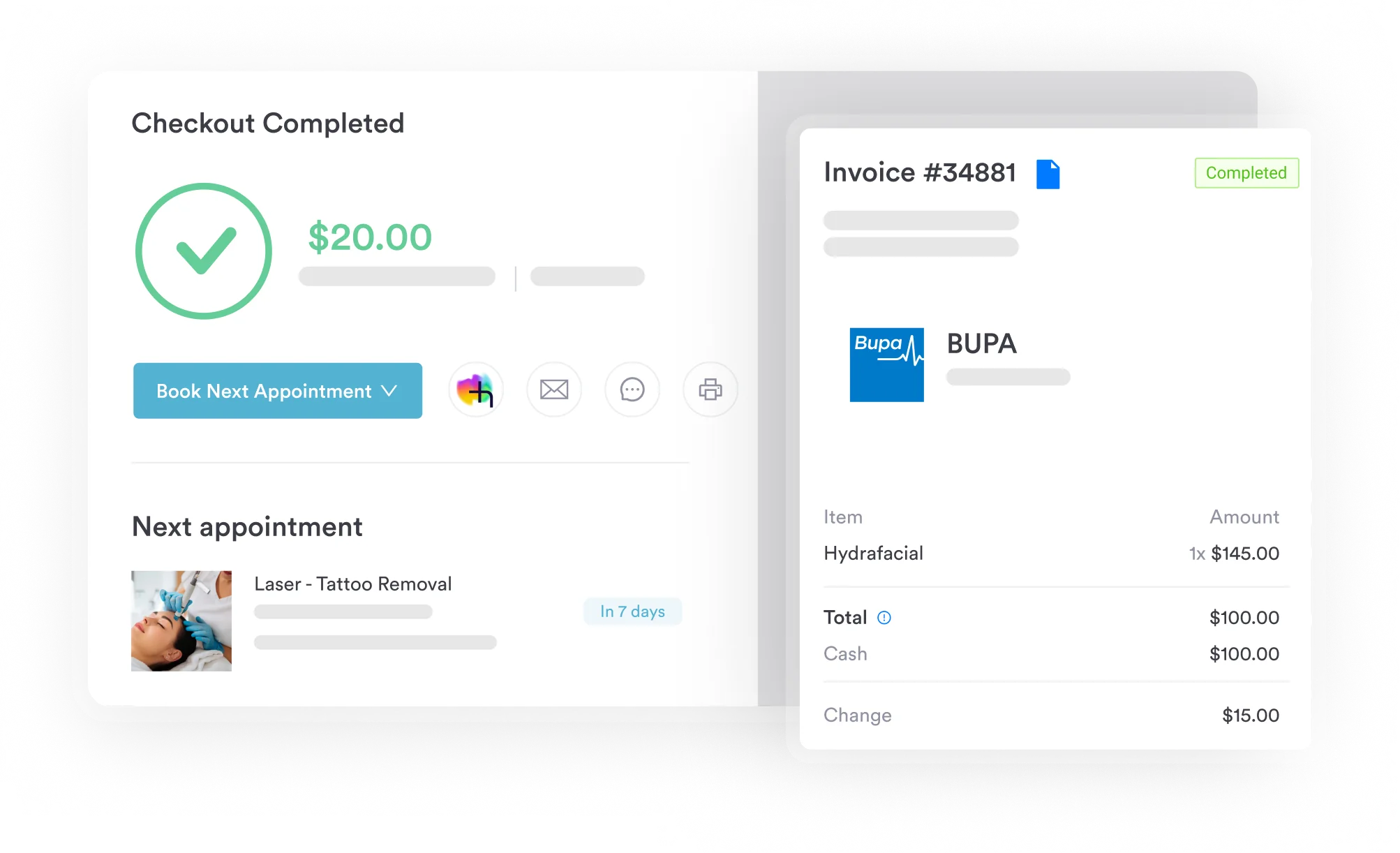

Pabau builds the chemical agent, TBSA estimate and depth into structured patient records. It then pre-fills the claim from the invoice and insurer details, and checks it before you send.

T32.0 is a small code with a narrow job. It tells the payer that a chemical injury covered less than a tenth of the body. The agent, the site, the depth and the encounter all live in other codes.
So treat T32.0 as the last piece you add, not the first. Start from a note that names the chemical and states a percentage, and the code order follows. Book a demo to see how Pabau keeps those details in one structured record.

Coding a thermal burn of the same size? ICD-10 code T31.0 covers burns involving less than 10% of body surface.
Need a framework for managing claim denials across your practice? Denial management in healthcare covers the end-to-end process for identifying, appealing, and preventing revenue leakage from denied claims.
Looking for guidance on clean claim requirements? Clean claim submission outlines what a payer-ready claim must contain, from required fields to common edit failures.
Want to understand how US medical billing works at the clearinghouse level? Claim.MD clearinghouse guide explains how electronic claims flow from practice to payer.
ICD-10-CM codes chemical burns as corrosions. Use the T51-T65 toxic-effect code first, then the corrosion site code. Add a T32 code for extent, such as T32.0 under 10%.
Yes. T32.0 is a valid, billable code for FY2027, which runs from October 1, 2026, to September 30, 2027. It also appears in the CMS v44 MS-DRG grouper.
No. Sunburn has its own codes in category L55, split by degree. T32.0 covers chemical corrosions only.
Corrosions of the eye and adnexa use codes from T26.5 to T26.9. As with skin corrosions, the toxic-effect code that names the chemical comes first.
Swallowed corrosives that injure internal organs use T28.5 to T28.9, starting with the mouth and pharynx. Inhaled corrosives that injure the airway use T27.4 to T27.7.