

ICD-10 Code R63.4: Abnormal weight loss
ICD-10 code R63.4: Definition, billability and code structure ICD-10 code R63.4 ...

Last Updated: Nov 13, 2026
Billable Code Specific Code
T87.41 is the billable ICD-10-CM code for infection of amputation stump, right upper extremity. It covers an infection the physician documents at the residual limb after amputation of any part of the right arm.
T87.41 is a complete five-character code with no 7th character. It sits under the non-billable header T87.4, beside T87.40 for an unspecified extremity and T87.42 to T87.44 for the other limbs. The laterality in the chart decides which one applies.
Let Pabau's smart automation suggest the right codes, reduce claim denials, and keep your practice compliant—effortlessly.
Automate repetitive tasks and focus on what matters most—your patients.
Reduce coding errors and ensure compliance with the latest regulations.
Clean claims, fewer denials, and faster reimbursements.
Powerful insights and reporting to help your practice thrive.
HIPAA compliant SOC 2 certified GDPR-compliant Trusted by 4,000+ clinics worldwide

ICD-10 Code T87.41 covers infection of an amputation stump on the right upper extremity, and no other laterality.
T87.41 is a complete, billable five-character code with no 7th character, while its parent T87.4 is a non-billable header.
Add a B95-B97 code when culture results identify the causative organism.
Code infection and necrosis of the same stump together when the physician documents both.
Pabau’s claims management software checks eligibility in real time and tracks claim status, so you can follow each T87.41 claim through to payment.
ICD-10 Code T87.41 is the billable ICD-10-CM code for infection of amputation stump, right upper extremity.
It is a complete five-character code in Chapter 19 of the Tabular List, with no 7th character to add. Use the table below to check its status, descriptor, and place in the hierarchy before submission.
T87.41 covers infection at an amputation stump on the right upper extremity. The infection develops at or around the residual limb after amputation of any part of the right arm. That includes the hand, wrist, forearm, upper arm, or shoulder girdle.
The code applies to both early postoperative wound infections and late-developing stump infections in established amputees. For coding, the physician’s documented diagnosis of infection at the stump site matters, not the time since the original amputation.
For this code to hold up on audit, the documentation should reflect these clinical features:
The CDC/NCHS ICD-10-CM page publishes the official Tabular List files for each fiscal year. Check T87.41 against the current release every October, when the annual update takes effect.
Knowing where T87.41 sits in the T87 block prevents the most common laterality and category errors. The T87.4x subcategory covers infection of amputation stump by limb, while neighboring subcategories cover neuroma, necrosis, and other complications.
T87.4 is a non-billable category, so code to the fifth character. The condition the physician documents picks the subcategory. The limb named in the record picks the code, so a left-arm stump infection takes T87.42 instead, as the decision panel below shows. On the lower limb, an infected left leg stump takes code T87.44.
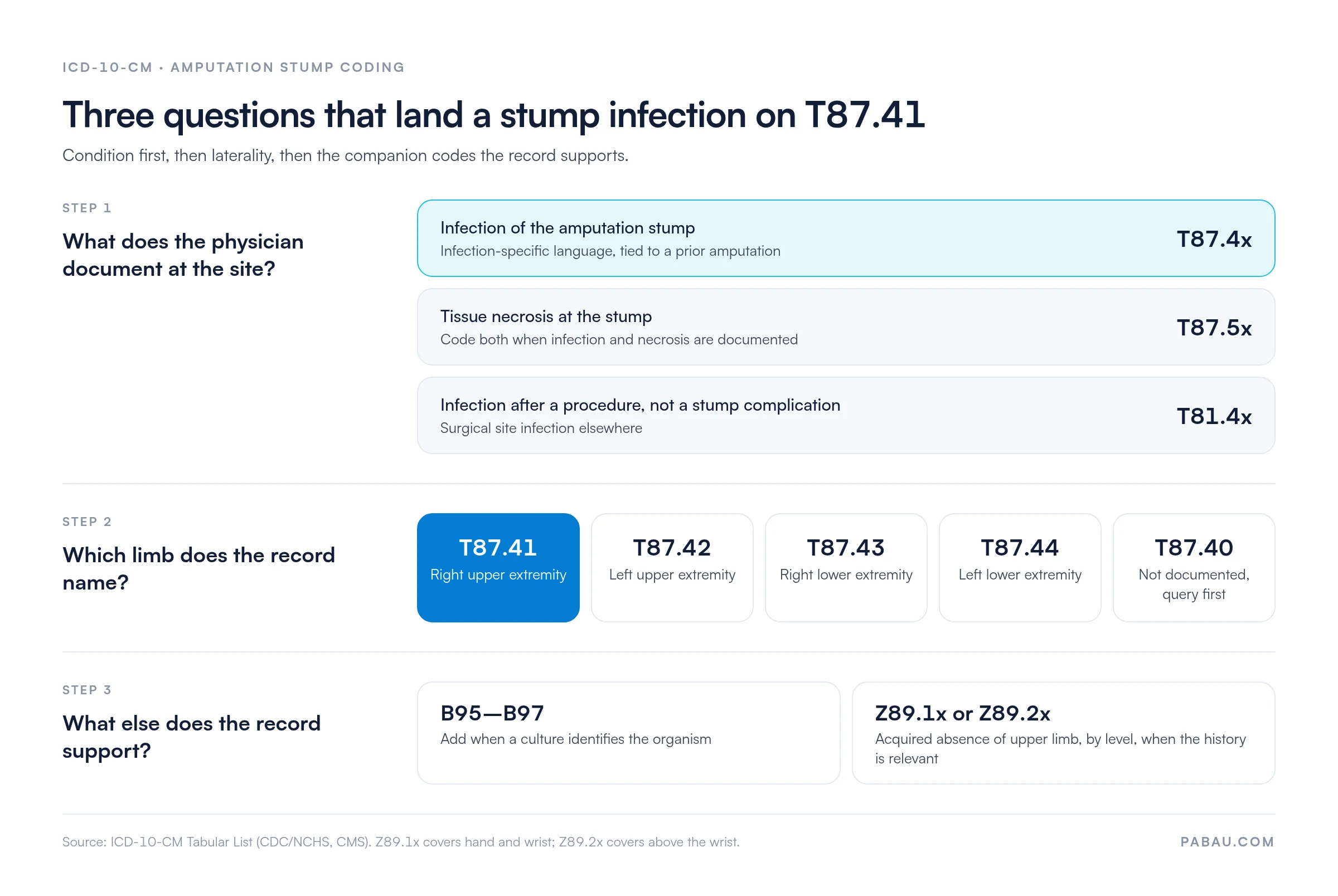
The T87.4 subcategory carries no Includes notes of its own. The guidance below affects how T87.41 is coded and sequenced.
The T87.4x subcategory is straightforward once laterality is confirmed. Coders also confuse T87.41 with the necrosis codes (T87.5x) and with post-procedural infection codes (T81.4x). The table below shows when each applies.
The infection vs necrosis distinction is clinically significant. An infected stump may also present with necrotic tissue, and T87.41 and T87.51 are both appropriate when both are documented. Never default to T87.40 when the chart specifies the right upper extremity. The unspecified code is a specificity downgrade that some payers actively flag.
Query the physician before defaulting to T87.40 (unspecified). ICD-10-CM Official Guidelines allow coders to query for laterality when the note omits it but the record makes it clinically determinable. For example, the operative report or prosthetics order may clearly reference the right arm. Document the query and response in the chart for audit protection.
Accurate coding of ICD-10 Code T87.41 depends entirely on what the clinical record contains. Coders cannot assign a code that is not supported by physician documentation.
The minimum documentation set for T87.41:
T87.41 rarely stands alone on a claim. The following companion codes apply depending on encounter details.
Sequencing rule: When the encounter’s primary reason is treatment of the stump infection, T87.41 is the principal diagnosis. Z47.81 (aftercare) is not appropriate as principal when an active complication like T87.41 is being treated. Per Official Guidelines Section I.C.19, the complication code takes precedence.
Medicare prior authorization for T87.41-related services depends on the procedure performed, not on the diagnosis code itself. Debridement (CPT 97597-97598 or 11042-11044) may require prior authorization under Medicare Advantage plans. Standard Medicare fee-for-service does not require it for wound debridement. Local Coverage Determinations (LCDs) govern which wound care services count as reasonable and necessary for stump infections.
The CMS ICD-10 codes page provides current-year code files and links to the MS-DRG Definitions Manual. That manual is where coders verify T87.41’s CC status for each fiscal year.
Most T87.41 denials trace back to three root causes. Each is preventable with the right pre-submission workflow.
Reviewing denial management workflows for amputation stump codes before the claim goes out reduces rework. When a claim does come back, our guide to denial codes in medical billing explains what each payer reason code means and how to respond.
Run a monthly internal audit on all T87.4x claims. Pull every claim coded T87.40 (unspecified) and cross-reference it against the clinical notes. Often the chart clearly documents laterality that never reached the code. That error is correctable, but it becomes a compliance risk if left in place. Flag these cases for coder education, and query the physician where laterality is genuinely ambiguous.
Coders reviewing legacy claims or historical data need to know how T87.41 maps from the predecessor system. An unspecified late stump complication coded 997.60 now maps to T87.9.
The key change in the ICD-10 transition is that laterality became part of the code. ICD-9-CM already had a separate code for stump infection, 997.62, but it did not distinguish right from left or upper from lower. Treat historical data converted with the General Equivalence Mappings (GEMs) with care, because 997.62 maps to five ICD-10-CM codes.
Our guide to medical billing fundamentals covers how diagnosis codes move through the claim cycle. The AAPC Codify ICD-10-CM lookup lets coders search both ICD-9 and ICD-10 codes and view crosswalk notes directly.
T87.41 may carry Complication or Comorbidity (CC) status in the CMS MS-DRG grouper. Verify CC/MCC status in the current Definitions Manual, v44 for FY2027. Where it does carry CC status, T87.41 as a secondary diagnosis can shift an inpatient claim to a higher-weighted DRG.
Take a patient admitted for debridement of an infected amputation stump. With T87.41 coded as a secondary diagnosis and CC status confirmed, the stay can group to a higher-reimbursed DRG than the same admission without it. Leaving off a T87.41 that the documentation supports is both a compliance risk and lost revenue.
Without an integrated clearinghouse, a T87.41 claim means coding in one system, checking coverage on a payer portal, and chasing claim status by phone. Pabau, the practice management and billing platform we build, connects to Claim.MD, a clearinghouse that reaches thousands of US payers.
Through that integration, Pabau runs real-time eligibility checks (270/271) before the visit and submits CMS-1500 claims electronically. Claim status and electronic remittance advice (ERA) come back into the same record, so a denied stump infection claim surfaces where the coder already works.
Pabau’s claims management reporting tracks denials and reimbursement by diagnosis code. That shows a billing team when T87.40 keeps appearing on claims where the chart supports T87.41, so coder education targets the pattern.

Pabau checks eligibility in real time, submits CMS-1500 claims electronically, and tracks claim status and ERAs. Follow each T87.41 claim from submission to payment.

T87.41 is simple to assign once the chart names the infection, the stump, and the right arm. The effort sits in the documentation around it. Query the physician when laterality is missing, and add the organism code when a culture comes back. During active treatment, keep aftercare codes out of the principal position.
Do those three things consistently and T87.40 stops appearing on claims where the record supports T87.41. Getting a clean claim out on the first pass also protects any CC status the code carries on inpatient claims.
Book a demo to see how Pabau checks eligibility and tracks each T87.41 claim through to payment.

Need to understand the broader denial landscape? Denial management in healthcare covers the workflows that reduce rework across all diagnosis code types.
Coding complication codes more broadly? Denial codes in medical billing explains the most common payer denial codes and how to respond to each.
Want fewer resubmissions? What is a clean claim covers the checks that get a claim paid on first submission.
Coding the left arm instead? ICD-10 code T87.42 covers infection of an amputation stump on the left upper extremity.
No specific stump complication documented? ICD-10 code T87.9 covers unspecified complications of an amputation stump.
ICD-10 Code T87.41 is the billable diagnosis code for infection of amputation stump, right upper extremity. It falls within the T87.4 subcategory of complications peculiar to reattachment and amputation, and it needs no 7th character. The parent code T87.4 is a non-billable header.
Yes, T87.41 is a fully billable, specific ICD-10-CM code valid for reimbursement submission. It is listed as billable in the ICD-10-CM Tabular List. The parent code T87.4 is not billable, so always code to the fifth character (T87.41, T87.42, and so on).
T87.41 specifies infection of amputation stump of the right upper extremity. T87.40 is the unspecified extremity code, used only when the record cannot establish laterality. When a note documents the right arm or right upper limb, T87.41 is required. Submitting T87.40 when laterality is documented is a specificity error.
T87.41 codes infection (bacterial or other infectious process at the stump), while T87.51 codes necrosis (tissue death at the right upper extremity stump). Both can coexist on the same claim when the physician documents both conditions, because there is no Excludes1 note between them. Assign both codes when both are clinically documented.
When the causative organism is identified by wound culture, add a code from B95-B97 as a secondary code. Add Z89.1x or Z89.2x (acquired absence of upper limb, by level) when amputation history is clinically relevant to the encounter. Avoid Z47.81 (aftercare) as the principal diagnosis when active infection is the primary reason for the visit.
Yes, T87.41 remains a valid, active code in the FY2027 ICD-10-CM Tabular List effective from October 1, 2026. No revisions or deletions have been announced for this code in the FY2027 update cycle. Verify annually against the CMS ICD-10-CM update files for any future changes.



