ICD-10 Code Z86.73: Personal history of TIA
ICD-10 Code Z86.73: Definition, descriptor, and code hierarchy ICD-10 Code Z86.7...

Last Updated: Nov 20, 2026
Billable Code Specific Code
T87.51 is the billable ICD-10-CM code for necrosis of amputation stump, right upper extremity. It covers dead tissue on a right hand, wrist, forearm, upper arm or shoulder stump.
Coders frequently confuse it with T87.81 (dehiscence) or T87.4x (infection) because all three describe stump wound complications. Each one maps to a different clinical finding and payer coverage policy. A necrotic right leg stump takes a separate code, T87.53, so the limb named in the note decides between the two.
Let Pabau's smart automation suggest the right codes, reduce claim denials, and keep your practice compliant—effortlessly.
Automate repetitive tasks and focus on what matters most—your patients.
Reduce coding errors and ensure compliance with the latest regulations.
Clean claims, fewer denials, and faster reimbursements.
Powerful insights and reporting to help your practice thrive.
HIPAA compliant SOC 2 certified GDPR-compliant Trusted by 4,000+ clinics worldwide

ICD-10 code T87.51 is billable and means necrosis of an amputation stump on the right upper extremity. It applies at any level from the hand to the shoulder.
A right below-knee or above-knee stump is not T87.51. Necrosis of a right leg stump takes T87.53.
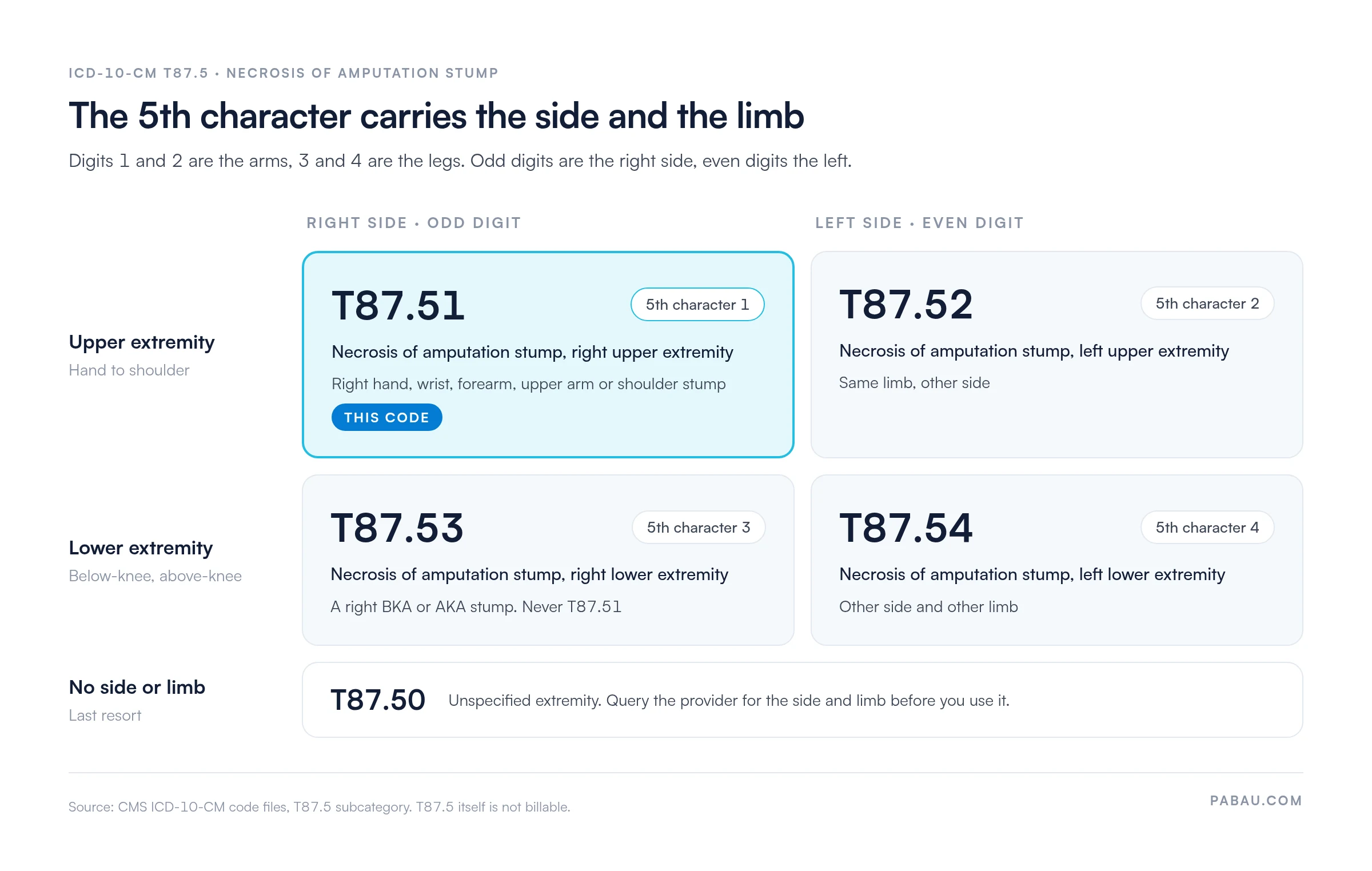
The 5th character carries side and limb. T87.52 is the left arm, and T87.54 is the left leg.
Infection of the same stump takes T87.41, and a neuroma takes T87.31. Report T87.41 alongside T87.51 when the note documents both.
Pair T87.51 with upper-limb CPT codes, such as 25907 or 24925, and an upper-limb Z89 status code, never a leg code.
ICD-10 code T87.51 is the billable code for necrosis of an amputation stump on the right upper extremity. The AAPC code record for T87.51 lists that exact descriptor. It applies to a right hand, wrist, forearm, upper arm or shoulder stump. A right leg stump takes a different code.
T87.51 reports necrosis at the residual limb after an amputation anywhere on the right upper extremity. The provider has to document tissue death, using necrosis or a term that means the same, such as necrotic tissue or eschar.
Upper-limb amputations most often follow trauma, such as crush, machinery or blast injuries. Necrosis usually starts at the flap edge, where the skin’s blood supply is weakest. Tension on the closure, swelling, infection or tissue bruised by the original injury can all set it off.
The code covers every amputation level on the right arm:
Coding a right leg stump? A right below-knee (BKA) or above-knee (AKA) stump with necrosis takes ICD-10 code T87.53, necrosis of amputation stump, right lower extremity. T87.51 on a leg claim is a laterality and limb error.
Read the code back as words before you submit it. If “T87.51” and “right BKA” sit on the same claim, one of them is wrong. The right leg is T87.53.
T87 holds the complications peculiar to reattachment and amputation. Its T87.5 subcategory splits stump necrosis into five billable codes, one for each limb and side. The CMS ICD-10 code files list the same five.
Read the 5th character as two facts. The digits 1 and 2 are the arms, and 3 and 4 are the legs. Odd digits are the right side, and even digits are the left. So T87.51 is right and upper, while T87.53 is right and lower.
The WHO version of ICD-10, used outside the US, stops at T87.5 with no side or limb. The five-way split exists only in ICD-10-CM, so a US claim needs the full five-character code. To look up a neighboring complication code, search our ICD-10-CM diagnostic codes library.
T87.51 carries no notes of its own. It takes the instructions set at the T80-T88 block and at Chapter 19, which apply to every T87.5 code.
Auditors read these inherited notes when they review a stump claim, so they belong in your medical billing compliance checks.
Three questions pick the code. Which side is it, which limb, and what happened to the tissue? The table shows how each neighbor differs from T87.51.
The replant row trips up hand surgery coders. Necrosis of a reattached right finger codes to T87.0X1. If the surgeon then removes the failed digit and the new stump breaks down, that later necrosis is T87.51.
The T87.4 codes carry their own instruction to add a code for the infection. So a necrotic, infected right forearm stump can carry T87.51, T87.41 and an organism code from B95-B97.
A 52-year-old machinist had a right transradial amputation after a press injury. Four weeks later, the surgeon finds a 4 cm by 3 cm area of black eschar along the distal flap.
She performs sharp debridement of 12 sq cm of devitalized tissue, down into subcutaneous fat. There are no signs of infection. Her note reads “necrosis of right transradial amputation stump.” The patient also has type 2 diabetes, which she does not link to the wound.
Payers judge medical necessity from the whole diagnosis set, so the codes around T87.51 matter. List T87.51 first when the visit is for the stump necrosis, then add the codes below that the note supports.
T87.51 already tells the payer an amputation happened, so check your coding policy on status codes. Many teams still add the Z89 code, because it is the only place the claim shows the level. Never use a lower-limb Z89.5- or Z89.6- code with T87.51.
T87.51 usually supports debridement or a revision of the stump. Revision codes depend on the level of the original amputation, so the CPT code has to match the right arm stump. For a finger or thumb stump closed directly, that match is CPT 26951.
Leg revision codes, such as 27884 for a below-knee stump or 27594 for a thigh stump, fail payer edits against T87.51. Selective debridement codes 97597 and 97598 are not reported with 11042-11047 for the same wound, so code the deepest tissue removed. Check your MAC’s wound care LCD and the current NCCI edits before you bill.
Auditors look for five facts in the record. If one is missing, the claim is open to a denial now or a recoupment later.
Coders can’t infer necrosis from a wound photo or a measurement. When a progress note says “non-healing” and nothing more, query the provider before the claim goes out.
Older records and audits sometimes need the ICD-9-CM code that came before T87.51. The CMS General Equivalence Mappings give one approximate match, 997.69, other late amputation stump complication. ICD-9 had no side, limb or necrosis detail, so read the old note before you convert it.
Most T87.51 denials trace back to the side, the limb or the tissue finding. Good denial management in healthcare starts at code assignment, before the claim leaves the practice.
A claim that passes these checks is far closer to a clean claim on the first try. If a T87.51 claim is still denied, appeal with the wound care note, the side and level, and the debridement depth. Medicare contractors generally decide a redetermination within 60 days of receiving it.
Most T87.51 errors start before charge entry, in a note that never named the side or the limb. They surface weeks later as a denial, when the visit details are harder to recover.
Pabau, the practice management and billing platform we build, generates each claim from the invoice raised at the visit. Its claims management software keeps the claim and the clinical record together, so nobody re-keys the charge.
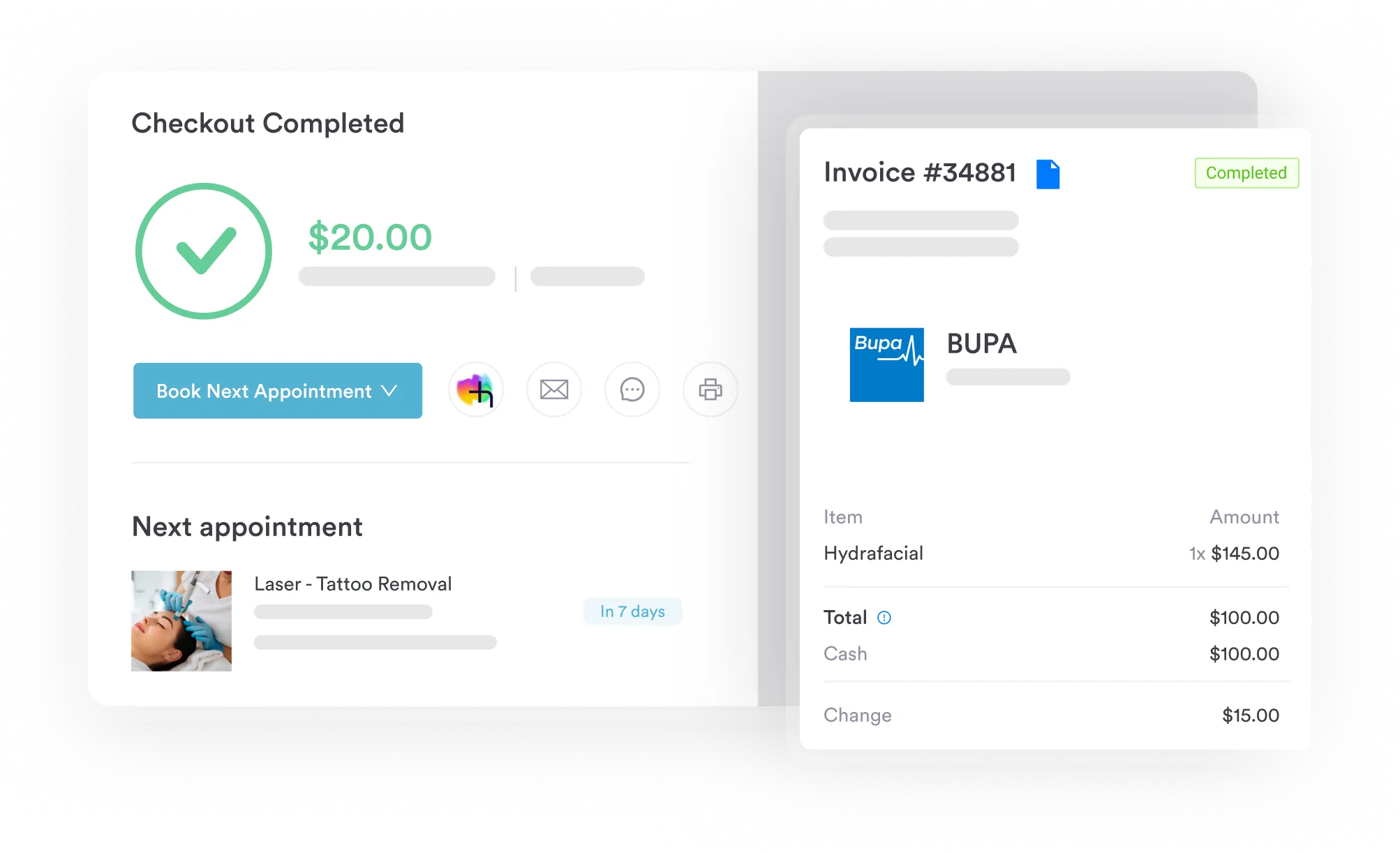
In the US, Pabau sends electronic claims through Claim.MD. Eligibility checks run from the patient record, and ERA remittances are matched to the claims they settle. Your billing team can see a pattern in stump claim denials and fix it at the note.

Pabau generates claims from the invoice, checks eligibility from the patient record, and posts ERA remittances back. Your team spends less time reworking stump necrosis claims.

On a T87.51 claim, confirm the side and the limb before anything else. T87.51 is the right arm, and a right leg stump belongs on T87.53. No CPT pairing can rescue a claim that names the wrong limb.
When the note is vague, query the provider before you bill. A one-line addendum naming a right transradial stump takes minutes, while an audit recoupment takes the whole payment.
Book a demo to see how Pabau helps your practice send stump necrosis claims that match the visit record.

Coding a right leg stump instead? ICD-10 code T87.53 covers necrosis of a right lower extremity amputation stump.
Coding the left arm? ICD-10 code T87.52 covers necrosis of a left upper extremity amputation stump.
Is the right arm stump infected too? ICD-10 code T87.41 covers infection of a right upper extremity amputation stump.
Reading denials on your remittance? Denial codes in medical billing explains CARC and RARC codes and how to respond to each one.
Connecting to a US clearinghouse? Claim.MD clearinghouse overview shows how Pabau sends 837P claims and retrieves ERAs.
T87.51 means necrosis of amputation stump, right upper extremity. It reports dead tissue on the residual limb after a right hand, wrist, forearm, arm or shoulder amputation.
No. T87.51 is the right arm. Necrosis of a right below-knee or above-knee stump is T87.53, and a left leg stump is T87.54.
T87.51 is billable and complete at five characters. It takes no 7th character and no placeholder X. Its parent, T87.5, is not billable.
Yes. When the note documents both necrosis and infection of the right arm stump, report T87.51 and T87.41. Add a code for the organism if it is known.
Use the right upper limb code for the documented level. That is Z89.211 below the elbow, Z89.221 above the elbow, Z89.231 at the shoulder, or Z89.111 and Z89.121 at the hand and wrist.
T87.51 pairs with debridement codes such as 97597 or 11042, and with upper-limb revision codes such as 25907, 25909, 24925 or 24930. Pick the revision code that matches the stump level.
The CMS General Equivalence Mappings link T87.51 to 997.69, other late amputation stump complication, as an approximate match. ICD-9 had no side, limb or necrosis detail.