ICD-10 Code S02.602D: Fracture of mandible, subsequent encounter
ICD-10 Code S02.602D: Definition and billable status ICD-10 Code S02.602D is the...

Last Updated: Oct 8, 2026
Billable Code Specific Code
T87.89 is the billable ICD-10-CM code for other complications of amputation stump. Its five Applicable To conditions are stump contracture, contracture of the next proximal joint, stump flexion, stump edema, and stump hematoma. Coders often default to T87.9 (unspecified) out of habit even when the record supports T87.89, and that habit triggers specificity denials.
The other frequent error is routing a condition to T87.89 that belongs elsewhere. Cellulitis and infection go to T87.4-, ulcers to L97.- or L98.4-, and phantom limb syndrome goes to G54.6 or G54.7 under an Excludes2 note.
Let Pabau's smart automation suggest the right codes, reduce claim denials, and keep your practice compliant—effortlessly.
Automate repetitive tasks and focus on what matters most—your patients.
Reduce coding errors and ensure compliance with the latest regulations.
Clean claims, fewer denials, and faster reimbursements.
Powerful insights and reporting to help your practice thrive.
HIPAA compliant SOC 2 certified GDPR-compliant Trusted by 4,000+ clinics worldwide
ICD-10 code T87.89 is the billable diagnosis code for other complications of an amputation stump. Five inclusion terms sit under it.
They are amputation stump contracture, contracture of the next proximal joint, stump flexion, stump edema, and stump hematoma. Assign it when the clinical record names one of those findings at the residual limb, instead of defaulting to the unspecified T87.9.
Two mistakes account for most T87.89 denials. The first is coding soft-tissue problems that happen at the same site but belong elsewhere, such as cellulitis, infection, ulceration, or necrosis.
The second is coding phantom limb pain here. That condition sits in the nervous system chapter under G54.6 and G54.7, and T87.89 carries an Excludes2 note that says so.
This page sets out the five inclusion terms, the Excludes2 note, the code hierarchy, and the sibling codes in T87. It also covers the CPT pairings that match those conditions and the documentation each one needs. Physical therapy and rehabilitation practices treating post-amputation patients meet this code most often during prosthetic fitting and range-of-motion follow-up.

T87.89 is a billable ICD-10-CM code for other specified stump complications. It is distinct from T87.9 (unspecified), so use it only when the record names the condition.
Five conditions fall under T87.89 via Applicable To notes: amputation stump contracture, contracture of the next proximal joint, stump flexion, stump edema, and stump hematoma.
Phantom limb syndrome is not a T87 code. It is coded G54.6 with pain and G54.7 without pain, and T87.89 carries an Excludes2 note pointing there.
Stump cellulitis and infection go to T87.4-, necrosis to T87.5-, dehiscence to T87.81, neuroma to T87.3-, and residual limb ulcers to L97.- or L98.4-.
Practice management software like Pabau integrates with Claim.MD to validate T87.89 against payer rules before submission, which cuts specificity-related denials.
T87.89 sits within the T87 parent category, which covers complications peculiar to reattachment and amputation. That category lives in Chapter 19 of ICD-10-CM, covering injury, poisoning, and certain other consequences of external causes.
The ICD-10-CM Tabular List gives T87.89 five Applicable To conditions. Three of them are mechanical problems at the residual limb, and the other two are fluid or blood collections.
None of them is a skin or infection diagnosis, so cellulitis and ulceration stay outside this code. Each one needs specific documentation language in the medical record to support the code.
T87.89 stops at those five terms. A clinician may document another specified stump complication that has no dedicated code. Check the Alphabetic Index first, then the Tabular List, before assigning T87.89 by default.
T87.89 is narrower than its plain-English descriptor suggests. Several conditions occur at the residual limb and still belong to other codes, and one of them is carried by a formal Excludes2 note. An Excludes2 note means the two conditions are different diagnoses.
A patient can still have both at once, so both codes may be reported together when the record supports them.
Phantom limb syndrome and neuroma of the stump are often discussed together, and they are not the same diagnosis. A neuroma is a physical growth of nerve tissue at the cut nerve ending, palpable and often tender.
Phantom limb syndrome is a perceived sensation in the limb that is no longer there. A patient can carry both, and each gets its own code.
T87.89 sits four levels deep in the ICD-10-CM structure. Reading the hierarchy helps coders spot which sibling code applies when documentation points somewhere more specific.
T87.8 itself is a non-billable header code, so coders submit T87.89 rather than T87.8. According to the CMS ICD-10 codes page, only the most specific code in a hierarchy is valid for reimbursement. A claim carrying T87.8 fails the specificity edit before it reaches adjudication.
T87.89 is correct when the documentation names a stump complication that matches one of the five inclusion terms.
T87.9, unspecified complications of amputation stump, applies only when the record genuinely cannot support a more precise diagnosis.
Payers audit that distinction, and the CDC/NCHS ICD-10-CM web tool confirms that unspecified codes invite post-payment review.
The ICD-10-CM Official Guidelines instruct coders to code to the highest degree of certainty supported by the record. Choosing T87.9 when T87.89 is supportable under-codes the encounter. A clinical documentation integrity query to the attending physician usually resolves the ambiguity within 24 to 48 hours.
T87.89 is one code in a larger family. Coders working with post-amputation patients regularly need to separate it from its siblings. The AAPC ICD-10-CM lookup carries the complete list, and the clinical differentiators are below.
The Excludes2 note says “not included here”, not “never code together”. T87.89 and G54.6 may therefore both appear on the same claim. The same holds for T87.89 with T87.4- when the record documents a contracture and an infection.
T87.89 is a diagnosis code, so it pairs with CPT procedure codes describing the service rendered. Because the inclusion terms are mostly contracture, flexion and swelling, the matching procedures lean toward therapy and compression rather than wound care.
Claims pairing T87.89 with a clinically appropriate CPT code submit cleanly through Claim.MD, our US clearinghouse partner. It validates diagnosis and procedure pairings before transmission.
Debridement codes such as 97597 and 97602 do not belong with T87.89, because ulceration of the residual limb is coded to L97.- or L98.4-. Pair those procedures with the skin chapter code instead. Verify current AMA CPT code status annually, since CPT is updated each January.
For inpatient admissions with T87.89 as the principal diagnosis, the grouper assigns MDC 08 and finds no qualifying operating-room procedure. The case then lands in MS-DRG 564, 565 or 566, depending on whether a secondary diagnosis carries an MCC or a CC.
Practice management software like Pabau supports cleaner claims management by mapping ICD-10 diagnosis codes to their CPT procedures and flagging pairing mismatches before submission. The remittance advice on a returned claim then names the pairing that triggered the denial.
Accurate coding for other complications of amputation stump depends on the treating physician’s notes. Coders cannot assign T87.89 on clinical inference alone. Documentation ownership is shared. The physician names the finding, and the coder verifies it against the Tabular List.
Post-amputation documentation works best when the physician and coder checklists run as one workflow. A query that turns “stump complication” into “stump flexion contracture” takes minutes, while a denial appeal takes weeks. Building that query step into the standard post-visit routine keeps the correction cheap.
Build a CDI query template specifically for T87.89. When a chart says ‘amputation stump complication’ with no further detail, give the physician checkboxes. List all five inclusion terms: stump contracture, contracture of the next proximal joint, stump flexion, stump edema, and stump hematoma. Add two more checkboxes for phantom limb syndrome with and without pain, so the physician can route that finding to G54.6 or G54.7 instead.
Post-amputation coding produces a predictable set of errors. Most share a root cause, which is a coder working from incomplete documentation instead of raising a query. Catching them before submission costs far less than appealing afterward, and the denial codes a payer returns usually name the specificity problem outright.
Most of those errors come down to one routing decision at the residual limb. The card below sets the five inclusion terms against the codes that take every other stump finding.
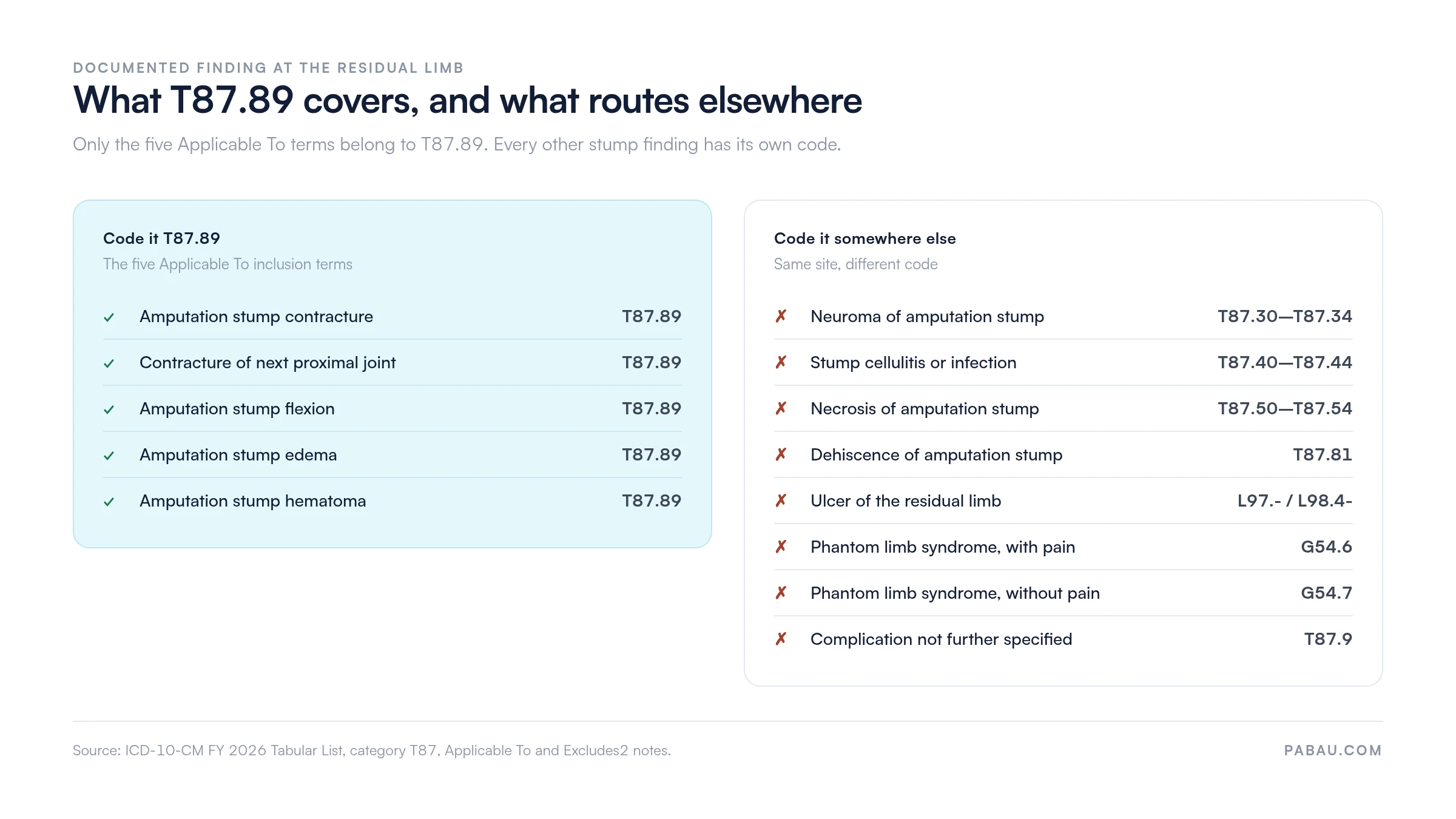
Building a clean claim for T87.89 means checking all seven of these points before transmission. A practice that keeps a standing code list for post-amputation follow-ups should print T87.89 beside its common siblings.
Add a note that the coder matches the code to the documentation, rather than picking from the list on autopilot.
In most rehabilitation practices, the T87.89 decision happens twice. A clinician picks a code from a searchable list during the visit, then a coder revisits that choice days later against the note. When the two disagree, the claim either goes out wrong or sits in a work queue until someone reconciles it.
Pabau keeps the clinical note and the code in the same record, so the coder reads the range-of-motion measurement and the diagnosis on one screen.
Claims then run through Claim.MD before transmission, where diagnosis and procedure pairings are validated against payer rules. A debridement code submitted with T87.89 gets flagged there rather than four weeks later on a remittance advice.
A practice treating post-amputation patients sees fewer specificity denials and a shorter time to payment. The documentation trail also holds up when a payer asks for the chart. Onboarding is structured, so your code sets and claim rules are configured with you rather than left for you to build alone.

Pabau integrates with Claim.MD to validate ICD-10 diagnosis codes against CPT procedure pairings before submission, reducing specificity denials and speeding up reimbursement for post-amputation care.

T87.89 is a narrow code wearing a broad descriptor. It covers stump contracture, contracture of the next proximal joint, stump flexion, stump edema, and stump hematoma, and nothing beyond those five.
Cellulitis, ulceration, infection, necrosis and dehiscence each sit elsewhere, and phantom limb syndrome sits in a different chapter under G54.6 and G54.7.
Get the inclusion list right and the rest of the claim follows. The physician names the finding, and the coder matches it to an inclusion term or a sibling code. The CPT pairing then describes work that fits the condition. Defaulting to T87.9 instead costs audit exposure and delays payment while the payer reviews.
Pabau’s integrated billing workflow validates ICD-10 diagnosis codes against CPT pairings and runs claims through Claim.MD before they reach the payer. To see how that works in a post-amputation care setting, book a demo with the Pabau team.

Need a framework for post-amputation billing workflows? What is revenue cycle management explains how documentation, coding, and claim submission connect in a single billing cycle.
Want to understand how clearinghouse submission reduces denials? Claim.MD clearinghouse overview covers how real-time eligibility checks and claim validation work before transmission.
Looking for guidance on medical billing compliance for injury codes? Medical billing compliance outlines the documentation and audit requirements that apply to Chapter 19 codes.
ICD-10 code T87.89 is the billable diagnosis code for other, specified complications of an amputation stump. Its five Applicable To conditions are amputation stump contracture and contracture of the next proximal joint. The list also covers amputation stump flexion, amputation stump edema, and amputation stump hematoma. Use it when the medical record names one of those findings at the residual limb.
Yes. T87.89 is a valid billable ICD-10-CM code for the 2026 edition, effective October 1, 2025, and it is accepted in all HIPAA-covered transactions. The parent code T87.8 is non-billable, so always submit T87.89 rather than T87.8.
No. Phantom limb syndrome with pain is coded G54.6, and phantom limb syndrome without pain is coded G54.7, both in the nervous system chapter. T87.89 carries an Excludes2 note that points to G54.6-G54.7. Phantom limb pain is also distinct from neuroma of the amputation stump, which is coded T87.30 to T87.34.
No. Neither condition appears in the T87.89 inclusion terms. Cellulitis or infection of an amputation stump is coded to T87.40 through T87.44, with a character for laterality. A non-pressure chronic ulcer of the residual limb is coded in the skin chapter, to L97.- or L98.4-.
T87.89 is for other specified stump complications when the record names a condition matching one of the five inclusion terms. T87.9 is for an unspecified stump complication, used only when the documentation cannot support a more precise code. ICD-10-CM guidelines require coding to the highest specificity, so T87.89 wins whenever the physician has named the finding.
The physician must name the specific complication, such as contracture of the amputation stump, stump flexion, stump edema, or stump hematoma. The note should also carry the anatomic level of the residual limb and the management plan. For a contracture of the next proximal joint, name the joint involved. Without a named condition matching one of the five inclusion terms, query the clinician rather than default to T87.9.
The parent category is T87, complications peculiar to reattachment and amputation, and the immediate parent subcategory is T87.8. Sibling codes include T87.30 to T87.34 for neuroma and T87.40 to T87.44 for infection. The set also carries T87.50 to T87.54 for necrosis, T87.81 for dehiscence, and T87.9 for an unspecified complication. Each has distinct clinical criteria and should not be substituted for T87.89.
Therapy and compression codes fit the T87.89 conditions best. Common pairings are 97110 and 97140 for contracture and flexion, plus 97530 for prosthetic preparation. Use 29580 for edema managed with an Unna boot, and 10160 for aspirating a stump hematoma. Debridement codes such as 97597 and 97602 belong with the skin chapter ulcer codes instead.