ICD-10 code T32.0: Corrosions involving less than 10% of body surface area
What ICD-10 code T32.0 covers: Chemical corrosions under 10% T32.0 reports chemi...

Last Updated: Nov 26, 2026
Billable Code Specific Code
ICD-10 code T32.85 is the billable code for corrosions involving 80-89% of body surface with 50-59% third degree corrosion. Corrosion means a chemical burn, so this code sits apart from T31, the series for burns from heat, electricity or radiation.
T32.85 records extent only. The chemical and intent come from T51-T65, and each injured site from T20-T25. Both percentages count against the whole body, and the provider's note must state each one. It covers acute care only, and scar follow-up takes other codes. Below, we follow a T32.85 claim from burn assessment to remittance, flag what trips it up and finish with a pre-submission checklist.
Let Pabau's smart automation suggest the right codes, reduce claim denials, and keep your practice compliant—effortlessly.
Automate repetitive tasks and focus on what matters most—your patients.
Reduce coding errors and ensure compliance with the latest regulations.
Clean claims, fewer denials, and faster reimbursements.
Powerful insights and reporting to help your practice thrive.
HIPAA compliant SOC 2 certified GDPR-compliant Trusted by 4,000+ clinics worldwide

T32.85 reports corrosions (chemical burns) covering 80-89% of body surface, with 50-59% of body surface at third degree.
It’s an extent code with no 7th character. The chemical and intent come from T51-T65, and each injured site from T20-T25.
Thermal burns of the same extent use T31.85, not T32.85, so confirm the agent before you pick the series.
Both percentages must appear in the provider’s documentation. If either one is missing, query rather than guess.
DRG grouping turns on skin grafts, inhalation injury and ventilation over 96 hours, not on the extent code alone.
T32.85 is for acute corrosions only. Scar and contracture visits take the site corrosion code with 7th character S.
ICD-10 code T32.85 is the billable ICD-10-CM code for corrosions involving 80-89% of body surface with 50-59% third degree corrosion.
The CDC’s FY2027 tabular list carries that exact descriptor under category T32. The code is valid for FY2027 and needs no extra characters. The rest of the claim rests on the codes reported around it.
ICD-10-CM splits burns and corrosions into separate code families. A corrosion is a burn caused by a chemical, such as an acid or an alkali. The burn codes cover heat, flame, steam and hot objects, plus burns from electricity and radiation.
That split runs through the whole chapter. Category T31 classifies burns by extent, and T32 classifies corrosions by extent. Categories T20 to T25 code each injury by body site, with separate subcategories for burns and corrosions.
So the agent decides the series before any percentage does. A worker splashed with caustic soda gets T32. A house-fire victim or an electrical injury with the same extent gets T31. If the record says only “burn” and the history mentions a chemical, query the provider before you choose.
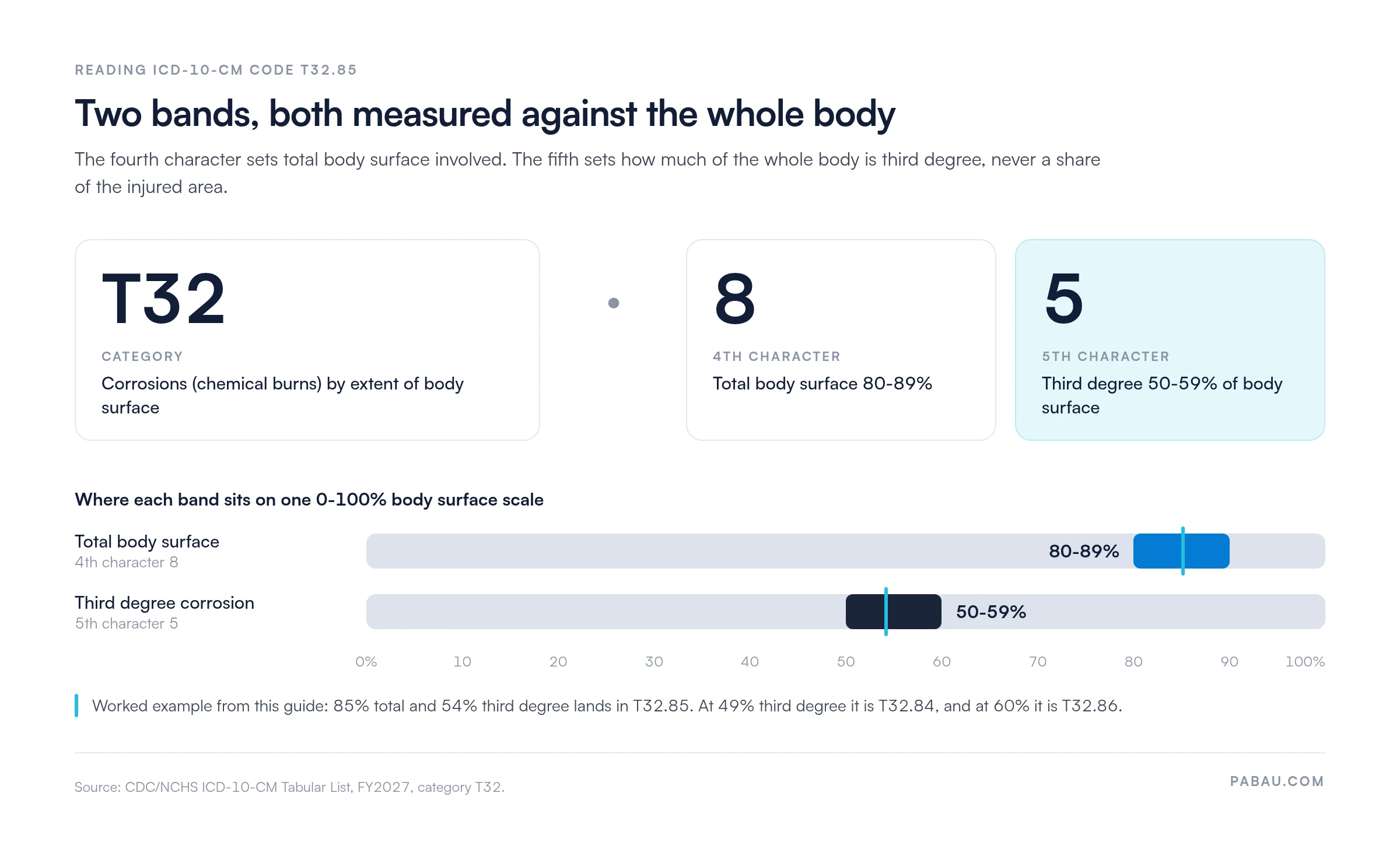
Within T32, the fourth character sets the total body surface involved. The fifth character sets how much of the body surface is third degree. The table below shows how far each subcategory runs, and our ICD-10-CM code library covers the neighboring codes.
The third degree share can never exceed the total, which is why T32.8x stops at T32.88. There’s no T32.89.
Both numbers describe the whole body surface, never a share of the injured area. A patient with 85% of the body corroded, and 54% of the body at full thickness, fits T32.85. The diagram shows how each character maps to its band.
Section I.C.19.d.6 of the FY2027 ICD-10-CM Official Guidelines ties T31 and T32 to the rule of nines. The head and neck count as 9%, each arm 9% and each leg 18%. The front and back of the trunk count 18% each, and the genitalia 1%.
Providers may adjust those figures for infants and children, whose heads are proportionately larger. Many burn units use the Lund-Browder chart for that reason. Either way, the coder reads the percentages from the provider’s note and never calculates them.
One band either side changes the code. At 49% full thickness you need T32.84, and at 60% you need T32.86.
Most T32.85 problems start long before the claim leaves the building. Here’s the path a clean claim follows.
Section I.C.19.d.6 frames the extent codes as additional data when sites are documented. T32 leads only when the record doesn’t name the sites.
Picture an illustrative case. A plant worker is sprayed with a caustic alkali solution in an accident. The burn surgeon documents corrosion of 85% of the body surface, with 54% at full thickness, mapped by the rule of nines.
The coder starts with T54.3X1A, the toxic effect of corrosive alkalis, accidental, initial encounter. Next come the third degree corrosion site codes from T20-T25, in the .7 subcategories, each with A as the 7th character.
T32.85 follows, since 85% total and 54% third degree land in that box. A Y92 code for the industrial site closes the set. No X00-X19 code appears, because there was no heat source.
Now change one detail. If the note had said 85% total with no full-thickness figure, the coder would stop and query. Picking T32.80 by default would understate the injury.
Corrosions get their chemical and intent from the T51-T65 toxic effect codes, not from an X code. The T20-T25 corrosion codes carry a code-first note for that reason, plus an instruction to add Y92 for place.
The encounter character follows the same logic as the rest of chapter 19. A, D or S goes on the T20-T25 site codes and on the T51-T65 agent code. T32.85 takes none, so don’t add one to it.
Code the agent from the ED note before the chart closes. The chemical name often appears only in the first triage entry, and progress notes may just say “burns.”
Inpatient burn and corrosion cases group within MDC 22, Burns. The CMS MS-DRG v44.0 definitions manual lists T32.85 on its Extensive Burns list, which feeds DRGs 927 and 933. The full-thickness list behind 928, 929 and 934 holds third-degree site codes instead. So T32.85 alone never qualifies a case for those three.
Mechanical ventilation counts as a procedure, so it reaches the grouper only through the ventilation code and its hours. Inhalation injury is a separate diagnosis too, such as T27.- for the respiratory tract or J70.5. Run the full code set through your FY2027 grouper before you rely on any expected DRG.
Large corrosions usually bring surgery and critical care with them. Each procedure stands on its own documentation, and the diagnosis never justifies a procedure by itself.
Graft areas should make sense next to the full-thickness percentage. A large mismatch between the two invites an audit question.
Most mix-ups involve a neighboring band or the wrong family. Use this table to check the code against the chart.
T31 covers burns from heat, electricity or radiation, and T32 covers chemical corrosions. For a burn case, see T31.85, and for the next extent band up, T32.95.
Each of these tends to come back as an adjustment on the remittance, often a CARC 16 or 11. Our guide to denial management in healthcare covers how to work them.
If any line fails, fix the chart or send a query before the claim goes out. That’s far cheaper than an appeal.
Most T32.85 cases are billed by hospital burn units. Outpatient practices see these patients later, for wound care, scar management or reconstructive follow-up. T32.85 is for acute corrosions only, so scar and contracture visits take the site corrosion code with 7th character S for sequela. Those visits still need clean claims and fast payment.
Pabau, a practice management platform with built-in billing, takes on that follow-up work. Eligibility checks run before the visit, claims go out electronically, and remittances come back into the same system.

With simpler claims management, your team sees which claims are paid, adjusted or waiting. Nobody has to log in to separate portals to find out.

Pabau runs eligibility checks, submits claims and brings remittances back into one system, so follow-up visits get paid without portal chasing.

T32.85 rewards coders who confirm the agent before they look at a single percentage. Once the case is clearly a corrosion, the two bands either match the provider’s note or they don’t.
When they don’t, a query beats a guess every time. Build that habit into your workflow, and these claims stop coming back.
Want claims, eligibility checks and remittances in one place? Book a demo to see how Pabau handles your practice’s billing.

Need to understand how claims move from code assignment to payment? Claim.MD clearinghouse guide walks through how electronic claims are validated, scrubbed, and routed to payers.
Looking for guidance on clean claim submission? Clean claim requirements explains the data elements every claim needs to avoid front-end rejections.
Dealing with denied claims? Denial codes in medical billing breaks down the most common CARC/RARC codes returned on denied inpatient claims.
Only rarely. Section I.C.19.d.6 uses the extent codes when the sites aren’t specified or when extra data is needed. When the record names the sites, the T51-T65 and T20-T25 codes come first.
ICD-9-CM used 948.85 for burns of 80-89% of body surface with 50-59% third degree. It had no separate chemical extent category, so 948.85 maps to both T31.85 (thermal) and T32.85 (chemical) in ICD-10-CM.
Yes. The extent bands are the same at any age. Providers may adjust the rule of nines for infants and children, and many use the Lund-Browder chart.
No. Corrosions of the eye and internal organs have their own categories, T26 to T28. T32 covers external body surface only.
Yes. T32.85 remains a billable ICD-10-CM code for FY2027. Check the CMS code files each October, since codes can change.