ICD-10 Code Y78.0: Radiological device malfunction
ICD-10 Code Y78.0: Definition and official descriptor ICD-10 Code Y78.0 is the b...

Last Updated: Nov 3, 2026
Billable Code Specific Code
T87.34 is the billable ICD-10-CM code for neuroma of amputation stump, left lower extremity. It covers a painful nerve-end mass at a left leg, foot or toe amputation site.
Assignment turns on two details in the record. The provider must name a neuroma, not just stump pain, and a note must place it on the left lower extremity. Necrosis of the same stump is T87.54 instead.
Let Pabau's smart automation suggest the right codes, reduce claim denials, and keep your practice compliant—effortlessly.
Automate repetitive tasks and focus on what matters most—your patients.
Reduce coding errors and ensure compliance with the latest regulations.
Clean claims, fewer denials, and faster reimbursements.
Powerful insights and reporting to help your practice thrive.
HIPAA compliant SOC 2 certified GDPR-compliant Trusted by 4,000+ clinics worldwide

T87.34 is the billable ICD-10-CM code for neuroma of amputation stump, left lower extremity.
It codes a painful nerve-end mass at a left leg, foot or toe stump, not tissue death or infection.
Stump necrosis on the left leg is T87.54, and stump infection is T87.44.
Phantom limb pain is coded to G54.6, so the provider must document a neuroma at the stump.
Add a Z89 code, such as Z89.512 for a left below-knee amputation, to show the amputation level.
ICD-10 code T87.34 is the billable diagnosis code for neuroma of amputation stump, left lower extremity. It sits in Chapter 19 of ICD-10-CM under category T87, complications peculiar to reattachment and amputation. It has been valid since October 1, 2015, and it remains valid in the FY2026 code set published in the CMS ICD-10-CM code files.
The code describes a painful nerve-end mass at a left leg, foot or toe amputation site. It doesn’t describe necrosis, infection or phantom limb pain, which each have their own codes.
A neuroma of the amputation stump is a disorganized mass of nerve fibers at the cut end of a nerve. After amputation, the severed fibers try to regrow but have no distal nerve to reach. They form a tangled, sensitive nodule near the end of the residual limb.
T87.34 applies when that neuroma sits on the left lower extremity. That covers a left toe, foot, ankle, below-knee, knee or above-knee amputation site. The original amputation can be traumatic, surgical or disease-related.
T87.3 is a non-billable header with five billable codes beneath it. A claim submitted at T87.3 is rejected, so the code has to name the extremity. T87.34 is the right one when the record places the neuroma on the left leg, foot or toe.
T87.33 and T87.34 are easy to swap on a busy coding queue. Check the side in the operative report or exam note before you assign either code. The ICD-10-CM Official Guidelines let you take laterality from another clinician’s note, such as a therapy entry. The neuroma diagnosis itself still has to come from the provider.
T87.34 is often confused with the other T87 complication codes for the same stump. Each describes a different problem, and the provider’s wording decides which one applies. A note describing dead or blackened stump tissue points to T87.54, not to a neuroma code.
A patient can have more than one of these at once. Code each condition the provider documents separately, and query the provider when a note says only “stump pain.” The path below runs the two checks in order, condition first and side second.
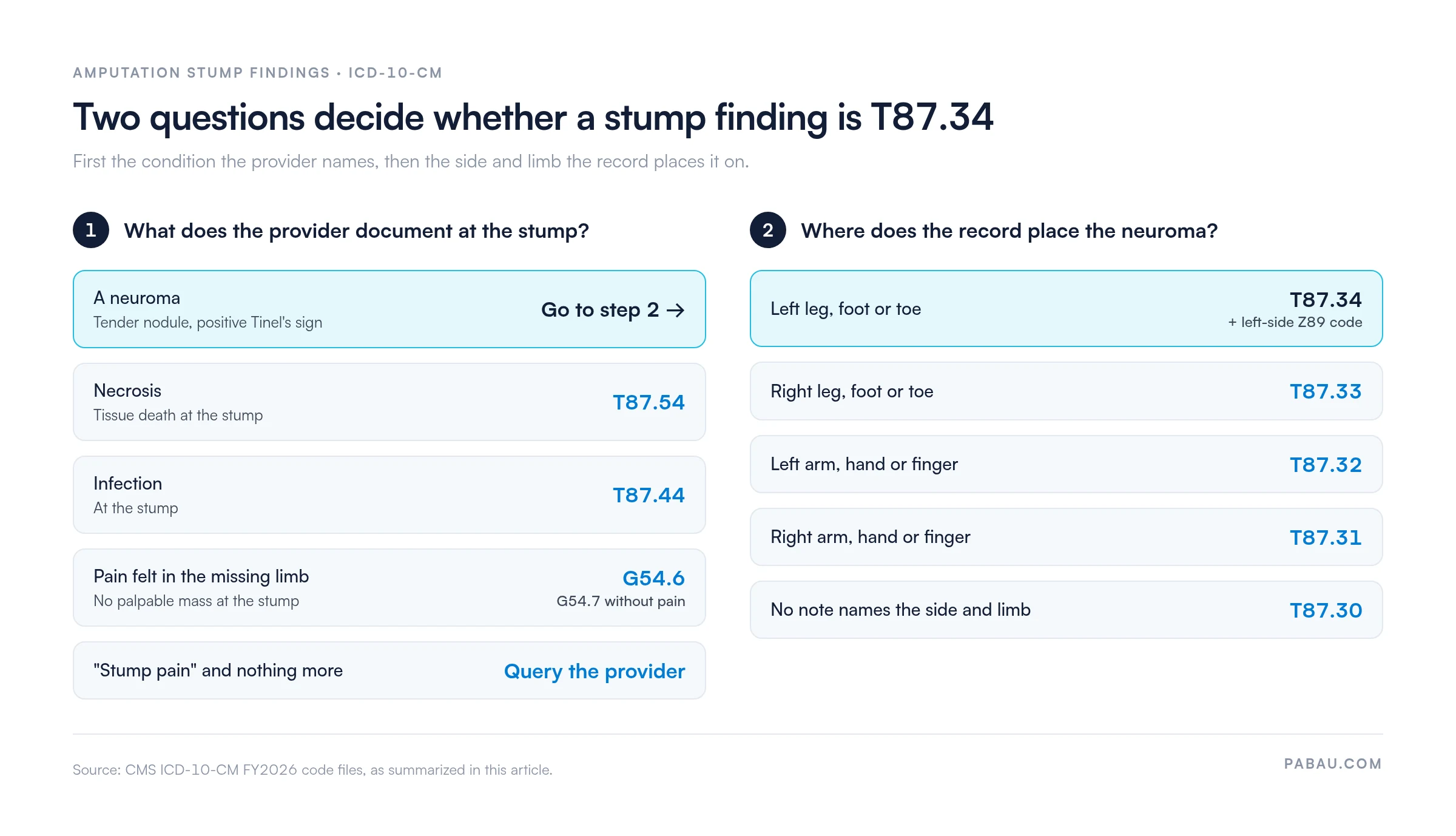
Stump neuroma pain sits in the residual limb, while phantom limb pain is felt in the part that is gone. Notes often blur the two, yet they need different codes and often different treatment.
Both codes can appear on one claim when the provider documents both conditions. Stump pain alone supports neither, so a clinical documentation query is the next step.
T87.34 names the complication, and a Z89 code names the missing part of the limb. Adding the Z89 code shows the payer the level of the left-side amputation. These left-side codes come up most often with T87.34:
Sequencing follows the reason for the visit. When the patient comes in to treat the neuroma, list T87.34 first and the Z89 code after it. When the neuroma is a secondary issue, list it after the main reason for the visit.
A payer reviewing a T87.34 claim looks for these elements in the record. Having them in place before billing is what makes a clean claim possible.
Before you assign T87.34, run a three-point check. Does the provider name a neuroma? Does a note place it on the left lower extremity? Is there a Z89 code for the level? If any answer is no, query the provider first.
The procedure code follows the treatment the provider chose. Check every descriptor against the current CPT manual, because annual revisions change procedure definitions.
Targeted muscle reinnervation (TMR) reroutes cut nerves into nearby motor nerves, and it is an established option for painful stump neuromas. It has no dedicated CPT code, so some claims go out as 64999, the unlisted nervous system procedure. Expect a prior authorization request and an operative report on those claims.
Nerve blocks are usually the first treatment, and the guide to CPT code 64450 covers how to bill them. Revision codes carry a 90-day global period, so check modifier rules when the original surgeon operates again.
No national coverage policy is written for T87.34 itself. Coverage for nerve blocks, neuroma excision and stump revision comes from your Medicare Administrative Contractor’s local coverage determinations. Search the Medicare Coverage Database for your jurisdiction before you schedule a procedure.
T87.34 claims tend to come back for a small set of reasons. Denial management workflows that track them help you spot a pattern early.
Before you edit a returned claim, decode the denial code on the remittance advice. A missing-information denial needs data added, while a medical necessity denial needs clinical evidence.
On a stump neuroma claim, the details sit in different places. The surgeon documents the neuroma, therapy may record the side, and someone retypes both onto the claim form.
Pabau’s billing tools open each claim pre-filled from the invoice that checkout already raised. Its claims management software checks for missing or invalid details before the claim leaves the system. US claims go out as CMS-1500 forms through our Claim.MD integration.
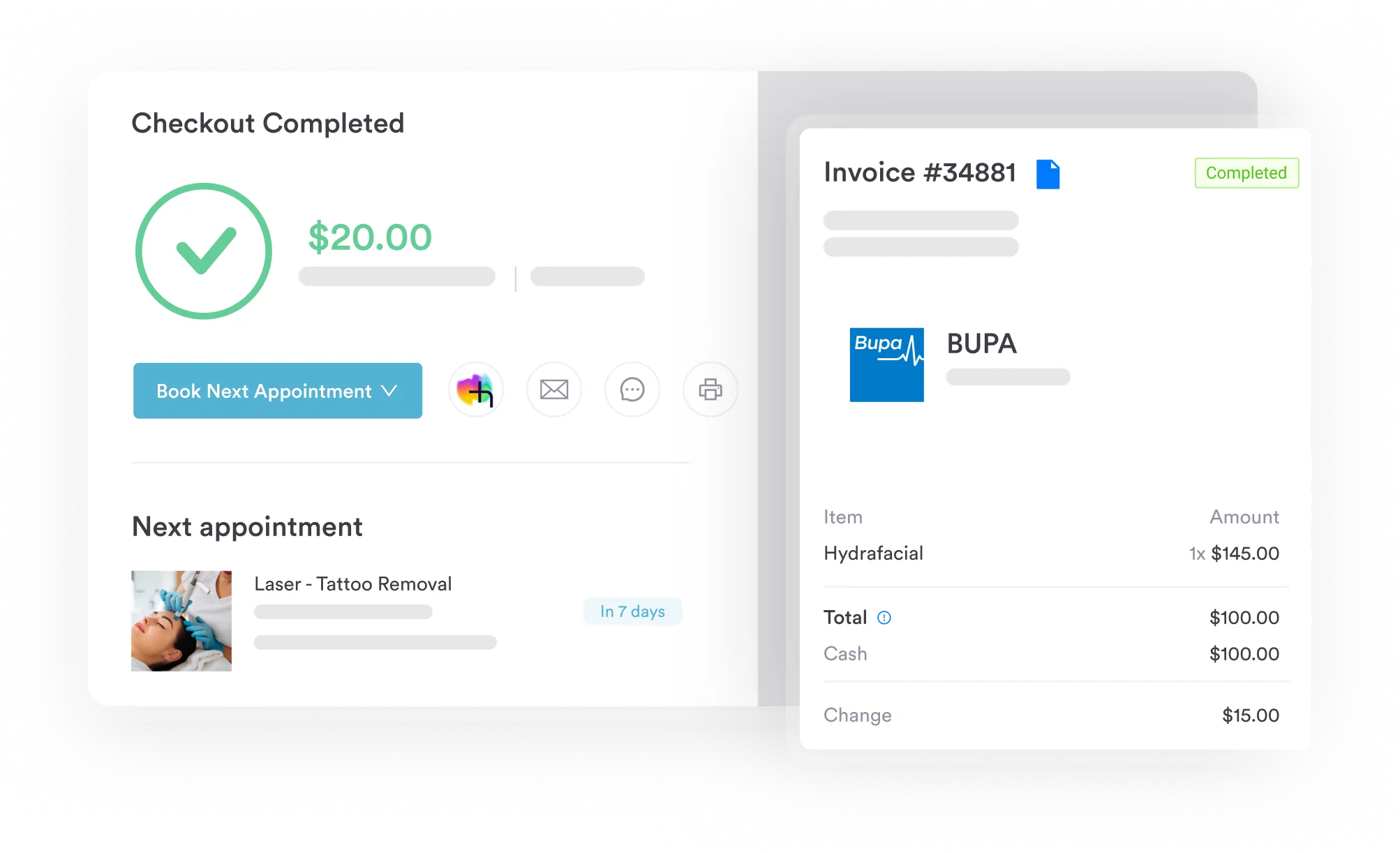
Your coder still chooses the code. What changes is the handoff, so T87.34 and its Z89 code reach the payer without retyping. Eligibility checks run before the visit, and a dashboard tracks each claim from pending to paid.

Pabau pre-fills claims from the invoice and checks for missing or invalid details before submission. US claims go through Claim.MD, with eligibility checks and claim tracking included.

T87.34 is a narrow code, and that narrowness is what protects the claim. Assign it only when the provider names a neuroma at a left lower extremity stump. Send necrosis to T87.54, infection to T87.44 and phantom pain to G54.6.
Add the left-side Z89 code every time, and query the provider whenever a note says only “stump pain.” A short query costs less than a recoded claim or an audit finding.
Book a demo to see how Pabau carries the diagnosis and Z89 status from the record onto a clean claim.

Need to understand how claim denials are managed? Denial management in healthcare covers the workflow for tracking, appealing and preventing rejected claims.
Submitting stump neuroma claims with T87.34? Clean claim submission principles outlines the documentation and formatting standards that reduce first-pass rejections.
Want to understand the clearinghouse role in ICD-10 billing? How medical claims clearinghouses work explains how claims move from practice to payer.
T87.34 is the billable ICD-10-CM code for neuroma of amputation stump, left lower extremity. It describes a painful nerve-end mass at a left leg, foot or toe amputation site.
Both codes describe a neuroma of a lower extremity amputation stump. T87.33 is the right side and T87.34 is the left side. T87.30 applies only when the record names no side or limb.
Use T87.54, necrosis of amputation stump, left lower extremity. T87.34 covers a neuroma at the same site, and T87.44 covers an infection of it.
No. Phantom limb syndrome with pain is G54.6, and G54.7 covers it without pain. Both a G54 code and T87.34 can appear when the provider documents both conditions.
Use the left-side Z89 code for the amputation level. Common examples are Z89.512 for a left below-knee amputation and Z89.612 for a left above-knee amputation.
Yes. T87.34 has been billable since October 1, 2015, and it remains valid in the FY2026 ICD-10-CM code set. It needs no seventh character.