ICD-10 Code V16.4XXD: Pedal cycle driver, nontraffic
ICD-10 Code V16.4XXD: definition, billable status, and clinical scenario ICD-10 ...

Last Updated: Oct 7, 2026
Billable Code Specific Code
T87.81 is the billable ICD-10-CM code for dehiscence of amputation stump. It covers a residual limb closure that has partly or fully separated, on an upper or lower limb stump, at any time after the amputation.
Coders can confuse it with T81.31-, the code for disruption of other external surgical wounds, and that substitution can trigger denials. Correct assignment turns on the provider naming the stump as the site, plus a Z89 status code where the record documents the amputation level.
Let Pabau's smart automation suggest the right codes, reduce claim denials, and keep your practice compliant—effortlessly.
Automate repetitive tasks and focus on what matters most—your patients.
Reduce coding errors and ensure compliance with the latest regulations.
Clean claims, fewer denials, and faster reimbursements.
Powerful insights and reporting to help your practice thrive.
HIPAA compliant SOC 2 certified GDPR-compliant Trusted by 4,000+ clinics worldwide

T87.81 is a billable ICD-10-CM code for dehiscence of the amputation stump, current for FY2027, with no 7th character required.
Use T87.81 when the stump closure opens at any time after amputation. Use T81.31- for disruption of any other external surgical wound.
Report a Z89 acquired-absence code alongside T87.81 when the amputation status is documented and relevant to the claim.
Pabau’s claims management submits claims through Claim.MD and tracks status and remittance, so billing teams can follow each T87.81 claim to payment.
ICD-10 Code T87.81 describes wound dehiscence specific to an amputation stump. The sutured closure of the residual limb has separated or opened, whether partially or fully. The code applies at any point after the amputation, not only in the immediate post-operative period.
Clinically, stump dehiscence presents as separation of wound edges at the residual limb site. Contributing factors include infection, ischemia, tension on suture lines, poor tissue perfusion from peripheral vascular disease, and uncontrolled diabetes mellitus. Documentation must identify the dehiscence as occurring at the amputation stump rather than at a separate incision site.
The code covers both upper and lower limb stumps. T87.81 has no site-specific subcodes, so the limb and amputation level are captured by a Z89 status code when the record documents them.
T87.81 sits within category T87 (Complications peculiar to reattachment and amputation). That category falls under block T80-T88 (Complications of surgical and medical care, not elsewhere classified). Understanding the sibling codes helps coders select the most specific option and avoid upcoding or downcoding.
T87.81 and T81.31- are the two dehiscence codes coders most often confuse, and choosing the wrong one can trigger denials on stump wound claims. The distinction comes down to site. T87.81 is for the amputation stump, and T81.31- is for any other external surgical wound.
The ICD-10-CM specificity principle requires the most specific code available. When the dehiscence is at the amputation stump, T87.81 is always the correct selection. The decision path below applies the same rule to the other findings a stump note can carry.
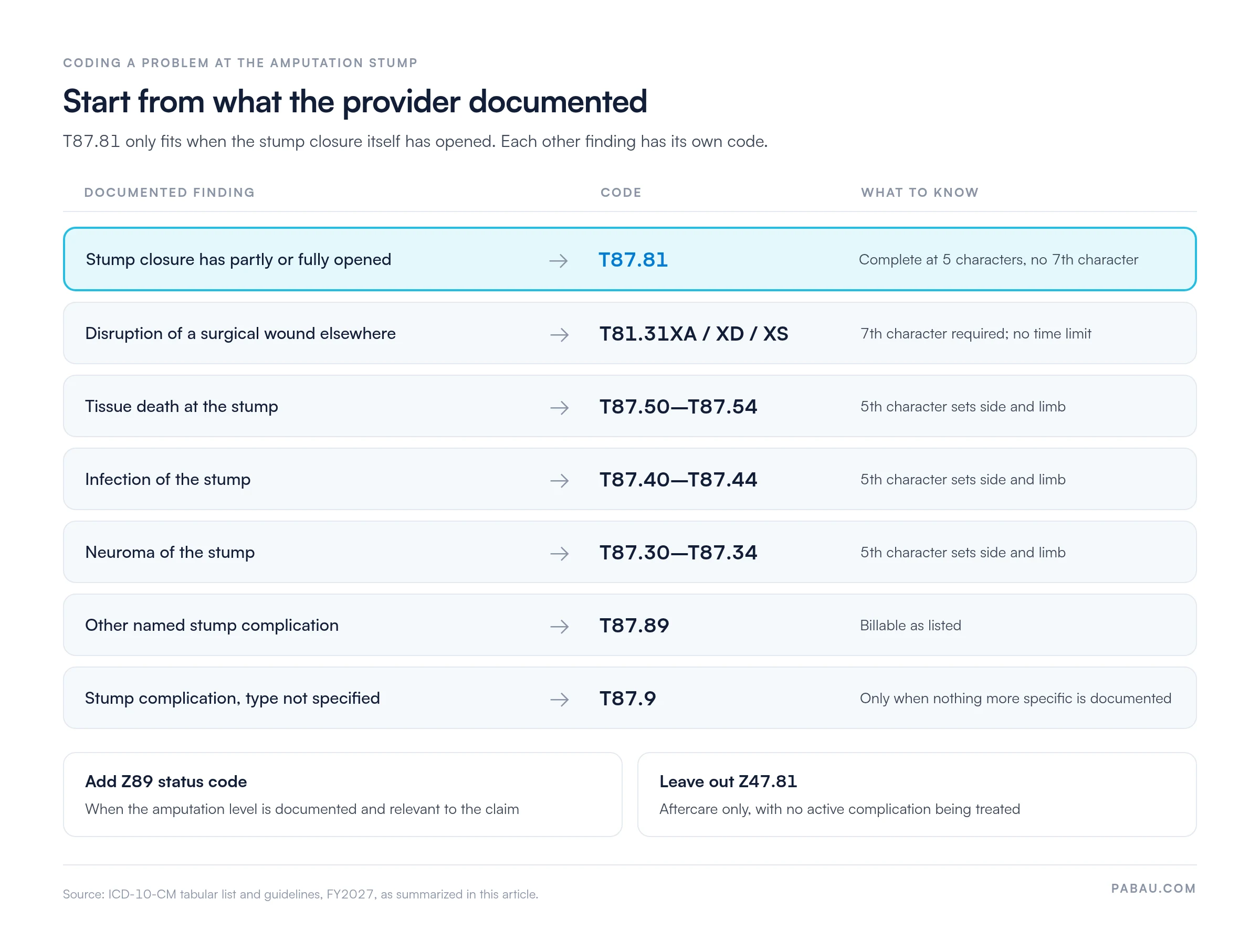
Necrosis (T87.5x) and dehiscence (T87.81) frequently co-occur, but they describe different pathologies and are coded separately when both are documented.
Under the CMS ICD-10-CM Official Guidelines for Coding and Reporting, complications of care (T80-T88) are sequenced by the reason for the encounter. Apply the following rules when coding T87.81.
Practices that build a pre-submission code review into their medical billing workflows catch sequencing errors before claims go out. That review prevents avoidable denials on T87.81 encounters.
When T87.81 is the principal diagnosis, check whether the record documents the amputation level. If it does, report the matching Z89 code so the claim shows the patient’s amputation status alongside the complication.
T87.81 must be supported by documentation that a provider has identified dehiscence at the amputation stump. A coder cannot assign the code from a wound care note alone if the provider has not explicitly stated dehiscence. Supporting clean claim submission starts with specific language in the medical record.
Clinical documentation improvement (CDI) queries are appropriate when the provider note describes findings consistent with dehiscence but does not use the term explicitly. Querying for clarification before coding protects both the accuracy of the code and the defensibility of the claim.
T87.81 rarely appears on a claim in isolation. The codes below are commonly reported alongside it, based on ICD-10-CM combination coding guidance and typical clinical presentations. Thorough superbill documentation captures each relevant diagnosis at the point of care.
Medicare and commercial payers cover wound care services for stump dehiscence when the claim demonstrates medical necessity. T87.81 on its own is not sufficient. Payers review the full diagnosis picture and whether the services billed against it are reasonable.
Pabau, the practice management platform we build, offers simpler claims management for these wound care claims. It submits claims through the Claim.MD clearinghouse and tracks status and remittance, so the billing team can see where each T87.81 claim stands.
Reviewing electronic remittance advice on T87.81 claims shows which payers deny them and for what reason. The billing team can then correct the documentation pattern before it turns into recurring write-offs.
T87.81 denials usually trace back to wrong code selection, an incomplete diagnosis picture, or thin documentation. Fixing each one at the point of coding prevents avoidable rejections. Effective denial management workflows start with understanding why each denial occurs. The table below maps the common causes to specific prevention actions.
Reviewing the full range of denial codes in medical billing alongside T87.81-specific patterns gives billing teams a systematic framework for appeals and root-cause correction.
Coders reconciling pre-2015 records or handling appeals involving older claims need the ICD-9-CM approximate equivalent. The AAPC’s ICD-10-CM code reference provides additional crosswalk context alongside the General Equivalence Mappings (GEM) published by CMS and NCHS.
T87.81 has been valid and unchanged in the ICD-10-CM tabular list since the US transition to ICD-10-CM on October 1, 2015. It is valid and billable for FY2027, which runs from October 1, 2026 to September 30, 2027. For additional code lookup and validation, the Check ICD-10 database mirrors the official CMS/NCHS data and is updated with each annual release.
Stump wound care often runs across several visits, each billed with T87.81, a status code and a wound care CPT code. Without one system, the billing team tracks those claims in a spreadsheet and chases payers by phone when a remittance looks wrong.
In Pabau, the claim is built from the data already in the patient’s visit record and goes out through Claim.MD. Claim status and remittance come back into the same system. The coder still chooses the codes, but nobody has to re-key the claim or call around for its status.
The result is a shorter path from a wound care visit to a paid claim. You also keep a clear record of which T87.81 claims were denied and why.

Pabau’s claims management submits claims through Claim.MD and tracks status and remittance in one place. Your billing team sees which wound care claims are paid, pending or denied.

T87.81 is easy to assign once the provider names the stump as the site that opened. The coding risk sits in the codes around it. Watch for T81.31- on the wrong site, an aftercare Z code on an active complication, or a documented Z89 status left off the claim.
Before the next stump wound claim goes out, confirm the note says dehiscence at the stump. Then check that each wound care CPT code is separately payable, because those two checks can save an appeal.
Book a demo to see how Pabau submits and tracks wound care claims through Claim.MD, so your team spends less time chasing T87.81 payments.

Need a framework for managing claim denials systematically? Denial management in healthcare covers root-cause analysis and appeal workflows for outpatient and wound care practices.
Looking for a clean-claim checklist before submission? Clean claim submission guide outlines the elements payers check on every claim, including diagnosis code completeness.
Want to understand how clearinghouse validation works? Medical claims clearinghouse overview explains how T87.81 claims are scrubbed and routed to payers through a clearinghouse.
ICD-10 Code T87.81 is a billable ICD-10-CM diagnosis code for dehiscence of the amputation stump. It means the wound closure at a residual limb has separated or opened. The code applies to both upper and lower limb stumps at any point after amputation and does not require a 7th character or placeholder X.
Yes, T87.81 is a valid billable code for the current fiscal year, FY2027, which began October 1, 2026. It has been active and unchanged in the ICD-10-CM tabular list since the October 1, 2015 US transition.
The approximate ICD-9-CM equivalent is 997.69 (other late amputation stump complication). ICD-9-CM grouped late amputation stump complications in its 997.6x family, so the match is approximate rather than exact. Use this crosswalk only for legacy record reconciliation or pre-2015 appeal documentation.
The medical record must include a provider statement that explicitly identifies dehiscence at the amputation stump. It also needs wound measurements (length, width, depth) and any contributing conditions, such as diabetes or peripheral vascular disease. Vague terms like “wound problem” are not sufficient; the provider must use clinical language that clearly describes wound edge separation at the residual limb.