ICD-10 code T32.0: Corrosions under 10% of body surface area
What ICD-10 code T32.0 covers: Chemical corrosions under 10% T32.0 reports chemi...

Last Updated: Nov 26, 2026
Billable Code Specific Code
T31.40 is the billable ICD-10-CM code for burns involving 40-49% of body surface with 0% to 9% third degree burns.
Coders use it when the physician documents a total body surface area (TBSA) of 40–49%. Third-degree burns must cover less than 10% of the body surface. T31.40 takes no 7th character, and the encounter character goes on the site-specific burn code. Query the physician when the third-degree percentage is not stated.
Let Pabau's smart automation suggest the right codes, reduce claim denials, and keep your practice compliant—effortlessly.
Automate repetitive tasks and focus on what matters most—your patients.
Reduce coding errors and ensure compliance with the latest regulations.
Clean claims, fewer denials, and faster reimbursements.
Powerful insights and reporting to help your practice thrive.
HIPAA compliant SOC 2 certified GDPR-compliant Trusted by 4,000+ clinics worldwide

T31.40 is a complete, billable five-character code that records burn extent (40-49% of body surface), not burn site or depth.
The fifth character (0) means third-degree burns cover 0 to 9 percent of total body surface. At 10% or more, use T31.41 through T31.44.
Category T31 has no 7th character, so T31.40 is used as is. The encounter character (A, D or S) goes on the site code.
When the burn site is specified, T31.40 is advisable as a supplementary code after the T20-T25 site codes. It stands alone only when the site is unspecified.
Chemical corrosions use T32.40 instead, and a note with no third-degree percentage needs a physician query before you code.
ICD-10 code T31.40 is the billable code for burns involving 40-49% of body surface with 0% to 9% third degree burns.
The FY2026 Tabular List in CDC’s ICD-10-CM browser tool lists it as a complete code with no further subdivisions. It sits in category T31, which classifies burns by the share of total body surface area (TBSA) involved, not by site.
The code is complete at five characters. Category T31 has no 7th-character extension, so T31.40A, T31.40D and T31.40S do not exist. T31.40 is used as is, and the encounter character goes on the paired site-specific burn codes from T20-T25.
Category T31 classifies burns by the percentage of total body surface area involved, wherever on the body the burns are. Categories T20-T25 do a different job, recording each burn by anatomic site and depth. T31 runs from T31.0 (less than 10% of body surface) to T31.9 (90% or more), in 10-point bands.
T31.40 falls in subcategory T31.4, which covers 40-49% TBSA. From T31.1 upward, a fifth character records how much of the total body surface has third-degree burns. The bands follow the Rule of Nines, which the guidelines build into categories T31 and T32.
The fourth character (4) sets the TBSA band at 40-49%. The fifth character records the percentage of total body surface with third-degree burns. In T31.40, that figure is 0% to 9%.
The most common selection error is keeping T31.40 when the note documents third-degree burns on 10% or more of the body. That note supports T31.41 or a higher subcode instead. If the chart describes full-thickness burns without a percentage, query the physician before coding.
ICD-10-CM describes a burn on two axes. Categories T20-T25 record the site and depth, such as a second-degree burn of the chest wall. Categories T31 and T32 record extent, meaning how much of the total body surface is involved.
The Tabular note at T31 sets the order. T31 is the primary code only when the burn site is unspecified. When the site is specified, it is a supplementary code used with T20-T25.
Section I.C.19.d of the ICD-10-CM Official Guidelines calls that extra extent code advisable, not mandatory. It recommends T31 when burn units need data on burn mortality. It also recommends T31 when third-degree burns cover 20% or more of the body surface.
The 7th character follows the same split. T31.40 never takes one. The A, D or S character sits on each T20-T25 site code and reflects the encounter.
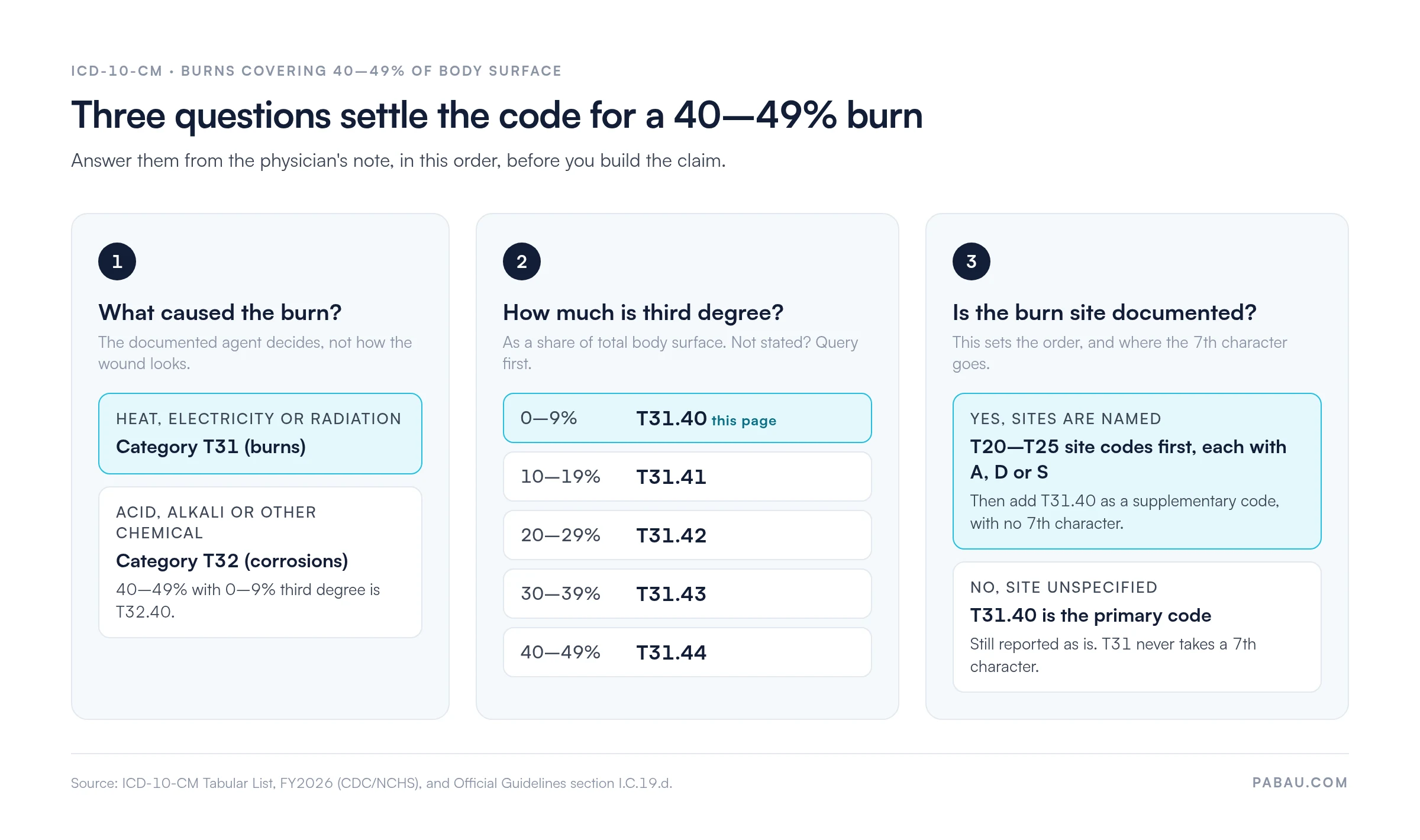
Three questions settle which code a 40-49% burn gets: the cause, the third-degree share and whether the sites are named. Answer them in that order, as the decision path shows.
After coding, the claim passes three checkpoints. Your billing software checks required fields and code validity. The clearinghouse then runs format and payer edits before it forwards the claim. Finally, the payer adjudicates it and returns an 835 remittance advice with the payment or denial details.
A patient arrives with flame burns to both arms, the anterior trunk and the head and neck. Using the Rule of Nines, the physician documents 45% TBSA. That is 9% for each arm, 18% for the anterior trunk and 9% for the head and neck.
Every burn is second-degree, with no third-degree involvement. Code each site with A for the initial encounter: T22.291A for the right arm and T22.292A for the left arm. Both cover multiple sites of the shoulder and upper limb, except wrist and hand.
Add T21.21XA (chest wall), T21.22XA (abdominal wall) and T20.29XA (multiple sites of head, face and neck). Then report T31.40, with no 7th character, to record the 45% extent. External cause codes for the source, intent and place complete the set.
T31.40 applies to thermal, electrical and radiation burns. Chemical corrosions from acids, alkalis and other corrosive agents belong in category T32, which mirrors the T31 structure. T32.40 is the corrosion equivalent, covering 40-49% of body surface with 0% to 9% third degree corrosion.
The choice rests on the causative agent the physician documents, not on how the wound looks. A hot-liquid scald and an acid burn can look alike, but only the acid burn uses T32. If the chart is unclear, query the physician for the mechanism before coding.
T31.40 needs specific physician documentation. Coders cannot estimate TBSA themselves, so the note must state the percentage. The guidelines base T31 on the Rule of Nines. Head and neck count as 9%, each arm 9% and each leg 18%. The anterior and posterior trunk count 18% each, and genitalia 1%.
Providers may adjust those figures for infants and children, whose heads are proportionately larger. Many burn teams use a Lund-Browder chart for that reason. Before you code, check the note for these five points.
When documentation is incomplete, send a query to the treating physician rather than assume T31.40 fits. Our guide to medical billing fundamentals shows where documentation and coding sit in the wider claim cycle.
T31.40 claims usually go wrong in one of three places: the pairing with site codes, the fifth character and the burn mechanism. A denial management workflow catches most of them before submission.
When a claim does come back, match the denial codes on the remittance advice against this table. You can then correct the right problem before resubmission.
Run these checks on every claim that carries T31.40, in this order.
As the patient moves from admission to healing, the encounter character on the site codes changes. T31.40 itself stays the same, and it drops off the claim once the visit is for late effects.
Any aftercare Z-code depends on what the encounter is for, such as surgical aftercare after a graft. Clear encounter rules like these are part of medical billing compliance for burn care.
A 45% burn admission can put six or more diagnosis codes on one claim. Rekeying them into a separate billing system is where site codes get dropped and invalid characters creep in.
Pabau, a practice management platform with claims software for billing teams, keeps coding and claims in one place. Coders search ICD-10-CM lookup libraries from the patient record. Claim forms are then pre-filled from the patient’s details and the codes you select.
Before a claim leaves the system, Pabau checks that the fields a claim requires are complete. Which burn codes to report, and in what order, stays a coding decision based on the physician’s note.
In the US, Pabau sends electronic claims through Claim.MD. The integration adds real-time eligibility checks and 835 electronic remittance advice, so payment and denial details land beside the original claim. Our guide to submitting a clean claim covers what a claim must contain before it reaches a payer.

Pabau’s claims management software pairs ICD-10-CM lookup libraries with pre-filled claim forms and required-field checks. Its Claim.MD integration handles US submission, eligibility checks and remittance.

Most T31.40 errors come from treating it like an injury code that needs an encounter character. Report it as is, and let the T20-T25 site codes carry A, D or S.
The fifth character is the call that depends on the chart. If the note gives no third-degree percentage, query before you settle on T31.40. That one question protects both the code and the claim.
Book a demo to see how Pabau keeps site codes, encounter characters and T31.40 together on one complete claim.

Need a framework for reducing claim rejections across your practice? Denial management in healthcare covers the end-to-end workflow for identifying, correcting, and preventing common billing denials.
Coding a burn one band down? ICD-10 code T31.30 explains the 30-39% extent code and when it applies instead.
Coding a burn one band up? ICD-10 code T31.50 covers burns on 50-59% of body surface with under 10% third degree.
Want to understand how the clearinghouse fits into your billing workflow? Claim.MD clearinghouse guide explains how electronic claim routing and real-time eligibility checks work in practice.
Looking to benchmark your billing operation? Best medical billing software for US practices compares platforms across claim accuracy, clearinghouse integration, and denial rate metrics.
Yes. T31.40 is a complete, billable code in the FY2026 ICD-10-CM code set. It has five characters and takes no 7th character, so it is reported exactly as written.
Only when the burn site is unspecified. When the note names the sites, the T20-T25 site codes come first, led by the highest-degree burn. T31.40 then follows as a supplementary code.
Both cover burns on 40-49% of the body surface. T31.40 applies when third-degree burns cover 0-9% of total body surface, and T31.41 applies when they cover 10-19%.
Category T32 covers chemical corrosions, so a 40-49% corrosion with under 10% third degree is T32.40. T31.40 is for thermal, electrical and radiation burns only.
The physician sets it, not the coder. The guidelines let providers adjust the Rule of Nines for infants and children, whose heads are proportionately larger. Many burn teams use a Lund-Browder chart instead.
No. The guidelines say T31 and T32 codes should not be used for sequelae. Code the scar or contracture first, then the site code with the 7th character S.