ICD-10 Code Y76.0: Diagnostic obstetric and gynecological devices
ICD-10 Code Y76.0: Definition and billable status ICD-10 Code Y76.0 is a valid, ...

Last Updated: Oct 23, 2026
Billable Code Specific Code
H82.9 is the billable ICD-10-CM code for vertiginous syndromes in diseases classified elsewhere, unspecified ear.
Most vertigo claims that get denied are not wrong about the diagnosis - they are wrong about the sequencing. ICD-10 Code H82.9 is a manifestation code, meaning it describes a symptom arising from another condition, and payers expect the underlying etiology to appear first on the claim. Miss that step, and even a perfectly documented vertigo encounter becomes a denial.
Let Pabau's smart automation suggest the right codes, reduce claim denials, and keep your practice compliant—effortlessly.
Automate repetitive tasks and focus on what matters most—your patients.
Reduce coding errors and ensure compliance with the latest regulations.
Clean claims, fewer denials, and faster reimbursements.
Powerful insights and reporting to help your practice thrive.
HIPAA compliant SOC 2 certified GDPR-compliant Trusted by 4,000+ clinics worldwide

ICD-10 Code H82.9 is a billable diagnosis code for vertiginous syndromes in diseases classified elsewhere, unspecified ear – valid for FY 2026 claims.
H82.9 requires an underlying etiology code sequenced first; it is a manifestation code and cannot stand alone as the primary diagnosis.
UnitedHealthcare’s Oxford Inappropriate Primary Diagnosis Code List has included H82.9 as an inappropriate primary diagnosis code – always verify payer policies before submission.
Practice management software like Pabau includes claims management tools that help ENT and audiology practices apply correct sequencing rules and reduce vertigo-related claim denials.
Official description: Vertiginous syndromes in diseases classified elsewhere, unspecified ear.
H82.9 is a billable ICD-10-CM diagnosis code at the 4-character specificity level. The CDC/NCHS ICD-10-CM web tool confirms it as valid and active for FY 2026. Its parent code, H82 (3-character only), is non-specific and non-billable – claims submitted with H82 alone will reject. The 4-character subcodes (H82.1 through H82.9) are required.
H82.9 falls within ICD-10-CM Chapter 8 (H60-H95): Diseases of the ear and mastoid process, subcategory block H80-H83 (Diseases of inner ear). The H82 category carries a generic “Code first underlying disease” instruction, along with an Excludes1 note for epidemic vertigo (A88.1). The two conditions are mutually exclusive and must never be coded together.
ICD-10 Code H82.9 is the unspecified-ear variant. The ICD-10-CM Official Guidelines and the AAPC Codify ICD-10-CM lookup both reinforce the convention: when documentation identifies which ear is affected, coders must use the laterality-specific code rather than the unspecified fallback.
Submitting H82.9 when the clinician’s note specifies “right ear” or “left ear” is a common documentation mismatch. Some payers treat this as a specificity error that warrants medical review, which can delay or reduce reimbursement.
The fix is simple: train providers to document laterality at every encounter involving vestibular symptoms, and flag H82.9 submissions for a documentation review before batch billing.
The same laterality-first rule governs H82.1, the right-ear counterpart within this category: use it only when the note specifically documents that laterality.
The most consequential coding rule for H82.9 is the etiology/manifestation convention. Per the CMS ICD-10-CM Official Guidelines, when a condition has both an underlying etiology and a body-system manifestation, the etiology code must be sequenced first and the manifestation code listed as secondary.
H82.9 is a manifestation code. That means the claim line must begin with the code for the condition causing the vertiginous syndrome, with H82.9 (or the appropriate laterality variant) coded additionally. Submitting H82.9 as the sole or primary diagnosis is incorrect under ICD-10-CM convention.
The tabular-list instruction “Code first underlying disease” appears directly under the H82 category in the ICD-10-CM classification, as confirmed by the ICD List reference and the WHO ICD-10 structure. This is not a payer-specific rule – it is a universal ICD-10-CM coding convention.
Flag H82.x codes in your EHR template as requiring a ‘Code first’ companion code. Build a billing workflow that checks for the presence of an underlying etiology diagnosis on any claim line containing H82.1 through H82.9 before submission. Catching the missing etiology code at charge entry is far less costly than resolving a denial post-adjudication.
Under ICD-10-CM convention, a manifestation code like H82.9 can never be the primary or first-listed diagnosis on a claim – the underlying etiology always leads. Payers increasingly enforce this rule directly at the claim-edit level rather than leaving it to convention alone.
UnitedHealthcare’s Oxford Inappropriate Primary Diagnosis Code List has included the H82 subcodes (H82.1, H82.2, H82.3, and H82.9) as unacceptable primary diagnoses, reinforcing that this payer will not accept any H82.x code as the lead diagnosis. Practices billing UnitedHealthcare for vestibular encounters should always pair the appropriate etiology code as the primary and relegate H82.x to secondary status.
Other commercial payers may have similar edits without publishing an explicit list. Best practice is to treat H82.9 as a secondary code regardless of payer, since the ICD-10-CM convention already requires that sequencing.
HIPAA mandates ICD-10-CM use for all covered entities, so the same sequencing rules apply across Medicare, Medicaid, and commercial lines. For HIPAA-compliant clinic software that supports correct diagnosis code ordering, systems that allow configurable claim-line sequencing reduce this exposure significantly.

Pabau’s claims management tools help ENT and audiology practices build correct etiology/manifestation code pairs into every encounter, so H82.x claims go out right the first time.

Strong documentation at the point of care is what separates a clean H82.9 claim from a denial. The clinical record must support three things: the presence and nature of the vertiginous syndrome, the specific ear affected (or a clinical statement that laterality could not be determined), and the confirmed underlying diagnosis that is driving the vestibular manifestation.
Audiologists, ENT specialists, neurologists.
The treating provider’s note must explicitly connect the vertiginous symptoms to the etiology – a diagnosis list that includes an underlying condition and H82.9 without a clinical statement linking the two gives the coder less defensible support during a payer audit.
For practices managing compliance documentation in physiotherapy clinics and other allied health settings, the same principle applies: the clinical rationale must live in the note, not just in the code set.
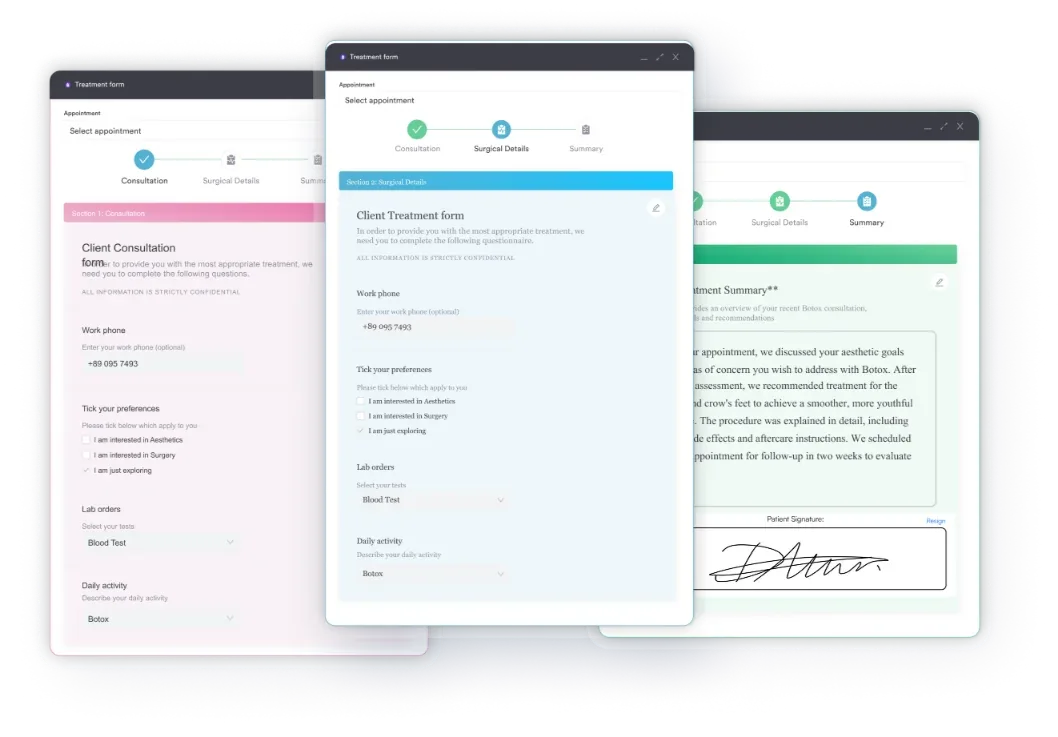
Using digital intake forms that prompt patients and providers to document ear-specific symptoms at check-in reduces missing laterality documentation before the encounter even begins.
Using an intake assessment template alongside structured patient records that link diagnosis codes to clinical notes also makes audit defense considerably faster.
When a patient presents with vertigo in the context of a known systemic disease, document the etiology first in the assessment and plan, then reference the vertiginous manifestation. Notes that lead with the manifestation and bury the etiology create ambiguity that coders and auditors both dislike. A single sentence linking the vertigo to its underlying cause before the H82.x code assignment prevents most sequencing errors.
Understanding where ICD-10 Code H82.9 sits within the broader code hierarchy helps coders select the right code for each clinical scenario. The H80-H83 block covers diseases of the inner ear; H81 (Disorders of vestibular function) is the adjacent category for primary vestibular disorders.
Vertigo coding sometimes overlaps with neuro-ophthalmologic findings documented in the same encounter.
The ICD-9-CM equivalent for this category is the 386.x range (Vertiginous syndromes and other disorders of vestibular system). CMS crosswalk data, effective October 1, 2015 when ICD-10-CM went live, maps the ICD-9 386.x codes to H82 approximately rather than directly, per the CMS General Equivalence Mappings (GEMs).
Practices converting legacy ICD-9 vertigo claims should validate that any ICD-9 code previously used for secondary vertigo now maps to the appropriate H82 subcode rather than defaulting to H82.9 when a laterality-specific variant is clinically supportable.
Vertiginous syndrome coding keeps failing at the sequencing step. When ICD-10 Code H82.9 goes out as a primary diagnosis, payers reject it because ICD-10-CM convention requires an etiology code first, a rule UnitedHealthcare’s Oxford Inappropriate Primary Diagnosis Code List enforces explicitly for its own claims.
Clinics that build the etiology/manifestation pair into their workflow before charge entry catch the error at the lowest possible cost.
Pabau’s claims management software supports ENT and audiology practices in structuring diagnosis code sequences correctly from encounter through submission. If vestibular coding is generating a pattern of denials in your practice, see how Pabau handles this end to end.

Coding paralytic strabismus without the nerve identified? ICD-10 code H49.9 guide covers when the more specific H49.0 through H49.4 codes fit better.
Coding strabismus without a specific type documented? ICD-10 code H50.9 guide covers billable status, MS-DRG mapping, and when a more specific code applies.
Coding a conjugate gaze disorder? ICD-10 code H51.0 guide covers the binocular movement disorder and why category H51 needs a subcode to bill.
ICD-10 Code H82.9 is a billable diagnosis code for vertiginous syndromes in diseases classified elsewhere, unspecified ear. It is a manifestation code used to describe secondary vertigo arising from an underlying systemic or neurological condition, and it must always be preceded by the etiology code on the claim.
Yes, H82.9 is billable at the 4-character level and is valid for FY 2026. Its 3-character parent, H82, is non-billable. However, billable does not mean it can stand alone as a primary diagnosis – the underlying etiology code must be listed first on any claim.
H82.1 specifies the right ear, H82.2 the left ear, and H82.3 bilateral involvement. H82.9 is the unspecified-ear fallback, used only when clinical documentation does not identify which ear is affected. Selecting H82.9 when laterality is documented in the note is a specificity error that some payers flag for review.
No. H82.9 is a manifestation code and cannot be the primary diagnosis. ICD-10-CM coding convention requires the underlying etiology to be sequenced first. UnitedHealthcare’s Oxford Inappropriate Primary Diagnosis Code List has also included H82.9 among codes classified as inappropriate primary diagnoses in its published payer policy.
There is no fixed list of etiology codes for H82.9. Whatever underlying disease the documentation identifies as causing the vertigo is coded first, with H82.9 (or the appropriate laterality variant) following as the manifestation code. One exception: H82 carries an Excludes1 note against epidemic vertigo (A88.1), so that code is never paired with H82.x.
The authoritative source is the CDC/NCHS ICD-10-CM web tool, which publishes the official tabular list updated each fiscal year. The WHO ICD-10 browser provides the international classification context for the H82 category.
H82.9 codes vertigo that is a manifestation of an underlying disease classified elsewhere, so the etiology is sequenced first and H82.9 is never the primary code. R42 (dizziness and giddiness) is used for undifferentiated dizziness or vertigo with no identified cause and can stand alone. H81 (disorders of vestibular function) covers primary vestibular disorders such as Meniere disease or benign paroxysmal positional vertigo, where the inner ear itself is the source. Choose H82.9 only when a separate underlying condition is driving the vertigo.