ICD-10 Code Z74.8: Other problems related to care provider dependency
ICD-10 Code Z74.8: Definition and code details ICD-10 Code Z74.8 is the billable...

Last Updated: Oct 19, 2026
Billable Code Specific Code
H81.4 is the billable ICD-10-CM code for vertigo of central origin.
ICD-10 code H81.4 designates Vertigo of central origin, a vestibular disorder arising from dysfunction in the central nervous system rather than the inner ear. It belongs to ICD-10-CM Chapter 8 (Diseases of the ear and mastoid process, H60-H95), block H80-H83 (Diseases of inner ear), category H81 (Disorders of vestibular function).
According to the CDC/NCHS ICD-10-CM web tool, H81.4 is valid and billable for fiscal year 2026.
The Applicable To note in the ICD-10-CM tabular list gives central positional nystagmus as an inclusion term under H81.4. The code is assigned when the clinician documents that the vertigo originates in the central nervous system rather than the inner ear.
Let Pabau's smart automation suggest the right codes, reduce claim denials, and keep your practice compliant—effortlessly.
Automate repetitive tasks and focus on what matters most—your patients.
Reduce coding errors and ensure compliance with the latest regulations.
Clean claims, fewer denials, and faster reimbursements.
Powerful insights and reporting to help your practice thrive.
HIPAA compliant SOC 2 certified GDPR-compliant Trusted by 4,000+ clinics worldwide

ICD-10 code H81.4 (Vertigo of central origin) is a valid, billable, specific code for FY2026, classified under Disorders of vestibular function (H81)
Vertigo of central origin has no laterality subcodes: H81.4 is reported directly, unlike the peripheral vertigo categories in the H81 block
H81.4 is assigned only when the clinical documentation establishes a central (CNS) origin in the brainstem or cerebellum rather than the inner ear
Pabau’s claims management software helps vestibular disorder practices attach supporting documentation to H81.4 claims and reduce coding-related denials
H81.4 is a valid, billable, specific code. Unlike Ménière’s disease (H81.0), benign paroxysmal vertigo (H81.1), and the other peripheral vertigo categories in the H81 block, vertigo of central origin is not subdivided by laterality. There are no H81.41, H81.42, or H81.49 subcodes; central vertigo is reported with the single code H81.4.
The most common H81.4 coding error is appending a laterality digit that does not exist. Because vertigo of central origin has no right, left, or bilateral subcodes, entries such as H81.41 or H81.43 will be rejected as invalid. Report H81.4 as written and record the central origin and affected structures in the encounter note to support medical necessity review.
Pabau’s claims management software allows practices to associate diagnosis codes with specific encounter types, helping ensure H81.4 is submitted with the documentation that supports a central-origin diagnosis.

Document the central origin of the vertigo at the time of the clinical encounter. Assigning H81.4 from a note that only records dizziness or positional vertigo, without establishing a CNS mechanism, leaves the claim exposed to denial. Train clinicians to state the origin explicitly in the assessment section of every vestibular encounter note.
Separating central from peripheral origin is the pivotal coding decision in vestibular encounters. Using a peripheral vertigo code when the documented diagnosis is central origin, or vice versa, creates a medical necessity mismatch that can trigger audits or denials.
Central vertigo originates in the brainstem, cerebellum, or other CNS structures. Peripheral vertigo arises from the inner ear or vestibular nerve. The ICD-10-CM H81 category separates these clearly, and the distinction must be supported by the provider’s clinical documentation before a code is assigned.
Peripheral vestibular conditions frequently coexist with hearing loss, which is coded separately under category H90 — for example, sensorineural hearing loss and other hearing loss. Central vertigo (H81.4) does not carry these ear-level associations, one more reason to confirm origin before coding.
R42 is a symptom code, not a diagnosis code. Per CMS ICD-10 coding guidance, when a definitive diagnosis has been established, the symptom code should not be assigned as the principal diagnosis. Use R42 only when the provider has not yet determined the underlying cause of the dizziness.
Vestibular migraine is another diagnosis to consider. It does not have a dedicated ICD-10-CM code (G43.D0 and G43.D1 are abdominal migraine, not vestibular migraine). When a specialist such as a neurologist or ENT diagnoses migraine-related vertigo rather than central vertigo, code it from the provider’s migraine documentation in category G43 rather than assigning H81.4.
Coders should not assign H81.4 based solely on the presence of positional nystagmus. The clinician’s documented assessment of central origin is required. Central causes often accompany other neurological diagnoses.
There is no single ICD-10 code for vertigo. The right code depends on where the vertigo originates and how far the workup has gotten. H81.4 is the central-origin member of the family, but a coder facing a vestibular encounter has to place it against every peripheral category and the symptom code R42.
The table below is a single when-to-use reference for the whole H81 vertigo family plus R42, with the documentation trigger that supports each choice.
The pattern payers reward is progression. Report R42 while the cause is still under evaluation, then advance to the specific code once testing confirms the source. An acute vestibular syndrome, for example, is coded by its determined origin: a central mechanism lands on H81.4, while a peripheral one moves to the matching H81.1 or H81.2 category. Repeating R42 across follow-up visits after a diagnosis is confirmed is a common trigger for medical necessity denials. Practices reconciling payment posting against expected fees find short-paid claims that never appear as denials.
Positional vertigo is the category most often miscoded here. It points to the peripheral H81.1 range when triggered by head movement, not to H81.4, so central positional nystagmus is the specific finding that separates a central-origin claim from routine BPPV.
An H81.4 claim withstands payer scrutiny only when the encounter note contains specific language confirming central origin. A note that says only “dizziness” or “positional vertigo,” without specifying central etiology, does not support the code.
The encounter note should document all of the following to support H81.4:
Practices using digital intake forms can build structured vestibular history templates that capture onset, triggers, associated neurological symptoms, and prior imaging results before the encounter begins. This captures the required elements while the note is being written, instead of surfacing omissions during claim review.
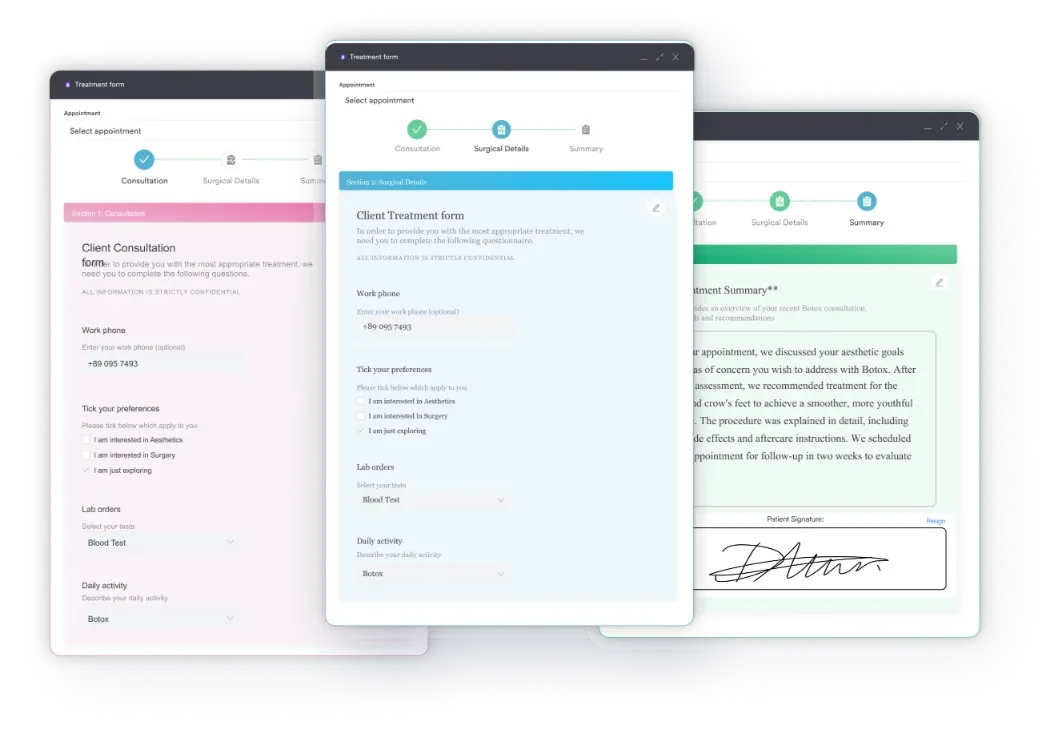
Structured digital workflows give each diagnostic category its own documentation pathway instead of relying on free-text notes that miss required elements. Purpose-built clinical documentation software enforces the fields a central-origin diagnosis needs at the point of care.
Accurate patient records that link encounter notes, imaging results, and vestibular test findings to the coded diagnosis are essential for withstanding a retrospective payer audit on H81.4 claims.
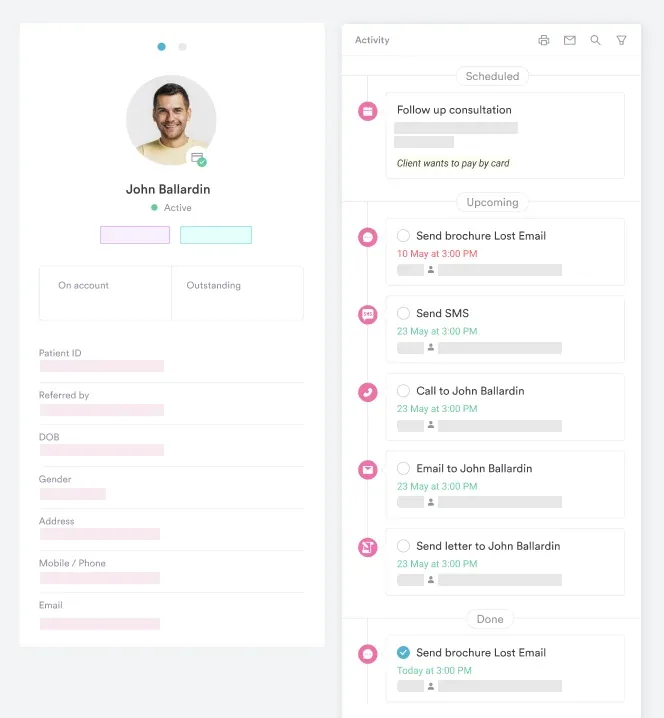

Pabau helps neurology and ENT practices capture structured vestibular encounter notes, attach diagnostic test results to patient records, and submit H81.4 claims with supporting documentation attached. Reduce coding errors before they become claim denials.

Vestibular disorder encounters generate several CPT billing scenarios depending on the specialty, the diagnostic workup performed, and whether treatment or rehabilitation is provided. The following CPT codes are most commonly paired with ICD-10 code H81.4 on the same claim.
The AAPC Codify ICD-10-CM lookup provides crosswalk references showing which CPT codes have documented medical necessity associations with H81.4. Coders should confirm that the billed CPT service occurred during the encounter and is reflected in the note before pairing it with H81.4.
Medicare Local Coverage Determinations (LCDs) for vestibular function testing specify which ICD-10 codes establish medical necessity for vestibular CPT codes.
H81.4 is generally included in LCD-covered diagnoses for 92540-series testing, but coders should verify the applicable contractor’s LCD for the patient’s jurisdiction before submitting. The CMS ICD-10 codes page links to the Medicare Coverage Database where relevant LCDs can be searched by code.
Physical and occupational therapy practices providing vestibular rehabilitation, guided by tools such as a structured cervicogenic dizziness exercises plan, should confirm that their state’s scope-of-practice rules permit coding vestibular diagnoses directly. For background on compliance requirements for physical therapy practices, including documentation obligations, Pabau’s compliance resource covers the core regulatory considerations.
Check modifier requirements when billing vestibular CPT codes with H81.4. Some payers require modifier 52 (reduced services) when only selected components of the 92540 battery are performed. Others require modifier 59 when vestibular testing codes are billed alongside evaluation and management codes on the same date. Document each service clearly in the encounter note to support modifier use.
Prior to the ICD-10-CM transition in October 2015, central vertigo was captured under ICD-9-CM code 386.2 (Vertigo of central origin). The GEM (General Equivalence Mapping) crosswalk maintained by CMS maps 386.2 forward to H81.4 in ICD-10-CM.
Practices that completed an EHR migration from legacy systems may encounter historical claims coded to 386.2. For continuity-of-care documentation and when querying historical diagnoses for prior authorization submissions, coders should note that H81.4 is the accepted forward-mapped equivalent.
The code history for H81.4 within ICD-10-CM is relevant for practices coding vestibular encounters across multiple years:
Verifying year-specific validity in an official ICD-10-CM lookup helps when correcting old claims or appealing denials based on prior-year coding. Practices auditing their end-to-end medical billing process can catch code-validity errors before submission.
For practices that schedule vestibular disorder follow-up appointments and need to ensure continuity between historical coding and current encounter documentation.
Central vestibular disorders require precise ICD-10 documentation, and H81.4 is where many vestibular claims get stuck: the origin is coded as peripheral when it is central, or the note lacks clinical evidence of a CNS mechanism. Getting those elements right before submission protects revenue and reduces retrospective audit exposure.
Pabau’s AI-assisted clinical documentation helps ENT and neurology practices capture the specific clinical language that supports the H81.4 diagnosis, while physical therapy EMR workflows connect vestibular rehabilitation CPT codes to the supporting ICD-10 diagnoses. To see how Pabau handles vestibular disorder coding workflows end to end, book a demo with the team.

Coding optic neuritis linked to multiple sclerosis? ICD-10 code H46.8 guide covers when H46.8 applies and how it relates to diagnoses like multiple sclerosis.
Coding an optic chiasm disorder from vascular disease? ICD-10 code H47.43 guide covers the Code Also note that requires reporting the underlying vascular condition.
Comparing billing platforms for your practice? Best medical billing software in the US reviews the tools that cut denials on codes like H81.4.
Coding a visual pathway disorder without a specific type? ICD-10 code H47.9 guide covers why this is one of the codes payers’ audit systems flag most often.
Coding ophthalmoplegia without laterality documented? ICD-10 code H49.40 guide covers when to use the laterality-specific H49.41 through H49.43 codes instead.
ICD-10 code H81.4 is the billable diagnosis code for Vertigo of central origin, a vestibular disorder caused by dysfunction in the central nervous system (brainstem or cerebellum) rather than the inner ear. It is a valid, specific code under the ICD-10-CM H81 category (Disorders of vestibular function) and is reported directly, with no laterality subcodes.
Central vertigo (H81.4) originates in the brainstem or cerebellum; peripheral vertigo (H81.10-H81.13 for BPPV, H81.3x for other peripheral, H81.0x for Meniere’s) originates in the inner ear or vestibular nerve. The distinction must be supported by clinical documentation before a coder assigns either category.
Yes. H81.4 is a valid, billable, specific ICD-10-CM code for FY2026 (effective October 1, 2025) and is reported directly. There are no H81.41, H81.42, or H81.49 subcodes, because vertigo of central origin is not subdivided by laterality.
The most common CPT codes paired with H81.4 include the basic vestibular evaluation (92540), individual vestibular testing components (92541, 92542, 92544, 92545), office visit codes (99213-99215), and vestibular rehabilitation codes (97110, 97112). The specific CPT code must reflect a service documented in the encounter note.
Documentation must confirm central origin through clinical findings such as direction-changing or vertical nystagmus, absence of BPPV characteristics on Dix-Hallpike, or imaging/neurological workup supporting a CNS mechanism. The assessment section must state a diagnosis consistent with vertigo of central origin.
Yes. H81.4 has been a valid, billable code since ICD-10-CM replaced ICD-9-CM on October 1, 2015, mapped forward from ICD-9 code 386.2. It has never been split into subcodes and remains billable for FY2026.
There is no dedicated ICD-10-CM code for cervicogenic vertigo or cervicogenic dizziness. Because the origin is musculoskeletal rather than central or inner-ear, it is reported with R42 alongside the underlying cervical spine diagnosis, not with H81.4.
An unspecified disorder of vestibular function is coded to the H81.9 range (H81.90–H81.93), which carries laterality subcodes. Assign H81.4 only when the documentation establishes a central nervous system origin rather than a general balance-system problem.
While the cause is still being worked up, report R42 (dizziness and giddiness). Move to a specific H81 code, such as H81.4 for a confirmed central origin, once testing establishes the source of the spinning.