Professional development record
A professional development record is a structured log of a healthcare practition...

8
Last Updated: Oct 8, 2026
Physical therapy compliance is the set of legal, professional and data duties a practice must meet to treat patients and get paid. Meeting them is only half the job, because every duty also has to be evidenced.
In the US those duties come from HIPAA, CMS, your state practice act, the HHS Office of Inspector General and OSHA. A UK physiotherapy practice answers instead to the HCPC, the Chartered Society of Physiotherapy and the Information Commissioner’s Office.
This guide maps every duty to the record that proves it, in both countries. We call that map the compliance evidence trail. It names the rule, the authority behind it, and the document an inspector asks to see.

Physical therapy compliance covers patient consent, clinical records, data protection, staff licensure, billing accuracy and workplace safety.
US practices answer to HIPAA, CMS, their state licensing board, the HHS Office of Inspector General and OSHA.
UK physiotherapy practices answer to the HCPC, the Chartered Society of Physiotherapy and the Information Commissioner’s Office.
Every duty has one record that proves it, and a cadence at which someone has to review that record.
The CY 2026 KX modifier threshold is $2,480 for physical therapy and speech-language pathology combined, and $2,480 for occupational therapy.
Physical therapy compliance means meeting the legal, professional, billing and data rules that govern a practice, and holding the records that prove you met them. The phrase also has a clinical sense, describing a patient’s adherence to a home exercise program. This article covers the regulatory sense.
Therapy compliance sits across five domains, and each one has a different owner. Clinical standards and licensure come from your state board or the HCPC. Privacy comes from HIPAA in the US and UK GDPR in Britain. Billing accuracy comes from CMS, with the Office of Inspector General (OIG) behind it. Workplace safety comes from OSHA.
Day to day, those five domains land on the same desk. The person who books the appointment also takes the consent, files the note and submits the claim. That is why compliance in a physical therapy practice usually fails at the record rather than at the rule.
Fraud, waste and abuse sit inside the billing domain rather than beside it. A claim for time that was not delivered is a billing error and a fraud exposure at once. So is a unit count the treatment note cannot support. Compliance training is what keeps the two apart.
The HHS Office of Inspector General names seven elements of an effective compliance program, running from written policies through to corrective action. OIG set them out in its General Compliance Program Guidance, published in November 2023.
A risk assessment sounds like a project, so element six tends to be the last one written. It is an afternoon’s work. List your ten riskiest tasks, rank them, and you have decided what your audits look at for the next year.
Every compliance duty has one record that proves you met it, and a cadence at which someone has to look at that record. Rule lists stop at the duty. The evidence trail carries on to the document an inspector will ask for, and to the date it was last reviewed.
| Compliance duty | Who sets it (US) | Who sets it (UK) | The record that proves it | How often you check it |
|---|---|---|---|---|
| Patient consent to treatment | State practice act | HCPC standards of conduct | Signed consent filed against the patient record | Each new episode of care |
| Clinical records and retention | State record-retention law | NHS Records Management Code of Practice | Dated, signed treatment note and the retention schedule | At discharge, then per schedule |
| Data protection | HIPAA, enforced by HHS OCR | UK GDPR, enforced by the ICO | Security risk analysis or record of processing activities | Annually |
| Staff registration and licensure | State physical therapy board | HCPC register | Current license or registration number on the staff file | At each renewal |
| Continuing education | State board CEU rules | HCPC CPD standards | CEU certificates or the CPD profile and its evidence | Each renewal cycle |
| Indemnity insurance | State law and payer contracts | HCPC condition of registration | Certificate of cover naming the practice and the work done | Annually |
| Exclusion and background screening | HHS OIG exclusion list | Disclosure and Barring Service, via the employer | Dated screening result for every employee and contractor | Monthly |
| Infection control | OSHA bloodborne pathogens standard | Health and Safety Executive, and CQC where registered | Written exposure control plan carrying its review date | At least annually |
| Billing accuracy | CMS, with HHS OIG behind it | Private medical insurer contracts | The claim, its modifiers and the note that supports them | Monthly claim sample |
| Incident and breach reporting | OSHA and HHS OCR | ICO, plus HCPC self-referral | Incident log entry and the regulator’s report reference | Per incident |
Where a regulator sets the cadence, the table uses the regulator’s. Where none is set, the cadence is our recommendation, and you should record the one you choose. The deadlines below are the fixed ones.
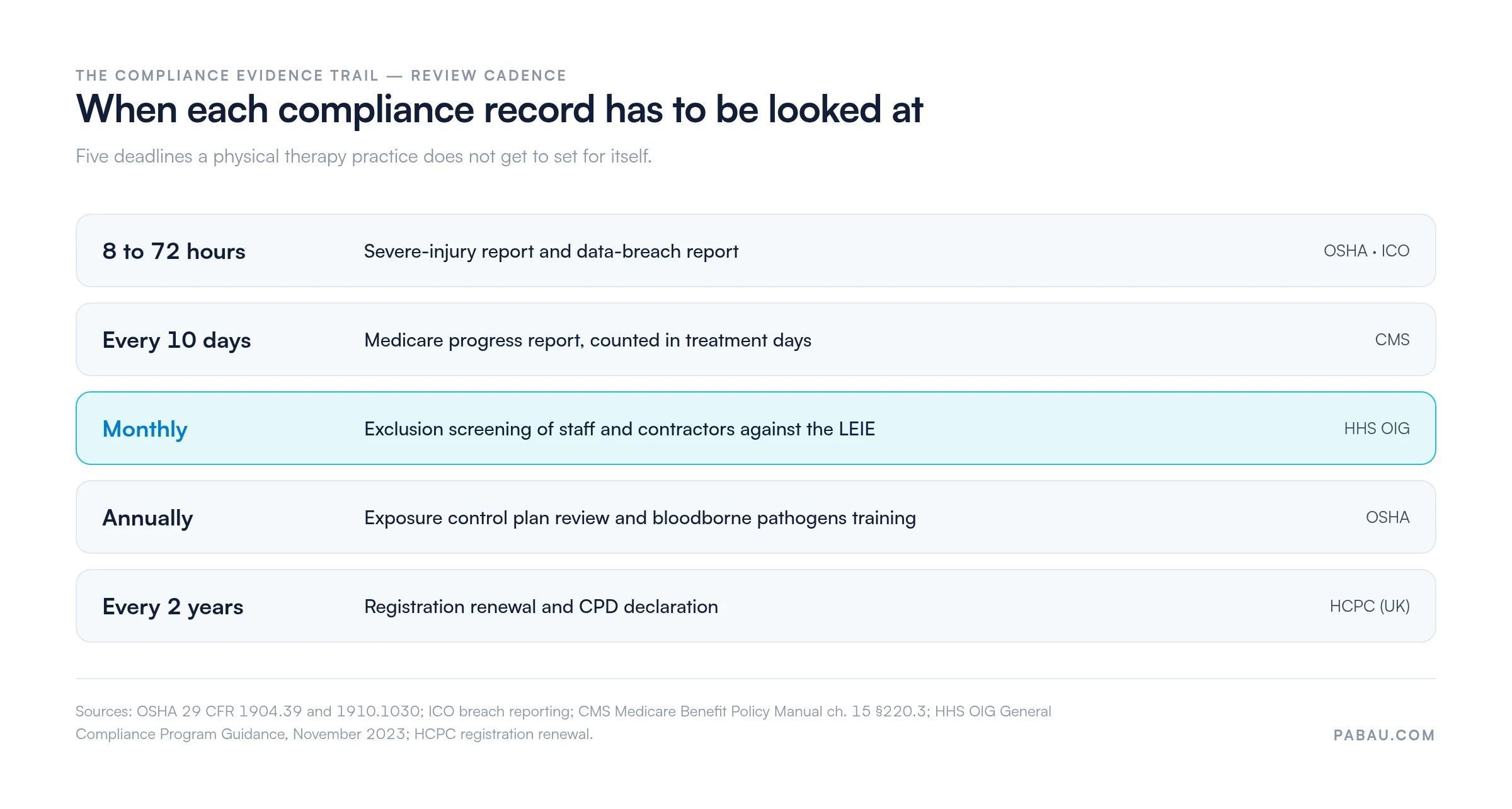
In practices we onboard, the row that fails first is almost always exclusion screening. The duty is understood, and nobody owns the monthly check, so the last dated result is from whenever the therapist was hired.
Five authorities reach into a US physical therapy practice, and each one owns a different part of the trail. Your state board decides who may treat. CMS decides what it will pay for. HHS OCR, HHS OIG and OSHA police privacy, fraud and workplace safety.
HIPAA treats a physical therapy practice as a covered entity, so protected health information must be secured and shared only as far as needed. Protected health information, known as PHI, is any record that can identify the patient it describes.
Four records carry the weight here. A notice of privacy practices you can show a patient received. A written security risk analysis, dated within the last year. A training log with names and dates. A breach log with the date each notification went out.
Breach notification is the deadline people miss. Affected patients must be told without unreasonable delay and no later than 60 days after discovery. That clock starts when anyone at the practice knew, not when the owner was told.
Everyday controls do the rest. Unique logins per user rather than a shared front-desk account. Encryption on laptops and on every device that leaves the building. Access rights that drop the day a therapist leaves.
CMS pays for outpatient therapy only when a certified plan of care, correctly counted timed units and current progress reports stand behind the claim. Miss any one of them and the claim is payable on paper but indefensible on review.
Certification comes first. The Medicare Benefit Policy Manual treats an initial certification as timely when it is dated within 30 calendar days of the initial treatment. A certification interval runs no more than 90 calendar days from the initial treatment.
Progress reports come next. The minimum reporting period is at least once every 10 treatment days, or at least once every 30 calendar days, whichever is less. A clinician has to write it, and an assistant’s notes do not replace it.
CMS also names what a defensible progress report contains. Alongside the reporting dates and a signature, the clinician’s report must carry three further elements.
Units are the second place claims come apart. For timed codes billed in 15-minute units, the Medicare Claims Processing Manual sets the intervals below. A single service under 8 minutes is not billable at all.
| Units billed | Total timed minutes |
|---|---|
| 1 unit | 8 through 22 minutes |
| 2 units | 23 through 37 minutes |
| 3 units | 38 through 52 minutes |
| 4 units | 53 through 67 minutes |
| 5 units | 68 through 82 minutes |
| 6 units | 83 through 97 minutes |
| 7 units | 98 through 112 minutes |
| 8 units | 113 through 127 minutes |
Source: CMS Medicare Claims Processing Manual, chapter 5, section 20.2. The pattern continues at the same spacing beyond two hours of treatment.
Modifiers are the third. GP marks services under an outpatient physical therapy plan of care, GO occupational therapy and GN speech-language pathology. Modifier 97 marks a service as rehabilitative rather than habilitative, and modifier 59 marks a distinct procedural service.
Two more modifiers turn on money. CQ flags a service furnished in whole or in part by a physical therapist assistant, which Medicare pays at 85% of the fee schedule rate. KX confirms medical necessity above the annual threshold.
For CY 2026, CMS set the KX modifier threshold at $2,480 for physical therapy and speech-language pathology combined, and $2,480 for occupational therapy. The targeted medical review threshold stays at $3,000. Our guide to physical therapy billing works through the codes behind those claims.
Your state practice act decides who may evaluate, who may treat without a referral, and how long that may go on. It changes more often than the federal rules do, which is why a policy written three years ago is usually out of date somewhere.
Take the PT practice act Texas works under. House Bill 4099, passed in 2025, extended how long a physical therapist may treat a patient without a referral. The old limit was 10 consecutive business days. From November 1, 2025 it is 30 consecutive calendar days.
That extension is not open to everyone. It applies to a physical therapist holding a doctoral degree in physical therapy. It also applies to one who has completed at least 30 continuing competence units in differential diagnosis. Arizona, meanwhile, sets its own route, which we cover in physical therapy clinic requirements in Arizona.
PT vs PTA scope of practice is the other line that moves by state. A physical therapist assistant works under a physical therapist’s plan of care and cannot perform the initial evaluation or set that plan. Supervision requirements and permitted tasks then vary.
Two records prove this part of the trail. A current license number on every staff file, checked at renewal. A written scope statement per role, showing which tasks that role may perform in your state.
Anyone excluded by the HHS Office of Inspector General cannot be paid by a federal health care program, directly or indirectly. The OIG publishes them in the List of Excluded Individuals and Entities, known as the LEIE. Employing one exposes the practice to overpayment and civil money penalty liability.
The cadence is set for you. OIG updates the LEIE monthly, and its guidance states that screening each month best limits that liability. Screening covers contractors and vendors as well as employees, plus the exclusion list of any state Medicaid program you participate in.
Risk assessment is the other half of this element. A practice that bills Medicare carries a different risk profile from a cash-based one, and the audits should follow the profile. Upcoding, billing untimed minutes as timed units and claims for supervised time all sit high on that list for therapy.
OSHA’s injury and illness recordkeeping rule partially exempts offices of other health practitioners, NAICS 6213, which is where most outpatient physical therapy practices sit. So a routine OSHA 300 log is generally not required of you.
Severe events are still reportable by every employer. A work-related fatality goes to OSHA within 8 hours. An in-patient hospitalization, an amputation or the loss of an eye goes within 24 hours.
The bloodborne pathogens standard is where a therapy practice carries the most work, because dry needling, wound care and sharps handling all bring exposure. Three requirements carry dates you can be asked for.
Employee medical records under that standard are kept for the duration of employment plus 30 years. Hazard communication covers the rest of the building. Every disinfectant, cleaning chemical and topical agent needs a current safety data sheet and a labelled container.
A UK physiotherapy practice answers to a smaller set of bodies than a US one, but the duties bite harder at the individual. Registration, indemnity and continuing development attach to the clinician, and the practice has to be able to evidence all three.
Anyone practising as a physiotherapist in the UK must be on the HCPC register, because physiotherapist and physical therapist are protected titles. Using either title without registration is a criminal offence, and the HCPC prosecutes it.
Registration runs in two-year cycles. Physiotherapy registrants are invited to renew between 1 February and 30 April in their renewal year. At renewal they confirm that they meet the standards and hold indemnity cover.
The Chartered Society of Physiotherapy (CSP) is the profession’s body and trade union, founded in 1894. CSP membership is not a legal requirement the way HCPC registration is. It brings the professional liability insurance scheme, clinical guidance and the CPD resources most independent practitioners rely on.
Clinical guidelines come from the National Institute for Health and Care Excellence (NICE). NICE guidance is not law, but a departure from it needs a documented clinical reason in the patient’s notes.
UK GDPR makes a physiotherapy practice a data controller, so each patient record needs a lawful basis, a retention period and an access route. Physiotherapy clinic GDPR compliance is a records job before it is a consent job.
Start with the lawful basis, because it is easy to pick the wrong one. Clinical records are special category data, and consent is rarely the basis you rely on. Most practices process them under Article 9(2)(h), which covers the provision of health care and treatment.
That matters practically. If consent were the basis, a patient withdrawing it would oblige you to stop processing. That includes records you have a legal duty to keep. Consent to treatment and a lawful basis for data are separate documents doing separate jobs.
A privacy notice then carries the transparency duty. It names every purpose you use patient data for, written plainly enough to be understood at reception.
A data protection officer is a narrower requirement than it first appears. A DPO is mandatory where core activities involve large-scale processing of special category data. Recital 91 of the UK GDPR says processing by an individual health care professional is not large scale, so many private practices fall outside it.
Falling outside it does not remove the duty. Someone still has to own data protection by name, keep the record of processing activities and answer the ICO if it calls. Write that name into the role description rather than leaving it with whoever is free.
Data subject rights need a procedure, not goodwill. A subject access request must be answered within one month, and that month includes the time you spend finding the notes. Patients can also ask you to correct records that are inaccurate or incomplete.
The right to erasure is the one to be careful with. It does not override a retention duty, so a physiotherapy record you are obliged to keep stays. The NHS Records Management Code of Practice sets 8 years after the last entry for adult health records, and private practices generally follow it.
Breaches have their own clock. A personal data breach that risks people’s rights is reported to the ICO within 72 hours of the practice becoming aware of it. Keep an internal log of every breach, including those you decide not to report, with the reason.
Continuing professional development is audited, not just declared. At the start of each renewal the HCPC randomly selects 2.5% of each profession. Those registrants must then submit a CPD profile with evidence behind it.
Keep the profile as you go rather than assembling it when the letter arrives. A dated entry per activity, what changed in your practice because of it, and the artifact that shows it happened.
Indemnity is a condition of registration. Every HCPC registrant must hold an indemnity arrangement appropriate to the work they do. That can come through an employer, a professional body scheme or an insurer. Appropriate means sized to the risk you actually carry.
Check the certificate against what the practice does now, not what it did when the policy started. Adding acupuncture, shockwave or home visits can take a service outside the cover you renewed without reading.
Cupping is another service to check against the policy before you offer it. It also changes what the note has to carry. A cupping mark chart keeps the color and location of each mark recorded the same way at every visit.
Consent to treatment is the last of the individual duties. The patient needs to understand the proposed treatment, the material risks and the alternatives before it starts. The notes then have to show that conversation took place.
Compliance plans get followed when every duty names an owner, a record and a review date, on a page staff can find in ten seconds. Plans fail when they describe the law instead of the routine.
A healthcare compliance plan template gives you the structure, not the content. Take the headings from a compliance plan sample if you want a starting shape. Then replace every line with your own state’s rules, your own payers and your own staff names.
Watch the scale of what you copy. A compliance plan template for healthcare written for a hospital system carries departments, committees and reporting lines that a four-therapist practice does not have. Carrying them over produces a document nobody reads.
Scale the program to the practice instead. OIG expects the seven elements everywhere, but says smaller entities can implement them with limited resources.
Having a medical practice compliance plan in place counts only if the reviews inside it happen. Put each review in the calendar as a recurring appointment with a named owner. Record the date it was done next to the record it covered.
Standard operating procedures should cover the tasks where a mistake leaves a record wrong, missing or unavailable. The rest is training. These are the physiotherapy clinic standard operating procedures worth writing down, and what each one has to say.
Keep each one to a single page with a version number and a review date. An SOP without a review date is a historical document, and an inspector will read it as one.
Pick five duties from the evidence trail, then try to produce the named record for each within ten minutes. A physiotherapy clinical audit in private practice needs no more apparatus than that to find where the trail breaks.
Run it as five steps, and write the result down as you go.
A worked example makes the scoring clearer. Say the five rows are consent, the treatment note, exclusion screening, the last claim and the exposure control plan.
Consent and the note usually come back inside two minutes, because both live in the patient record. The claim takes longer, since somebody has to open the note beside it and check the units. Screening and the exposure control plan are the two that come back undated.
An undated record is a failed row, and the corrective action is the same in both cases. Give the check an owner and put it in the calendar at the cadence the regulator sets. Then file the dated result somewhere the next audit can reach it.
Corrective action is element seven of the OIG’s list, and it is the step the audit exists for. Keep a register of every action, its owner, its due date and the retest result. That register is itself a record an inspector can ask for.
The compliance issues in therapy practices that cost the most are missing documentation, unscreened staff, late breach reports and claims the treatment note cannot support. None of them starts as misconduct.
Each one carries a published consequence. The figures below come from the regulators themselves rather than from industry estimates.
| What goes wrong | What it breaches | The published consequence |
|---|---|---|
| PHI disclosed or left unsecured | HIPAA | Civil money penalties from $145 to $73,011 per violation, with a calendar-year cap of $2,190,294 (Federal Register, January 28, 2026) |
| Patient data mishandled in the UK | UK GDPR | Up to £17.5 million or 4% of total annual worldwide turnover, whichever is higher (ICO) |
| An excluded individual employed or contracted | Federal health care program exclusion | Overpayment liability for the items and services, plus civil money penalty exposure (HHS OIG) |
| KX modifier missing above the threshold | CMS therapy billing rules | The claim is denied once the beneficiary passes $2,480 in allowed charges for the year |
| Practising under a protected title unregistered | UK protected title law | Criminal prosecution brought by the HCPC |
| No annual bloodborne pathogens training | OSHA 29 CFR 1910.1030 | Citation and penalty on inspection |
Two consequences sit outside any table. A state board can suspend or revoke a license, which closes the practice for as long as it lasts. And a patient who believes they were harmed can sue whatever the regulator decides.
Reputation is the slow one. Enforcement action against a health professional is published, indexed and easy to find. A single breach then follows the practice through every search a prospective patient runs.
The evidence trail breaks because its records live in different places. Consent forms sit in a filing cabinet, treatment notes in the EMR, staff licenses in a drive folder and screening results in somebody’s inbox. Producing five of them in ten minutes is then a scavenger hunt.
Practice management software like Pabau puts them on one patient timeline instead. Pabau stores the signed consent, the treatment note, uploaded documents and the invoice against the same record. The whole trail for one patient then opens in a single screen.
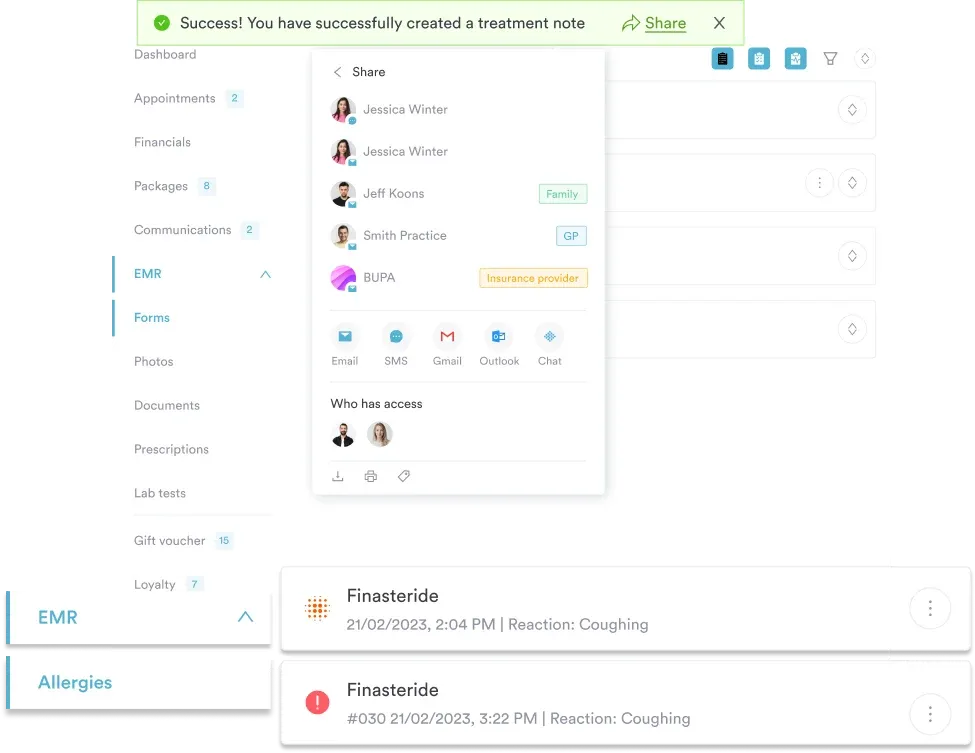
Pabau’s digital forms take consent before the appointment rather than in the waiting room, and file the signed copy automatically. Staff records, license numbers and training sit alongside, so the staffing rows of the trail are dated rather than assumed.
Audit trails are the part practices notice during their first audit. Pabau logs who opened a record and when, which is what turns a claim that access was controlled into a record that proves it.

Pabau stores consent forms, treatment notes, documents and audit trails against the same patient record. A practice can then produce the document behind any compliance duty in minutes. Staff licenses and training records sit alongside them.

Compliance is judged on what you can produce, not on what you know. Two practices can follow identical rules, and only the one that can date its records will survive an inspection.
So start at the evidence trail rather than at the regulations. Pick the five rows you would least like to be asked for. Give each an owner and a review date, then retest them in a month. The rows you cannot fill are the scope of your compliance program.
The trade-off worth remembering is time. Every cadence in this guide costs a few hours a year, and the penalties attached to missing them run into six figures. Book a demo to see how Pabau keeps consent, notes, staff records and audit trails in one place for a physical therapy practice.

Wondering where compliance records should live? Best physical therapy EMR software in 2026 compares seven platforms on documentation and records handling.
Setting up a practice from scratch? Physical therapy business plan: what to include and why covers the operational decisions compliance later depends on.
Billing patients directly instead of insurers? Cash-based physical therapy explains how the model changes your documentation and payer obligations.
Opening a practice in the UK? How to open a physiotherapy clinic walks through registration, insurance and setup step by step.
Losing patients partway through a course of treatment? Patient retention in physical therapy sets out what keeps people coming back to their plan of care.
PT compliance is a physical therapy practice meeting the rules that govern treatment, records, privacy, staffing and billing. It also means keeping the documents that show each rule was met. In clinical conversation the same phrase sometimes describes a patient sticking to a home exercise program.
The HHS Office of Inspector General lists seven. Written policies and procedures, compliance leadership and oversight, training and education, and effective lines of communication make up the first four. The rest are enforcing standards, risk assessment with auditing and monitoring, and responding to detected offenses with corrective action. The section above shows what each looks like in a therapy practice.
Therapy practices can group their duties into five areas. Those are clinical care and consent, patient records and data protection, staffing and licensure, billing accuracy, and workplace safety. Each area maps onto rows of the compliance evidence trail table above. That table names the record proving each duty and how often it is reviewed.
Statutory training is training the law requires, such as OSHA bloodborne pathogens training in the US. Mandatory training is what an employer, regulator or insurer requires on top of that. For a therapy practice, mandatory compliance training usually covers HIPAA or UK GDPR, consent and documentation standards.
In the UK, the Health and Care Professions Council regulates physiotherapists and the Information Commissioner’s Office enforces data protection. In the US, a state physical therapy board licenses practitioners. CMS, the HHS Office for Civil Rights, the HHS Office of Inspector General and OSHA then enforce billing, privacy, fraud and safety rules.