ICD-10 code T87.52: Necrosis of amputation stump, left upper extremity
ICD-10 code T87.52 at a glance: Left arm, not left leg ICD-10 code T87.52 is the...

Last Updated: Oct 26, 2026
Billable Code Specific Code
H91.91 is the billable ICD-10-CM code for unspecified hearing loss, right ear.
"Unspecified" in this context means the clinician has identified a right-ear hearing deficit, but hasn't yet determined or documented the underlying cause, type (conductive, sensorineural, or mixed), or configuration.
Let Pabau's smart automation suggest the right codes, reduce claim denials, and keep your practice compliant—effortlessly.
Automate repetitive tasks and focus on what matters most—your patients.
Reduce coding errors and ensure compliance with the latest regulations.
Clean claims, fewer denials, and faster reimbursements.
Powerful insights and reporting to help your practice thrive.
HIPAA compliant SOC 2 certified GDPR-compliant Trusted by 4,000+ clinics worldwide

H91.91 is the billable ICD-10-CM code for unspecified hearing loss of the right ear, valid for FY2026 (October 1, 2025 through September 30, 2026).
Laterality is encoded in the sixth character: right ear = 1, left ear = 2, bilateral = 3, unspecified ear = 0. Always use the most specific code available.
The parent code H91.9 is non-billable; H91.91 (right), H91.92 (left), or H91.93 (bilateral) must be used for claim submission.
Practice management software like Pabau helps audiology and ENT practices submit laterality-specific codes accurately, reducing denial rates.
Understanding where H91.91 sits in the ICD-10-CM hierarchy prevents using a non-billable header code on a claim. The CDC/NCHS ICD-10-CM files organize codes from broad to specific, and only the most granular billable code should appear on a HIPAA-covered transaction.
ICD-10-CM requires the highest level of specificity available. Submitting H91.9 as a claim code instead of H91.91 causes rejection, because H91.9 is a header code, not a valid diagnosis code for billing. Most payers follow HIPAA-compliant clinical documentation rules that require specific, billable codes on every transaction. Coders searching for “hearing loss, unspecified” in ICD-10 will land on H91.9 first, but that header code can’t be submitted on its own — the claim needs the laterality digit that makes it H91.90, H91.91, H91.92, or H91.93. A clean claim rate below the practice benchmark usually points at one recurring coding or eligibility error. Coding names the service; medical billing gets it submitted, adjudicated and paid.
Laterality is the most common source of claim denial for hearing loss codes. The sixth character of H91.91 encodes the ear affected. Payers will reject the claim, or ask for more documentation, when the chart names a specific ear but the claim uses the unspecified-ear variant (H91.90).
A practical rule: if the audiogram or clinical note names a specific ear, match the code to that ear. The ICD-10-CM Official Guidelines state that “unspecified” codes fit only when no further detail is available in the record, not as a shortcut when the detail already exists.
Practices that routinely default to H91.90 risk payer audits and medical necessity queries. Good digital intake forms that capture laterality at registration cut down on downstream coding guesswork.

Category H91 covers hearing loss that doesn’t fit the conductive or sensorineural subtypes classified under H90. Knowing the sibling codes within H91 helps coders tell when H91.91 fits and when a more specific code exists, such as H90.3 for bilateral sensorineural hearing loss or H90.6.
H91.91 sits at the “least specific but laterality-correct” end of the H91 spectrum. If subsequent workup reveals the loss is presbycusis (H91.1x) or ototoxic in origin (H91.0x), update the code at the next encounter. ICD-10 diagnostic coding is built to gain specificity as clinical evidence accumulates. Avoid leaving an initial unspecified code in place permanently.
Coders frequently confuse H90 and H91 because both cover hearing loss. The distinction matters for payer adjudication and clinical accuracy. Audiology practices should understand the type-based split between H90 and H91 to code these encounters correctly.
If a patient’s audiogram clearly shows sensorineural loss in the right ear, H90.41 (sensorineural hearing loss, right) fits better than H91.91. Using ICD-10 Code H91.91 when H90 applies is a common coding mistake. It can affect medical necessity determinations, particularly for hearing aid authorizations and cochlear implant workups.
Flag any H91.91 claim where the patient record also contains a completed audiogram. Review whether H90.4x (sensorineural) or H90.1x (conductive) fits better before submitting. Payers may require the most specific code consistent with documented findings.
Claim denials for H91.91 most often trace back to thin documentation rather than the wrong code choice. The medical record must support every element of the code: the diagnosis of hearing loss, the unspecified nature, and the right-ear laterality.
The CDC/NCHS ICD-10-CM coding tool holds the official tabular list and index, which coders can check to confirm documentation rules for H91.91. Good medical forms at your practice capture the relevant detail at the point of service, cutting the need for documentation fixes after the fact.
Pabau’s patient record management system lets audiology and ENT teams build structured encounter templates. These templates prompt clinicians to document laterality, audiometric status, and referral plans on every hearing loss encounter, which cuts down on the missing documentation that drives H91.91 denials.
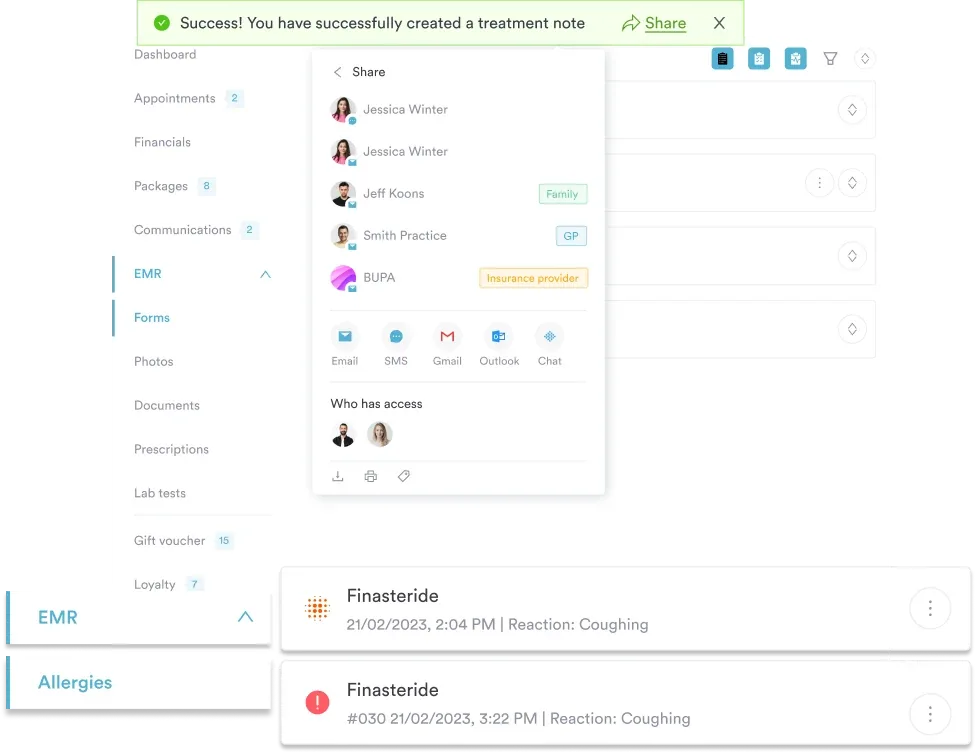

Pabau helps audiology and ENT practices capture laterality, audiometric findings, and referral plans at the point of care, supporting accurate ICD-10 coding from the first encounter.

CMS and NCHS jointly maintain the ICD-10-CM Official Guidelines for Coding and Reporting, which govern when coders should use unspecified codes. Several guideline principles apply directly to H91.91.
ICD-10-CM guidelines permit unspecified codes when the medical record lacks specificity. They aren’t a shortcut for detail that exists but wasn’t recorded. If the chart documents “right sensorineural hearing loss confirmed by audiometry,” coding H91.91 instead of H90.41 is a coding error, even though H91.91 is technically billable.
H91.91 may be the principal diagnosis when hearing loss is the main reason for the encounter. It can also appear as a secondary diagnosis when a clinician sees the patient for a related condition.
Standard ICD-10-CM sequencing rules apply: code the condition chiefly responsible for the encounter first. In inpatient settings, the distinction between principal and secondary diagnosis affects claim adjudication and DRG assignment.
H91.91 fits at an initial or follow-up encounter when audiometric findings are pending. Once audiometry confirms the type of hearing loss, update the code at the next visit. Practices that leave H91.91 on the problem list after audiometry confirms a hearing loss type risk coding inaccuracies on future claims. Structured automated workflows can flag encounters where staff haven’t reviewed an unspecified hearing loss code after an audiogram result arrives.

Coders frequently pair ICD-10 Code H91.91 with CPT codes for audiological evaluation. Common pairings include CPT 92551 or 92557 (audiometry screening and comprehensive audiometry), CPT 92553 (pure tone audiometry, air and bone), and CPT 92567 (tympanometry).
The ICD-10 diagnosis code must support the medical necessity of the procedure code. If a claim submits H91.91 with a CPT code for a procedure that requires a confirmed hearing loss type, payers may question medical necessity.
Run a monthly audit of all H91.91 claims older than 60 days. Check whether subsequent audiometry results exist in the record for those patients. If findings are documented, update the diagnosis code to H90.4x or H91.1x at the next encounter rather than carrying an outdated unspecified code forward.
ICD-10-CM tabular notes apply at multiple levels of the H91 hierarchy and affect how coders can use H91.91. Review the notes at both the H91.9 subcategory level and the H91 category level, since these apply to all codes below them.
Most audiology and ENT claim denials for hearing loss codes come down to one preventable problem: the chart names a specific ear, but the claim uses the wrong code. ICD-10 Code H91.91 is the correct billable code when the record documents right-ear hearing loss and the type remains unspecified, but the code depends on structured encounter documentation to survive payer review.
Pabau’s claims management software and structured patient record templates help audiology and ENT practices capture laterality and audiometric status at every encounter. This supports accurate H91.91 coding from referral through resolution. To see how Pabau can help your practice document hearing loss claims correctly, book a demo with the team.

Coding mixed hearing loss without laterality? Unspecified mixed hearing loss guide explains when the unspecified code applies and when a more specific laterality code is needed.
Coding a deaf nonspeaking patient? Deaf nonspeaking coding guide covers the not elsewhere classified qualifier for patients whose condition has no more specific code.
Billing for enteral feeding supplies? HCPCS code B4034 covers the per-day billing rules for syringe-fed enteral feeding supply kits.
Coding anesthesia for a thyroid biopsy? CPT code 00322 covers anesthesia billing for needle biopsy of the thyroid gland.
ICD-10 Code H91.91 is a billable ICD-10-CM diagnosis code for unspecified hearing loss of the right ear, classified under Chapter 8 (Diseases of the ear and mastoid process). It’s valid for FY2026 and applies when a clinician documents right-ear hearing loss but hasn’t yet established the type or cause through audiometric testing or clinical assessment.
Yes. H91.91 is a billable, specific ICD-10-CM code valid from October 1, 2025 through September 30, 2026 (FY2026). Coders and billers should verify the code’s status annually in the CMS ICD-10-CM tabular list, since code sets update each October 1.
Use H91.91 when the medical record specifically names the right ear as affected. H91.90 (unspecified ear) fits only when laterality genuinely can’t be determined from the encounter, such as when a patient can’t cooperate with evaluation or an initial contact doesn’t yet establish which ear is affected.
No. When hearing loss affects both ears and the type and cause remain unspecified, use H91.93 (unspecified hearing loss, bilateral) instead of pairing H91.91 and H91.92. Submitting both unilateral codes for a bilateral condition is a coding error and may trigger payer edits or denials.
Coders frequently submit H91.91 alongside CPT 92557 (comprehensive audiometry evaluation), CPT 92553 (pure tone audiometry, air and bone), and CPT 92567 (tympanometry). Confirm the procedure code’s medical necessity criteria before submission, since some payers require a confirmed hearing loss type for certain audiological procedure codes.
Yes. Once audiometry confirms the type of hearing loss (for example, sensorineural loss maps to H90.41 for the right ear), update the active diagnosis code at the next encounter. Keeping H91.91 after a confirmed audiometric result is a coding inaccuracy that can affect medical necessity for downstream services such as hearing aid prescriptions or cochlear implant evaluations.
It depends on whether the type has been confirmed. If audiometry hasn’t yet established the type, H91.91 (unspecified hearing loss, right ear) applies. Once testing confirms conductive, sensorineural, or mixed loss, use the matching H90 code for the right ear instead, such as H90.41 for confirmed sensorineural loss.
Yes. ICD-10-CM doesn’t have a separate code set for “hearing impairment” — the term maps to the same H90 and H91 codes based on the documented type and laterality. A note describing right-ear hearing impairment with no confirmed type still codes to H91.91, the same as a note describing right-ear hearing loss.