ICD-10 Code Y76.0: Diagnostic obstetric and gynecological devices
ICD-10 Code Y76.0: Definition and billable status ICD-10 Code Y76.0 is a valid, ...

Last Updated: Oct 23, 2026
Billable Code Specific Code
H51.9 is the billable ICD-10-CM code for unspecified disorder of binocular movement.
ICD-10-CM codes have been required for all reimbursement claims with a date of service on or after October 1, 2015, per CMS guidance. H51.9 is one of several codes in the H51 category, each addressing a distinct binocular movement condition. Getting the selection right starts with understanding what H51.9 represents.
Let Pabau's smart automation suggest the right codes, reduce claim denials, and keep your practice compliant—effortlessly.
Automate repetitive tasks and focus on what matters most—your patients.
Reduce coding errors and ensure compliance with the latest regulations.
Clean claims, fewer denials, and faster reimbursements.
Powerful insights and reporting to help your practice thrive.
HIPAA compliant SOC 2 certified GDPR-compliant Trusted by 4,000+ clinics worldwide

ICD-10 Code H51.9 describes Unspecified disorder of binocular movement, a billable diagnosis code under the H49-H52 range.
Use H51.9 only when clinical documentation cannot support a more specific H51 code such as H51.11 (convergence insufficiency) or H51.0 (palsy of conjugate gaze).
H51.9 groups into MS-DRG 124 (Other disorders of the eye with MCC or thrombolytic agent) when an MCC is present, or MS-DRG 125 (Other disorders of the eye without MCC) when it is not, under MS-DRG v43.0; payer reimbursement varies by locality and plan.
Pabau’s claims management software helps ophthalmology and optometry practices reduce coding errors and track claim status across H51 codes.
H51.9 stands for Unspecified disorder of binocular movement. It classifies conditions affecting how both eyes work together to produce single, clear vision when the available documentation does not specify which binocular disorder is present.
The code sits within the International Classification of Diseases, Tenth Revision, Clinical Modification (ICD-10-CM), maintained jointly by the CDC’s NCHS and CMS.
Binocular movement disorders encompass any dysfunction in the coordination between the two eyes, including problems with vergence (the simultaneous movement of both eyes toward or away from each other), conjugate gaze (both eyes moving in the same direction), and internuclear pathways. H51.9 is the catch-all code for this category when specificity is not available.
The WHO ICD-10 browser classifies this code under Diseases of the eye and adnexa (H00-H59). In the U.S. clinical modifier system, the CM additions provide the specificity that coding and billing teams rely on.
H51.9 is a billable and specific ICD-10-CM code, confirmed across multiple authoritative coding references including AAPC Codify and the CDC’s ICD-10-CM tool. Practices can submit it on an insurance claim to indicate a diagnosis for reimbursement purposes. That said, payer reimbursement varies by payer, locality, and plan, and submitting H51.9 alone does not guarantee payment.
Several factors determine whether a claim carrying H51.9 will be reimbursed. Payers look for:
Practices that skip specificity in their medical documentation workflows are more likely to see denials or additional documentation requests. A claim pairing H51.9 with V2744, for example, needs documentation supporting both the diagnosis and the procedure to clear medical necessity review.
Before submitting H51.9, audit the clinical note for any documented finding that matches a child code within H51. A documented diagnosis of convergence insufficiency, for example, supports H51.11 and will face less scrutiny from medical necessity reviewers than the unspecified H51.9.
H51.9 sits at the bottom of the H51 hierarchy, serving as the residual code when no other H51 subcategory applies. Understanding the full tree helps coders make the right selection the first time and avoid unspecified code submissions that could attract payer scrutiny.
Practices managing EHR integration for ophthalmology practices benefit from having these code hierarchies mapped inside their system so clinicians are prompted toward specificity during documentation rather than defaulting to the unspecified code.
Reserving an unspecified code for genuine last-resort use, rather than convenience, is a pattern that extends well beyond ophthalmology.
Coders frequently encounter uncertainty when choosing between H51.9 and H50.9 (Unspecified strabismus). The distinction matters because they describe different anatomical problems and different clinical presentations.
H50.9 refers to unspecified strabismus, a condition where the eyes are misaligned at rest (one eye turns in, out, up, or down). H51.9, by contrast, addresses disorders of binocular movement coordination without implying resting misalignment. A patient with a documented convergence problem but no frank strabismus, whose records are incomplete, would be coded H51.9 rather than H50.9.
The full H49-H52 block covers disorders of ocular muscles, binocular movement, accommodation, and refraction. Key adjacent codes include:
When a binocular disorder is clearly linked to a cranial nerve palsy, the appropriate code is within H49 rather than H51. Good coding practice involves reviewing the clinician’s working diagnosis against the full tabular list before defaulting to the unspecified H51.9.
The AAPC Codify ICD-10-CM lookup tool is useful for verifying the full hierarchy and any excludes notes before assigning a code.
For practices that also handle neurological billing, coders should watch for cases where a binocular disorder is secondary to a cranial nerve palsy.
A similar sequencing question comes up when anxiety or stress-related symptoms accompany ocular complaints. The same unspecified-code logic used for H51.9 governs F41.9 coding, and either code can be listed alongside H51.9 without violating sequencing rules.

Pabau’s claims management tools help ophthalmology and optometry practices track H51 code submissions, flag missing documentation before claims go out, and reduce rework across your billing workflow.

The best medical practice management tools track specialist referrals, so these diagnoses don’t stall between providers.
For inpatient billing, diagnosis codes are grouped into Medicare Severity Diagnosis Related Groups (MS-DRGs), which determine reimbursement amounts under the inpatient prospective payment system.
H51.9 is grouped within MS-DRG 124 (Other disorders of the eye with major complication or comorbidity [MCC] or thrombolytic agent) when an MCC is documented, or MS-DRG 125 (Other disorders of the eye without MCC) when it is not, under MS-DRG v43.0, according to data from icd10data.com.
MS-DRG groupings update annually, so practices should verify against the current version when billing inpatient stays.
In outpatient and clinic settings, where most ophthalmology and optometry billing occurs, the MS-DRG system does not apply. Reimbursement is instead governed by the Medicare Physician Fee Schedule, payer-specific fee schedules, and the medical necessity determination tied to the CPT code paired with H51.9.
CMS publishes annual update files, code descriptions, and the Official ICD-10-CM Coding Guidelines that govern code assignment.
The most common reason H51.9 claims face scrutiny is insufficient documentation. Payers need to see that the clinician genuinely could not identify a more specific binocular disorder, and that the evaluation was medically necessary. This scrutiny isn’t unique to ophthalmology:
A clinical note that describes convergence insufficiency symptoms but does not carry a formal convergence assessment leaves the coder uncertain whether H51.11 or H51.9 is correct. In that situation, the coder should query the provider rather than default to H51.9 unilaterally. Querying the provider and updating the record is always preferable to assigning an unspecified code when specificity likely exists. Adjustment and remark codes on the ERA separate a contractual write-off from a genuine denial.
Practices using digital intake forms can pre-populate binocular symptom checklists into the patient’s pre-visit questionnaire, giving clinicians a structured prompt that surfaces the information needed to assign a specific H51 code during the encounter. This reduces H51.9 assignments that result from incomplete documentation rather than genuine clinical uncertainty.
Connecting those intake forms to a client record management system keeps the full clinical history accessible at the point of coding.

Flag H51.9 assignments in your coding review queue. Any chart that carries H51.9 more than twice for the same patient warrants a clinical query: either the diagnosis has been established by now and a specific code applies, or there is an underlying systemic condition driving ongoing binocular dysfunction that should be documented.
Coding guidelines from the ICD-10-CM Official Guidelines for Coding and Reporting are clear on this: use the unspecified code only when documentation does not provide enough information to assign a more specific code. H51.9 is appropriate in three scenarios:
In contrast, H51.9 should not be used when the clinical note clearly documents convergence insufficiency (H51.11), convergence excess (H51.12), internuclear ophthalmoplegia (H51.20-H51.22), or another named condition. Using H51.9 in those situations is a coding error that misrepresents the clinical picture and may reduce reimbursement or trigger a medical necessity denial.
When internuclear ophthalmoplegia is documented as a sequela of prior CNS inflammatory disease, G09 is coded alongside H51.20-H51.22 rather than H51.9.
Ensuring coders have access to the full set of practice management software tools, including real-time coding assistance and claim scrubbing, reduces the rate of preventable H51.9 misuse.
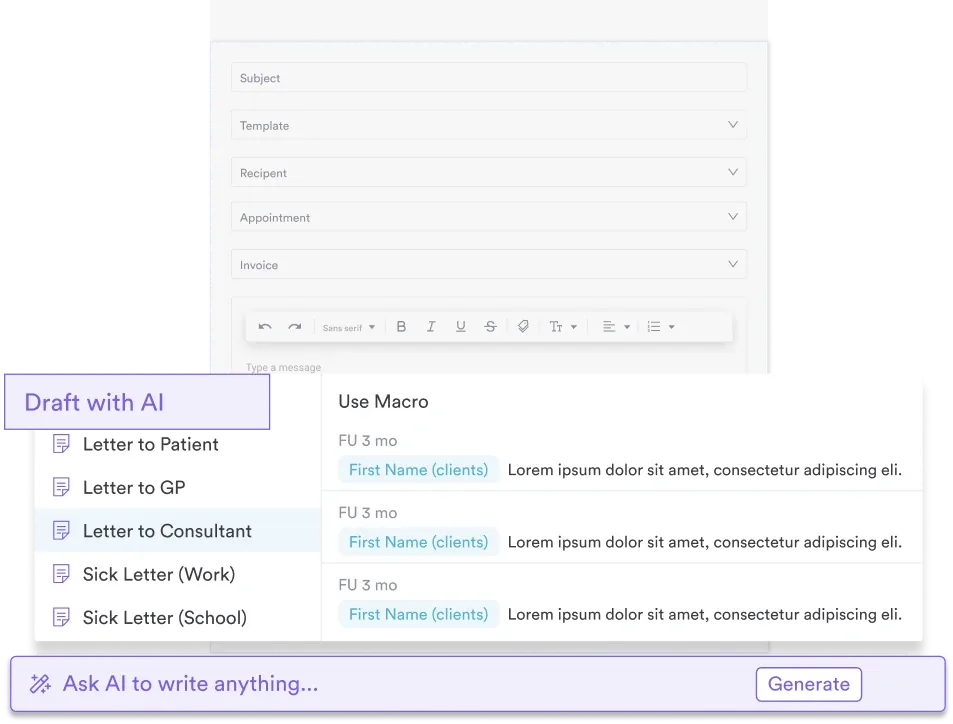
Practices that have also implemented AI-powered clinical documentation tools report that structured note generation reduces ambiguity in the diagnostic statement, making it easier to select a specific code at the time of coding rather than defaulting to the unspecified version.
Efficient H51.9 coding starts before the patient enters the room. Practices that build binocular symptom capture into their intake process consistently produce richer clinical documentation, which supports more specific coding and fewer claim delays. The same principle applies well beyond eye care:
Optometry practices billing for comprehensive ocular motility evaluations should also ensure the CPT code submitted alongside H51.9 reflects the level of examination documented. Submitting a high-level evaluation code with only a brief exam note is a separate billing risk that compounds the issues associated with an unspecified diagnosis code.
For practices tracking coding patterns over time. Combining that view with up-to-date client records ensures historical ocular motility findings are accessible during each encounter, reducing the need for an unspecified code at follow-up visits.
H51.9 is a legitimate billable code, but it carries the same risk as any unspecified diagnosis: payers expect clinicians to characterize what they found, and a pattern of unspecified coding invites scrutiny. Better clinical documentation from the start prevents more denials than a stricter coding review process ever will.
Pabau’s claims management tools help ophthalmology and optometry practices catch unspecified code submissions before they leave the practice, pair diagnoses with compliant CPT codes, and track denial patterns across the H51 category. To see how Pabau handles coding compliance and claim tracking for eye care practices, book a demo.

Coding intracranial phlebitis cases? Intracranial phlebitis coding guide covers G08, the billable code for intracranial and intraspinal phlebitis and thrombophlebitis.
Coding residual damage after CNS infection? CNS inflammatory sequelae coding guide explains why G09 is billable only as a secondary code sequenced after the original diagnosis.
Need to reduce no-shows and keep documentation complete? Automated workflows send pre-visit prompts and post-visit follow-up that keep patient records complete.
ICD-10 Code H51.9 is used to report an unspecified disorder of binocular movement when clinical documentation does not support a more specific H51 subcategory diagnosis. It applies to patients with binocular coordination dysfunction whose workup is incomplete or whose condition does not meet criteria for a named subcategory such as convergence insufficiency (H51.11) or internuclear ophthalmoplegia (H51.20).
Yes, H51.9 is a billable and specific ICD-10-CM diagnosis code that can be submitted on insurance claims for reimbursement purposes. Reimbursement depends on medical necessity documentation and payer-specific policies, not the billable status of the code alone.
H51.9 (Unspecified disorder of binocular movement) describes dysfunction in coordinated eye movement without implying resting misalignment, while H50.9 (Unspecified strabismus) describes a condition where the eyes are misaligned at rest. A patient with convergence-related symptoms but no frank strabismus is more accurately coded H51.9 than H50.9.
Under MS-DRG v43.0, H51.9 is grouped within MS-DRG 124 (Other disorders of the eye with major complication or comorbidity or thrombolytic agent) when an MCC is present, or MS-DRG 125 (Other disorders of the eye without MCC) when it is not. MS-DRG groupings update annually; practices should verify the current version for inpatient billing accuracy.
Use H51.9 only when documentation does not support a more specific code, the clinical workup is genuinely incomplete, or the binocular disorder does not meet criteria for any named H51 subcategory after full evaluation. Per ICD-10-CM Official Guidelines, unspecified codes are last-resort options, not defaults.
Yes, H51.9 can be coded as a secondary diagnosis alongside a primary diagnosis code when the binocular movement disorder is present but not the main reason for the visit. Sequencing rules from the ICD-10-CM Official Coding Guidelines and payer-specific requirements govern which code is listed first. Review the ICD List diagnostic code reference for sequencing and excludes notes relevant to H51.9.