HIPAA compliant texting: What you can send patients & how to communicate securely
HIPAA compliant texting is possible when a text holds no protected health inform...

Last Updated: Oct 16, 2026

An intake assessment, also called an admissions assessment and intake evaluation, is a comprehensive clinical document that captures a patient’s medical history, presenting concerns, and diagnostic impression at the start of treatment.
A standardized intake assessment keeps documentation complete, improves continuity of care, and sets a baseline for measuring treatment progress.
Digital intake forms with conditional logic cut manual data entry, automatically populate client records, and support HIPAA-compliant data capture.
Practice management software like Pabau automates the pre-appointment intake process with customizable digital forms and a client portal, linking responses directly to client records and clinical workflows.
A comprehensive clinical document covering patient demographics, medical history, presenting concerns, mental status examination, substance use history, social history, and diagnostic impression necessary for effective treatment planning.
Download templateAn intake assessment, also called an admissions assessment and intake evaluation, is the first structured record you build on a new client. It anchors diagnosis, treatment planning, and continuity of care. Whether you run a mental health or therapy practice, a psychiatry office, or a behavioral health program, a consistent intake process protects your clients, reduces liability, and speeds up your workflow.
This guide explains what to include in an intake assessment, how to use the template, the screening tools clinicians rely on, and how digital intake changes day-to-day operations. Download the free template above and adapt it to your setting.
An intake assessment, also known as an intake evaluation, is the comprehensive clinical evaluation conducted when a patient first enters treatment. It documents background information, medical history, current functioning, and presenting concerns needed for accurate diagnosis and safe, effective treatment planning.
The words intake and assessment are often paired, but they describe different steps. Intake is the information-gathering stage, and assessment is how the clinician interprets what’s been gathered.
According to ASAM Criteria implementation tools, intake assessment evaluates six dimensions: acute intoxication and/or withdrawal potential, biomedical conditions and complications, emotional, behavioral, and cognitive conditions, readiness to change, relapse/continued-use potential, and recovery/living environment.
The intake process achieves three goals:
A comprehensive intake assessment template typically includes the sections below.
Beyond these sections, most clinicians add validated screening tools to the intake assessment. The PHQ-9 and GAD-7 rate depression and anxiety severity.
The AUDIT and DAST screen alcohol and drug use. For substance use disorders, the ASAM Criteria assess the client across those same six dimensions to set the appropriate level of care.
A full intake assessment usually runs 60 to 90 minutes. Build the scoring into the template, not just the raw answers, so each score lands in the client record and gives you a baseline to measure progress against.
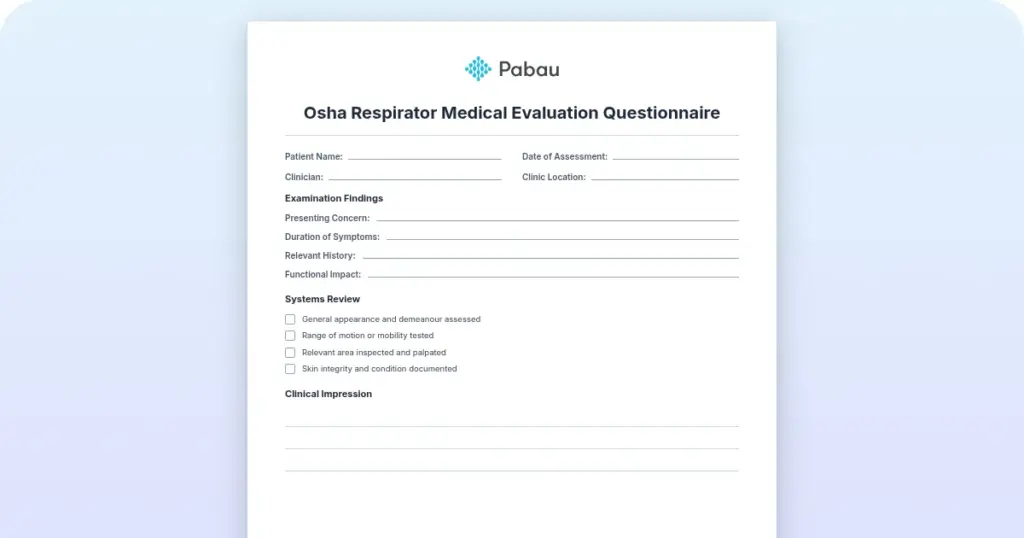
The sections above lean toward behavioral health, where mental status and substance use carry the most weight. In a medical practice, a general health assessment form covers the same history, medication, and allergy ground. In occupational health, employers screen staff with the respirator medical evaluation questionnaire before clearing them to wear one.
Using a structured intake template requires five operational steps that integrate the form into your clinical workflow.
In software built for occupational therapy practices, scores from scales like this feed straight into progress notes.
Intake assessment templates apply across multiple clinical settings, and different professionals lead the process.
Each specialty adapts the template to its clinical context, emphasizing domains such as substance use for addiction services, mental status for psychiatry, and functional ability for allied health.
Keeps documentation complete: A standardized template makes sure every clinician captures the same essential information, so no section is missed and nothing that could delay diagnosis or compromise safety slips through.
Improves care continuity: When all staff use the same intake structure, new clinicians quickly understand a client’s history, presenting problem, and prior treatment response without having to decipher inconsistent handwritten notes.
Supports accurate diagnosis: Structured assessment of medical history, substance use, mental status, and psychosocial factors reduces diagnostic errors and ensures treatment aligns with the client’s clinical presentation.
Creates accountability: Documented intake assessment proves you have conducted a thorough initial evaluation, protecting your practice in regulatory reviews, malpractice cases, and insurance audits.
Enables outcome measurement: A consistent baseline assessment allows you to track progress over time, measure treatment effectiveness, and adjust interventions based on objective clinical change.
Paper intake forms require clients to hand-write responses, staff to manually transcribe them into client records, and clinicians to re-read scattered pages during sessions. Digital intake streamlines this process.
When you deploy intake forms through customizable digital intake forms built into your practice management system, client responses automatically populate the client record, removing manual data entry and transcription errors.
Conditional logic branches questions based on the client’s answers. If a client reports no substance use history, those detailed follow-up questions hide automatically, so clients only answer what applies to them.
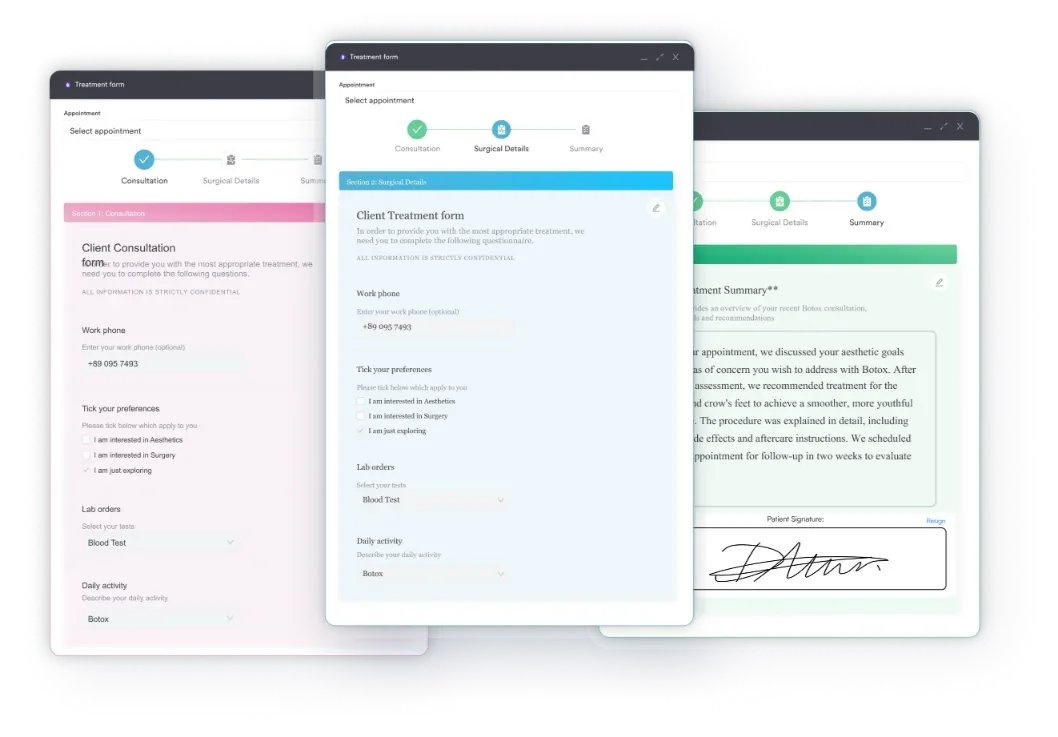
Automated intake workflows send reminders if clients miss the deadline, track completion status, and notify staff when forms are ready for review. Practice management software with integrated intake also populates demographic data, appointment details, and referral sources automatically, cutting data-entry burden on both clients and staff.
Post-completion. This accelerates note completion and reduces the time spent on administrative tasks between sessions.
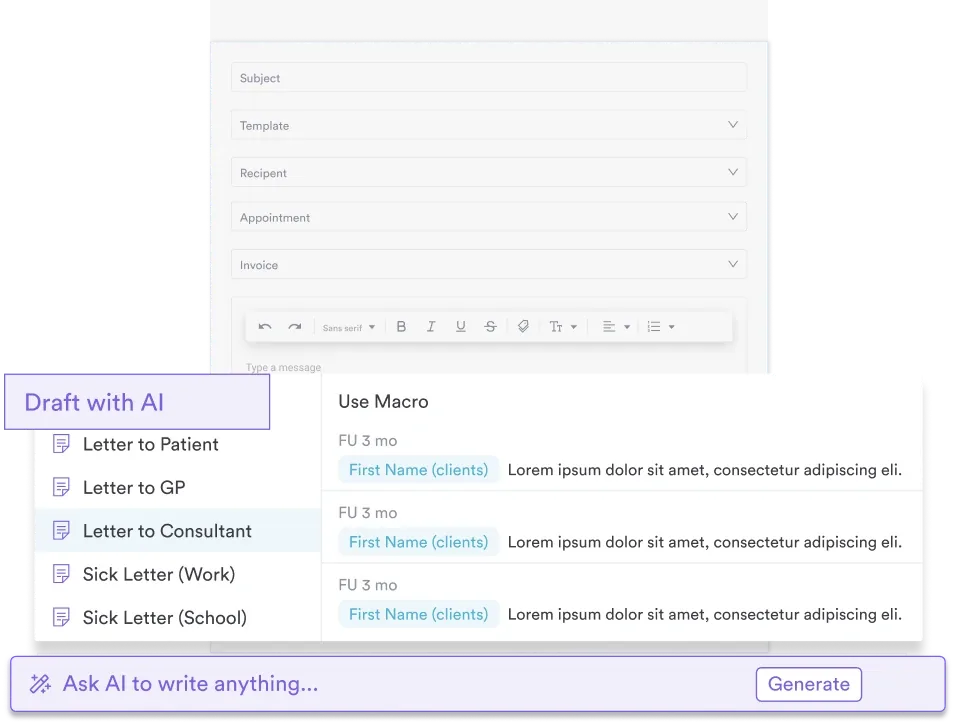
For therapy practice management, integrated intake also enables automated intake workflows that trigger follow-up tasks: scheduling the first clinical visit, sending pre-session instructions, or flagging high-risk responses for immediate clinician review.
Book a demo to see how Pabau’s digital intake and client portal automate the intake assessment process while maintaining HIPAA compliance and clinical quality.
Administer at the right time: Send intake forms 24-48 hours before the appointment, not the day of. This gives clients time to reflect on their history and reduces last-minute completion errors.
Brief clients on confidentiality: Clearly explain that the intake form is part of the confidential clinical record. Clients may omit sensitive information if they fear breaches of privacy, so reiterating confidentiality and data-protection practices increases disclosure accuracy.
Conduct an in-person follow-up: Do not rely on written intake alone. The clinical interview allows you to observe mental status directly, build rapport, and clarify ambiguous responses. Combining written intake with face-to-face assessment yields the most complete picture.
Update periodically: Readminister key sections (medical history updates, medication changes, current substance use) at set intervals, such as annually or when a client’s circumstances change. This keeps the record current and supports continuity.
Train your team: Ensure all staff who administer, enter, or review intake forms understand the template’s purpose and how to document findings consistently.
Regulators and insurers expect practices to document a thorough initial assessment. A missing or incomplete intake form signals inadequate clinical evaluation and can trigger compliance findings during audits.
Accreditation bodies set concrete expectations. The Joint Commission and CARF, along with most insurance payers, expect the intake assessment to be completed within a set window, often 24 to 72 hours of admission, then signed, dated, and filed in the client’s medical record.
Incomplete or late assessments are a common audit finding and can lead to claim denials when a payer decides medical necessity wasn’t established at admission.
In the United States, SAMHSA-funded programs and state health departments require a documented intake assessment for every client. In the UK, the CQC expects practices to hold comprehensive assessment records showing they understand presenting needs and risks before treatment begins.
By using a standardized intake assessment template, you demonstrate clinical rigor, reduce documentation liability, and build the foundation for evidence-based, patient-centered care.
The same structure carries into ongoing patient care management.
A standardized intake assessment turns a new client’s first session into a complete clinical record, not a stack of scattered notes. It gives every clinician the same starting point, supports accurate diagnosis and treatment planning, and gives auditors and payers the documentation they expect at admission.
Download the template above and adapt it to your setting, then bring it into Pabau’s digital intake and client portal so responses flow straight into the client record without re-typing a thing.
Intake is the initial process of gathering client information through forms and interviews. Assessment is the clinician’s evaluation and interpretation of that information to formulate a diagnosis and treatment plan. Intake feeds into assessment as part of one continuous workflow.
Administer it before or at the very first clinical session. Sending the form 24-48 hours in advance allows clients to complete it thoughtfully. Reviewing it together during the initial appointment clarifies responses and establishes rapport.
Explore why. Some clients fear a breach of confidentiality or worry their answers will be used against them. Reaffirm confidentiality protections, explain that the assessment supports safe, tailored treatment, and offer to complete it verbally during the session if writing feels too burdensome. Document the refusal and any verbal assessment conducted.
File the completed form in the client’s secure digital record within your practice management system, not loose papers or spreadsheets. Use role-based access controls so only authorized clinicians can view it. Make sure your system is HIPAA-compliant with encryption, audit logs, and regular backups.
The template structure (demographics, medical history, mental status, treatment plan) applies across specialties. However, emphasize different sections based on your setting. A mental health practice highlights psychiatric symptoms and trauma. A substance use program emphasizes use history and withdrawal risk. Customize the template to your client population.
Conduct a full reassessment annually or when significant changes occur (new diagnosis, medication change, housing instability). Brief check-ins on current symptoms and medication compliance can happen at each session without redoing the entire intake.
There isn’t one universal code. In behavioral health, clinicians most often bill an intake assessment as CPT code 90791 (psychiatric diagnostic evaluation) or 90792 (with medical services). Substance use programs may use HCPCS code H0001 for an alcohol or drug assessment. Confirm the correct code with the payer, since coverage rules vary.
Cover each core domain: the presenting concern in the client’s own words, medical and psychiatric history, current medications, substance use, and social and family history, then a mental status check and a question about risk of harm to self or others. A consistent set of intake assessment questions keeps the interview thorough and makes sure nothing critical is missed.