Fertility clinic marketing: Strategies that attract & convert patients
Fertility clinic marketing is how a fertility practice attracts, educates, and c...

Last Updated: Oct 14, 2026

Healthcare lead generation is the process of attracting and converting prospective patients into booked appointments across digital and offline channels.
For private clinics, the highest-ROI tactics are local SEO, Google Business Profile optimization, and referral programs, which usually outperform paid ads.
Most practices lose leads between inquiry and appointment, so online booking, automated intake, and follow-up sequences are what recover them.
Pabau’s lead management, online booking, and automated workflows turn the practice management platform into a full patient acquisition engine.
Over 70% of patients now search online before choosing a healthcare provider, according to a Healthgrades review. For private clinics, aesthetic practices, and independent healthcare providers, that statistic represents both the problem and the opportunity: your next patient is already searching; the question is whether they find you, trust you, and book. This guide covers the core healthcare lead generation strategies that work across inbound and outbound channels, what compliance requires, and how your practice management platform should be doing more of the heavy lifting.
Healthcare lead generation is the structured process of attracting prospective patients, capturing their contact details or intent, and converting that interest into a booked appointment. It spans everything from a Google search that lands someone on your website to a referral from a physician to a social media ad that drives a consultation booking. In a consumer setting these prospects are called patient leads. In a business-to-business one, they are medical leads or healthcare sales leads. This guide focuses mainly on patient lead generation for private practices, with a section on the B2B side later.
Private clinics face a specific version of this challenge. Unlike NHS or insurance-covered services, every patient relationship starts with a voluntary decision to seek and pay for care. There is no captive audience. Combine that with rising competition in aesthetics, wellness, and private primary care, and patient acquisition strategies that worked three years ago are delivering diminishing returns today.
The wellness side of that list has its own playbook. Our guide to marketing for wellness practices puts local SEO, fresh reviews, email recalls, and referrals ahead of paid ads.
The core failure point is almost never the top of the funnel. Most clinics generate some level of interest. The problem is the conversion layer: a prospective patient finds the clinic, visits the website, and then… nothing happens fast enough. No instant booking option. No automated follow-up. No intake form to confirm intent. They move on.
The lead generation tactics that work best in the healthcare industry combine inbound activity (pulling interested patients toward your practice) with selective outbound outreach (reaching prospects who haven’t yet found you). For most private practices, the inbound side delivers better long-term ROI.
When someone searches “dermatologist near me” or “Botox clinic in Manchester,” Google shows a local pack before organic results. Clinics with optimized Google Business Profiles, strong review counts, and locally relevant website content dominate this space. This is among the highest-converting channels for patient acquisition because the searcher already has intent.
Key actions: keep your GBP category accurate, post regularly, respond to every review, and ensure NAP (name, address, phone) consistency across every directory listing. For lead generation for med spas and aesthetic clinics in particular, photo quality on GBP listings measurably affects click-through rates.
Patients research treatments before booking. A clinic that publishes clear, trustworthy content about the conditions it treats and the procedures it offers captures this research traffic. A well-structured blog post about “what to expect from a HydraFacial” can outrank paid ads and generate booked consultations for months.
This requires consistent publishing and topic authority, not just keyword density. Cover the patient’s decision journey: what is this treatment, who is it for, what does recovery look like, what are realistic outcomes? Clinics that answer these questions earn trust before the first interaction. A structured healthcare content marketing strategy keeps that publishing consistent instead of ad hoc.
Google Ads targeting high-intent keywords (“laser hair removal consultation [city]”) converts well for clinics willing to invest in the paid channel. Meta advertising (Facebook and Instagram) works better for awareness and remarketing, particularly for elective procedures where patients need to see a service multiple times before converting.
The trap most clinics fall into is running paid campaigns to websites that aren’t optimized to convert. Traffic without a clear call to action, fast-loading booking flow, or mobile-friendly experience wastes budget. Paid healthcare lead generation only works when the landing page completes the job. Read more about building that foundation in clinic marketing fundamentals.
Referrals from physicians and GPs remain one of the most trusted lead sources for specialist and private practices. Formalizing this relationship, whether through a structured referral process, regular communication with referring clinicians, or a patient referral incentive program, turns passive word-of-mouth into a measurable acquisition channel.
Patient referrals convert at substantially higher rates than cold traffic because trust is transferred with the recommendation. A clinic that actively asks satisfied patients to refer family and friends, and makes that process frictionless, builds a compounding lead source over time. Pair this with social media marketing for clinics to amplify word-of-mouth digitally.
Google reviews, Trustpilot, and health-specific platforms act as passive healthcare lead generation. A prospective patient who finds your clinic via any channel will almost certainly check your reviews before booking. A thin or outdated review profile loses patients at the final decision stage.
Automated review request sequences, triggered after each appointment, maintain a consistent flow of fresh feedback. This requires no additional marketing budget and compounds over time into a competitive advantage that is genuinely difficult for a competing clinic to replicate quickly.
Review velocity matters as much as average rating. A clinic with 200 reviews and a 4.6 average outperforms one with 50 reviews and a 4.9 average in most local search rankings. Build a system for requesting reviews after every appointment, not just for satisfied patients – patients who received good clinical care are usually willing to say so.
Driving traffic is only half the battle in healthcare lead generation. The conversion rate between website visit and booked appointment determines whether a marketing spend is profitable. Most clinics underinvest in this layer relative to their top-of-funnel spending.
The core elements of a high-converting clinic website are: a clear service offering above the fold, social proof (reviews and credentials), a frictionless online booking option, and a mobile experience that works flawlessly. Every additional click a patient has to make between “I want to book” and “booking confirmed” loses a percentage of potential appointments.
For a full breakdown of how to convert more inquiries into booked appointments, see converting leads into booked appointments.
Industry reports from Healthgrades and PatientPoint consistently indicate that online booking and automated intake forms reduce patient drop-off between inquiry and appointment. When a patient has to call during business hours to book, a portion of that interested traffic is lost to clinics with 24/7 online booking. This is especially acute for aesthetic and elective procedures, where the decision window is short and patients are often comparing multiple providers simultaneously.
| Conversion friction point | Impact | Solution |
|---|---|---|
| Phone-only booking | Lost leads outside business hours | Online booking widget (24/7) |
| Manual intake process | Drop-off between inquiry and first visit | Automated digital intake forms |
| No follow-up sequence | Inquiries go cold within 48 hours | Automated email/SMS follow-up |
| No review presence | Lost at final decision stage | Automated post-appointment review requests |
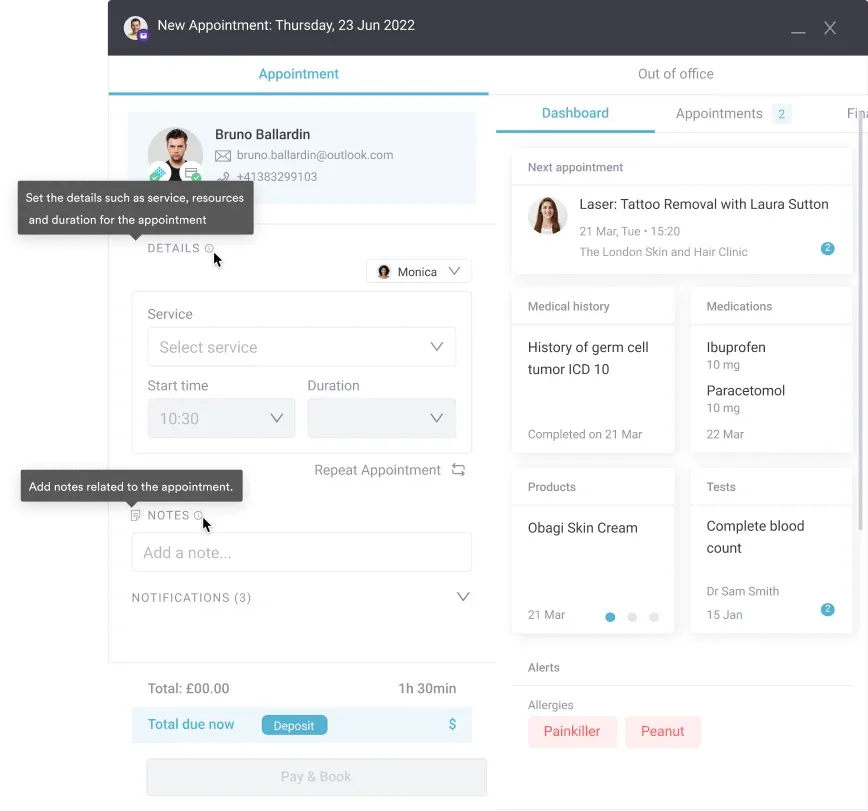
The practice management platform is where this conversion layer lives. A platform with integrated online booking, digital intake forms, and automated messaging sequences handles these conversion points without additional software or manual staff intervention.
Most clinic owners think of practice management software as an operational tool: scheduling, notes, billing. The better framing is that the right platform is a patient acquisition engine running continuously in the background.
Healthcare CRM software tracks every patient interaction from first inquiry through treatment history, enabling targeted recall campaigns, reactivation sequences for lapsed patients, and segmented marketing based on treatment type. For a clinic seeing 300 patients a month, that patient database is worth more than any paid advertising spend if it is actively used.
Pabau combines CRM, marketing automation, and clinical workflows in a single platform. Rather than managing separate tools for scheduling, email marketing, and patient records, clinic teams work from one system where every lead and patient interaction is captured automatically.
Lead management for clinics is the discipline of giving every new inquiry an owner, an automated follow-up sequence, and a clear status, so nothing sits unanswered in a shared inbox. When a website form, a phone call, and an Instagram message all land in the same pipeline, the front desk can see at a glance which prospective patients are still waiting on a reply and which have gone quiet.
Pabau’s lead management tools tag each inquiry by source, trigger the first response automatically, and flag leads that stall before booking. So a busy reception never loses track of who still needs a callback, and a form submission moves to a confirmed slot instead of drifting until the prospective patient books elsewhere.
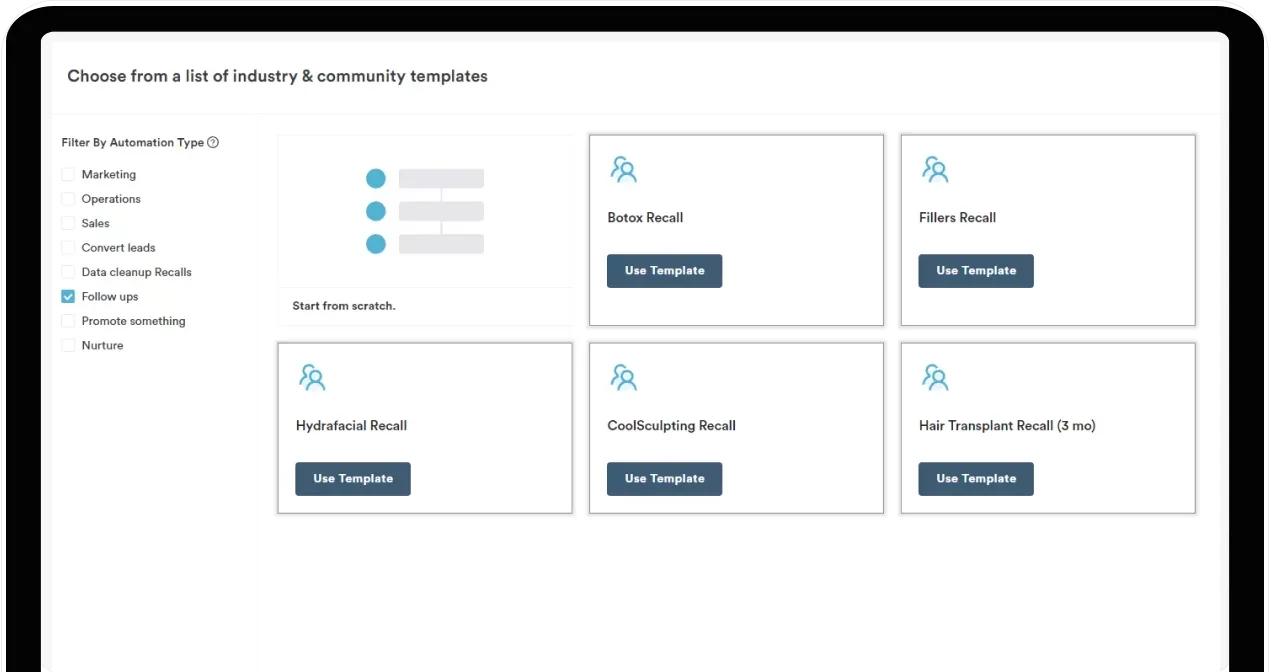

From online booking and automated intake to recall campaigns and review requests, Pabau connects every stage of the patient acquisition funnel inside one platform. No separate marketing tools required.

Most lead capture ends when the form is submitted or the call is taken. In reality, most prospective patients need between two and five touchpoints before booking. Clinics that automate this sequence, sending a confirmation, a treatment overview, and a booking reminder across email and SMS, convert a materially higher share of inquiries into appointments.
Speed matters as much as the sequence. The chance of connecting with a new lead drops sharply once the first few minutes pass, so the initial reply should fire automatically rather than waiting for someone at the front desk to notice a new inquiry between patients.
That same touchpoint thinking carries past the booking, which is where patient engagement tactics keep new patients active instead of lapsing.
Pabau’s automated follow-up workflows handle this without manual staff involvement. A new inquiry triggers a sequence: immediate acknowledgement, treatment information within 24 hours, a booking prompt at 48 hours if no appointment has been made. The same logic applies to patient recalls: a patient who had a Botox treatment four months ago is a warm lead for a follow-up appointment; automated recall messaging surfaces that opportunity without anyone having to remember to send it.
Healthcare lead generation operates under stricter compliance requirements than most industries. Any collection, storage, or use of patient data in marketing activities must comply with applicable regulations: HIPAA in the United States, GDPR in the UK and EU, and sector-specific guidance from bodies including the FTC, ASA, and CQC.
The HHS Office for Civil Rights is explicit that marketing communications involving protected health information require patient authorization. This has direct implications for remarketing pixels, email list management, and data sharing with third-party lead generation agencies.
In the UK, the ICO’s GDPR guidance requires a lawful basis for processing patient data in marketing contexts. Consent must be specific, informed, and freely given. Broad consent gathered during registration does not automatically cover all future marketing activity. UK clinics regulated by the Care Quality Commission (CQC) also face additional scrutiny around patient communications.
Practically, compliant healthcare lead generation means: explicit opt-in for all marketing communications, secure handling of any data collected through lead capture forms, clear data retention policies, and a platform that supports audit trails and consent management. Pabau is built with these requirements in mind, supporting both HIPAA and GDPR workflows out of the box.
Not all healthcare lead generation targets patients directly. Medical device companies, health tech vendors, and pharmaceutical suppliers operate in a B2B environment where the “lead” is a procurement manager, clinical director, or GP practice owner. These sales cycles are fundamentally different from consumer patient acquisition.
B2B healthcare lead generation typically involves longer evaluation periods, multiple stakeholders, and compliance documentation requirements at every stage. Tactics that convert well in B2B include LinkedIn outreach targeting clinical job titles, content marketing aimed at practice owners (clinical guides, benchmark reports, ROI calculators), and webinar-based lead capture where value is demonstrated before any sales conversation begins.
For clinic owners reading this guide, the B2B angle is most relevant when marketing to referring clinicians, corporate health accounts, or insurance networks. The aesthetic clinic marketing plan framework translates well to both patient-facing and B2B contexts when adapted for the relevant audience and decision timeline.
B2B healthcare lead generation cycles average three to six months from first contact to signed contract, according to Belkins.io case study data. Build nurture sequences accordingly: a monthly newsletter with clinical insights keeps your practice top-of-mind with referring clinicians without being pushy. LinkedIn is the most effective outreach channel for reaching GP practice managers and clinical directors.
At some point most practice owners weigh whether to hire a healthcare lead generation company or build the machine in-house. Specialist agencies and pay-per-lead vendors promise a faster start: they run the ads, buy the media, and hand over qualified patient leads or, in a B2B setting, booked sales appointments. For a practice with no marketing resource and an urgent need for volume, that shortcut can be worth it in the first few months.
The trade-offs show up later. Purchased leads are often sold to competing practices at the same time, arrive with little context, and stop the moment you stop paying. You rent the channel rather than own it, and the patient relationship data that compounds over time sits with the vendor, not in your own records.
A simple way to decide between the two:
For most private practices, the durable answer is to own the funnel. A practice management platform like Pabau turns your own website traffic, referrals, and past patients into a first-party lead source you control, so you are not renting patients from an agency indefinitely. A common path is to use an agency to prime the pump early, then move spend in-house once your booking, follow-up, and recall workflows are converting on their own.
Healthcare lead generation investment only compounds when the results are measured and optimized. The metrics that matter most for private clinics are: cost per lead by channel, lead-to-appointment conversion rate, patient lifetime value (to assess which acquisition channels bring the most valuable patients), and time-to-first-appointment from initial inquiry.
Most clinics track bookings but not the full funnel from inquiry to appointment. When the data shows that 60% of website inquiries never book, the intervention point is conversion optimization, not more ad spend. When a particular referral source consistently brings patients who rebook three or four times, that channel deserves more investment.
For clinics building out a complete patient engagement system, patient engagement after the first visit is where healthcare lead generation transitions into retention. A patient who returns for a second appointment is worth five times the acquisition cost of a new patient; measuring that transition is as important as measuring initial lead volume. Pabau’s reporting tools surface these funnel metrics across channels and time periods, so decisions are based on data rather than intuition.
That second-visit transition is where lead generation hands off to patient retention tactics that protect the value of every patient you acquire.
The clinics winning on patient acquisition in 2026 treat the full funnel as an integrated operation: marketing that generates aware traffic, conversion infrastructure that turns visits into inquiries, booking flows that capture appointments, and CRM automation that maintains relationships until the patient is ready to rebook. Each stage depends on the one before it. The medical spa CRM is the connective tissue holding this together.
For most clinics, the weak point in healthcare lead generation is rarely traffic. Leads are already being generated, then lost to slow follow-up, phone-only booking, or a CRM that isn’t doing its job. Fixing that layer often delivers better returns than doubling the advertising budget.
Pabau’s integrated platform handles online booking, automated patient follow-up, lead tracking, recall campaigns, and review requests inside a single clinical workflow system. To see how it works in practice, book a demo and we’ll walk through the patient acquisition setup for your clinic type.

Want a full growth strategy for your practice? Medical practice marketing guide explains why patients drift away and how follow-up gaps quietly cost your practice.
Want a lower-cost way to find new patients? Patient referral program guide shows how to build and automate referrals as ad costs keep climbing.
Want to build rapport before the first visit? About me template gives you a free self-assessment worksheet covering patient history, lifestyle, and goals.
Healthcare lead generation is the process of attracting prospective patients or healthcare buyers, capturing their intent or contact details, and converting that interest into a booked appointment or sales conversation. It spans digital channels (SEO, PPC, social media, email) and offline channels (referrals, events, direct mail), and must comply with applicable data privacy regulations including HIPAA and GDPR.
The highest-ROI tactics for private clinics are local SEO and Google Business Profile optimization, content marketing targeting treatment research keywords, patient referral programs, and automated review request sequences. Paid search converts well for high-intent keywords. All tactics require a conversion-optimized website with online booking to capture the interest they generate.
HIPAA requires that any marketing communication involving protected health information obtains prior patient authorization. This affects remarketing pixel use on health-related pages, email list segmentation based on clinical data, and data sharing with third-party lead generation agencies. HHS Office for Civil Rights guidance is the primary compliance reference for US-based practices.
Patient acquisition targets individual consumers deciding to seek care, with conversion cycles typically measured in days or weeks. B2B healthcare lead generation targets organizations (hospitals, physician groups, procurement teams) buying products or services, with sales cycles averaging three to six months and involving multiple decision-makers. The channels, content, and nurture sequences differ substantially between the two.
The best patient lead generation strategies for private clinics combine local SEO, Google Business Profile management, patient referral programs, content marketing for treatment research queries, and automated review requests. The conversion layer matters as much as traffic generation: online booking available 24/7, automated follow-up sequences, and digital intake forms prevent leads from going cold between inquiry and appointment.
The tactics with the best returns in healthcare are local SEO and Google Business Profile optimization, treatment-focused content, patient referral programs, and automated review requests, all feeding a website with 24/7 online booking. Paid search adds high-intent volume, but only converts when the booking flow behind it is fast and mobile-friendly.
Lead management for clinics tracks every inquiry from first contact through to a booked appointment, so nothing is lost between a website form and a confirmed slot. A practice management platform records the source, triggers automated follow-up, and flags inquiries that have gone quiet, turning scattered interest into a measurable pipeline the front desk can work.
Costs vary widely by channel. Paid search and social ads run on a cost-per-click or cost-per-lead basis, while agencies and pay-per-lead vendors charge per qualified lead or a monthly retainer. Owned channels like local SEO, referrals, and automated recall carry mostly time and software costs, which is why they tend to deliver the lowest cost per acquired patient over time.
The 5-minute rule holds that responding to a new lead within five minutes of their inquiry sharply improves the odds of reaching and converting them, compared with waiting hours or days. For a clinic, that speed is only realistic with automated acknowledgement, so a prospective patient gets an instant reply even when the front desk is mid-appointment.