CCSD Code J5520: Total pancreatectomy billing guide
CCSD Code J5520: Definition and procedure scope CCSD Code J5520 describes a tota...

Last Updated: Oct 20, 2026
V5298 is the HCPCS Level II code for a hearing aid, not otherwise classified. It covers a hearing aid that no specific V5xxx device code describes, such as a new, proprietary or custom-configured instrument.
Because the code has no fixed fee, payers price it from the manufacturer or supplier invoice attached to the claim. Medicare Part B excludes routine hearing aids, so payment comes from commercial plans, Medicaid or the patient.
Let Pabau's smart automation suggest the right codes, reduce claim denials, and keep your practice compliant—effortlessly.
Automate repetitive tasks and focus on what matters most—your patients.
Reduce coding errors and ensure compliance with the latest regulations.
Clean claims, fewer denials, and faster reimbursements.
Powerful insights and reporting to help your practice thrive.
HIPAA compliant SOC 2 certified GDPR-compliant Trusted by 4,000+ clinics worldwide

HCPCS Code V5298 is the not otherwise classified code for a hearing aid that no specific HCPCS device descriptor fits.
Medicare Part B excludes routine hearing aids by statute, so V5298 almost never produces a Part B payment.
Payers price V5298 from the manufacturer or supplier invoice, so a claim sent without it is likely to be denied.
Supplies and accessories bill under V5267 and hearing services under V5299, so neither belongs on V5298.
Pabau’s claims management software checks claims for missing details and sends them with the invoice attached.
HCPCS Code V5298 is the Level II code for a hearing aid, not otherwise classified. The Centers for Medicare & Medicaid Services (CMS) maintains it in the V5xxx hearing services section, alongside the codes in our HCPCS billing guides. The full official descriptor is Hearing aid, not otherwise classified.
The hearing services range runs from V5008 through V5364 and covers hearing assessments, fittings, dispensing fees, devices and supplies. Within it, specific device codes describe a hearing aid by ear, wearing style and circuit type. V5298 is the not otherwise classified (NOC) code, so it takes any hearing aid that none of those specific descriptors fits.
V5298 applies to a hearing aid dispensed to a patient when no other hearing aid code accurately describes the device. Use it for new hearing technology, hybrid devices that combine amplification with other features, or an instrument with no specific HCPCS descriptor.
Covered under V5298:
Not covered under V5298:
The most common billing error with HCPCS Code V5298 is using it when a more specific code exists. The table below maps the neighboring codes coders confuse most often, so you can confirm the right one before submission.
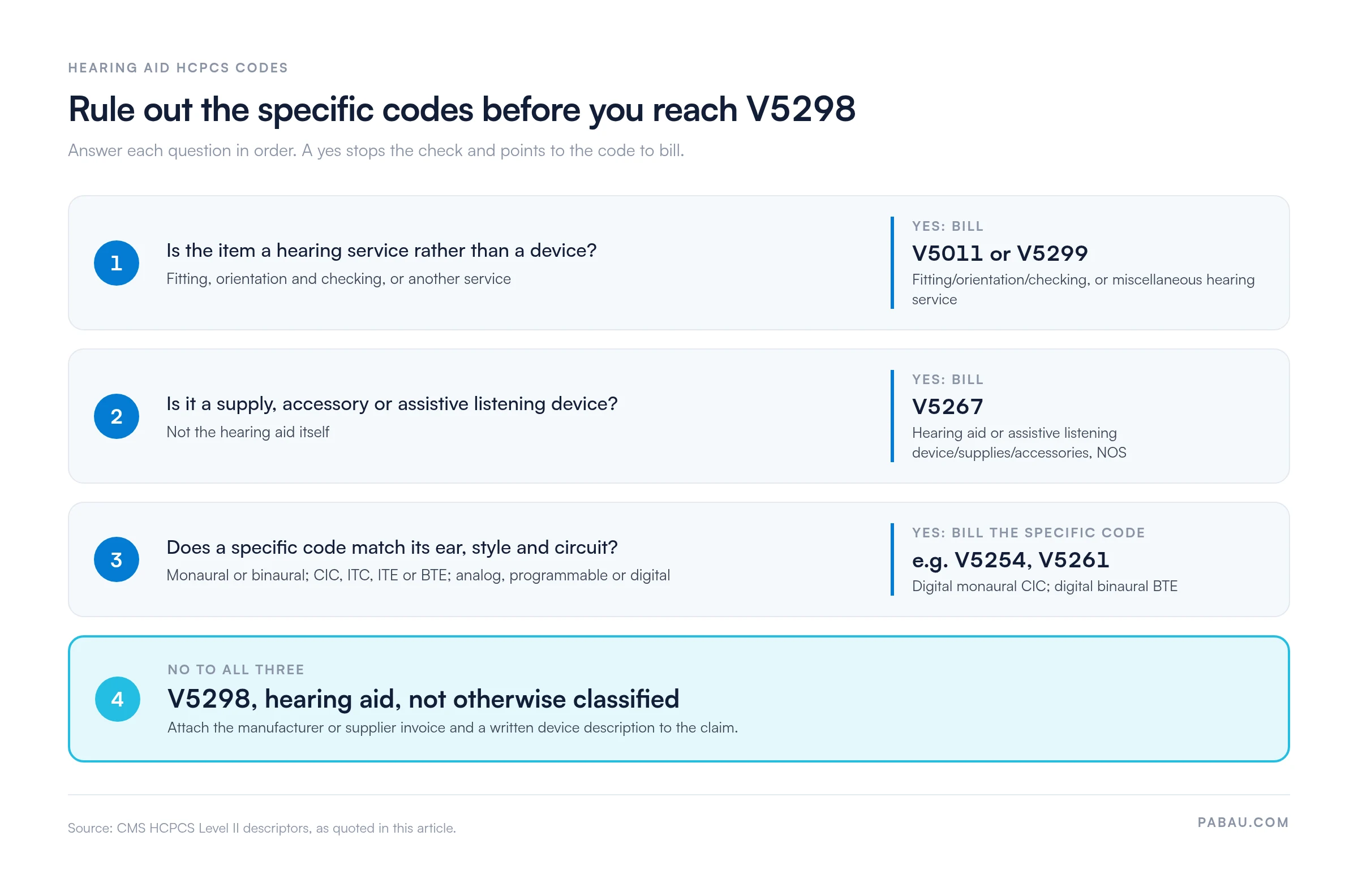
Laterality alone never sends a claim to V5298. The specific codes split by ear, by style and by circuit, so a pair of digital behind-the-ear aids bills V5261. V5267 is not a hearing aid code at all, because it covers supplies, accessories and assistive listening devices.
Work through the checks in the order below, and V5298 is only left once every specific code has been ruled out.
Medicare Part B does not cover routine hearing aids. The exclusion sits in Section 1862(a)(7) of the Social Security Act, so neither CMS nor a local coverage determination (LCD) can waive it. A V5298 claim to Part B for a standard hearing aid is denied, whatever the medical necessity documentation says.
V5298 can still appear on a Medicare-adjacent claim in two narrow scenarios:
When a Medicare-primary patient asks about hearing aid coverage, note in the medical record that you explained the Part B exclusion. An Advance Beneficiary Notice (ABN) isn’t required for a statutorily excluded item, but a voluntary one documents that the patient chose to pay privately.
Medicaid hearing aid coverage varies by state. Some programs cover hearing aids for adults with documented hearing loss, while others limit coverage to children or exclude hearing aids entirely. Medi-Cal (California Medicaid), for example, covers certain hearing aids for eligible beneficiaries and requires prior authorization above a set cost threshold.
Commercial health plans are the most likely source of V5298 payment for adult patients. Rules differ by plan, but most commercial payers that cover hearing aids follow a similar pattern:
V5298 has no published Medicare fee schedule amount, because Medicare Part B excludes routine hearing aids. Payers that do cover the code usually pay from the billed charge or the supplier invoice rather than a fixed fee schedule figure.
The table below summarizes how the most common payer types price V5298:
To set the billed charge for V5298, start with the supplier or manufacturer invoice. Bill the fitting separately under V5011, or a dispensing fee under V5090, V5110 or V5160. Keep the device charge at the invoice cost, because payers that price NOC codes by invoice will request it and adjust the claim to match.
Request the manufacturer or distributor invoice before you dispense the device, then scan it into the claim file straight away. Hunting for it after a denial adds weeks to your revenue cycle, and the supplier may no longer be able to reissue it.
NOC codes draw extra payer scrutiny because no standard code describes the device. The documentation bar for HCPCS Code V5298 sits higher than for specific hearing aid codes, and a missing element usually ends in denial. Review your medical billing compliance standards before you set up the intake workflow.
V5298 denials cluster around five causes, and each one is cheaper to fix at intake than after the remittance arrives. Building denial management in healthcare into the workflow before claims go out keeps audiology billing teams off the appeals treadmill.
DMEPOS suppliers and audiology practices bill V5298 on the CMS-1500 claim form or its electronic equivalent, the 837P transaction. Claims management software that checks each claim before it goes out catches a missing attachment or authorization number early. Follow these steps for a clean submission.
The AAPC’s HCPCS Level II code reference and the PGM Billing HCPCS lookup tool help you verify current descriptors and check adjacent codes before submission.
Build a V5298 pre-submission checklist into your dispensing workflow. It covers six items: a recent audiogram, the signed physician order, the necessity narrative, the invoice, the device description and the PA number. Run through all six before every claim leaves your practice.
Most audiology teams assemble a V5298 claim by hand. The audiogram sits in one folder, the supplier invoice in an inbox, and the PA number on a sticky note. Each claim then waits on someone to gather the pieces, and one missed attachment sends it back unpaid.
Pabau, the practice management platform we build, keeps claims beside the patient record, the appointment and the invoice. Background checks confirm details such as membership numbers and authorization codes before a claim leaves. In the US, claims go electronically to payers through Claim.MD, with the invoice attached.
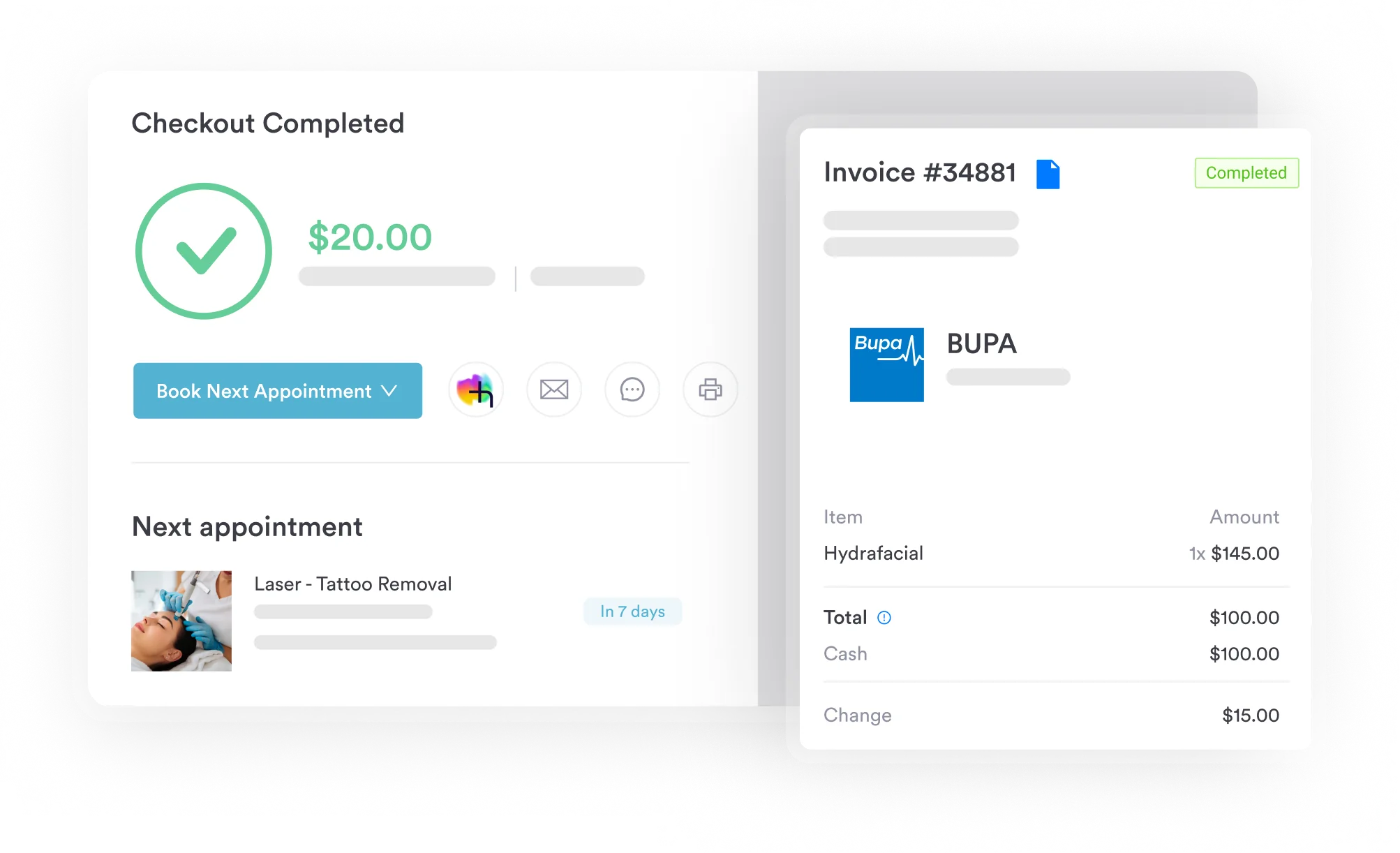
Every claim then moves through the same stages, from pending and submitted to paid or error. Your team sees which V5298 claims are stuck and why, so they fix a missing invoice in minutes rather than weeks.

Pabau checks each claim for authorization codes and attaches the invoice before submission. Your team spends less time chasing hearing aid denials and more time with patients.

Treat V5298 as the last code you reach for. Rule out services, supplies and every specific hearing aid code first, then bill it with the invoice and device description already attached.
Check the payer before the fitting, not after. Medicare Part B will never pay, so the patient conversation and the private-pay paperwork belong at the first visit. A practice that gets those two steps right turns V5298 from a denial risk into a routine invoice-priced claim.
Book a demo to see how Pabau keeps the invoice, authorization and audiogram together for every hearing aid claim.

Want to understand how the billing cycle connects to your revenue? What is revenue cycle management explains the end-to-end process from patient encounter to final payment.
Looking for a clean-claim reference before your next submission? Submitting a clean claim covers the data elements and common errors that decide whether a claim pays on first pass.
Billing a hearing service rather than a device? HCPCS code V5299 covers miscellaneous hearing services that have no specific code.
HCPCS Code V5298 covers a hearing aid that has no specific descriptor in the HCPCS Level II hearing aid codes. It is a not otherwise classified (NOC) code for new, proprietary or custom-configured devices. Use a specific code instead whenever one fits, such as V5256 (digital monaural ITE) or V5261 (digital binaural BTE).
No. A statutory exclusion in the Social Security Act bars Medicare Part B from covering routine hearing aids. V5298 claims sent to Part B are denied. Some Medicare Advantage (Part C) plans offer supplemental hearing benefits. Check each plan’s Evidence of Coverage before dispensing.
Specific hearing aid codes describe the device by ear (monaural or binaural) and wearing style (CIC, ITC, ITE or BTE). They also split by circuit: analog, digitally programmable or digital. V5298 is the NOC code for a hearing aid that none of them describes. Billing V5298 when a specific code applies is grounds for denial or audit.
You need a current diagnostic audiogram, a physician or audiologist order and a medical necessity narrative. Add the manufacturer or supplier invoice showing the device name and cost, a written device description and fitting notes. Most commercial payers and state Medicaid programs want all of these on first submission.
There is no Medicare fee schedule amount for V5298, because Medicare Part B excludes hearing aids. Commercial and Medicaid payers that cover the code usually pay from the invoice amount or the plan’s negotiated rate for NOC device codes. Confirm each payer’s current 2026 pricing method directly.
Use V5298 only after confirming that no specific code describes the hearing aid you are dispensing. If the device has a defined wearing style and a known ear configuration, a specific code almost certainly exists. V5298 fits new technology or proprietary instruments without a CMS-assigned specific code.