

HCPCS Code Q4175: Billing, coverage, and documentation guide
HCPCS Code Q4175: Code Description and Product Identity HCPCS Code Q4175 is the ...

Last Updated: Nov 20, 2026
V5014 is the HCPCS Level II code for repair/modification of a hearing aid. It covers work on an aid the patient already owns, such as a new receiver, a shell repair or reprogramming during a repair.
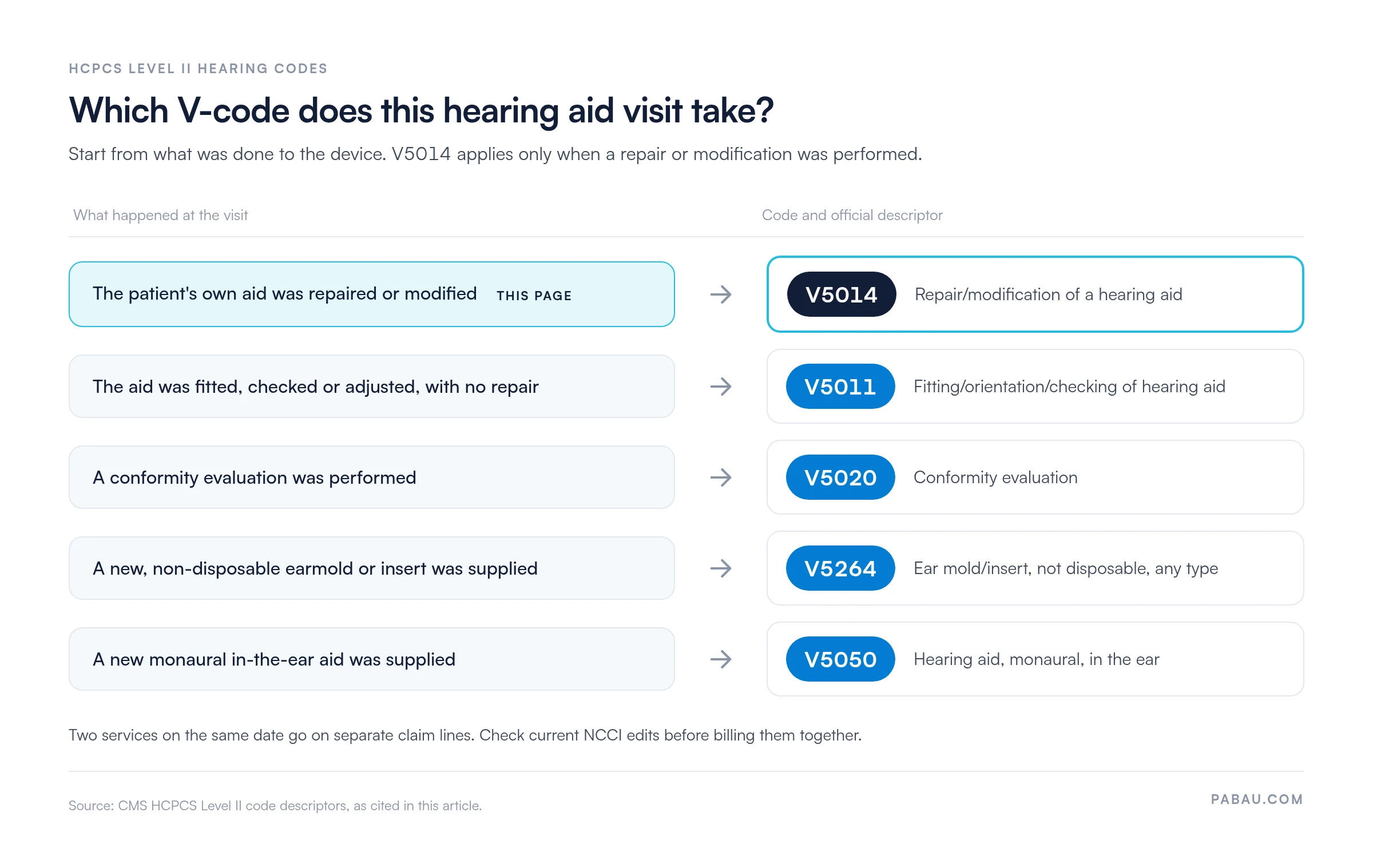
The code sits in the V5000-V5999 hearing services block that CMS maintains. A fitting, orientation or check with no repair is billed as V5011, and a new non-disposable earmold as V5264.
Let Pabau's smart automation suggest the right codes, reduce claim denials, and keep your practice compliant—effortlessly.
Automate repetitive tasks and focus on what matters most—your patients.
Reduce coding errors and ensure compliance with the latest regulations.
Clean claims, fewer denials, and faster reimbursements.
Powerful insights and reporting to help your practice thrive.
HIPAA compliant SOC 2 certified GDPR-compliant Trusted by 4,000+ clinics worldwide

HCPCS code V5014 covers repair or modification of a hearing aid the patient already owns, not new device supply or audiological testing.
A fitting check or adjustment with no repair belongs under V5011, so V5014 only fits a visit where the aid was repaired or modified.
Medicare has a statutory exclusion for hearing aids, so traditional Medicare Part B rarely pays for V5014 outside narrow exceptions.
Missing or incorrect modifiers, especially the LT/RT ear designators, are a frequent cause of V5014 denials with Medicare Advantage and commercial payers.
Pabau’s claims management software sends CMS-1500/837P claims with eligibility checks and ERA remittances, so payer requirements surface before the visit.
HCPCS code V5014 is the alphanumeric Level II code that describes the repair and/or modification of a hearing aid.
It sits within the V5000-V5999 series, the HCPCS block for hearing services, maintained by CMS as part of the HCPCS Level II code set.
The code captures post-sale work on a device the patient already owns. Typical examples are replacing a receiver, repairing a cracked shell, recasing the electronics, or reprogramming the aid as part of a repair. It does not cover the initial fitting or dispensing of a new hearing aid, audiological evaluations, or earmold fabrication, which are billed under other codes. A new digital in-the-canal aid for one ear, for example, is reported as code V5255.
Audiologists, hearing instrument specialists (HIS), and their billing staff are the primary submitters of V5014. Some ENT practices that perform in-house hearing aid repairs also bill the code. Billing authority depends on the payer. Medicaid programs frequently restrict V5014 claims to licensed audiologists, while commercial plans vary by contract.
The official CMS descriptor for V5014 has remained unchanged through the 2026 HCPCS update cycle. The code is active and billable as of January 1, 2026.
Getting the scope of HCPCS code V5014 right is the first line of defense against miscoding and audits. The descriptor reads “Repair/modification of a hearing aid,” which is broad by design but has clear boundaries.
Bundling an earmold fabrication into a V5014 claim when V5264 is separately payable is a known CCI edit trigger. Submit each distinct service on its own line. Check the current National Correct Coding Initiative tables before combining codes on the same date of service. A fresh impression taken to remake a shell or earmold is a separate service, reported per ear under impression code V5275.
The V-series hearing codes are tightly clustered, and coders frequently conflate V5014 with its neighbors. The table below shows the most commonly confused codes and the clinical distinction that determines correct selection.
V5011 and V5014 are the pair coders mix up most often. V5014 applies only when a repair or modification is performed on the aid. A recheck or adjustment visit with no repair is the checking service billed under V5011. The chart below sorts a visit by what was done to the device, and AAPC’s HCPCS Level II lookup settles any remaining doubt.
Documentation is where most V5014 claims fall apart. Payers require a specific record package, and an incomplete one is treated the same as no documentation at all. Sound medical billing fundamentals start with capturing the full record before the service date.
Every V5014 claim should be backed by all of the following before submission:
When a hearing aid is sent to an external repair lab, the return date is not the date of service. The claim date should reflect when the audiologist received the repaired device and confirmed functionality with the patient, unless payer policy states otherwise.
Modifier selection directly affects whether HCPCS code V5014 passes automated adjudication. Submitting without the appropriate modifier is the fastest route to a denial. Refer to your payer contracts and the current CMS guidance for clean claim submission standards before filing.
LT and RT must appear on separate claim lines when both ears are serviced on the same date. Stacking both modifiers on a single line triggers a CCI edit at most clearinghouses.
Traditional Medicare Part B does not cover hearing aids or the routine examination for fitting them. This exclusion flows directly from Social Security Act Section 1862(a)(7) and applies to all standard V-series hearing device codes, including V5014. Assistive devices sit under it as well, so an alerting device billed as V5269 gets the same denial. Medical billing compliance for audiology practices hinges on understanding exactly where this exclusion ends and what narrow coverage remains.
Three scenarios determine how V5014 interacts with Medicare:
Always obtain a signed Advance Beneficiary Notice before performing a V5014 service for a traditional Medicare patient. The ABN protects your practice’s ability to collect from the patient if the claim is denied. Refer to the CMS LCD database and your MAC’s policies for current guidance on bone-anchored device repairs.
Medicaid coverage for HCPCS code V5014 varies significantly by state. Some state programs cover hearing aid repair as an optional benefit with defined frequency limits. Others exclude it entirely or require a referral from a physician. There is no federal mandate requiring state Medicaid programs to cover V5014, so practices must verify coverage individually for each state in which they operate.
Commercial payers generally take one of three approaches to V5014:
Prior authorization is required for V5014 by most Medicare Advantage plans, many commercial payers, and select state Medicaid programs. Submitting without authorization when one is required results in an automatic denial that is difficult to overturn.
Build a PA workflow into the intake process for every V5014 service so the authorization is in hand before the patient arrives. Strong eligibility verification at the time of scheduling catches payer requirements early enough to act on them.
A standard V5014 prior authorization submission typically requires:
Submit PA requests as early as possible. Most payers require 5-10 business days to process, and emergency repair exceptions are rarely granted for hearing aid services.
Traditional Medicare Part B does not cover V5014 for conventional hearing aids. As a result, there is no published Part B fee schedule allowable for the code in that context. Reimbursement for V5014 comes from three sources: Medicare Advantage plan contracts, state Medicaid fee schedules, and commercial payer contracts. All three vary by geography, plan year, and negotiated rates.
Use the CMS Physician Fee Schedule search tool to check for a geographic adjustment factor on a Part B-adjacent HCPCS code in your MAC region. For V5014, this tool is most relevant when a bone-anchored device repair qualifies for limited DME coverage.
Run a V5014 payer eligibility check at scheduling, not at check-in. Booking the repair at least 5-10 business days out gives your team time to obtain authorization. It also leaves room to secure the ABN signature for Medicare patients and quote the patient accurately before they arrive.
V5014 denials cluster around five predictable failure points. Addressing each one proactively keeps clean claim rates high and appeals queues short. A structured denial management workflow turns what are typically avoidable errors into systematic fixes. Each denied line returns with a reason code, and the guide to medical billing denial codes explains what each one means.
Manual V5014 billing in a spreadsheet or on paper produces the error patterns the denial table above describes. Modifiers get left off, device serial numbers go missing, and PA requests go out after the service date.
Pabau, a practice management platform, includes claims management software that supports US electronic claims on the CMS-1500 and 837P formats. Eligibility checks run before the visit, so a payer that needs prior authorization shows up while there is still time to request it.
ERA remittances post back against each claim, so a denied V5014 line surfaces for correction rather than sitting unnoticed in a payer portal. With a steady flow of hearing aid repairs, clean billing often comes down to one test. Does the system catch documentation issues before the claim leaves the practice?
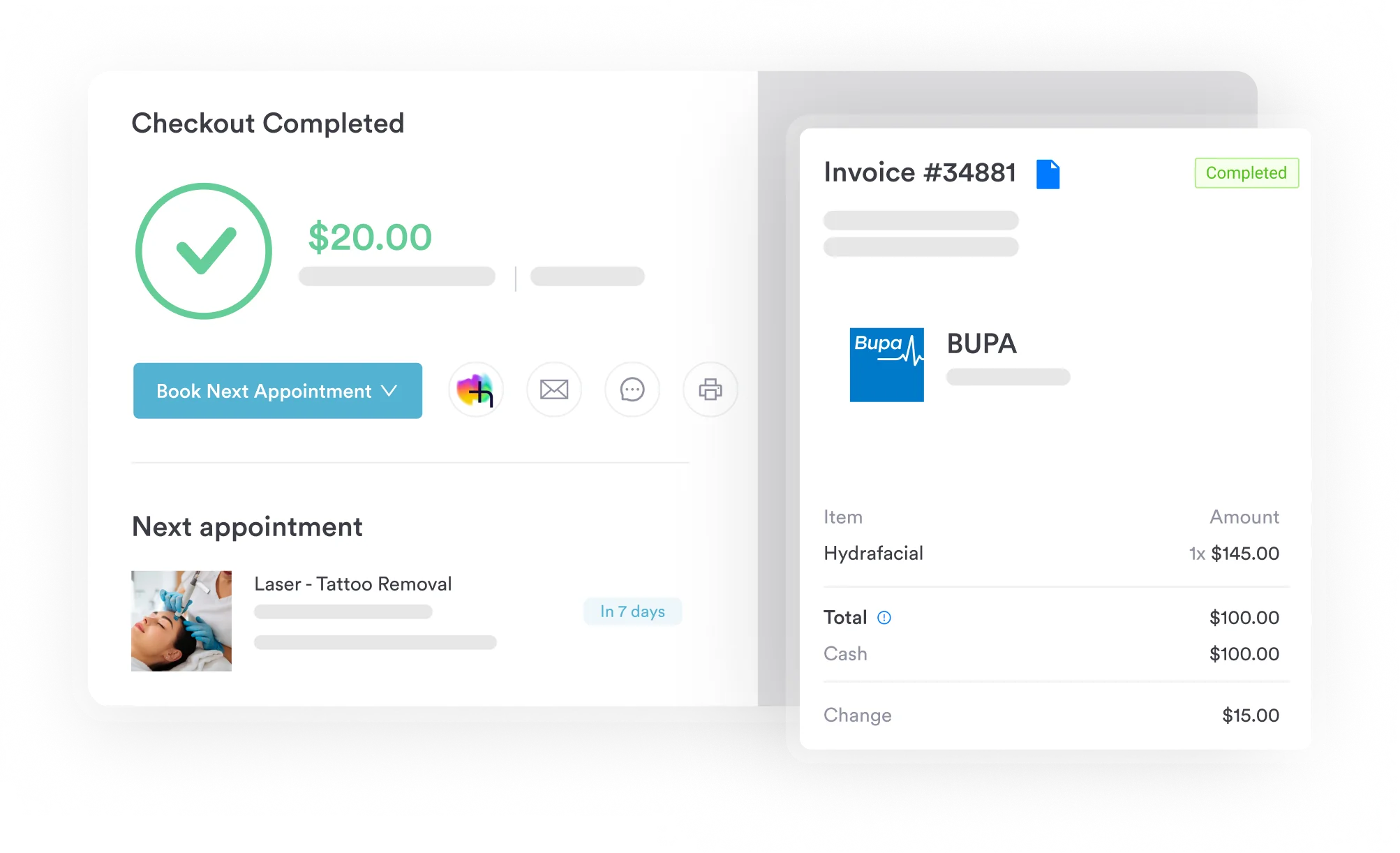

Pabau’s claims management software checks eligibility before the visit, sends electronic claims and posts ERA remittances, so hearing aid repair billing stays clean.

V5014 gets paid when the claim proves which aid was repaired and what was done to it. Where the payer requires approval, it must also show the payer agreed in advance. Capture those at intake and the code stops being a denial risk.
Let your payer mix decide where to start. If most V5014 patients are on traditional Medicare, the GY and patient-billing workflow matters most. If they are on Medicare Advantage or commercial plans, prior authorization lead time decides whether the repair goes ahead on the day booked.
Either way, V5014 is one line in a wider revenue cycle management process, and fixing it at intake protects the rest of the cycle. Book a demo to see how Pabau handles insurance claims and documentation.

Need a full picture of how claims move from service to payment? Medical billing fundamentals explains the end-to-end claims lifecycle for healthcare practices.
Struggling with denied claims across multiple codes? Denial management in healthcare covers the systematic approach to reducing and appealing payer rejections.
Want to understand how clearinghouses handle HCPCS submissions? Clean claim requirements details what a submission must contain to pass automated adjudication.
HCPCS code V5014 covers repair/modification of a hearing aid the patient already owns. That includes receiver replacement, shell repair, microphone replacement, volume control repair, and reprogramming that is part of a repair. It does not cover new hearing aid procurement, audiological evaluations, or the separate fabrication of custom earmolds.
Traditional Medicare Part B does not cover V5014 for conventional hearing aid repairs. The statutory exclusion under Social Security Act Section 1862(a)(7) applies. Medicare Advantage plans may cover hearing aid repair as a supplemental benefit, but coverage varies by plan. Submit with modifier GY under traditional Part B to generate a denial that allows direct patient billing.
V5011 covers fitting, orientation and checking of a hearing aid, while V5014 covers repair or modification of a device the patient already owns. The two should never appear on the same claim for the same ear on the same date of service.
A valid V5014 claim requires a dated repair or modification order and the hearing aid’s make, model, and serial number. It also needs a specific description of the service, a medical necessity statement, and the ordering clinician’s NPI and license number. Missing the device serial number is the single most common reason for documentation-based denials.
Prior authorization is required by most Medicare Advantage plans and many commercial payers for V5014 services. State Medicaid programs vary. The safest workflow is to verify PA requirements at scheduling rather than at the appointment. Allow 5-10 business days to secure approval before the service date.
Medicaid coverage for V5014 depends entirely on the state. Some state programs cover hearing aid repair as an optional benefit, often with annual frequency limits. Others exclude it entirely. Verify coverage through the state Medicaid provider portal before scheduling the service, and confirm whether a physician referral is required in that state.





