CPT Code 51705: Change of cystostomy tube, simple
CPT Code 51705 at a glance CPT Code 51705 reports a simple change of a cystostom...

Last Updated: Oct 16, 2026
V5250 is the HCPCS Level II code for a hearing aid, digitally programmable analog, binaural, CIC. It covers a pair of completely-in-canal aids, one for each ear, whose analog circuits are set by computer programming.
One aid of the same type bills as V5244, and a fully digital CIC pair bills as V5258. Original Medicare excludes hearing aids by statute, so most V5250 claims go to Medicaid, Medicare Advantage or commercial plans.
Let Pabau's smart automation suggest the right codes, reduce claim denials, and keep your practice compliant—effortlessly.
Automate repetitive tasks and focus on what matters most—your patients.
Reduce coding errors and ensure compliance with the latest regulations.
Clean claims, fewer denials, and faster reimbursements.
Powerful insights and reporting to help your practice thrive.
HIPAA compliant SOC 2 certified GDPR-compliant Trusted by 4,000+ clinics worldwide

V5250 bills one unit for a pair of digitally programmable analog CIC hearing aids, one fitted in each ear.
A single aid of the same type bills as V5244, and a fully digital CIC pair bills as V5258.
Original Medicare excludes hearing aids under Social Security Act §1862(a)(7), so V5250 carries Medicare coverage code S.
Medicaid, Medicare Advantage and commercial plans set their own rules, and most require prior authorization and a current audiogram.
The diagnosis and audiogram must support amplification in both ears, so code the hearing loss as bilateral.
HCPCS code V5250 is one of the Level II HCPCS procedure codes, in the V5000-V5999 hearing services range. The Centers for Medicare and Medicaid Services (CMS) maintains the code set. The official long descriptor reads: Hearing aid, digitally programmable analog, binaural, CIC. The code has been in effect since January 1, 2002.
Each part of the descriptor narrows the device. “Digitally programmable analog” means the aid amplifies sound through analog circuitry, while a computer sets its response for the patient’s hearing loss. A fully digital aid converts sound into a digital signal, and it bills under the V5254-V5261 codes instead.
“Binaural” means one aid for each ear, dispensed and billed together as one unit. “CIC” stands for completely in the canal, a custom shell that sits deep in the ear canal and is the least visible hearing aid style.
V5250 covers the supply of two digitally programmable analog CIC hearing aids, one for each ear, dispensed as a pair. The code describes the devices only. Assessment, fitting, dispensing, batteries and repairs each have their own V-codes.
Included: one matched pair of digitally programmable analog CIC hearing aids. Excluded from V5250 (bill separately where payable):
V5250 sits among the V5242-V5261 hearing aid codes, where every code turns on technology, ear count and style. The most common substitutions are V5244 for a one-ear fitting and V5258 for a fully digital pair.
Code from the device record, not from the order alone. The manufacturer’s specification sheet states whether the aid is fully digital or digitally programmable analog. Most hearing aids sold today are fully digital, so confirm the technology before a V5250 claim goes out. The decision path below runs in that order: technology first, then ear count, then style.
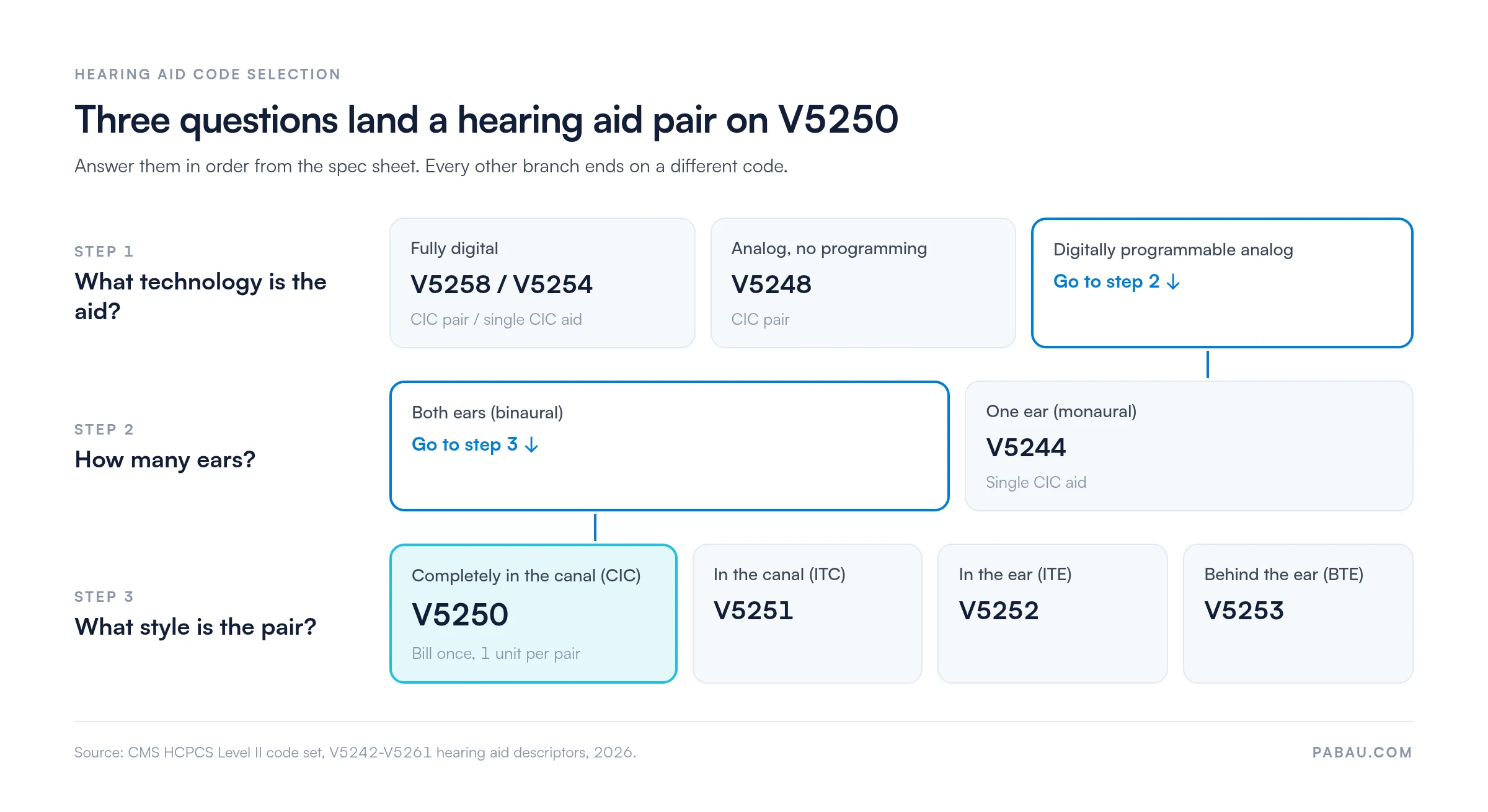
Original Medicare does not cover V5250. Section 1862(a)(7) of the Social Security Act excludes “hearing aids or examinations therefor” from Medicare coverage. The HCPCS file gives V5250 coverage code S, which means non-covered by Medicare statute.
No National Coverage Determination (NCD) or Local Coverage Determination (LCD) creates an exception for conventional hearing aids. A V5250 claim to Medicare Part B receives a statutory exclusion denial.
When a patient needs a Medicare denial on file, for example to bill a secondary plan, append modifier GY. GY tells Medicare the item is statutorily excluded. An Advance Beneficiary Notice is not required for a statutory exclusion, although some practices issue one voluntarily.
Two carve-outs are often confused with hearing aid coverage:
Before billing V5250 to a Medicare Advantage plan, read the plan’s Evidence of Coverage for its hearing aid benefit. Some plans cover devices only through a contracted hearing aid network, or cap the allowance per aid. A prior authorization for the wrong code or vendor can be denied even when the plan covers hearing aids.
Medicaid coverage of V5250 varies by state. Hearing aids are an optional adult benefit under federal Medicaid rules, so each state decides whether to cover them and how often.
A state that covers hearing aids does not always list every hearing aid code. Check that V5250 itself appears on the current fee schedule before dispensing the pair.
Hearing aid V-codes sit in the hearing services range, outside the DMEPOS fee schedule. State licensure and each payer’s enrollment rules decide who may dispense and bill them. Understanding medical billing compliance requirements helps when state rules differ.
Most Medicaid programs and commercial plans require prior authorization (PA) before a hearing aid pair is dispensed and billed. Original Medicare has no PA process for V5250 because it excludes hearing aids entirely.
A standard prior authorization request for V5250 typically includes:
Submit the PA request before dispensing the pair. Retroactive authorization for hearing aids already delivered is rarely granted.
Insufficient documentation is a leading reason V5250 claims are denied. Every claim should rest on a complete record, because payers and auditors can request it at any time.
Pabau, the practice management platform we build for specialty practices, keeps the audiogram, signed order and PA reference on the patient record. Its claims management tools pull that record data into a pre-filled claim and track its status after submission.
A clean claim has every required field, unit and attachment checked before it leaves the practice.
The diagnosis on a V5250 claim must support amplification in both ears. Code the hearing loss as bilateral, and make sure the audiogram thresholds for each ear back it up.
Where the loss differs between ears, the H90.A codes describe a unilateral loss with restricted hearing on the other side. Some plans expect a bilateral code for a pair, so check the accepted diagnosis list first.
Avoid unilateral codes such as H90.41 or H90.42 on a V5250 claim. A one-ear diagnosis signals a one-ear fitting, which bills as V5244 rather than V5250.
V5250 remains active in the 2026 HCPCS code set. Because original Medicare excludes hearing aids, CMS publishes no national Medicare fee for it. The code appears on neither the Physician Fee Schedule nor the DMEPOS fee schedule.
Reimbursement for V5250 comes from three other payer types:
The NLM Clinical Table Search API offers a free HCPCS dataset built from CMS releases. The AAPC Codify HCPCS lookup is another cross-reference for descriptors and effective dates.
When a Medicare Advantage plan covers V5250, record the plan name, PA reference number and approved allowance on the patient’s account before dispensing. If the plan later disputes the amount, those details settle it faster than a formal appeal.
V5250 denials cluster around a predictable set of coding and documentation errors. The table below maps each pattern to a fix. Practices that track denial management data can spot repeat causes within one billing cycle.
The device code and the service codes around it are separate. V5010 is the assessment for a hearing aid, V5011 covers fitting, orientation and checking, and V5160 is the binaural dispensing fee.
Practices with repeated bundling denials should review their payer contracts and update their billing rules. Sound medical billing fundamentals start with knowing which services each payer pays separately.
A V5250 claim pays first time when the clinical and billing teams follow the same sequence. These steps prevent the most common denials.
Hearing aid claims often stall between the fitting room and the billing desk. The audiogram sits in one system, the PA reference in an email and the serial numbers on paper.
In Pabau, those records live on the patient file. The claim is pre-filled from data already on the record, then submitted and tracked to payment in one place.
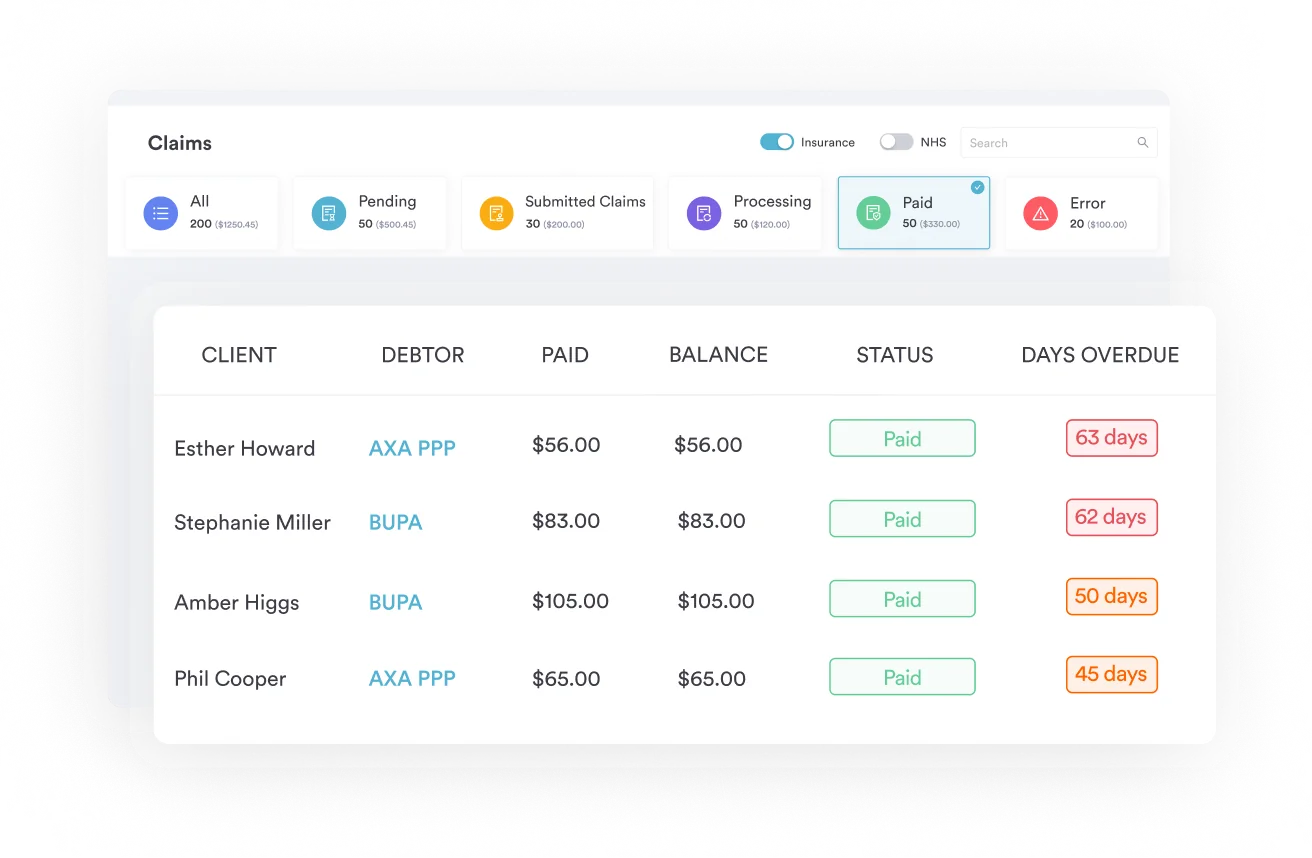
Your team sees which pair claims are pending or rejected, and can act before a filing deadline passes.

Pabau keeps audiograms, orders and authorizations on the patient record, then tracks each claim through to payment.

V5250 is a narrow code: one pair of digitally programmable analog CIC aids, billed once. Most errors on it come from treating it as a one-ear or fully digital code.
Because Medicare excludes it, your payer mix decides whether a V5250 pair gets paid at all. Confirm the technology, bill the pair as 1 unit and attach a bilateral diagnosis.
To see how Pabau keeps hearing aid records and claims together, book a demo.

Dispensing a fully digital CIC pair instead? HCPCS code V5258 covers the digital binaural CIC code and its payer rules.
Fitting a single fully digital CIC aid? HCPCS code V5254 explains the monaural digital CIC code.
Billing an analog CIC pair? HCPCS code V5248 covers the analog binaural CIC code.
Billing the dispensing fee for a pair? HCPCS code V5160 covers the binaural dispensing fee.
Want hearing aid claims to pass on first submission? What makes a clean claim lists the checks payers run before processing.
HCPCS code V5250 covers a pair of digitally programmable analog, completely-in-canal (CIC) hearing aids, one for each ear. It is billed as 1 unit for the pair. Fitting, dispensing, batteries and repairs are billed separately.
No. Original Medicare excludes hearing aids under Social Security Act §1862(a)(7). The HCPCS file lists V5250 with coverage code S, meaning non-covered by statute. Medicare Advantage plans may cover hearing aids as a supplemental benefit, so verify each plan individually.
Use a bilateral diagnosis that matches the audiogram, such as H90.3 for bilateral sensorineural loss, H90.0 for bilateral conductive loss or H91.13 for bilateral presbycusis. Check each payer’s accepted diagnosis list.
Most Medicaid programs and commercial plans require prior authorization before the pair is dispensed. Original Medicare has no PA process because it excludes hearing aids. Retroactive authorization is rarely granted.
There is no national Medicare fee for V5250 because original Medicare excludes hearing aids. Rates come from Medicare Advantage contracts, state Medicaid fee schedules and commercial payer agreements.
Usually not. V5250 already describes a pair for both ears, so it is billed once as 1 unit. Add ear modifiers only when a specific payer instructs you to.