CPT Code 22610: Thoracic posterior arthrodesis
CPT Code 22610: official descriptor and clinical scope CPT Code 22610 describes ...

Last Updated: Oct 16, 2026
V2513 is the HCPCS Level II code for contact lens, gas permeable, extended wear, per lens.
It covers one rigid gas permeable lens prescribed for overnight wear, billed per lens with an RT or LT modifier. A soft extended-wear lens is V2523, and a daily-wear GP lens is V2510 to V2512. Medicare covers it for aphakia and once after each cataract surgery with an intraocular lens. The fitting is billed separately under a CPT code.
Let Pabau's smart automation suggest the right codes, reduce claim denials, and keep your practice compliant—effortlessly.
Automate repetitive tasks and focus on what matters most—your patients.
Reduce coding errors and ensure compliance with the latest regulations.
Clean claims, fewer denials, and faster reimbursements.
Powerful insights and reporting to help your practice thrive.
HIPAA compliant SOC 2 certified GDPR-compliant Trusted by 4,000+ clinics worldwide

V2513 bills one gas permeable (rigid) contact lens prescribed for extended, overnight wear, so each eye is its own claim line.
A soft extended-wear lens is V2523, and a daily-wear GP lens is V2510, V2511 or V2512 by design.
Medicare covers V2513 for aphakia, and once after each cataract surgery with an IOL, not for routine refractive correction.
Append RT or LT to every V2513 line. RB is a DME repair modifier, not a bilateral one.
Bill the fitting separately with the CPT code that matches the patient: 92310 or 92314 non-aphakic, 92311 to 92316 aphakic.
HCPCS Code V2513 sits in the V2500-V2599 contact lens series of HCPCS Level II, which the Centers for Medicare and Medicaid Services (CMS) maintains. The official descriptor reads: Contact lens, gas permeable, extended wear, per lens. The CMS short descriptor is “Contact lens extended wear”.
Two words in that descriptor decide the code. “Gas permeable” means a rigid lens material, and “extended wear” means the lens is prescribed to stay in overnight. Each unit is one lens, so a pair of lenses takes two claim lines.
Medicare treats contact lenses after cataract surgery as prosthetic devices, so they bill through the DMEPOS system. A practice that dispenses V2513 to Medicare patients needs a valid DMEPOS supplier enrollment.
V2513 covers the lens itself when two conditions hold. The lens is made of a rigid gas permeable (GP or RGP) material, and it is prescribed for extended wear. Extended wear means the patient sleeps in the lens rather than removing it every night.
Included under V2513:
Not covered by V2513:
The prescription drives the choice between V2513 and V2510. The same GP lens can be written for daily or extended wear, and only the extended-wear order supports V2513. If the chart does not state an overnight wearing schedule, the claim cannot back up the code.
Once the schedule is daily wear, the lens design picks the code. A toric GP lens with prism ballast takes V2511, and a GP bifocal takes V2512.
Payers look for a diagnosis that a spectacle lens or a daily-wear lens cannot handle well. For Medicare, the diagnosis is narrow: the patient lacks the natural lens of the eye. Commercial and Medicaid plans may accept a wider list.
The chart should state the clinical reason the patient needs to sleep in the lens. A reviewer reads that sentence to decide whether V2513 is covered or an elective upgrade.
The V2510-V2513 group covers gas permeable lenses, and V2520-V2523 covers hydrophilic (soft) lenses. Each group splits by design in the same order: spherical, toric, bifocal, then extended wear. V2513 and V2523 are the two extended-wear codes, separated only by material.
The two most common coding slips on this code run in opposite directions. A soft extended-wear lens billed as V2513 fails the material test. A GP lens worn only during the day and billed as V2513 fails the wearing-schedule test.
Every V2513 line needs a linked ICD-10-CM code that supports medical necessity. For Medicare, the Refractive Lenses policy article (A52499) lists the covered diagnoses. Commercial plans often accept more.
Use the most specific code available and match laterality to the modifier. An H27.01 diagnosis belongs on the V2513-RT line, and H27.02 belongs on the V2513-LT line. In an audit, the diagnosis on each claim line has to match the clinical record exactly.
Medicare Part B does not cover contact lenses for routine vision correction. It covers them only to restore the focusing power the natural lens used to provide.
Before dispensing, verify the patient’s Medicare eligibility. For a pseudophakic patient, check that the post-surgery pair has not already been supplied by another optician or supplier.
Medicaid coverage of V2513 varies by state. Some programs cover medically necessary contact lenses directly, while others carve vision out to a managed care plan with its own rules. There is no single national Medicaid policy, so confirm coverage by state and plan before dispensing.
Commercial payer points to check:
The Medicare Refractive Lenses policy requires the RT or LT modifier on every lens code, and most other payers follow the same rule. A missing laterality modifier is one of the most frequent reasons a V2513 line comes back unpaid.
For a pair, bill two lines: V2513-RT with 1 unit, then V2513-LT with 1 unit. Do not use RB for a pair. RB means “replacement of a part of a DME, orthotic or prosthetic item furnished as part of a repair”. It says nothing about laterality. Use the AAPC Codify V2513 entry to confirm payer-specific modifier guidance.
Complete records support medical necessity and hold up in a post-payment audit. The chart should contain the following before the claim is submitted.
Practices using practice management software like Pabau can keep the prescription, surgical history and delivery receipt in one patient record. That cuts the time spent assembling documents before each V2513 claim, and keeps each file ready for an audit request.
Check four items on every V2513 claim before it leaves the practice. Confirm the RT or LT modifier, a diagnosis that matches the chart, an extended-wear schedule on the prescription, and a signed delivery receipt.
V2513 billing comes down to clean line items on the CMS-1500 or 837P. Follow these steps for each dispensing encounter.
Neither 92310 nor 92314 is a one-eye or aphakic code. Both cover a non-aphakic fitting for both eyes. An aphakic patient being fitted with V2513 lenses takes 92311 or 92312, or 92315 or 92316 when a technician directs the fitting.
CPT also notes that follow-up of successfully fitted extended-wear lenses is reported as a general ophthalmological service.
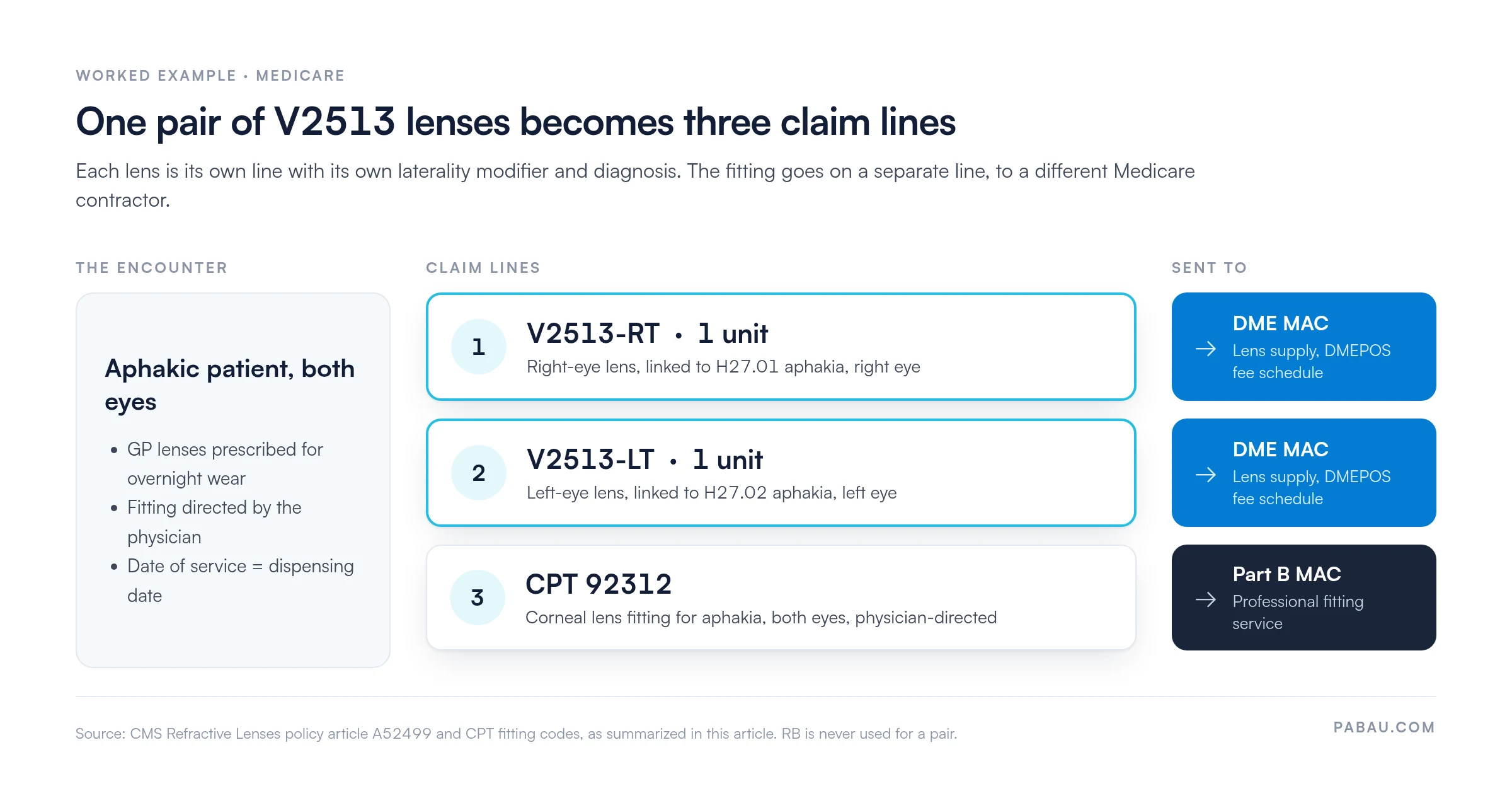
Put together, one pair of lenses for an aphakic patient fitted by a physician becomes three claim lines sent to two contractors.
Most V2513 denials can be prevented. The table maps frequent denial scenarios to a typical claim adjustment reason code (CARC) and the fix for each.
When a denial posts on the electronic remittance advice, match the code to the table before you correct the claim. Tracking denials by reason code also shows which V2513 errors keep coming back. For the full list, see the denial reason codes guide.
Medicare sets allowed amounts for V2513 through the DMEPOS fee schedule. The schedule is state-specific and updated every year, so the rate depends on where the patient lives.
Practices that reconcile V2513 payments against each payer’s contracted rate catch underpayments before they build up across a year of claims.
Pull the new DMEPOS fee schedule every January when CMS publishes it. Update the V2513 fee in your practice management system before the first billing run of the year.
Most V2513 errors start before the claim is built. The wearing schedule sits in the prescription, the diagnosis sits in the exam note, and the delivery receipt sits in a paper file. Billing staff then rebuild the claim by hand and miss a modifier or a pointer.
Pabau’s claims management workflow keeps the prescription, diagnosis codes and dispensing record in the same patient file. The claim pulls the supply code, the laterality modifier and the fitting code onto separate lines. Staff can then track each claim from submission to payment.
The result is fewer returned lines and faster payment on lens claims. Your team also spends less time chasing paperwork after an audit request.

Pabau helps eye care practices track HCPCS lens codes, RT and LT modifiers and diagnosis links in one workflow, so V2513 claims go out clean.

Three facts in the chart decide V2513: the lens material, the wearing schedule and the diagnosis. Check all three against the prescription before the claim is built, and the choice between V2513, V2510 and V2523 is already made.
For Medicare patients, confirm aphakia or a recent cataract surgery with an IOL first, because routine correction is never covered. Book a demo to see how Pabau keeps the prescription, modifiers and fitting line in one record, so your lens claims go out clean.

Need to understand how clearinghouse edits affect your vision supply claims? Clean claim submission guide covers the pre-submission checks that prevent rejections.
Billing a soft lens instead of a GP one? HCPCS code V2520 covers the daily-wear spherical hydrophilic lens and its Medicare rules.
Want a structured approach to working denial queues? Denial management in healthcare outlines a workflow for sorting, appealing and preventing recurring denials.
HCPCS code V2513 covers one gas permeable contact lens prescribed for extended, overnight wear. Each unit is one lens, so each eye goes on its own claim line. The fitting is billed separately with a CPT fitting code.
Both codes describe extended-wear contact lenses, and the material is the only difference. V2513 is a gas permeable (rigid) lens, and V2523 is a hydrophilic (soft) lens.
Both are gas permeable lenses, but the wearing schedule differs. V2510 is for daily wear, and V2513 is for a lens prescribed for overnight wear. The prescription must state the extended-wear schedule to support V2513.
Yes, but only for aphakia or after cataract surgery. Aphakic patients (H27.0-, Q12.3) are covered, including medically necessary replacements. Pseudophakic patients (Z96.1) get one pair of eyeglasses or contact lenses after each cataract surgery with an IOL. Routine refractive correction is not covered.
Append RT for the right eye or LT for the left eye to every V2513 line. For a pair, bill V2513-RT and V2513-LT on separate lines. RB is not a laterality modifier. It marks a replacement part furnished as part of a DME repair.
It depends on the patient and who directed the fitting. Use 92310 (physician) or 92314 (technician) for a non-aphakic fitting of both eyes. For aphakia, use 92311 or 92312, or 92315 or 92316 when a technician directs it.
Common causes are a missing RT or LT modifier and a diagnosis the payer does not cover. Others are a soft or daily-wear lens billed as V2513, the fitting on the same line, and a missing prior authorization.
Bill 1 unit per eye per claim line: V2513-RT with 1 unit and V2513-LT with 1 unit. Medicare limits pseudophakic patients to one pair after each cataract surgery. Aphakic patients can get medically necessary replacements.